

Homework Answers
Request Answer!
We need at least 10 more requests to produce the answer.
0 / 10 have requested this problem solution
The more requests, the faster the answer.
Add Answer to:
PROCEDURE 1. Place a reaction tube into a 5-mL Erienmeyer and tare. Add between 0.275- 0.300g...
Write out your separation scheme for this experiment. 1. Heat 75 mL of water to 90...
Write out your separation scheme for this experiment. 1. Heat 75 mL of water to 90 °C in a 250-mL beaker. 2. While the water is being heated, place 250 mg of salicylic acid, 1 drop of 85% phosphoric acid and 0.5 mL of acetic anhydride in a test tube. Add a boiling chip to the mixture and gently shake it in order to mix the reactants. 3. Heat the tube in the beaker of water at 85 - 90...
Preparation of salicylic acid: Place 2g of salicylic acid into dry conical flask. Add 5 mL...
Preparation of salicylic acid: Place 2g of salicylic acid into dry conical flask. Add 5 mL acetic anhydride and 5 drops of 85% phosphoric acid. Swirl the mixture and heat on a steam bath for 5 minutes. Remove flask form the steam bath and whilst still hot add 2 mL of water in one portion to decompose excess acetic anhydride. Why add the reaction mixture while it is still hot? Preparation of salicylic acid: Place 2g of salicylic acid into...
Place 3.0 g of salicylic acid in a 125-ml Erlenmeyer flask. Carefully add, stirring constantly, 6...
 Place 3.0 g of salicylic acid in a 125-ml Erlenmeyer flask. Carefully add, stirring constantly, 6 mL of acetic anhydride, followed by 10 drops of concentrated sulfuric acid. Swirl the contents of the flask so that the reactants are thoroughly mixed. Stopper the flask with a one- hole cork fitted with an inverted Pasteur pipet to prevent condensation of water in the reaction flask during heating on the steam bath. Heat the flask in a boiling-water or steam bath for...
Calculate theoretical and percent yield. In this experiment, salicylic acid and acetic anhydride will be reacted...
Calculate theoretical and percent yield. In this experiment, salicylic acid and acetic anhydride will be reacted to form acetylsalicylic acid in an acid catalyzed reaction. In a reaction tube, add approx. 140 mg salicylic acid, a boiling chip and a small drop of 85% phosphoric acid. Add 0.3mL acetic anhydride, which should wash the reactants to the bottom of the tube. Mix thoroughly. Heat in a beaker of water at 90oC for 5 min. Cautiously add 0.2 mL water to...
used. Experimental . Place 2.0 g of salicylic acid in a 125-mL conical flask. 2. Add...
 used. Experimental . Place 2.0 g of salicylic acid in a 125-mL conical flask. 2. Add 4.0 ml (d = 1.08 g/mL; 4.3 g) of acetic anhydride and 6-8 drops of 85% phosphoric acid. 3. Swirl the flask to mix all reagents, and place it in a 70°C water bath. Heat for about 10 minutes. 4. Remove the flask from the water bath and add 2 mL of cold water drop- wise, swirling the flask after each addition, 5. Add...
Running the Reaction Add 0.100 g benzil and 0.30 mL 95% ethanol to a 3-mL conical vial. Place a s...
 Determine the theoretical yield and limiting reagent
Running the Reaction Add 0.100 g benzil and 0.30 mL 95% ethanol to a 3-mL conical vial. Place a spin vane in the vial and attach an air condenser. Heat the mixture with an aluminum block (90-100°C) while stirring until the benzil has dissolved (see inset in Tech- nique 6, Figure 6.1A). Using a 9-inch Pasteur pipette, add dropwise 0.25 mL of an aqueous potassium hydroxide solution' downward through the condenser into the...
Determine the theoretical yield and limiting reagent
Running the Reaction Add 0.100 g benzil and 0.30 mL 95% ethanol to a 3-mL conical vial. Place a spin vane in the vial and attach an air condenser. Heat the mixture with an aluminum block (90-100°C) while stirring until the benzil has dissolved (see inset in Tech- nique 6, Figure 6.1A). Using a 9-inch Pasteur pipette, add dropwise 0.25 mL of an aqueous potassium hydroxide solution' downward through the condenser into the...
In this Diels-Alder reaction, what is the limiting reagent for this reaction? Please show work In...
 In this Diels-Alder reaction, what is the limiting reagent for
this reaction? Please show work
In this experiment, a Diels-Alder reaction will be performed to generate 4-cyclohexene- 1,2-dicarboxylic anhydride. The reaction occurs when 1,3-butadiene is combined with maleic anhydride and heated as shown below. Once the product has been isolated, the IR spectrum, melting point, and experimental yield can be determined. 5.- I111NI O Due to the inherent difficulties with the handling of gaseous 1,3-butadiene, it will be generated in...
In this Diels-Alder reaction, what is the limiting reagent for
this reaction? Please show work
In this experiment, a Diels-Alder reaction will be performed to generate 4-cyclohexene- 1,2-dicarboxylic anhydride. The reaction occurs when 1,3-butadiene is combined with maleic anhydride and heated as shown below. Once the product has been isolated, the IR spectrum, melting point, and experimental yield can be determined. 5.- I111NI O Due to the inherent difficulties with the handling of gaseous 1,3-butadiene, it will be generated in...
this is the procedure of melting point experiment ( preparation acetanilid) I want the summarize of...
 this is the procedure of melting point experiment
( preparation acetanilid) I want the summarize of this
procedure
EXPERIMENTAL PROCEDURE Measure 0.100 to 0.125 g of aniline (in dropper bottles near the balances) into a tared reaction tube from the microscale kit and record the weight to the nearest milligram. Add 2 mL of distilled water and 6 to 7 drops (an excess amount, 21 drops =1 mL) of acetic anhydride. Stir the mixture for about 4 minutes untiha solid...
this is the procedure of melting point experiment
( preparation acetanilid) I want the summarize of this
procedure
EXPERIMENTAL PROCEDURE Measure 0.100 to 0.125 g of aniline (in dropper bottles near the balances) into a tared reaction tube from the microscale kit and record the weight to the nearest milligram. Add 2 mL of distilled water and 6 to 7 drops (an excess amount, 21 drops =1 mL) of acetic anhydride. Stir the mixture for about 4 minutes untiha solid...
Question 1 Use a DRY 5 mL conical vial for the reaction A Serves as a...
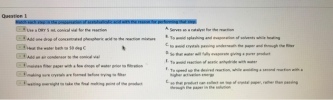 Question 1 Use a DRY 5 mL conical vial for the reaction A Serves as a catalyst for the reaction Add one drop of concentrated phosphoric acid to the reaction mixtureTo avod splashing and evaporation of solvents while heating -8) Heat the water bath to 50 deg C Cto avoid crystals passing underneath the paper and through the filter D. So that water will fully evaporate giving a purer product Add an air condensor to the conical vial E. To...
PLEASE ANSWER #10 AND PLEASE SHOW WORK. (MY RECORDINGS OF THE MEASURMENTS ARE GIVEN IN BOLD...
PLEASE ANSWER #10 AND PLEASE SHOW WORK. (MY RECORDINGS OF THE MEASURMENTS ARE GIVEN IN BOLD ) Preparation of aspirin (lab) CHEMISTRY 1. Obtain about 3 g of salicylic acid and place it into a 125mL erlenmeyer flask. Record the mass of the salicylic acid. mass= 3.0184 g 2. in the fume hood transfer 6mL of acetic anhydride to your flask and then add 5 drops of concentrated sulfuric acid. Thoroughly mix the reagents by swirling the flask. 3. Place...
 Place 3.0 g of salicylic acid in a 125-ml Erlenmeyer flask. Carefully add, stirring constantly, 6 mL of acetic anhydride, followed by 10 drops of concentrated sulfuric acid. Swirl the contents of the flask so that the reactants are thoroughly mixed. Stopper the flask with a one- hole cork fitted with an inverted Pasteur pipet to prevent condensation of water in the reaction flask during heating on the steam bath. Heat the flask in a boiling-water or steam bath for...
 used. Experimental . Place 2.0 g of salicylic acid in a 125-mL conical flask. 2. Add 4.0 ml (d = 1.08 g/mL; 4.3 g) of acetic anhydride and 6-8 drops of 85% phosphoric acid. 3. Swirl the flask to mix all reagents, and place it in a 70°C water bath. Heat for about 10 minutes. 4. Remove the flask from the water bath and add 2 mL of cold water drop- wise, swirling the flask after each addition, 5. Add...
 Determine the theoretical yield and limiting reagent
Running the Reaction Add 0.100 g benzil and 0.30 mL 95% ethanol to a 3-mL conical vial. Place a spin vane in the vial and attach an air condenser. Heat the mixture with an aluminum block (90-100°C) while stirring until the benzil has dissolved (see inset in Tech- nique 6, Figure 6.1A). Using a 9-inch Pasteur pipette, add dropwise 0.25 mL of an aqueous potassium hydroxide solution' downward through the condenser into the...
Determine the theoretical yield and limiting reagent
Running the Reaction Add 0.100 g benzil and 0.30 mL 95% ethanol to a 3-mL conical vial. Place a spin vane in the vial and attach an air condenser. Heat the mixture with an aluminum block (90-100°C) while stirring until the benzil has dissolved (see inset in Tech- nique 6, Figure 6.1A). Using a 9-inch Pasteur pipette, add dropwise 0.25 mL of an aqueous potassium hydroxide solution' downward through the condenser into the...
 In this Diels-Alder reaction, what is the limiting reagent for
this reaction? Please show work
In this experiment, a Diels-Alder reaction will be performed to generate 4-cyclohexene- 1,2-dicarboxylic anhydride. The reaction occurs when 1,3-butadiene is combined with maleic anhydride and heated as shown below. Once the product has been isolated, the IR spectrum, melting point, and experimental yield can be determined. 5.- I111NI O Due to the inherent difficulties with the handling of gaseous 1,3-butadiene, it will be generated in...
In this Diels-Alder reaction, what is the limiting reagent for
this reaction? Please show work
In this experiment, a Diels-Alder reaction will be performed to generate 4-cyclohexene- 1,2-dicarboxylic anhydride. The reaction occurs when 1,3-butadiene is combined with maleic anhydride and heated as shown below. Once the product has been isolated, the IR spectrum, melting point, and experimental yield can be determined. 5.- I111NI O Due to the inherent difficulties with the handling of gaseous 1,3-butadiene, it will be generated in...
 this is the procedure of melting point experiment
( preparation acetanilid) I want the summarize of this
procedure
EXPERIMENTAL PROCEDURE Measure 0.100 to 0.125 g of aniline (in dropper bottles near the balances) into a tared reaction tube from the microscale kit and record the weight to the nearest milligram. Add 2 mL of distilled water and 6 to 7 drops (an excess amount, 21 drops =1 mL) of acetic anhydride. Stir the mixture for about 4 minutes untiha solid...
this is the procedure of melting point experiment
( preparation acetanilid) I want the summarize of this
procedure
EXPERIMENTAL PROCEDURE Measure 0.100 to 0.125 g of aniline (in dropper bottles near the balances) into a tared reaction tube from the microscale kit and record the weight to the nearest milligram. Add 2 mL of distilled water and 6 to 7 drops (an excess amount, 21 drops =1 mL) of acetic anhydride. Stir the mixture for about 4 minutes untiha solid...
 Question 1 Use a DRY 5 mL conical vial for the reaction A Serves as a catalyst for the reaction Add one drop of concentrated phosphoric acid to the reaction mixtureTo avod splashing and evaporation of solvents while heating -8) Heat the water bath to 50 deg C Cto avoid crystals passing underneath the paper and through the filter D. So that water will fully evaporate giving a purer product Add an air condensor to the conical vial E. To...
Most questions answered within 3 hours.
-
Where is the error in this code sequence?
String s1 = "Hello";
String s2 = "ello";...
asked 11 months ago -
Financial data for Joel de Paris, Inc., for last year
follow:
Joel de Paris, Inc.
Balance...
asked 11 months ago -
Consider this reaction:
Al2(SO4)3 (aq)+ BaCl3
(aq) Al2Cl6 (aq)- +
3BaSO4(s) . What is the...
asked 11 months ago -
Suppose that Savneet is considering increasing her
recent random sample from 20 car rentals to 40...
asked 11 months ago -
Trucks arrive at an unloading terminal at an average rate of 120
per hour.
Trucks arrive...
asked 11 months ago -
Why are methanol and ethanol completely soluble in water while
octanol is not very little soluble....
asked 11 months ago -
A facilities manager at a university reads in a research report
that the mean amount of...
asked 11 months ago -
When the CuSO4 is rehydrated by adding water to the anhydrous
compound, is this an endothermic...
asked 11 months ago -
A ray of sunlight is passing from diamond into crown glass; the
angle of incidence is...
asked 11 months ago -
A block of mass 0.249 kg is placed on top of a light, vertical
spring of...
asked 11 months ago -
how do the kidneys compensate in the presences of acidosis
a) trigger hyperventilate
b) reserve acid...
asked 11 months ago -
Question 501 pts
The rental rate of capital to the firm increases. Which of the
following...
asked 11 months ago