![Graph for Table 3: Results of the Adaptation Test 300 250 8 200 150 a 100 50 2 cm proximal from wrist (1 Midway1 cm Distal between Wrist from Elbow (1 2 cm proximal from wrist (5 penny) Midway between Wrist and Elbow (5 penny) 1 cm Distal from Elbow (5 penny) penny) and Elbow (1 penoy) penny) Coin Placement on Anterior Forearmm Test 1 Test 2 Test 3 Test 4 Adapation Were there any differences in adaptation based on the different locations in the arm? Why or Why not? [approximately one paragraph Was there a difference when more coins were added to any of these spots? Why or why not? approximately one paragraph] So, people have sensory processing disorders where they can have issues adapting to consistent stimuli. Explain what you would expect their adaptation test results to be for someone with this disorder. (approximately one paragraph 1. 2. 3.](http://img.homeworklib.com/questions/4f514360-7110-11ea-bca4-17870dbabdca.png?x-oss-process=image/resize,w_560)
Homework Answers
RESULTS OF THE ADAPTATION TEST
- Yes, according to table, there were differences in adaptaion based on different locations in arm and it is mainly because of the receptors that are found in each body part. Firstly, somatosensory system is the huge network which controls our sense of touch by several nerve endings and touch receptors and it have different types of sensory receptors which respond to various stimulus. The adaptation differences are by the density of skin receptors scattered over in specific regions that are exclusively for sensing environment.
- yes, there was a huge difference when more coins, 5penny to be exact, were added to different locations on forearm. it is because the sense of pressure is comparitively shorter when it was only one coin but changed or increased in some areas when it was 5coins
- Sensory processing disorder is a condition in which the patient has problem receiving stimulus and responding to it. In this condition patient could not sense the pressure or perceive the stimulus so as to respond
Add Answer to:
Graph for Table 3: Results of the Adaptation Test 300 250 8 200 150 a 100...
Results of Two-Point Discrimination Test 70 60 50 -20 10 Face Face (lips) Posterior Forearm Forearm...
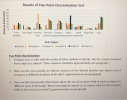 Results of Two-Point Discrimination Test 70 60 50 -20 10 Face Face (lips) Posterior Forearm Forearm Hand Hand Finger tips Leg (cheek) neck (anterior) (posterior) (posterior) (anterior) Body Region Subject 1 Subject 2 Subject 3 Subject 4 Subject 5 Subject 6 Two Point Discrimination 1. Compare your results with the results of other students in the lab. Are the results consistent 2 from subject to subject? [Your response should be approximately one paragraph.] 2. How can this test provide an...
QUESTION 7 CASE STUDY 16: Determine which of the following CPT should be reported for the...
 QUESTION 7
CASE STUDY 16: Determine which of the following CPT should be
reported for the OP services.
A.
93452, 93454
B.
93459
C.
93458
D.
93461
10 points
QUESTION 8
CASE STUDY 16: Which statement from the procedural record
indicates that a left heart catheterization was performed? (This
question counts as 0 points, since it meant to demonstrate the
differences between arteriography and a heart catheterization.)
A.
Approximate 60-70% stenosis in the midportion of the posterior
descending coronary...
QUESTION 7
CASE STUDY 16: Determine which of the following CPT should be
reported for the OP services.
A.
93452, 93454
B.
93459
C.
93458
D.
93461
10 points
QUESTION 8
CASE STUDY 16: Which statement from the procedural record
indicates that a left heart catheterization was performed? (This
question counts as 0 points, since it meant to demonstrate the
differences between arteriography and a heart catheterization.)
A.
Approximate 60-70% stenosis in the midportion of the posterior
descending coronary...
QUESTION 7 CASE STUDY 16: Determine which of the following CPT should be reported for the...
 QUESTION 7
CASE STUDY 16: Determine which of the following CPT should be
reported for the OP services.
A.
93452, 93454
B.
93459
C.
93458
D.
93461
10 points
QUESTION 8
CASE STUDY 16: Which statement from the procedural record
indicates that a left heart catheterization was performed? (This
question counts as 0 points, since it meant to demonstrate the
differences between arteriography and a heart catheterization.)
A.
Approximate 60-70% stenosis in the midportion of the posterior
descending coronary...
QUESTION 7
CASE STUDY 16: Determine which of the following CPT should be
reported for the OP services.
A.
93452, 93454
B.
93459
C.
93458
D.
93461
10 points
QUESTION 8
CASE STUDY 16: Which statement from the procedural record
indicates that a left heart catheterization was performed? (This
question counts as 0 points, since it meant to demonstrate the
differences between arteriography and a heart catheterization.)
A.
Approximate 60-70% stenosis in the midportion of the posterior
descending coronary...
5. Based on laboratory test results, which types of nutritional supplementation should be enhanced? 8. Describe...
 5. Based on laboratory test results, which types of nutritional
supplementation should be enhanced?
8. Describe the pathophysiology that is causing pallor
in this patient.
CASE STUDY CYSTIC FIBROSIS Aerial For the Disease Summary for this case study see the CD-ROM. this PATIENT CASE ciente lent Patient's Chief Complaints Provided by patient's mother: "I noticed a let-down in T's exercise tolerance level a week ago and the last couple of days his cough and sputum production have gotten much worse....
5. Based on laboratory test results, which types of nutritional
supplementation should be enhanced?
8. Describe the pathophysiology that is causing pallor
in this patient.
CASE STUDY CYSTIC FIBROSIS Aerial For the Disease Summary for this case study see the CD-ROM. this PATIENT CASE ciente lent Patient's Chief Complaints Provided by patient's mother: "I noticed a let-down in T's exercise tolerance level a week ago and the last couple of days his cough and sputum production have gotten much worse....
are theses correct? please correct me if they are not. Results Fe Test Tube 2: FeSCN...
 are
theses correct?
please correct me if they are not.
Results Fe Test Tube 2: FeSCN (aa) SCN () Fe Chemical equation: Explanation: The equilibrium shifted toward the increased the due to the addition of Fe(NO,)) because it of the Test Tube 3: FESCN 0) SCN () (as Chemical equation: Fe(ag) Explanation: Test Tube 4: Chemical equation: Fe(agk FeSCN( (aq)h Explanation: Test Tube 5: Chemical equation: Fe"( SCN () FESCN 3+ + (sq) Explanation: Test Tube 6 Chemical equation: Fe(a...
are
theses correct?
please correct me if they are not.
Results Fe Test Tube 2: FeSCN (aa) SCN () Fe Chemical equation: Explanation: The equilibrium shifted toward the increased the due to the addition of Fe(NO,)) because it of the Test Tube 3: FESCN 0) SCN () (as Chemical equation: Fe(ag) Explanation: Test Tube 4: Chemical equation: Fe(agk FeSCN( (aq)h Explanation: Test Tube 5: Chemical equation: Fe"( SCN () FESCN 3+ + (sq) Explanation: Test Tube 6 Chemical equation: Fe(a...
Experiment 2: Diffusion Concentration Gradients and Membrane Permeability Data Tables Table 2: Indicator Reagent Data Indicator...
 Experiment 2: Diffusion Concentration Gradients and Membrane
Permeability
Data Tables
Table 2: Indicator Reagent Data
Indicator
Starch Positive
Starch Negative
Glucose Positive
Glucose Negative
Glucose Test Strip
n/a
n/a
green
yellow
IKI Solution
dark blue
light brown
n/a
n/a
Table 3: Diffusion of Starch and Glucose Over
Time
Indicator
Dialysis Bag After 60 Minutes
Beaker Water After 60 Minutes
Glucose Test Strip
yellow
green ( if all glucose passed to the beaker from the bag)
IKI
from incolore changed to...
Experiment 2: Diffusion Concentration Gradients and Membrane
Permeability
Data Tables
Table 2: Indicator Reagent Data
Indicator
Starch Positive
Starch Negative
Glucose Positive
Glucose Negative
Glucose Test Strip
n/a
n/a
green
yellow
IKI Solution
dark blue
light brown
n/a
n/a
Table 3: Diffusion of Starch and Glucose Over
Time
Indicator
Dialysis Bag After 60 Minutes
Beaker Water After 60 Minutes
Glucose Test Strip
yellow
green ( if all glucose passed to the beaker from the bag)
IKI
from incolore changed to...
Please answer these question on this case study Case study Your patient, 58-year-old K.Z., has a...
Please answer these question on this case study Case study Your patient, 58-year-old K.Z., has a significant cardiac history. He has long-standing coronary artery disease (CAD) with occasional episodes of heart failure (HF). One year ago, he had an anterior wall myocardial infarction (MI). In addition, he has chronic anemia, hypertension, chronic renal insufficiency, and a recently diagnosed 4-cm suprarenal abdominal aortic aneurysm. Because of his severe CAD, he had to retire from his job as a railroad engineer about...
148 Chapter 8 Refining the Continuum of Care Case Study Table 8.3 is a set of...
 148 Chapter 8 Refining the Continuum of Care Case Study Table 8.3 is a set of admission criteria for medical and surgical admissions. Figure 8.10 shows an example of one patient's history and physical report. Use the patient history and physical report (figure 8.10) and the admission criteria (table 8.3) to determine whether this patient meets the criteria fo admission to the hospital. The patient must meet at least one criterion in severity of illness and one crite rion in...
Please answer these question on this case study Case study Your patient, 58-year-old K.Z., has a...
Please answer these question on this case study Case study Your patient, 58-year-old K.Z., has a significant cardiac history. He has long-standing coronary artery disease (CAD) with occasional episodes of heart failure (HF). One year ago, he had an anterior wall myocardial infarction (MI). In addition, he has chronic anemia, hypertension, chronic renal insufficiency, and a recently diagnosed 4-cm suprarenal abdominal aortic aneurysm. Because of his severe CAD, he had to retire from his job as a railroad engineer about...
MULTIPLE CHOICE. Choose the one alternative that best completes the statement or answers the qu 1)...
 MULTIPLE CHOICE. Choose the one alternative that best completes the statement or answers the qu 1) Normally, the amount of plasma in whole blood is than the amount of formed elements: 1) C plasma makes up approximately percent of whole blood A) greater; 65 B) less; 45 @ greater; 55 D) less; 30 2) The most numerous blood cells are 2) 8 red blood cells B) lymphocytes C) neutrophils D) monocytes 3) Granulocytes include 3) A) eosinophils, monocytes, neutrophils C)...
 Results of Two-Point Discrimination Test 70 60 50 -20 10 Face Face (lips) Posterior Forearm Forearm Hand Hand Finger tips Leg (cheek) neck (anterior) (posterior) (posterior) (anterior) Body Region Subject 1 Subject 2 Subject 3 Subject 4 Subject 5 Subject 6 Two Point Discrimination 1. Compare your results with the results of other students in the lab. Are the results consistent 2 from subject to subject? [Your response should be approximately one paragraph.] 2. How can this test provide an...
 QUESTION 7
CASE STUDY 16: Determine which of the following CPT should be
reported for the OP services.
A.
93452, 93454
B.
93459
C.
93458
D.
93461
10 points
QUESTION 8
CASE STUDY 16: Which statement from the procedural record
indicates that a left heart catheterization was performed? (This
question counts as 0 points, since it meant to demonstrate the
differences between arteriography and a heart catheterization.)
A.
Approximate 60-70% stenosis in the midportion of the posterior
descending coronary...
QUESTION 7
CASE STUDY 16: Determine which of the following CPT should be
reported for the OP services.
A.
93452, 93454
B.
93459
C.
93458
D.
93461
10 points
QUESTION 8
CASE STUDY 16: Which statement from the procedural record
indicates that a left heart catheterization was performed? (This
question counts as 0 points, since it meant to demonstrate the
differences between arteriography and a heart catheterization.)
A.
Approximate 60-70% stenosis in the midportion of the posterior
descending coronary...
 QUESTION 7
CASE STUDY 16: Determine which of the following CPT should be
reported for the OP services.
A.
93452, 93454
B.
93459
C.
93458
D.
93461
10 points
QUESTION 8
CASE STUDY 16: Which statement from the procedural record
indicates that a left heart catheterization was performed? (This
question counts as 0 points, since it meant to demonstrate the
differences between arteriography and a heart catheterization.)
A.
Approximate 60-70% stenosis in the midportion of the posterior
descending coronary...
QUESTION 7
CASE STUDY 16: Determine which of the following CPT should be
reported for the OP services.
A.
93452, 93454
B.
93459
C.
93458
D.
93461
10 points
QUESTION 8
CASE STUDY 16: Which statement from the procedural record
indicates that a left heart catheterization was performed? (This
question counts as 0 points, since it meant to demonstrate the
differences between arteriography and a heart catheterization.)
A.
Approximate 60-70% stenosis in the midportion of the posterior
descending coronary...
 5. Based on laboratory test results, which types of nutritional
supplementation should be enhanced?
8. Describe the pathophysiology that is causing pallor
in this patient.
CASE STUDY CYSTIC FIBROSIS Aerial For the Disease Summary for this case study see the CD-ROM. this PATIENT CASE ciente lent Patient's Chief Complaints Provided by patient's mother: "I noticed a let-down in T's exercise tolerance level a week ago and the last couple of days his cough and sputum production have gotten much worse....
5. Based on laboratory test results, which types of nutritional
supplementation should be enhanced?
8. Describe the pathophysiology that is causing pallor
in this patient.
CASE STUDY CYSTIC FIBROSIS Aerial For the Disease Summary for this case study see the CD-ROM. this PATIENT CASE ciente lent Patient's Chief Complaints Provided by patient's mother: "I noticed a let-down in T's exercise tolerance level a week ago and the last couple of days his cough and sputum production have gotten much worse....
 are
theses correct?
please correct me if they are not.
Results Fe Test Tube 2: FeSCN (aa) SCN () Fe Chemical equation: Explanation: The equilibrium shifted toward the increased the due to the addition of Fe(NO,)) because it of the Test Tube 3: FESCN 0) SCN () (as Chemical equation: Fe(ag) Explanation: Test Tube 4: Chemical equation: Fe(agk FeSCN( (aq)h Explanation: Test Tube 5: Chemical equation: Fe"( SCN () FESCN 3+ + (sq) Explanation: Test Tube 6 Chemical equation: Fe(a...
are
theses correct?
please correct me if they are not.
Results Fe Test Tube 2: FeSCN (aa) SCN () Fe Chemical equation: Explanation: The equilibrium shifted toward the increased the due to the addition of Fe(NO,)) because it of the Test Tube 3: FESCN 0) SCN () (as Chemical equation: Fe(ag) Explanation: Test Tube 4: Chemical equation: Fe(agk FeSCN( (aq)h Explanation: Test Tube 5: Chemical equation: Fe"( SCN () FESCN 3+ + (sq) Explanation: Test Tube 6 Chemical equation: Fe(a...
 Experiment 2: Diffusion Concentration Gradients and Membrane
Permeability
Data Tables
Table 2: Indicator Reagent Data
Indicator
Starch Positive
Starch Negative
Glucose Positive
Glucose Negative
Glucose Test Strip
n/a
n/a
green
yellow
IKI Solution
dark blue
light brown
n/a
n/a
Table 3: Diffusion of Starch and Glucose Over
Time
Indicator
Dialysis Bag After 60 Minutes
Beaker Water After 60 Minutes
Glucose Test Strip
yellow
green ( if all glucose passed to the beaker from the bag)
IKI
from incolore changed to...
Experiment 2: Diffusion Concentration Gradients and Membrane
Permeability
Data Tables
Table 2: Indicator Reagent Data
Indicator
Starch Positive
Starch Negative
Glucose Positive
Glucose Negative
Glucose Test Strip
n/a
n/a
green
yellow
IKI Solution
dark blue
light brown
n/a
n/a
Table 3: Diffusion of Starch and Glucose Over
Time
Indicator
Dialysis Bag After 60 Minutes
Beaker Water After 60 Minutes
Glucose Test Strip
yellow
green ( if all glucose passed to the beaker from the bag)
IKI
from incolore changed to...
 148 Chapter 8 Refining the Continuum of Care Case Study Table 8.3 is a set of admission criteria for medical and surgical admissions. Figure 8.10 shows an example of one patient's history and physical report. Use the patient history and physical report (figure 8.10) and the admission criteria (table 8.3) to determine whether this patient meets the criteria fo admission to the hospital. The patient must meet at least one criterion in severity of illness and one crite rion in...
 MULTIPLE CHOICE. Choose the one alternative that best completes the statement or answers the qu 1) Normally, the amount of plasma in whole blood is than the amount of formed elements: 1) C plasma makes up approximately percent of whole blood A) greater; 65 B) less; 45 @ greater; 55 D) less; 30 2) The most numerous blood cells are 2) 8 red blood cells B) lymphocytes C) neutrophils D) monocytes 3) Granulocytes include 3) A) eosinophils, monocytes, neutrophils C)...
Most questions answered within 3 hours.
-
Where is the error in this code sequence?
String s1 = "Hello";
String s2 = "ello";...
asked 10 months ago -
Financial data for Joel de Paris, Inc., for last year
follow:
Joel de Paris, Inc.
Balance...
asked 10 months ago -
Consider this reaction:
Al2(SO4)3 (aq)+ BaCl3
(aq) Al2Cl6 (aq)- +
3BaSO4(s) . What is the...
asked 10 months ago -
Suppose that Savneet is considering increasing her
recent random sample from 20 car rentals to 40...
asked 10 months ago -
Trucks arrive at an unloading terminal at an average rate of 120
per hour.
Trucks arrive...
asked 10 months ago -
Why are methanol and ethanol completely soluble in water while
octanol is not very little soluble....
asked 10 months ago -
A facilities manager at a university reads in a research report
that the mean amount of...
asked 10 months ago -
When the CuSO4 is rehydrated by adding water to the anhydrous
compound, is this an endothermic...
asked 10 months ago -
A ray of sunlight is passing from diamond into crown glass; the
angle of incidence is...
asked 10 months ago -
A block of mass 0.249 kg is placed on top of a light, vertical
spring of...
asked 10 months ago -
how do the kidneys compensate in the presences of acidosis
a) trigger hyperventilate
b) reserve acid...
asked 10 months ago -
Question 501 pts
The rental rate of capital to the firm increases. Which of the
following...
asked 10 months ago