
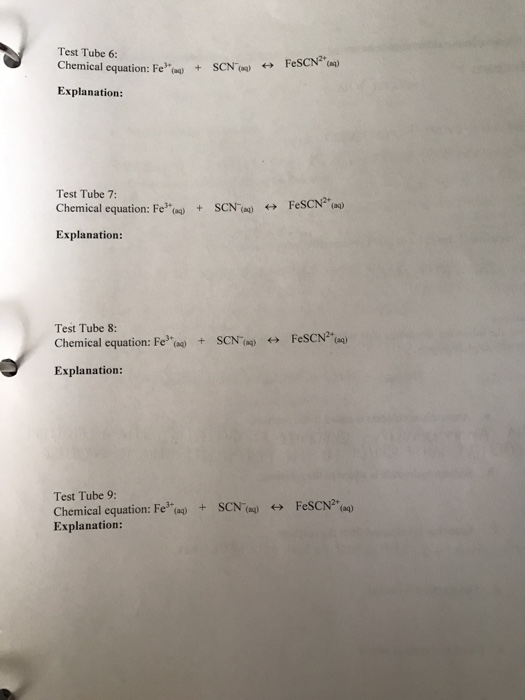


Test Tube 6 Chemical equation: Fe(a FeSCN(a) SCN (a) + Explanation: Test Tube 7: FESCN Chemical equation: Fe (a) (aq) (aq) + Explanation: Test Tube 8: SCN()FeSCN) Chemical equation: Fe(a) + (ag) Explanation: Test Tube 9: Chemical equation: Fe"(aq) Explanation: SCN (a)FeSCN) 34 + (aq)
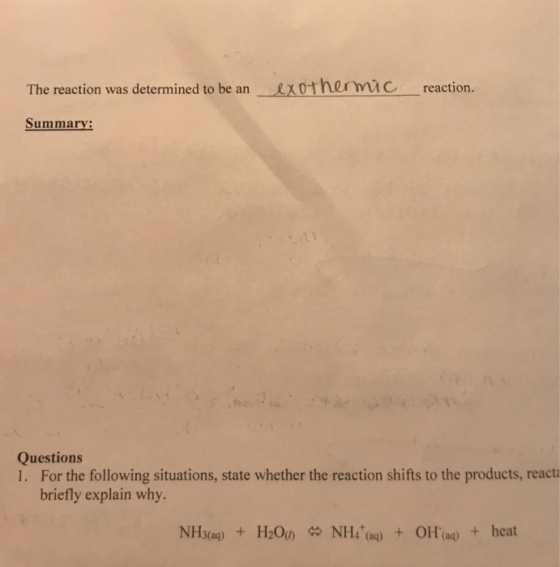
reaction. The reaction was determined to be an Summary:
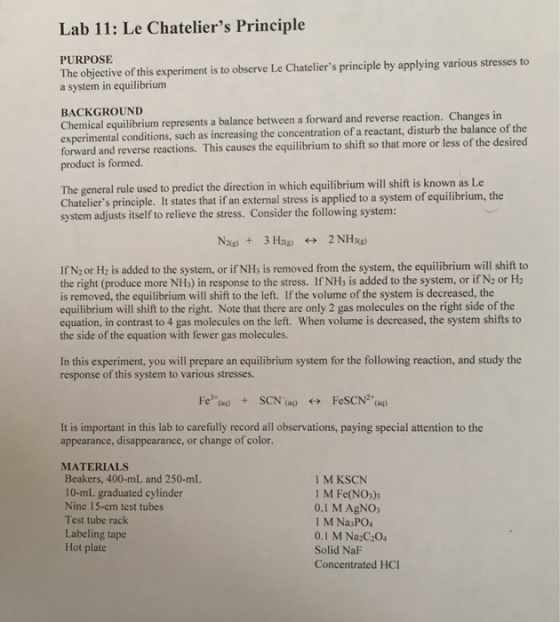
Lab 11: Le Chatelier's Principle The objective of this experiment is to observe Le Chatelier's principle by applying various stresses to a system in equilibrium PURPOSE BACKGROUND Chemical equilibrium represents a balance between a forward and reverse reaction. Changes in experimental conditions, such as increasing the concentration of a reactant, disturb the balance of the forward and reverse reactions. This causes the equilibrium to shift so that more or less of the desired product is formed The general rule used to predict the direction in which equilibrium will shift is known as Le Chatelier's principle. It states that if an external stress is applied to a system of equilibrium, the system adjusts itself to relieve the stress. Consider the following system: 3 Ha 2 NH3 Nae) + If N2 or H2 is added to the system, or if NHs is removed from the system, the equilibrium will shift to the right (produce more NHs) in response to the stress. If NH3 is added to the system, or if N2 or H2 is removed, the equilibrium will shift to the left. If the volume of the system is decreased, the equilibrium will shift to the right. Note that there are only 2 gas molecules on the right side of the equation, in contrast to 4 gas molecules on the left. When volume is decreased, the system shifts to the side of the equation with fewer gas molecules. In this experiment, you will prepare an equilibrium system for the following reaction, and study the response of this system to various stresses. Fe (a) SCN (a) FeSCN2(a) It is important in this lab to appearance, disappearance, or change of color. carefully record all observations, paying special attention to the MATERIALS Beakers, 400-mL and 250-mL 10-mL graduated eylinder Nine 15-cm test tubes 1M KSCN 1M Fe(NOs) 0.1 M AgNO 1 M NajPO4 Test tube rack Labeling tape Hot plate 0.1 M Na2C2O Solid NaF Concentrated HCI
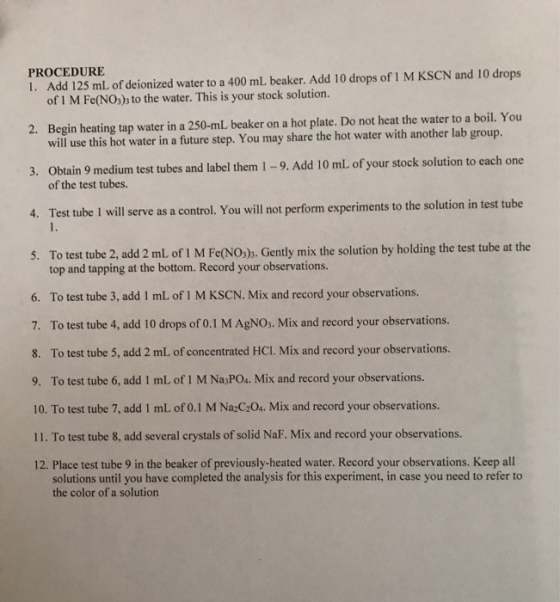
PROCEDURE 1. Add 125 mL of deionized water to a 400 mL beaker. Add 10 drops of 1 M KSCN and 10 drops of 1 M Fe(NOs)s to the water. This is your stock solution. 2. Begin heating tap water in a 250-mL beaker on a hot plate. Do not heat the water to a boil. You will use this hot water in a future step. You may share the hot water with another lab group. 3. Obtain 9 medium test tubes and label them 1-9. Add 10 mL of your stock solution to each one of the test tubes. 4. Test tube 1 will serve as a control. You will not perform experiments to the solution in test tube 1. To test tube 2, add 2 mL of 1 M Fe(NOs)s. Gently mix the solution by holding the test tube at the top and tapping at the bottom. Record your observations. 5. 6. To test tube 3, add 1 mL of1 M KSCN. Mix and record your observations. 7. To test tube 4, add 10 drops of 0.1 M AgNO3. Mix and record your observations. 8. To test tube 5, add 2 mL of concentrated HCl. Mix and record your observations. 9. To test tube 6, add 1 mL of1 M NasPO4. Mix and record your observations. 10. To test tube 7, add 1 mL of 0.1 M Na2C2O4. Mix and record your observations. 11. To test tube 8, add several crystals of solid NaF. Mix and record your observations. 12. Place test tube 9 in the beaker of previously-heated water. Record your observations. Keep all solutions until you have completed the analysis for this experiment, in case you need to refer to the color of a solution
Results Fe Test Tube 2: Chemical equation: FESCN + SCN) Fe Explanation: The equilibrium shifted toward the increased the ncentratior the pdiuct due to the addition of Fe(NO;)s because it Test Tube 3:SCN Chemical equation: Fe(ag) SCN ()FeSCN The equilibrium shift towardsthe hant duu to the addihon of KSCN bucause r mutased the concuntrahon o+ the producds Explanation: Ag FeSCN Test Tube 4: Chemical equation: Fe SCN ) (aq) (ag) Explanation: The equiliunum shitttd to the left cue To the addmon of gNO3 because the toncentratibn ot reactants mcreased. aadaian of Test Tube 5: HCL Chemical equation: Fe"(ag 3t SCN) FeSCN2 + (ac) Explanation: The equcibrum shifted t the lett due th the addtn on ot HI vecause -the Concentratim of rLactonts ncreased
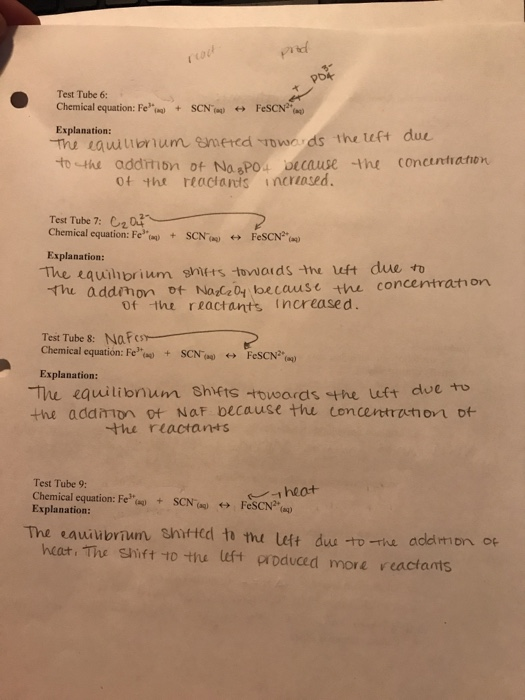
rod PO Test Tube 6: Chemical equation: Fe + SCN (a) FeSCNa) Explanation: The auilibium emered-owards the teft due o the addrtbn of NaaPo4 because he concentiaton Of the reaclants incrased Test Tube 7: C2ai Chemical equation: Fea SCN ( FESCN2 (ag) Explanation: The equihprium shitts tovards the uft due to The addinon of NazceD4 loecause the concentration Of the reactants Increased. Test Tube 8: NaFcs Chemical equation: Fe +SCNo0 FeSCN2 (a) Explanation: The equilibnum Shifts towards the uft due t the addmo ot NaF because the concentranon ot the reactants Test Tube 9: Chemical equation: Fe Explanation: heat SCN FESCN) (aq) (aq) The eauiibrinum shifted ta the Left du torhe heat. The shift to the left produced more reactants addimon ot
LKOthermic reaction. The reaction was determined to be an Summary: Questions 1. For the following situations, state whether the reaction shifts to the products, reacta briefly explain why. NH4 (a) + OH (a) heat NH3(ag) H2Ou
Homework Answers
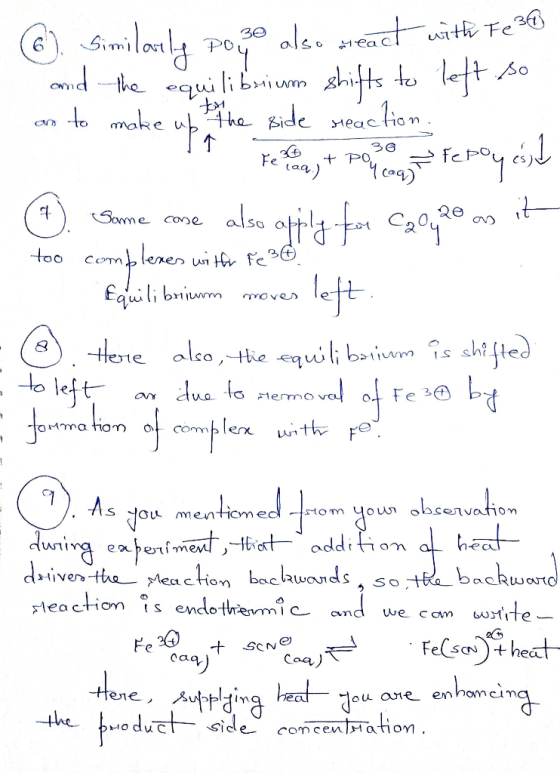
First Things first,according to Le-Chatelier's principle-
- Addition of excess reactant dives the reaction forward
- Addition of product slows down the forward reaction
Now,try to understand the following cases.In most of them
(Testtubes 4 to 8) addition of an external agent results in
complexation phenomenon with one of the reactants (it is 


Add Answer to:
are
theses correct?
please correct me if they are not.
Results Fe Test Tube 2: FeSCN...
What's the concentration of [FeSCN2+] using limiting reactant theory and equation? For each test tube solution...
 What's the concentration of [FeSCN2+] using limiting
reactant theory and equation?
For each test tube solution enter the initial concentration of Fe+ and SCNthe equilibrium concentration of FeSCN2: into the ICE table given. Complete entries for the rest of the table and calculate the K value for each of the tables. The values of K should be confined to a narrow range to reflect constancy. Comment on the quality of your work in this regard and calculate the average K....
What's the concentration of [FeSCN2+] using limiting
reactant theory and equation?
For each test tube solution enter the initial concentration of Fe+ and SCNthe equilibrium concentration of FeSCN2: into the ICE table given. Complete entries for the rest of the table and calculate the K value for each of the tables. The values of K should be confined to a narrow range to reflect constancy. Comment on the quality of your work in this regard and calculate the average K....
2. In Part A of this experiment, you prepare five FeSCN solutions (one that is just...
 2. In Part A of this experiment, you prepare five FeSCN solutions (one that is just a blank) according to the reaction below Fe (aq) SCN (aq) > FeSCN (a) SCN formed We assume that the starting SCN determines the concentration of Fe (because Fe is in excess and SCN is limiting). Calculate the concentration ot FeSCN2 that forms for each of the solutions (Beakers 1-4) and fill out the table below. Show your calculations beneath the table. Concentration of...
Reaction Rates and Chemical Equilibrim 09 In test tube 2, did the equilibrium shift in the direct...
 Reaction Rates and Chemical Equilibrim 09 In test tube 2, did the equilibrium shift in the direction of products or reactants? Explain. 010 In test tube 3, what is the evidence that the shift in equilibrium was in the direc- tion of products? 011 In test tube 4, what is the evidence that the shift in equilibrium was in the direc- tion of reactants? C.2 Effect of Temperature Test tube Color Temperature Color is deeper or [FeSCN (increased or lighter...
1- A calibration plot to model Beer’s Law is constructed for a range of [FeSCN]2+ solutions...
1- A calibration plot to model Beer’s Law is constructed for a range of [FeSCN]2+ solutions between 1.00 x 10⁻⁵ M and 5 x 10⁻⁴ M. The equation of the line is y=5325x. Determine the molar absorptivity of FeSCN2+ in this range. 2- An unknown FeSCN2+ solution is prepared by adding 8.00 mL of 2.00 x 10⁻³ M Fe(NO3)3, 4.00 mL of 2.00 x 10⁻³ M KSCN, and 3.00 mL of water. The absorbance of the unknown [FeSCN]2+ solution is...
A student made solution #3 using the experimental method in this lab, and measured an absorbance of 0.559. The starting...
 A student made solution #3 using the experimental method in this
lab, and measured an absorbance of 0.559. The starting reagents are
2.00 x 10⁻³ M Fe(NO3)3 and 2.00 x
10-3 M KSCN.
The amount of absorption is proportional to the concentration
of
FeSCN2+. This relationship – true for many solutions – is called
“Beer’s Law”, and has the simple equation:
A = bc
where “A” is the absorption, “b” is 5174.6 for FeSCN2+ and “c”
is molarity
Make Five...
A student made solution #3 using the experimental method in this
lab, and measured an absorbance of 0.559. The starting reagents are
2.00 x 10⁻³ M Fe(NO3)3 and 2.00 x
10-3 M KSCN.
The amount of absorption is proportional to the concentration
of
FeSCN2+. This relationship – true for many solutions – is called
“Beer’s Law”, and has the simple equation:
A = bc
where “A” is the absorption, “b” is 5174.6 for FeSCN2+ and “c”
is molarity
Make Five...
can you please help me with this Data and Calculations Trial 0:29 Absorbance 0.378 Je 0.086...
 can you please help me with this
Data and Calculations Trial 0:29 Absorbance 0.378 Je 0.086 Trial 2 0.47 Trial 3 0.632 Trial 4 0.729 0.686 Absorbance of standard Triw. 329 0.6 6 Temperature ke [Fe(SCN) 2+]/([Fe3+] [SCN-]) Ferrag) + SCN Cag) 2 FescN2t (ag) Absorbance of standard (Trial) Temperature 0.3 Ke expression: [Fe] 0.0010 [SCN) 10.00040 [FeSCN? Jeg [Fe [SCN ] Ke value Average of Ke values Percent error (see pg 7): (Discuss this result as part of your...
can you please help me with this
Data and Calculations Trial 0:29 Absorbance 0.378 Je 0.086 Trial 2 0.47 Trial 3 0.632 Trial 4 0.729 0.686 Absorbance of standard Triw. 329 0.6 6 Temperature ke [Fe(SCN) 2+]/([Fe3+] [SCN-]) Ferrag) + SCN Cag) 2 FescN2t (ag) Absorbance of standard (Trial) Temperature 0.3 Ke expression: [Fe] 0.0010 [SCN) 10.00040 [FeSCN? Jeg [Fe [SCN ] Ke value Average of Ke values Percent error (see pg 7): (Discuss this result as part of your...
Fe3(aq) FESCN (aq) SCN (aq) In this experiment, we'll be examining the temperature-dependence of the rate constant...
 Fe3(aq) FESCN (aq) SCN (aq) In this experiment, we'll be examining the temperature-dependence of the rate constant for the reaction above. 1. Using the UV-Vis instrument, you measured a room temperature absorbance for FESCN2 at 477 nm of 0.815. What is its concentration in molarity (M)? Please show all work. The molar absorptivity for FeSCN2 is 4,258 м"сm1 a. Answer: b. You calculated the [FeSCN2] above from the observed room temperature absorbance. Which one of the following statements about the...
1. A student mixes 5.00 mL of 2.00 x 10 M Fe(NO3)3 with 5.0 mL of...
 1. A student mixes 5.00 mL of 2.00 x 10 M Fe(NO3)3 with 5.0 mL of 2.00 x 10⁻³ M KSCN. She finds that in the equilibrium mixture the concentration of FeSCN+2 is 1.2 x 10⁴ M. Find the Kc for the reaction of Fe (aq) + SCN (aq) → FeSCN2(aq) using the following steps. a. Find the initial concentration of Fe and SCN. (Use Equation 4). Record the value in the ICE Chart below. b. What is the equilibrium...
what are the chemical reactions for 2,3,4,5,7,8,9 if you're adding each of those to the balanced...
 what are the chemical reactions for 2,3,4,5,7,8,9 if
you're adding each of those to the balanced equation from the
instructions which is Fe3+ + SCN---> FeSCN2+
PROCEDURE dean 400 ml beaker add 125 ml of delonized water, 10 drops of MKSCN and 10 drops A u ton This stack solution will have an intense red color due to the formation FeSON Onain 10 clean medium-sited test tubes and label them I through 10. Add 10 mL of the ution into...
what are the chemical reactions for 2,3,4,5,7,8,9 if
you're adding each of those to the balanced equation from the
instructions which is Fe3+ + SCN---> FeSCN2+
PROCEDURE dean 400 ml beaker add 125 ml of delonized water, 10 drops of MKSCN and 10 drops A u ton This stack solution will have an intense red color due to the formation FeSON Onain 10 clean medium-sited test tubes and label them I through 10. Add 10 mL of the ution into...
0.0018 is a wrong answer. Please do it again. Question 6 of 10 Try Again > Attempt 3 A standard solution of FeSCN...
 0.0018 is a wrong answer. Please do it again.
Question 6 of 10 Try Again > Attempt 3 A standard solution of FeSCN2+ is prepared by combining 9.0 mL of 0.20 M Fe(NO3), with 1.0 mL of 0.0020 M KSCN. The equation for the reaction is as follows. Fe(NO3)3 + KSCN=FeSCN2+ + KNO, +2 NO; What allows us to assume that the reaction goes essentially to completion? The concentration of Fe(NO,), is much higher than the concentration of KSCN. The...
0.0018 is a wrong answer. Please do it again.
Question 6 of 10 Try Again > Attempt 3 A standard solution of FeSCN2+ is prepared by combining 9.0 mL of 0.20 M Fe(NO3), with 1.0 mL of 0.0020 M KSCN. The equation for the reaction is as follows. Fe(NO3)3 + KSCN=FeSCN2+ + KNO, +2 NO; What allows us to assume that the reaction goes essentially to completion? The concentration of Fe(NO,), is much higher than the concentration of KSCN. The...
 What's the concentration of [FeSCN2+] using limiting
reactant theory and equation?
For each test tube solution enter the initial concentration of Fe+ and SCNthe equilibrium concentration of FeSCN2: into the ICE table given. Complete entries for the rest of the table and calculate the K value for each of the tables. The values of K should be confined to a narrow range to reflect constancy. Comment on the quality of your work in this regard and calculate the average K....
What's the concentration of [FeSCN2+] using limiting
reactant theory and equation?
For each test tube solution enter the initial concentration of Fe+ and SCNthe equilibrium concentration of FeSCN2: into the ICE table given. Complete entries for the rest of the table and calculate the K value for each of the tables. The values of K should be confined to a narrow range to reflect constancy. Comment on the quality of your work in this regard and calculate the average K....
 2. In Part A of this experiment, you prepare five FeSCN solutions (one that is just a blank) according to the reaction below Fe (aq) SCN (aq) > FeSCN (a) SCN formed We assume that the starting SCN determines the concentration of Fe (because Fe is in excess and SCN is limiting). Calculate the concentration ot FeSCN2 that forms for each of the solutions (Beakers 1-4) and fill out the table below. Show your calculations beneath the table. Concentration of...
 Reaction Rates and Chemical Equilibrim 09 In test tube 2, did the equilibrium shift in the direction of products or reactants? Explain. 010 In test tube 3, what is the evidence that the shift in equilibrium was in the direc- tion of products? 011 In test tube 4, what is the evidence that the shift in equilibrium was in the direc- tion of reactants? C.2 Effect of Temperature Test tube Color Temperature Color is deeper or [FeSCN (increased or lighter...
 A student made solution #3 using the experimental method in this
lab, and measured an absorbance of 0.559. The starting reagents are
2.00 x 10⁻³ M Fe(NO3)3 and 2.00 x
10-3 M KSCN.
The amount of absorption is proportional to the concentration
of
FeSCN2+. This relationship – true for many solutions – is called
“Beer’s Law”, and has the simple equation:
A = bc
where “A” is the absorption, “b” is 5174.6 for FeSCN2+ and “c”
is molarity
Make Five...
A student made solution #3 using the experimental method in this
lab, and measured an absorbance of 0.559. The starting reagents are
2.00 x 10⁻³ M Fe(NO3)3 and 2.00 x
10-3 M KSCN.
The amount of absorption is proportional to the concentration
of
FeSCN2+. This relationship – true for many solutions – is called
“Beer’s Law”, and has the simple equation:
A = bc
where “A” is the absorption, “b” is 5174.6 for FeSCN2+ and “c”
is molarity
Make Five...
 can you please help me with this
Data and Calculations Trial 0:29 Absorbance 0.378 Je 0.086 Trial 2 0.47 Trial 3 0.632 Trial 4 0.729 0.686 Absorbance of standard Triw. 329 0.6 6 Temperature ke [Fe(SCN) 2+]/([Fe3+] [SCN-]) Ferrag) + SCN Cag) 2 FescN2t (ag) Absorbance of standard (Trial) Temperature 0.3 Ke expression: [Fe] 0.0010 [SCN) 10.00040 [FeSCN? Jeg [Fe [SCN ] Ke value Average of Ke values Percent error (see pg 7): (Discuss this result as part of your...
can you please help me with this
Data and Calculations Trial 0:29 Absorbance 0.378 Je 0.086 Trial 2 0.47 Trial 3 0.632 Trial 4 0.729 0.686 Absorbance of standard Triw. 329 0.6 6 Temperature ke [Fe(SCN) 2+]/([Fe3+] [SCN-]) Ferrag) + SCN Cag) 2 FescN2t (ag) Absorbance of standard (Trial) Temperature 0.3 Ke expression: [Fe] 0.0010 [SCN) 10.00040 [FeSCN? Jeg [Fe [SCN ] Ke value Average of Ke values Percent error (see pg 7): (Discuss this result as part of your...
 Fe3(aq) FESCN (aq) SCN (aq) In this experiment, we'll be examining the temperature-dependence of the rate constant for the reaction above. 1. Using the UV-Vis instrument, you measured a room temperature absorbance for FESCN2 at 477 nm of 0.815. What is its concentration in molarity (M)? Please show all work. The molar absorptivity for FeSCN2 is 4,258 м"сm1 a. Answer: b. You calculated the [FeSCN2] above from the observed room temperature absorbance. Which one of the following statements about the...
 1. A student mixes 5.00 mL of 2.00 x 10 M Fe(NO3)3 with 5.0 mL of 2.00 x 10⁻³ M KSCN. She finds that in the equilibrium mixture the concentration of FeSCN+2 is 1.2 x 10⁴ M. Find the Kc for the reaction of Fe (aq) + SCN (aq) → FeSCN2(aq) using the following steps. a. Find the initial concentration of Fe and SCN. (Use Equation 4). Record the value in the ICE Chart below. b. What is the equilibrium...
 what are the chemical reactions for 2,3,4,5,7,8,9 if
you're adding each of those to the balanced equation from the
instructions which is Fe3+ + SCN---> FeSCN2+
PROCEDURE dean 400 ml beaker add 125 ml of delonized water, 10 drops of MKSCN and 10 drops A u ton This stack solution will have an intense red color due to the formation FeSON Onain 10 clean medium-sited test tubes and label them I through 10. Add 10 mL of the ution into...
what are the chemical reactions for 2,3,4,5,7,8,9 if
you're adding each of those to the balanced equation from the
instructions which is Fe3+ + SCN---> FeSCN2+
PROCEDURE dean 400 ml beaker add 125 ml of delonized water, 10 drops of MKSCN and 10 drops A u ton This stack solution will have an intense red color due to the formation FeSON Onain 10 clean medium-sited test tubes and label them I through 10. Add 10 mL of the ution into...
 0.0018 is a wrong answer. Please do it again.
Question 6 of 10 Try Again > Attempt 3 A standard solution of FeSCN2+ is prepared by combining 9.0 mL of 0.20 M Fe(NO3), with 1.0 mL of 0.0020 M KSCN. The equation for the reaction is as follows. Fe(NO3)3 + KSCN=FeSCN2+ + KNO, +2 NO; What allows us to assume that the reaction goes essentially to completion? The concentration of Fe(NO,), is much higher than the concentration of KSCN. The...
0.0018 is a wrong answer. Please do it again.
Question 6 of 10 Try Again > Attempt 3 A standard solution of FeSCN2+ is prepared by combining 9.0 mL of 0.20 M Fe(NO3), with 1.0 mL of 0.0020 M KSCN. The equation for the reaction is as follows. Fe(NO3)3 + KSCN=FeSCN2+ + KNO, +2 NO; What allows us to assume that the reaction goes essentially to completion? The concentration of Fe(NO,), is much higher than the concentration of KSCN. The...
Most questions answered within 3 hours.
-
Where is the error in this code sequence?
String s1 = "Hello";
String s2 = "ello";...
asked 11 months ago -
Financial data for Joel de Paris, Inc., for last year
follow:
Joel de Paris, Inc.
Balance...
asked 11 months ago -
Consider this reaction:
Al2(SO4)3 (aq)+ BaCl3
(aq) Al2Cl6 (aq)- +
3BaSO4(s) . What is the...
asked 11 months ago -
Suppose that Savneet is considering increasing her
recent random sample from 20 car rentals to 40...
asked 11 months ago -
Trucks arrive at an unloading terminal at an average rate of 120
per hour.
Trucks arrive...
asked 11 months ago -
Why are methanol and ethanol completely soluble in water while
octanol is not very little soluble....
asked 11 months ago -
A facilities manager at a university reads in a research report
that the mean amount of...
asked 11 months ago -
When the CuSO4 is rehydrated by adding water to the anhydrous
compound, is this an endothermic...
asked 11 months ago -
A ray of sunlight is passing from diamond into crown glass; the
angle of incidence is...
asked 11 months ago -
A block of mass 0.249 kg is placed on top of a light, vertical
spring of...
asked 11 months ago -
how do the kidneys compensate in the presences of acidosis
a) trigger hyperventilate
b) reserve acid...
asked 11 months ago -
Question 501 pts
The rental rate of capital to the firm increases. Which of the
following...
asked 11 months ago