
Homework Answers
Add Answer to:
number 9 and 10
0 The hot and cold reservoirs of Camot engine are 293°C and...
Imagine you have a hot reservoir at a temperature of 89.0 °C, and cold reservoir at...
Imagine you have a hot reservoir at a temperature of 89.0 °C, and cold reservoir at a temperature of 15.0 °C. Given their vast size, it is reasonable to assume the reservoirs\' temperatures will not change significantly if heat flows into or out of them. These reservoirs are then brought into thermal contact, during which 39210 J of heat flows from the hot reservoir to the cold reservoir. As a result of this heat exchange, what is the total change...
1.The efficiency of a Carnot engine is 27%. The engine absorbs 826 J of energy per...
1.The efficiency of a Carnot engine is 27%. The engine absorbs 826 J of energy per cycle by heat from a hot reservoir at 503 K. (a) Determine the energy expelled per cycle. _ J (b) Determine the temperature of the cold reservoir. _K 2.A sample of helium behaves as an ideal gas as energy is added by heat at constant pressure from 273 K to 343 K. If 15.0 J of work is done by the gas during this...
Complete Analysis of Heat Engine Goal Solve for the efficiency of a heat engine using a...
 Complete Analysis of Heat Engine Goal Solve for the efficiency of a heat engine using a five-step process the includes: 1. Making a state table. 2. Making a process table. 3. Calculating the totals for Work, Heat, and Internal-Energy-Change. 4. Identifying the heat input (hot reservoir) and output (cold reservoir). 5. Calculating the efficiency of the engine. isothermal Problem Shown in the figure to the right is a cyclic process undergone by a heat engine. Your heat engine shall use...
An engine absorbs 1.71 kJ from a hot reservoir at 277°C and expels 1.21 kJ to...
 An engine absorbs 1.71 kJ from a hot reservoir at 277°C and expels 1.21 kJ to a cold reservoir at 27°C in each cycle. (a) What is the engine's efficiency? (b) How much work is done by the engine in each cycle? (c) What is the power output of the engine if each cycle lasts 0.297 s? kW Need Help? Read it A Styrofoam cup holding 104 g of hot water at 1.00 x 10²°C cools to room temperature, 26.0°C....
Goal Solve for the efficiency of a heat engine using a five-step process the includes: 1....
 Goal Solve for the efficiency of a heat engine using a five-step process the includes: 1. Making a state table. 2. Making a process table. 3. Calculating the totals for Work, Heat, and Internal-Energy-Change. 4. Identifying the heat input (hot reservoir) and output (cold reservoir). 5. Calculating the efficiency of the engine. isothermal Problem Shown in the figure to the right is a cyclic process undergone by a heat engine. Your heat engine shall use 10.0 moles of nitrogen gas...
+ -/24 points Complete Analysis of Heat Engine Goal Solve for the efficiency of a heat...
 + -/24 points Complete Analysis of Heat Engine Goal Solve for the efficiency of a heat engine using a five-step process the includes: 1. Making a state table. 2. Making a process table. 3. Calculating the totals for Work, Heat, and Internal-Energy-Change. 4. Identifying the heat input (hot reservoir) and output (cold reservoir). 5. Calculating the efficiency of the engine. isothermal Problem Shown in the figure to the right is a cyclic process undergone by a heat engine. Your heat...
1)A gas is compressed at a constant pressure of 0.800 atm from 8.00 L to 1.00...
 1)A gas is compressed at a constant pressure of 0.800 atm from
8.00 L to 1.00 L. In the process, 410 J of energy leaves the gas by
heat. (a) What is the work done on the gas? J
(b) What is the change in its internal energy? J
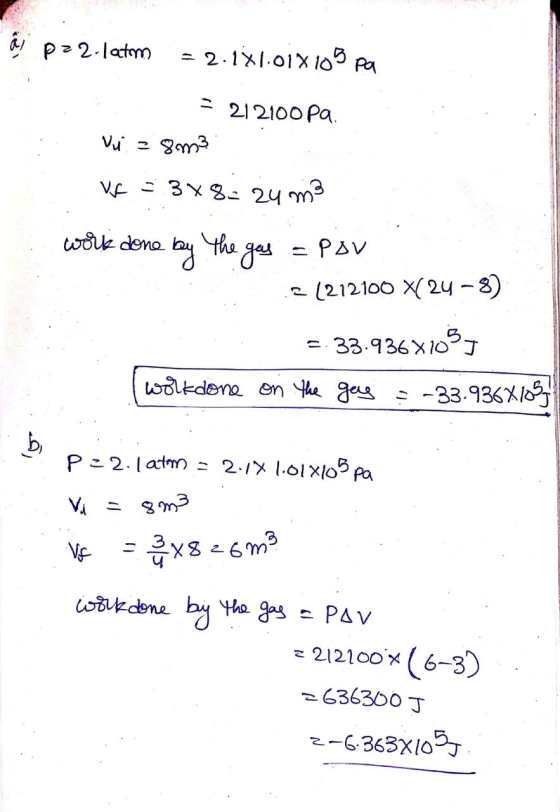
2) A gas increases in pressure from 2.00 atm to 6.00 atm at a
constant volume of 1.00 m3 and then expands at constant
pressure to a volume of 3.00 m3...
1)A gas is compressed at a constant pressure of 0.800 atm from
8.00 L to 1.00 L. In the process, 410 J of energy leaves the gas by
heat. (a) What is the work done on the gas? J
(b) What is the change in its internal energy? J
2) A gas increases in pressure from 2.00 atm to 6.00 atm at a
constant volume of 1.00 m3 and then expands at constant
pressure to a volume of 3.00 m3...
Rectangular PV Cycle 1 2 3 4 A piston contains 600 moles of an ideal monatomic...
 Rectangular PV Cycle 1 2 3 4 A piston contains 600 moles of an ideal monatomic gas that initally has a pressure of 2.31 x 10 Pa and a volume of 3.8 m'. The piston is connected to a hot and cold reservoir and the gas goes through the following quasi-static cycle accepting energy from the hot reservoir and exhausting energy into the cold reservoir. 1. The pressure of the gas is increased to 5.31 x 10⁹ Pa while maintaining...
For a Carnot engine with 10 moles of ideal gas (Cv = 1.5 nR) and operating...
For a Carnot engine with 10 moles of ideal gas (Cv = 1.5 nR) and operating between a hot reservoir of 500 K and a cold reservoir of 300 K, a) What would be the heat exchanges (q1) and entropy change (∆S1) for step 1, where the gas reversibly and isothermally expands to double its volume (V2 = 2 V1) at 500 K? b) What would be the heat exchanges (q3) and entropy change (∆S3) for step 3, where the...
For a Carnot engine with 10 moles of ideal gas (Cv= 1.5 nR) and operatingbetween a...
For a Carnot engine with 10 moles of ideal gas (Cv= 1.5 nR) and operatingbetween a hot reservoir of 500 K and a cold reservoir of 300 K,a. (6 Points) What would be the heat exchanges (q1) and entropy change (∆S1) for step 1, where thegas reversibly and isothermally expands to double its volume (V2= 2 V1) at 500 K?b. (6 Points) What would be the heat exchanges (q3) and entropy change (∆S3) for step 3, where thegas is reversibly...
 Complete Analysis of Heat Engine Goal Solve for the efficiency of a heat engine using a five-step process the includes: 1. Making a state table. 2. Making a process table. 3. Calculating the totals for Work, Heat, and Internal-Energy-Change. 4. Identifying the heat input (hot reservoir) and output (cold reservoir). 5. Calculating the efficiency of the engine. isothermal Problem Shown in the figure to the right is a cyclic process undergone by a heat engine. Your heat engine shall use...
 An engine absorbs 1.71 kJ from a hot reservoir at 277°C and expels 1.21 kJ to a cold reservoir at 27°C in each cycle. (a) What is the engine's efficiency? (b) How much work is done by the engine in each cycle? (c) What is the power output of the engine if each cycle lasts 0.297 s? kW Need Help? Read it A Styrofoam cup holding 104 g of hot water at 1.00 x 10²°C cools to room temperature, 26.0°C....
 Goal Solve for the efficiency of a heat engine using a five-step process the includes: 1. Making a state table. 2. Making a process table. 3. Calculating the totals for Work, Heat, and Internal-Energy-Change. 4. Identifying the heat input (hot reservoir) and output (cold reservoir). 5. Calculating the efficiency of the engine. isothermal Problem Shown in the figure to the right is a cyclic process undergone by a heat engine. Your heat engine shall use 10.0 moles of nitrogen gas...
 + -/24 points Complete Analysis of Heat Engine Goal Solve for the efficiency of a heat engine using a five-step process the includes: 1. Making a state table. 2. Making a process table. 3. Calculating the totals for Work, Heat, and Internal-Energy-Change. 4. Identifying the heat input (hot reservoir) and output (cold reservoir). 5. Calculating the efficiency of the engine. isothermal Problem Shown in the figure to the right is a cyclic process undergone by a heat engine. Your heat...
 1)A gas is compressed at a constant pressure of 0.800 atm from
8.00 L to 1.00 L. In the process, 410 J of energy leaves the gas by
heat. (a) What is the work done on the gas? J
(b) What is the change in its internal energy? J
2) A gas increases in pressure from 2.00 atm to 6.00 atm at a
constant volume of 1.00 m3 and then expands at constant
pressure to a volume of 3.00 m3...
1)A gas is compressed at a constant pressure of 0.800 atm from
8.00 L to 1.00 L. In the process, 410 J of energy leaves the gas by
heat. (a) What is the work done on the gas? J
(b) What is the change in its internal energy? J
2) A gas increases in pressure from 2.00 atm to 6.00 atm at a
constant volume of 1.00 m3 and then expands at constant
pressure to a volume of 3.00 m3...
 Rectangular PV Cycle 1 2 3 4 A piston contains 600 moles of an ideal monatomic gas that initally has a pressure of 2.31 x 10 Pa and a volume of 3.8 m'. The piston is connected to a hot and cold reservoir and the gas goes through the following quasi-static cycle accepting energy from the hot reservoir and exhausting energy into the cold reservoir. 1. The pressure of the gas is increased to 5.31 x 10⁹ Pa while maintaining...
Most questions answered within 3 hours.
-
Where is the error in this code sequence?
String s1 = "Hello";
String s2 = "ello";...
asked 11 months ago -
Financial data for Joel de Paris, Inc., for last year
follow:
Joel de Paris, Inc.
Balance...
asked 11 months ago -
Consider this reaction:
Al2(SO4)3 (aq)+ BaCl3
(aq) Al2Cl6 (aq)- +
3BaSO4(s) . What is the...
asked 11 months ago -
Suppose that Savneet is considering increasing her
recent random sample from 20 car rentals to 40...
asked 11 months ago -
Trucks arrive at an unloading terminal at an average rate of 120
per hour.
Trucks arrive...
asked 11 months ago -
Why are methanol and ethanol completely soluble in water while
octanol is not very little soluble....
asked 11 months ago -
A facilities manager at a university reads in a research report
that the mean amount of...
asked 11 months ago -
When the CuSO4 is rehydrated by adding water to the anhydrous
compound, is this an endothermic...
asked 11 months ago -
A ray of sunlight is passing from diamond into crown glass; the
angle of incidence is...
asked 11 months ago -
A block of mass 0.249 kg is placed on top of a light, vertical
spring of...
asked 11 months ago -
how do the kidneys compensate in the presences of acidosis
a) trigger hyperventilate
b) reserve acid...
asked 11 months ago -
Question 501 pts
The rental rate of capital to the firm increases. Which of the
following...
asked 11 months ago