
Homework Answers
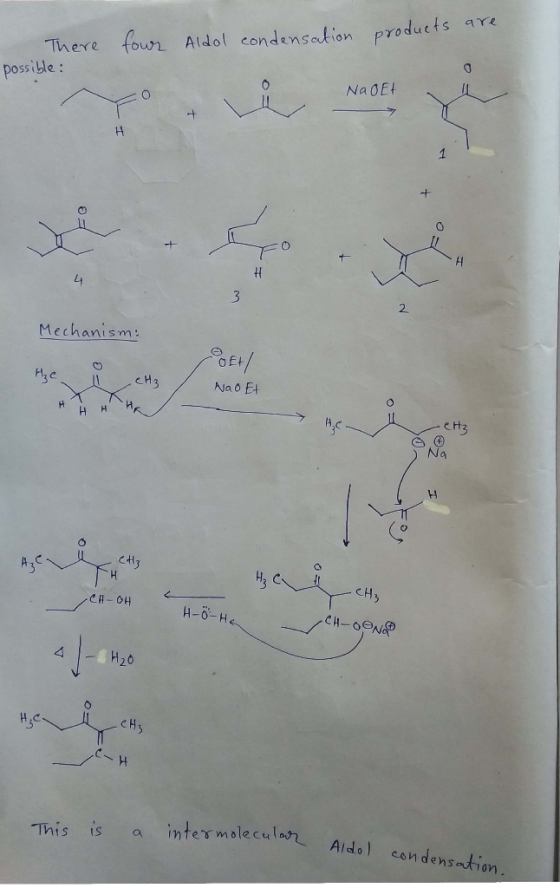
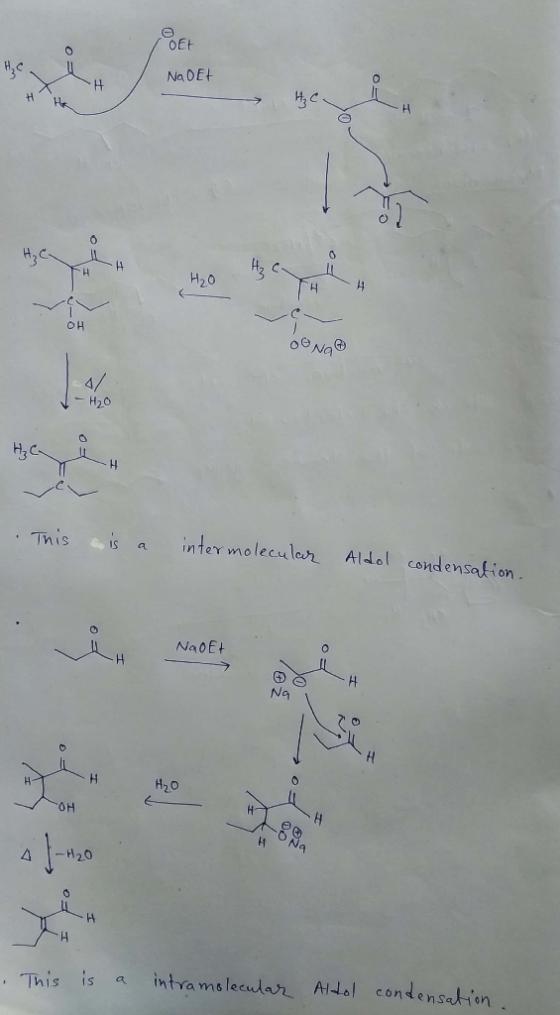
 all products are possible
products and not form an equal amount.
all products are possible
products and not form an equal amount.
 This is the controlled aldol
condensation products.
This is the controlled aldol
condensation products.
Add Answer to:
5) Draw the Structure of ALL the alpha/beta unsaturated carbon obtained as the dehydration products from...
The following Aldol Condensation produces a mixture of SIX -alpha, beta-unsaturated carbonyl products. DRAW the structure...
 The following Aldol Condensation produces a mixture of SIX -alpha, beta-unsaturated carbonyl products. DRAW the structure of all Six the alpha, beta-unsaturated products obtained.
Rheosmin is a saturated ketone obtained from an alpha,beta-unsaturated ketone (a crossed aldol condensation product) which...
 Rheosmin is a saturated ketone obtained from an
alpha,beta-unsaturated ketone (a crossed aldol condensation
product) which is capable of undergoing hydrogenation to yield a
saturated ketone (Rheosmin). Using this technique, identify the
reagents needed to prepare Rheosmin via crossed aldol reaction.
Rheosmin 4-(4-hydroxyphenyl)butan-2-one
Rheosmin is a saturated ketone obtained from an
alpha,beta-unsaturated ketone (a crossed aldol condensation
product) which is capable of undergoing hydrogenation to yield a
saturated ketone (Rheosmin). Using this technique, identify the
reagents needed to prepare Rheosmin via crossed aldol reaction.
Rheosmin 4-(4-hydroxyphenyl)butan-2-one
Product was formed successfully based on the exp. below (about 85% yield), please interpret/discuss HNMR/IR in...
 Product was formed successfully based on the exp. below (about
85% yield), please interpret/discuss HNMR/IR in as much detail as
possible and assign peaks on HNMR (which peak represents which
protons of which group, etc). Note: I already know how you
determine the formation of the product so you can skip that part of
part b).
Based on this exp:
Discuss the IR spectrum and what is the peak in IR that you can see for a specific functional group...
Product was formed successfully based on the exp. below (about
85% yield), please interpret/discuss HNMR/IR in as much detail as
possible and assign peaks on HNMR (which peak represents which
protons of which group, etc). Note: I already know how you
determine the formation of the product so you can skip that part of
part b).
Based on this exp:
Discuss the IR spectrum and what is the peak in IR that you can see for a specific functional group...
The alkene mixture obtained on dehydration of 2,2-dimethylcyclohexanol contains a significant amount of 1,2-dimethylcyclohexene Draw the...
The alkene mixture obtained on dehydration of 2,2-dimethylcyclohexanol contains a significant amount of 1,2-dimethylcyclohexene Draw the structure of 1,2-dimethylcyclohexene Show a mechanism for the formation of this alkene product Draw the structures and give the names of any other alkene products, explaining how they could arise from the dehydration reaction
Draw the structure of only the Zaitsev product that would be obtained from the dehydration of...
Draw the structure of only the Zaitsev product that would be obtained from the dehydration of 1-methylcyclohexanol.
1)Draw the structure of only the Zaitsev product that would be obtained from the dehydration of...
1)Draw the structure of only the Zaitsev product that would be obtained from the dehydration of 1- methylcyclohexanol. 2)Write out a detailed mechanism of the acid catalyzed dehydration of cyclohexanol. Use only hydronium as your acid source. 3)With respect to GC, what effect would raising the column temperature have on the retention time? 4)What would happen if you spiked your sample with a small amount of known cyclohexene and re-ran the GC?
Question 1 Match each reagent with its role in aldol condensation reaction. Not yet answered D-anisaldehyde...
 Question 1 Match each reagent with its role in aldol condensation reaction. Not yet answered D-anisaldehyde Choose... Points out of 10.00 dium hydroxide Choose... P Flag question acetophenone Choose... ethanol Choose... Question 2 Not yet answered To purify the aldol condensation product you will have to recrystallize it from methanol. Give the steps in recrystallization procedure the appropriate order numbering. Points out of 10.00 The compound is kept under vacuum for 10 min Choose... + P Flag question The solution...
4. Multiple Choice Place your answer in the space provided. (2 pts. each; 12 pts. total)...
 4. Multiple Choice Place your answer in the space provided. (2 pts. each; 12 pts. total) Which is NOT true of the aldol condensation? A. It accomplishes the formation of a new carbon-carbon bond B. The enolate is favored at equilibrium (assume NaOH as the base) C. The key step is the mechanism is attack of the enolate ion on a carbonyl carbon atom D. Dehydration of the aldol product is often observed and is irreversible. _Which sets of hydrogen...
d. (a total of 5 pts) What would be the four products obtained from the dehydration...
 d. (a total of 5 pts) What would be the four products obtained from the dehydration of 2,3-dimethyl-3- heptanol? Draw the chemical equation showing structural formulas of all organic reactants and products (1 pt for each correct product structure with the correct IUPAC name that includes E/Z, if relevant). Indicate which of the four products is expected to be major (1 pt).
Draw a structural formula for the product of the aldol reaction of the compound shown above,...
 Draw a structural formula for the product of the aldol reaction of the compound shown above, as well as the a.B-unsaturated aldehyde or ketone formed from dehydration of the aldol product. You do not have to consider stereochemistry. You do not have to explicitly draw H atoms. • Draw one structure per sketcher. Add additional sketchers using the drop-down menu in the bottom right comer. Separate structures using the sign from the drop-down menu. . o 1. Og 2. (CH3)2...
 The following Aldol Condensation produces a mixture of SIX -alpha, beta-unsaturated carbonyl products. DRAW the structure of all Six the alpha, beta-unsaturated products obtained.
 Rheosmin is a saturated ketone obtained from an
alpha,beta-unsaturated ketone (a crossed aldol condensation
product) which is capable of undergoing hydrogenation to yield a
saturated ketone (Rheosmin). Using this technique, identify the
reagents needed to prepare Rheosmin via crossed aldol reaction.
Rheosmin 4-(4-hydroxyphenyl)butan-2-one
Rheosmin is a saturated ketone obtained from an
alpha,beta-unsaturated ketone (a crossed aldol condensation
product) which is capable of undergoing hydrogenation to yield a
saturated ketone (Rheosmin). Using this technique, identify the
reagents needed to prepare Rheosmin via crossed aldol reaction.
Rheosmin 4-(4-hydroxyphenyl)butan-2-one
 Product was formed successfully based on the exp. below (about
85% yield), please interpret/discuss HNMR/IR in as much detail as
possible and assign peaks on HNMR (which peak represents which
protons of which group, etc). Note: I already know how you
determine the formation of the product so you can skip that part of
part b).
Based on this exp:
Discuss the IR spectrum and what is the peak in IR that you can see for a specific functional group...
Product was formed successfully based on the exp. below (about
85% yield), please interpret/discuss HNMR/IR in as much detail as
possible and assign peaks on HNMR (which peak represents which
protons of which group, etc). Note: I already know how you
determine the formation of the product so you can skip that part of
part b).
Based on this exp:
Discuss the IR spectrum and what is the peak in IR that you can see for a specific functional group...
 Question 1 Match each reagent with its role in aldol condensation reaction. Not yet answered D-anisaldehyde Choose... Points out of 10.00 dium hydroxide Choose... P Flag question acetophenone Choose... ethanol Choose... Question 2 Not yet answered To purify the aldol condensation product you will have to recrystallize it from methanol. Give the steps in recrystallization procedure the appropriate order numbering. Points out of 10.00 The compound is kept under vacuum for 10 min Choose... + P Flag question The solution...
 4. Multiple Choice Place your answer in the space provided. (2 pts. each; 12 pts. total) Which is NOT true of the aldol condensation? A. It accomplishes the formation of a new carbon-carbon bond B. The enolate is favored at equilibrium (assume NaOH as the base) C. The key step is the mechanism is attack of the enolate ion on a carbonyl carbon atom D. Dehydration of the aldol product is often observed and is irreversible. _Which sets of hydrogen...
 d. (a total of 5 pts) What would be the four products obtained from the dehydration of 2,3-dimethyl-3- heptanol? Draw the chemical equation showing structural formulas of all organic reactants and products (1 pt for each correct product structure with the correct IUPAC name that includes E/Z, if relevant). Indicate which of the four products is expected to be major (1 pt).
 Draw a structural formula for the product of the aldol reaction of the compound shown above, as well as the a.B-unsaturated aldehyde or ketone formed from dehydration of the aldol product. You do not have to consider stereochemistry. You do not have to explicitly draw H atoms. • Draw one structure per sketcher. Add additional sketchers using the drop-down menu in the bottom right comer. Separate structures using the sign from the drop-down menu. . o 1. Og 2. (CH3)2...
Most questions answered within 3 hours.
-
Where is the error in this code sequence?
String s1 = "Hello";
String s2 = "ello";...
asked 11 months ago -
Financial data for Joel de Paris, Inc., for last year
follow:
Joel de Paris, Inc.
Balance...
asked 11 months ago -
Consider this reaction:
Al2(SO4)3 (aq)+ BaCl3
(aq) Al2Cl6 (aq)- +
3BaSO4(s) . What is the...
asked 11 months ago -
Suppose that Savneet is considering increasing her
recent random sample from 20 car rentals to 40...
asked 11 months ago -
Trucks arrive at an unloading terminal at an average rate of 120
per hour.
Trucks arrive...
asked 11 months ago -
Why are methanol and ethanol completely soluble in water while
octanol is not very little soluble....
asked 11 months ago -
A facilities manager at a university reads in a research report
that the mean amount of...
asked 11 months ago -
When the CuSO4 is rehydrated by adding water to the anhydrous
compound, is this an endothermic...
asked 11 months ago -
A ray of sunlight is passing from diamond into crown glass; the
angle of incidence is...
asked 11 months ago -
A block of mass 0.249 kg is placed on top of a light, vertical
spring of...
asked 11 months ago -
how do the kidneys compensate in the presences of acidosis
a) trigger hyperventilate
b) reserve acid...
asked 11 months ago -
Question 501 pts
The rental rate of capital to the firm increases. Which of the
following...
asked 11 months ago