1)Draw the structure of only the Zaitsev product that would be obtained from the dehydration of...
1)Draw the structure of only the Zaitsev product that would be obtained from the dehydration of 1- methylcyclohexanol.
2)Write out a detailed mechanism of the acid catalyzed dehydration of cyclohexanol. Use only hydronium as your acid source.
3)With respect to GC, what effect would raising the column temperature have on the retention time?
4)What would happen if you spiked your sample with a small amount of known cyclohexene and re-ran the GC?
Homework Answers

Add Answer to:
1)Draw the structure of only the Zaitsev product that would be
obtained from the dehydration of...
Draw the structure of only the Zaitsev product that would be obtained from the dehydration of...
Draw the structure of only the Zaitsev product that would be obtained from the dehydration of 1-methylcyclohexanol.
1) Draw a complete scheme and mechanism for the dehydration of cyclohexanol to cyclohexene. Propose a...
1) Draw a complete scheme and mechanism for the dehydration of cyclohexanol to cyclohexene. Propose a scheme and conditions for the preparation of cyclohexanol from cyclohexene. How would you track the progress of your reactions and confirm product identification? 2) Create a chart comparing E1, E2, SN1 and SN2 reactions. Be detailed and cover: structure of RX, reactivity of nucleophile, concentration of nucleophile, solvent and stereochemistry. 3) Mixing cyclohexanol with phosphoric acid is an exothermic process, whereas the production of...
Section/Group: Post-Lab: Experiment 8 1. Draw the structure of the major product that would be obtained from the d...
 Section/Group: Post-Lab: Experiment 8 1. Draw the structure of the major product that would be obtained from the dehydration of 3. 5-dimethylcyclohexanol 2. In what way did the use of the sodium chloride solution and the separating funnel assist to purify the cyclohexene? See Figure 8.12. Initial distilate with NaCl for pre-drying Upper organic layer (mostly cyclohexene) OG79 Nach NS CH Na co Na Lower aqueous layer (mainly H,0) opangoסניוור CH SCH Figure 8.12. Sodium Chloride for pre-drying. Tests for...
Experiments Dehydration of 2-methylcyclohexanol Questions 1. Please answer this question on notebook paper, not in the...
 Experiments Dehydration of 2-methylcyclohexanol Questions 1. Please answer this question on notebook paper, not in the lab sometimes dimicult to read.) tebook (carbon copies are Consider the phosphoric acid-catalyzed dehydration of the following list of nine alcohols. Give the structure of each alcohol and that of the resultant alese. If a MIXTURE of alenes is anticipated. give both products and circle the major product (a) Cyclohexanol: (b) 1-methylcyclohexanol (c)2-methylcobecnold 3-methylcyclohexanol: (e) 4-methylcyclohexanol: (cyclopentanol (R) 3- canotth) 2-pentano: 0) 3-pentanol. 2....
Convert Cyclohexanol to Cyclohexene via a Acid-Catalyzed Dehydration reaction 1. Why does the product ‘come over’...
Convert Cyclohexanol to Cyclohexene via a Acid-Catalyzed Dehydration reaction 1. Why does the product ‘come over’ after being formed? Please think about the properties of the starting material and product. 2. If there was no acid present, would you expect to get a product? Why/why not? 3. If we start off with 10 molecules of the starting alcohol and only get an 80% yield, how many molecules will we find in the product flask? 4. Look up the concept of...
Which linear alkenes would you expect to be obtained from the acid-catalyzed dehydration of 1-hexanol? Draw...
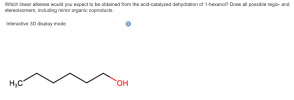 Which linear alkenes would you expect to be obtained from the acid-catalyzed dehydration of 1-hexanol? Draw all possible regio- and stereoisomers, including minor organic coproducts. Interactive 3D display mode
5) Draw the Structure of ALL the alpha/beta unsaturated carbon obtained as the dehydration products from...
 5) Draw the Structure of ALL the alpha/beta unsaturated carbon obtained as the dehydration products from the following aldol cond ůco + nsaturated carbonyl products that would be he following aldol condensation: NaOEt 6) The Aldol Condensation below provides only ONE PRODUCT. Provide the structure of the Aldol Dehydration Product and a Full Mechanism to account for its formation. C. –
Please help with the question that I have circled in red. This is from a lab...
 Please help with the question that I have circled in red. This
is from a lab I did and I have included the entire handout in case
it helps you to answer the question.
2015 Chem 263 2-Credit Org Lab 6T: Dehydration of Cyclohexanol to Cyclohexene Lab 6T w lecture you recently learned that alkenes undergo acid-catalyzed addition of H20 (hydration of the alkene) to yield alcohols. This lab with illustrate the same chemistry in reverse; the microscopic reverse of...
Please help with the question that I have circled in red. This
is from a lab I did and I have included the entire handout in case
it helps you to answer the question.
2015 Chem 263 2-Credit Org Lab 6T: Dehydration of Cyclohexanol to Cyclohexene Lab 6T w lecture you recently learned that alkenes undergo acid-catalyzed addition of H20 (hydration of the alkene) to yield alcohols. This lab with illustrate the same chemistry in reverse; the microscopic reverse of...
Draw the structure of each compound 1. Draw the structure of each compound: (a) cis-1,2-Cyclohexanediol (b)...
 Draw the structure of each compound
1. Draw the structure of each compound: (a) cis-1,2-Cyclohexanediol (b) Isobutanol (c) 2,4,6-Trinitrophenol (d) (R)-2,2-Dimethyl-3-heptanol (e) Ethylene glycol (0) (s)-2-Methyl-1-butanol 2. Acid-catalyzed hydration of 3,3-dimethyl-1-butene produces 2,3-dimethyl-2-butanol. Show a mechanism for this reaction 3. Acid-catalyzed hydration of 1-methylcyclohexene yields two alcohols. The major product does not undergo oxidation, while the minor product will undergo oxidation. Explain. 4. Using 2-propanol as your only source of carbon, show how you would prepare 2-methyl- 2-pentanol. 5. Identify...
Draw the structure of each compound
1. Draw the structure of each compound: (a) cis-1,2-Cyclohexanediol (b) Isobutanol (c) 2,4,6-Trinitrophenol (d) (R)-2,2-Dimethyl-3-heptanol (e) Ethylene glycol (0) (s)-2-Methyl-1-butanol 2. Acid-catalyzed hydration of 3,3-dimethyl-1-butene produces 2,3-dimethyl-2-butanol. Show a mechanism for this reaction 3. Acid-catalyzed hydration of 1-methylcyclohexene yields two alcohols. The major product does not undergo oxidation, while the minor product will undergo oxidation. Explain. 4. Using 2-propanol as your only source of carbon, show how you would prepare 2-methyl- 2-pentanol. 5. Identify...
Working on the questions at the end of this lab report (see above). I need help answering questio...
 Working on the questions at the end of this lab report
(see above). I need help answering questions 2, 3, and 4 completely
and thoroughly. Thank you!
s, until the I hexano 1 clean disti CYCLOHEXENE from CYCLOHEXANOL be dehydrated with solfuric acid to yield cyclohexene and waterf Add a 0°C (record ct and cal H,SO + H20 ainer. s in purification of any crude product are (a) the preliminary separation of the product from the reaction mixture by distillation...
Working on the questions at the end of this lab report
(see above). I need help answering questions 2, 3, and 4 completely
and thoroughly. Thank you!
s, until the I hexano 1 clean disti CYCLOHEXENE from CYCLOHEXANOL be dehydrated with solfuric acid to yield cyclohexene and waterf Add a 0°C (record ct and cal H,SO + H20 ainer. s in purification of any crude product are (a) the preliminary separation of the product from the reaction mixture by distillation...
 Section/Group: Post-Lab: Experiment 8 1. Draw the structure of the major product that would be obtained from the dehydration of 3. 5-dimethylcyclohexanol 2. In what way did the use of the sodium chloride solution and the separating funnel assist to purify the cyclohexene? See Figure 8.12. Initial distilate with NaCl for pre-drying Upper organic layer (mostly cyclohexene) OG79 Nach NS CH Na co Na Lower aqueous layer (mainly H,0) opangoסניוור CH SCH Figure 8.12. Sodium Chloride for pre-drying. Tests for...
 Experiments Dehydration of 2-methylcyclohexanol Questions 1. Please answer this question on notebook paper, not in the lab sometimes dimicult to read.) tebook (carbon copies are Consider the phosphoric acid-catalyzed dehydration of the following list of nine alcohols. Give the structure of each alcohol and that of the resultant alese. If a MIXTURE of alenes is anticipated. give both products and circle the major product (a) Cyclohexanol: (b) 1-methylcyclohexanol (c)2-methylcobecnold 3-methylcyclohexanol: (e) 4-methylcyclohexanol: (cyclopentanol (R) 3- canotth) 2-pentano: 0) 3-pentanol. 2....
 Which linear alkenes would you expect to be obtained from the acid-catalyzed dehydration of 1-hexanol? Draw all possible regio- and stereoisomers, including minor organic coproducts. Interactive 3D display mode
 5) Draw the Structure of ALL the alpha/beta unsaturated carbon obtained as the dehydration products from the following aldol cond ůco + nsaturated carbonyl products that would be he following aldol condensation: NaOEt 6) The Aldol Condensation below provides only ONE PRODUCT. Provide the structure of the Aldol Dehydration Product and a Full Mechanism to account for its formation. C. –
 Please help with the question that I have circled in red. This
is from a lab I did and I have included the entire handout in case
it helps you to answer the question.
2015 Chem 263 2-Credit Org Lab 6T: Dehydration of Cyclohexanol to Cyclohexene Lab 6T w lecture you recently learned that alkenes undergo acid-catalyzed addition of H20 (hydration of the alkene) to yield alcohols. This lab with illustrate the same chemistry in reverse; the microscopic reverse of...
Please help with the question that I have circled in red. This
is from a lab I did and I have included the entire handout in case
it helps you to answer the question.
2015 Chem 263 2-Credit Org Lab 6T: Dehydration of Cyclohexanol to Cyclohexene Lab 6T w lecture you recently learned that alkenes undergo acid-catalyzed addition of H20 (hydration of the alkene) to yield alcohols. This lab with illustrate the same chemistry in reverse; the microscopic reverse of...
 Draw the structure of each compound
1. Draw the structure of each compound: (a) cis-1,2-Cyclohexanediol (b) Isobutanol (c) 2,4,6-Trinitrophenol (d) (R)-2,2-Dimethyl-3-heptanol (e) Ethylene glycol (0) (s)-2-Methyl-1-butanol 2. Acid-catalyzed hydration of 3,3-dimethyl-1-butene produces 2,3-dimethyl-2-butanol. Show a mechanism for this reaction 3. Acid-catalyzed hydration of 1-methylcyclohexene yields two alcohols. The major product does not undergo oxidation, while the minor product will undergo oxidation. Explain. 4. Using 2-propanol as your only source of carbon, show how you would prepare 2-methyl- 2-pentanol. 5. Identify...
Draw the structure of each compound
1. Draw the structure of each compound: (a) cis-1,2-Cyclohexanediol (b) Isobutanol (c) 2,4,6-Trinitrophenol (d) (R)-2,2-Dimethyl-3-heptanol (e) Ethylene glycol (0) (s)-2-Methyl-1-butanol 2. Acid-catalyzed hydration of 3,3-dimethyl-1-butene produces 2,3-dimethyl-2-butanol. Show a mechanism for this reaction 3. Acid-catalyzed hydration of 1-methylcyclohexene yields two alcohols. The major product does not undergo oxidation, while the minor product will undergo oxidation. Explain. 4. Using 2-propanol as your only source of carbon, show how you would prepare 2-methyl- 2-pentanol. 5. Identify...
 Working on the questions at the end of this lab report
(see above). I need help answering questions 2, 3, and 4 completely
and thoroughly. Thank you!
s, until the I hexano 1 clean disti CYCLOHEXENE from CYCLOHEXANOL be dehydrated with solfuric acid to yield cyclohexene and waterf Add a 0°C (record ct and cal H,SO + H20 ainer. s in purification of any crude product are (a) the preliminary separation of the product from the reaction mixture by distillation...
Working on the questions at the end of this lab report
(see above). I need help answering questions 2, 3, and 4 completely
and thoroughly. Thank you!
s, until the I hexano 1 clean disti CYCLOHEXENE from CYCLOHEXANOL be dehydrated with solfuric acid to yield cyclohexene and waterf Add a 0°C (record ct and cal H,SO + H20 ainer. s in purification of any crude product are (a) the preliminary separation of the product from the reaction mixture by distillation...
Most questions answered within 3 hours.
-
Where is the error in this code sequence?
String s1 = "Hello";
String s2 = "ello";...
asked 10 months ago -
Financial data for Joel de Paris, Inc., for last year
follow:
Joel de Paris, Inc.
Balance...
asked 10 months ago -
Consider this reaction:
Al2(SO4)3 (aq)+ BaCl3
(aq) Al2Cl6 (aq)- +
3BaSO4(s) . What is the...
asked 10 months ago -
Suppose that Savneet is considering increasing her
recent random sample from 20 car rentals to 40...
asked 10 months ago -
Trucks arrive at an unloading terminal at an average rate of 120
per hour.
Trucks arrive...
asked 10 months ago -
Why are methanol and ethanol completely soluble in water while
octanol is not very little soluble....
asked 10 months ago -
A facilities manager at a university reads in a research report
that the mean amount of...
asked 10 months ago -
When the CuSO4 is rehydrated by adding water to the anhydrous
compound, is this an endothermic...
asked 10 months ago -
A ray of sunlight is passing from diamond into crown glass; the
angle of incidence is...
asked 10 months ago -
A block of mass 0.249 kg is placed on top of a light, vertical
spring of...
asked 10 months ago -
how do the kidneys compensate in the presences of acidosis
a) trigger hyperventilate
b) reserve acid...
asked 10 months ago -
Question 501 pts
The rental rate of capital to the firm increases. Which of the
following...
asked 10 months ago