
Homework Answers


Add Answer to:
Which linear alkenes would you expect to be obtained from the acid-catalyzed dehydration of 1-hexanol? Draw...
how does the mixture of isomeric alkenes produced by an acid-catalyzed dehydration reaction compare with the...
 how does the mixture of isomeric alkenes produced by an
acid-catalyzed dehydration reaction compare with the alkene mixture
from a base-catalyzed dehydrochlorination reaction? Are either or
both sets or products influenced primarily by product
stability?
E1/E2 Elimination Reactions. Acid-Catalyzed Dehydration of 2-Me Base-Catalyzed Dehydrochlorination of 2-Chloro-2-methylbutane Acid-Catalyzed Dehydration of 2-Methyl-2-butanol and Adapted for an experiment published in More J.R - Hammond, C.N. Schatz, PF: Morrill, T.C.: Modern Projects and P. Hammond CN: Schatz, P.F., Morrill... Experiments in Organic Chemistry, 2nd...
how does the mixture of isomeric alkenes produced by an
acid-catalyzed dehydration reaction compare with the alkene mixture
from a base-catalyzed dehydrochlorination reaction? Are either or
both sets or products influenced primarily by product
stability?
E1/E2 Elimination Reactions. Acid-Catalyzed Dehydration of 2-Me Base-Catalyzed Dehydrochlorination of 2-Chloro-2-methylbutane Acid-Catalyzed Dehydration of 2-Methyl-2-butanol and Adapted for an experiment published in More J.R - Hammond, C.N. Schatz, PF: Morrill, T.C.: Modern Projects and P. Hammond CN: Schatz, P.F., Morrill... Experiments in Organic Chemistry, 2nd...
1)Draw the structure of only the Zaitsev product that would be obtained from the dehydration of...
1)Draw the structure of only the Zaitsev product that would be obtained from the dehydration of 1- methylcyclohexanol. 2)Write out a detailed mechanism of the acid catalyzed dehydration of cyclohexanol. Use only hydronium as your acid source. 3)With respect to GC, what effect would raising the column temperature have on the retention time? 4)What would happen if you spiked your sample with a small amount of known cyclohexene and re-ran the GC?
Acid-catalyzed dehydration of secondary and tertiary alcohols proceeds through an E1 mechanism. The first step is...
 Acid-catalyzed dehydration of secondary and tertiary alcohols
proceeds through an E1 mechanism. The first step is the protonation
of alcohol and oxygen to form an oxonium ion.
Dehydration of 3-methyl-2-butanol forms one major and two minor
organic products. Draw the structures, including hydrogen atoms, of
the three organic products of this reaction.
The 3.) is correct that is the minor product I came up with but
I cant get the answer correct for 1.) major product? and 2.) minor
product
Acid-catalyzed dehydration of secondary and tertiary alcohols
proceeds through an E1 mechanism. The first step is the protonation
of alcohol and oxygen to form an oxonium ion.
Dehydration of 3-methyl-2-butanol forms one major and two minor
organic products. Draw the structures, including hydrogen atoms, of
the three organic products of this reaction.
The 3.) is correct that is the minor product I came up with but
I cant get the answer correct for 1.) major product? and 2.) minor
product
Two stereoisomers are obtained from the reaction of HBr with (S)-4-bromo-1-pentene. One of the stereoisomers is...
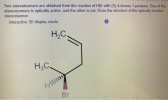 Two stereoisomers are obtained from the reaction of HBr with (S)-4-bromo-1-pentene. One of the stereoisomers is optically active, and the other is not. Draw the structure of the optically inactive stereoisomer. Interactive 3D display mode HC Н.С. Br
2. Predict the product(s) from the acid catalyzed dehydration of the following substrates. If there is...
 2. Predict the product(s) from the acid catalyzed dehydration of the following substrates. If there is more than one possible product indicate which is the major product. a. 1-methyl cyclohexanol b. 3,methyl 2-butanol c. 3-hexanol d. 1-phenyl 1-propano
Acid-catalyzed dehydration of secondary and tertiary alcohols proceeds through an E1 mechanism. The first step is...
 Acid-catalyzed dehydration of secondary and tertiary alcohols proceeds through an E1 mechanism. The first step is the protonation of the alcohol oxygen to form an oxonium ion Dehydration of 3-methyl-2-butanol forms one major and two minor organic products. Draw the structures, including hydrogen atoms, of the three organic products of this reaction. Realize, the major product follows Zaitsev's Rule; minor products may not follow this rule. Do NOT forget to add in all HYDROGENS! Н-б-н Н-о-н) H-O-H :он 3-methyl-2-butanol an...
Draw the major product obtained when the following alkyl halide undergoes an E2 reaction. If you...
 Draw the major product obtained when the following alkyl halide undergoes an E2 reaction. If you expect no reaction to occur, submit the starting material as your answer. Interactive 3D display mode Draw the molecule on the canvas by choosing buttons from the Tools for bonds). Atoms and Advanced Template toolbars. The single bond is active by default
Draw the organic product of the acid-base reaction between the following species: Interactive 3D display mode...
 Draw the organic product of the acid-base reaction between the following species: Interactive 3D display mode Draw the molecule or ion on the canvas by choosing buttons from the Tools (for bonds), Atoms and Advanced Template toolbars, including charges where needed. The single bond is active b default.
Acid-catalyzed dehydration of 3-methyl-2-pentanol gives three alkenes: 3-methyl-1-pentene, 3-methyl-2-pentene, and 3-methyl- 3-pentane. Draw the structures and...
Acid-catalyzed dehydration of 3-methyl-2-pentanol gives three alkenes: 3-methyl-1-pentene, 3-methyl-2-pentene, and 3-methyl- 3-pentane. Draw the structures and mechanisms leading to the formation of 3-methyl-1-pentene & 3-methylenepentane .
Chemistry 2401 Experiment 7 Acid Catalyzed Dehydration of 3.3-Dimethyl-2-Butanol with Rearrangement Experiment 7 Pre-lab Assignment Dehydration...
 Chemistry 2401 Experiment 7 Acid Catalyzed Dehydration of 3.3-Dimethyl-2-Butanol with Rearrangement Experiment 7 Pre-lab Assignment Dehydration of 3,3-Dimethyl-2-Butanol 1. Draw the structures of all the expected products from the following reactions: a) 3-methyl-3-pentanol + H = b)2-methylcyclohexanol + H - c) 2-methyl-2-butanol + H - d) 2,2-dimethylcyclohexanol + H = This reaction will give a complex mixture of products, since rearrangements can occur. Show the full mechanism for this reaction and how the possible products can form from the carbocation...
 how does the mixture of isomeric alkenes produced by an
acid-catalyzed dehydration reaction compare with the alkene mixture
from a base-catalyzed dehydrochlorination reaction? Are either or
both sets or products influenced primarily by product
stability?
E1/E2 Elimination Reactions. Acid-Catalyzed Dehydration of 2-Me Base-Catalyzed Dehydrochlorination of 2-Chloro-2-methylbutane Acid-Catalyzed Dehydration of 2-Methyl-2-butanol and Adapted for an experiment published in More J.R - Hammond, C.N. Schatz, PF: Morrill, T.C.: Modern Projects and P. Hammond CN: Schatz, P.F., Morrill... Experiments in Organic Chemistry, 2nd...
how does the mixture of isomeric alkenes produced by an
acid-catalyzed dehydration reaction compare with the alkene mixture
from a base-catalyzed dehydrochlorination reaction? Are either or
both sets or products influenced primarily by product
stability?
E1/E2 Elimination Reactions. Acid-Catalyzed Dehydration of 2-Me Base-Catalyzed Dehydrochlorination of 2-Chloro-2-methylbutane Acid-Catalyzed Dehydration of 2-Methyl-2-butanol and Adapted for an experiment published in More J.R - Hammond, C.N. Schatz, PF: Morrill, T.C.: Modern Projects and P. Hammond CN: Schatz, P.F., Morrill... Experiments in Organic Chemistry, 2nd...
 Acid-catalyzed dehydration of secondary and tertiary alcohols
proceeds through an E1 mechanism. The first step is the protonation
of alcohol and oxygen to form an oxonium ion.
Dehydration of 3-methyl-2-butanol forms one major and two minor
organic products. Draw the structures, including hydrogen atoms, of
the three organic products of this reaction.
The 3.) is correct that is the minor product I came up with but
I cant get the answer correct for 1.) major product? and 2.) minor
product
Acid-catalyzed dehydration of secondary and tertiary alcohols
proceeds through an E1 mechanism. The first step is the protonation
of alcohol and oxygen to form an oxonium ion.
Dehydration of 3-methyl-2-butanol forms one major and two minor
organic products. Draw the structures, including hydrogen atoms, of
the three organic products of this reaction.
The 3.) is correct that is the minor product I came up with but
I cant get the answer correct for 1.) major product? and 2.) minor
product
 Two stereoisomers are obtained from the reaction of HBr with (S)-4-bromo-1-pentene. One of the stereoisomers is optically active, and the other is not. Draw the structure of the optically inactive stereoisomer. Interactive 3D display mode HC Н.С. Br
 2. Predict the product(s) from the acid catalyzed dehydration of the following substrates. If there is more than one possible product indicate which is the major product. a. 1-methyl cyclohexanol b. 3,methyl 2-butanol c. 3-hexanol d. 1-phenyl 1-propano
 Acid-catalyzed dehydration of secondary and tertiary alcohols proceeds through an E1 mechanism. The first step is the protonation of the alcohol oxygen to form an oxonium ion Dehydration of 3-methyl-2-butanol forms one major and two minor organic products. Draw the structures, including hydrogen atoms, of the three organic products of this reaction. Realize, the major product follows Zaitsev's Rule; minor products may not follow this rule. Do NOT forget to add in all HYDROGENS! Н-б-н Н-о-н) H-O-H :он 3-methyl-2-butanol an...
 Draw the major product obtained when the following alkyl halide undergoes an E2 reaction. If you expect no reaction to occur, submit the starting material as your answer. Interactive 3D display mode Draw the molecule on the canvas by choosing buttons from the Tools for bonds). Atoms and Advanced Template toolbars. The single bond is active by default
 Draw the organic product of the acid-base reaction between the following species: Interactive 3D display mode Draw the molecule or ion on the canvas by choosing buttons from the Tools (for bonds), Atoms and Advanced Template toolbars, including charges where needed. The single bond is active b default.
 Chemistry 2401 Experiment 7 Acid Catalyzed Dehydration of 3.3-Dimethyl-2-Butanol with Rearrangement Experiment 7 Pre-lab Assignment Dehydration of 3,3-Dimethyl-2-Butanol 1. Draw the structures of all the expected products from the following reactions: a) 3-methyl-3-pentanol + H = b)2-methylcyclohexanol + H - c) 2-methyl-2-butanol + H - d) 2,2-dimethylcyclohexanol + H = This reaction will give a complex mixture of products, since rearrangements can occur. Show the full mechanism for this reaction and how the possible products can form from the carbocation...
Most questions answered within 3 hours.
-
Where is the error in this code sequence?
String s1 = "Hello";
String s2 = "ello";...
asked 10 months ago -
Financial data for Joel de Paris, Inc., for last year
follow:
Joel de Paris, Inc.
Balance...
asked 10 months ago -
Consider this reaction:
Al2(SO4)3 (aq)+ BaCl3
(aq) Al2Cl6 (aq)- +
3BaSO4(s) . What is the...
asked 10 months ago -
Suppose that Savneet is considering increasing her
recent random sample from 20 car rentals to 40...
asked 10 months ago -
Trucks arrive at an unloading terminal at an average rate of 120
per hour.
Trucks arrive...
asked 10 months ago -
Why are methanol and ethanol completely soluble in water while
octanol is not very little soluble....
asked 10 months ago -
A facilities manager at a university reads in a research report
that the mean amount of...
asked 10 months ago -
When the CuSO4 is rehydrated by adding water to the anhydrous
compound, is this an endothermic...
asked 10 months ago -
A ray of sunlight is passing from diamond into crown glass; the
angle of incidence is...
asked 10 months ago -
A block of mass 0.249 kg is placed on top of a light, vertical
spring of...
asked 10 months ago -
how do the kidneys compensate in the presences of acidosis
a) trigger hyperventilate
b) reserve acid...
asked 10 months ago -
Question 501 pts
The rental rate of capital to the firm increases. Which of the
following...
asked 10 months ago