
Homework Answers
In general, atomic radii, ionic radii and atomic volume increase on moving down the group from top to bottom and decrease across a period from left to right side.
Electron affinity, ionization energy decrease on moving
down the group from top to bottom and increase across a period from
left to right side.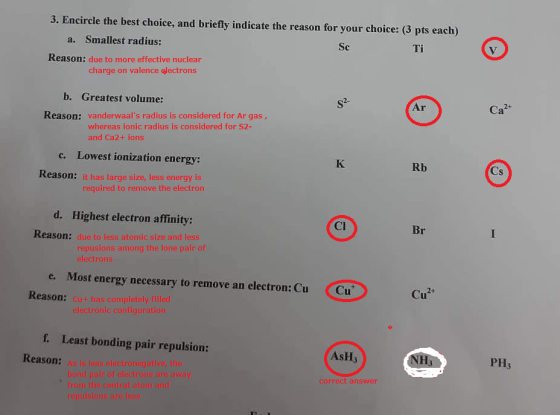
Add Answer to:
3. Encircle the best choice, and briefly indicate the reason for your choice: (3 pts each)...
Draw Lewis dot structures of the following molecules, identify the steric number, and indicate if there...
 Draw Lewis dot structures of the following molecules, identify the steric number, and indicate if there is a net dipole moment using an arrow and δ- 8- as we did in class (and in your book). Use VSEPR theory to predict the geometry around the central atom of the molecule 1. (e) [Hs0] (f) HCO2 (a) CCl4 (b) COCl2 (c) NFs (d) BrO (g) [I3] (h) OC(NH2)2 2. Select the best choice, and BRIEFLY indicate the reason for your choice...
(a) Based on your knowledge of the periodic trend in first electron affinity, place the following...
(a) Based on your knowledge of the periodic trend in first electron affinity, place the following in order of DECREASING electron affinity such that 1 is the element with the highest predicted first electron affinity and 5 is the element with the lowest predicted first electron affinity. 1 2 3 4 5 Si 1 2 3 4 5 C 1 2 3 4 5 Sn 1 2 3 4 5 W 1 2 3 4 5 F (b) Based on your knowledge of the periodic...
A) As B) Sb C) P D)Bi E)N 10. In which of the series of elements...
 A) As B) Sb C) P D)Bi E)N 10. In which of the series of elements listed below would the elements have most nearly the same atomic radius? A) Na, K. Rb, Cs B)F, CI, Br.I C) Na, Mg. Al, Si D) Sc, Ti, V, Cr E)B, Si, As, Te Which of the following properties, in general, increases from left to right across a period in the periodic table? A) ionic charge 11、 B) atomic radius C) density D) ionization...
Question 4 3. (20 marks) Arrange the following elements in the order of: a) Increasing radius:...
 Question 4
3. (20 marks) Arrange the following elements in the order of: a) Increasing radius: Cl', K*, Ar, Ca2*; b) Increasing radius: As, Br, P, Al; c) Increasing radius: N, S, F, Br; d) Increasing electron affinity: Si, P, Cl, C; e) Increasing ionization energy: Al, Rb, Mg, Ca, Mg 4. (20 marks) The following three Lewis structures can be drawn for N2O: N N-O :N-N=O:-:N=N=ö: a) Show the correct formal charges on each atom. Considering these values, which...
Question 4
3. (20 marks) Arrange the following elements in the order of: a) Increasing radius: Cl', K*, Ar, Ca2*; b) Increasing radius: As, Br, P, Al; c) Increasing radius: N, S, F, Br; d) Increasing electron affinity: Si, P, Cl, C; e) Increasing ionization energy: Al, Rb, Mg, Ca, Mg 4. (20 marks) The following three Lewis structures can be drawn for N2O: N N-O :N-N=O:-:N=N=ö: a) Show the correct formal charges on each atom. Considering these values, which...
Questions 3 and 4 3. (20 marks) Arrange the following elements in the order of: a) Increasing radius: Cl', K*, Ar, Ca2*...
 Questions 3 and 4
3. (20 marks) Arrange the following elements in the order of: a) Increasing radius: Cl', K*, Ar, Ca2*; b) Increasing radius: As, Br, P, Al; c) Increasing radius: N, S, F, Br; d) Increasing electron affinity: Si, P, Cl, C; e) Increasing ionization energy: Al, Rb, Mg, Ca, Mg 4. (20 marks) The following three Lewis structures can be drawn for N2O: N N-O :N-N=O:-:N=N=ö: a) Show the correct formal charges on each atom. Considering these...
Questions 3 and 4
3. (20 marks) Arrange the following elements in the order of: a) Increasing radius: Cl', K*, Ar, Ca2*; b) Increasing radius: As, Br, P, Al; c) Increasing radius: N, S, F, Br; d) Increasing electron affinity: Si, P, Cl, C; e) Increasing ionization energy: Al, Rb, Mg, Ca, Mg 4. (20 marks) The following three Lewis structures can be drawn for N2O: N N-O :N-N=O:-:N=N=ö: a) Show the correct formal charges on each atom. Considering these...
All questions showing all work and units please Chemistry 101/103 Due date: Friday, November 14.2019 Problem...
 All questions showing all work and units please
Chemistry 101/103 Due date: Friday, November 14.2019 Problem Set 2: Atomic Structure and Chemical Bonding 1. (15 marks) When the excited electron in a hydrogen atom falls from an unknown level to n-5, a photon of 3740 nm wavelength is emitted. What is the initial position for this electron? 2. (15 marks) Answer and explain: a) How many electrons can have: i.n=3,1 = 2? ii.n=3,1-2, m/=0? iii. n=3,1=2, ms - +1/2? iv....
All questions showing all work and units please
Chemistry 101/103 Due date: Friday, November 14.2019 Problem Set 2: Atomic Structure and Chemical Bonding 1. (15 marks) When the excited electron in a hydrogen atom falls from an unknown level to n-5, a photon of 3740 nm wavelength is emitted. What is the initial position for this electron? 2. (15 marks) Answer and explain: a) How many electrons can have: i.n=3,1 = 2? ii.n=3,1-2, m/=0? iii. n=3,1=2, ms - +1/2? iv....
e. 18 Test Your Knowledge MULTIPLE CHOICE: Choose the one best answer. 1. Each element has...
 e. 18 Test Your Knowledge MULTIPLE CHOICE: Choose the one best answer. 1. Each element has its own characteristic atom in which a. the atomic mass is constant. b. the atomic number is constant. c. the mass number is constant. d. Two of the above are correct. e. All of the above are correct. 2. Which of the following is not a trace element in the human body? a. iodine b. zinc c. iron d. calcium e. fluorine 3. A...
please number and write the correct answer Ar have a total pressure of 1.6 bar. What...
 please number and write the correct answer
Ar have a total pressure of 1.6 bar. What is the partial 17. A mixture of 100 g of Ne and 10.0 Ne? a) 0.40 bar b) 1.1 bar c) 0.54 bar GP 0.80 bar e) 1.3 bar 18. A sample of N, effuses in 255 s. How long will the same size sample of Cl2 take to effuser c12 a) 388 5 b) 1555 c) 247 s d) 406 5 e) 6455...
please number and write the correct answer
Ar have a total pressure of 1.6 bar. What is the partial 17. A mixture of 100 g of Ne and 10.0 Ne? a) 0.40 bar b) 1.1 bar c) 0.54 bar GP 0.80 bar e) 1.3 bar 18. A sample of N, effuses in 255 s. How long will the same size sample of Cl2 take to effuser c12 a) 388 5 b) 1555 c) 247 s d) 406 5 e) 6455...
 Draw Lewis dot structures of the following molecules, identify the steric number, and indicate if there is a net dipole moment using an arrow and δ- 8- as we did in class (and in your book). Use VSEPR theory to predict the geometry around the central atom of the molecule 1. (e) [Hs0] (f) HCO2 (a) CCl4 (b) COCl2 (c) NFs (d) BrO (g) [I3] (h) OC(NH2)2 2. Select the best choice, and BRIEFLY indicate the reason for your choice...
 A) As B) Sb C) P D)Bi E)N 10. In which of the series of elements listed below would the elements have most nearly the same atomic radius? A) Na, K. Rb, Cs B)F, CI, Br.I C) Na, Mg. Al, Si D) Sc, Ti, V, Cr E)B, Si, As, Te Which of the following properties, in general, increases from left to right across a period in the periodic table? A) ionic charge 11、 B) atomic radius C) density D) ionization...
 Question 4
3. (20 marks) Arrange the following elements in the order of: a) Increasing radius: Cl', K*, Ar, Ca2*; b) Increasing radius: As, Br, P, Al; c) Increasing radius: N, S, F, Br; d) Increasing electron affinity: Si, P, Cl, C; e) Increasing ionization energy: Al, Rb, Mg, Ca, Mg 4. (20 marks) The following three Lewis structures can be drawn for N2O: N N-O :N-N=O:-:N=N=ö: a) Show the correct formal charges on each atom. Considering these values, which...
Question 4
3. (20 marks) Arrange the following elements in the order of: a) Increasing radius: Cl', K*, Ar, Ca2*; b) Increasing radius: As, Br, P, Al; c) Increasing radius: N, S, F, Br; d) Increasing electron affinity: Si, P, Cl, C; e) Increasing ionization energy: Al, Rb, Mg, Ca, Mg 4. (20 marks) The following three Lewis structures can be drawn for N2O: N N-O :N-N=O:-:N=N=ö: a) Show the correct formal charges on each atom. Considering these values, which...
 Questions 3 and 4
3. (20 marks) Arrange the following elements in the order of: a) Increasing radius: Cl', K*, Ar, Ca2*; b) Increasing radius: As, Br, P, Al; c) Increasing radius: N, S, F, Br; d) Increasing electron affinity: Si, P, Cl, C; e) Increasing ionization energy: Al, Rb, Mg, Ca, Mg 4. (20 marks) The following three Lewis structures can be drawn for N2O: N N-O :N-N=O:-:N=N=ö: a) Show the correct formal charges on each atom. Considering these...
Questions 3 and 4
3. (20 marks) Arrange the following elements in the order of: a) Increasing radius: Cl', K*, Ar, Ca2*; b) Increasing radius: As, Br, P, Al; c) Increasing radius: N, S, F, Br; d) Increasing electron affinity: Si, P, Cl, C; e) Increasing ionization energy: Al, Rb, Mg, Ca, Mg 4. (20 marks) The following three Lewis structures can be drawn for N2O: N N-O :N-N=O:-:N=N=ö: a) Show the correct formal charges on each atom. Considering these...
 All questions showing all work and units please
Chemistry 101/103 Due date: Friday, November 14.2019 Problem Set 2: Atomic Structure and Chemical Bonding 1. (15 marks) When the excited electron in a hydrogen atom falls from an unknown level to n-5, a photon of 3740 nm wavelength is emitted. What is the initial position for this electron? 2. (15 marks) Answer and explain: a) How many electrons can have: i.n=3,1 = 2? ii.n=3,1-2, m/=0? iii. n=3,1=2, ms - +1/2? iv....
All questions showing all work and units please
Chemistry 101/103 Due date: Friday, November 14.2019 Problem Set 2: Atomic Structure and Chemical Bonding 1. (15 marks) When the excited electron in a hydrogen atom falls from an unknown level to n-5, a photon of 3740 nm wavelength is emitted. What is the initial position for this electron? 2. (15 marks) Answer and explain: a) How many electrons can have: i.n=3,1 = 2? ii.n=3,1-2, m/=0? iii. n=3,1=2, ms - +1/2? iv....
 e. 18 Test Your Knowledge MULTIPLE CHOICE: Choose the one best answer. 1. Each element has its own characteristic atom in which a. the atomic mass is constant. b. the atomic number is constant. c. the mass number is constant. d. Two of the above are correct. e. All of the above are correct. 2. Which of the following is not a trace element in the human body? a. iodine b. zinc c. iron d. calcium e. fluorine 3. A...
 please number and write the correct answer
Ar have a total pressure of 1.6 bar. What is the partial 17. A mixture of 100 g of Ne and 10.0 Ne? a) 0.40 bar b) 1.1 bar c) 0.54 bar GP 0.80 bar e) 1.3 bar 18. A sample of N, effuses in 255 s. How long will the same size sample of Cl2 take to effuser c12 a) 388 5 b) 1555 c) 247 s d) 406 5 e) 6455...
please number and write the correct answer
Ar have a total pressure of 1.6 bar. What is the partial 17. A mixture of 100 g of Ne and 10.0 Ne? a) 0.40 bar b) 1.1 bar c) 0.54 bar GP 0.80 bar e) 1.3 bar 18. A sample of N, effuses in 255 s. How long will the same size sample of Cl2 take to effuser c12 a) 388 5 b) 1555 c) 247 s d) 406 5 e) 6455...
Most questions answered within 3 hours.
-
Where is the error in this code sequence?
String s1 = "Hello";
String s2 = "ello";...
asked 10 months ago -
Financial data for Joel de Paris, Inc., for last year
follow:
Joel de Paris, Inc.
Balance...
asked 10 months ago -
Consider this reaction:
Al2(SO4)3 (aq)+ BaCl3
(aq) Al2Cl6 (aq)- +
3BaSO4(s) . What is the...
asked 10 months ago -
Suppose that Savneet is considering increasing her
recent random sample from 20 car rentals to 40...
asked 10 months ago -
Trucks arrive at an unloading terminal at an average rate of 120
per hour.
Trucks arrive...
asked 10 months ago -
Why are methanol and ethanol completely soluble in water while
octanol is not very little soluble....
asked 10 months ago -
A facilities manager at a university reads in a research report
that the mean amount of...
asked 10 months ago -
When the CuSO4 is rehydrated by adding water to the anhydrous
compound, is this an endothermic...
asked 10 months ago -
A ray of sunlight is passing from diamond into crown glass; the
angle of incidence is...
asked 10 months ago -
A block of mass 0.249 kg is placed on top of a light, vertical
spring of...
asked 10 months ago -
how do the kidneys compensate in the presences of acidosis
a) trigger hyperventilate
b) reserve acid...
asked 10 months ago -
Question 501 pts
The rental rate of capital to the firm increases. Which of the
following...
asked 10 months ago