
Homework Answers
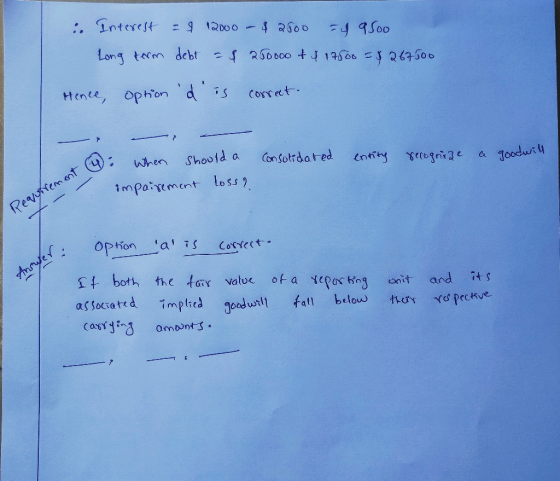
Refer to the below images for more detailed solution, for the above asked multiple choice questions.

Add Answer to:
1. A company acquires a subsidiary and will prepare consolidated financial statements for extemal reporting purposes....
explanation and details Check On January 1, 2018, Jay Company acquired all the outstanding ownership shares of Z...
 explanation and details
Check On January 1, 2018, Jay Company acquired all the outstanding ownership shares of Zee Company. In assessing Zee's acquisition-date fair values, Jay concluded that the carrying value of Zee's long-term debt (8-year remaining life) was less than its fair value by $20,000. At December 31, 2018, Zee Company's accounts show interest expense of $12,000 and long-term debt of $250,000. What amounts of interest expense and long-term debt should appear on the December 31, 2018, consolidated financial...
explanation and details
Check On January 1, 2018, Jay Company acquired all the outstanding ownership shares of Zee Company. In assessing Zee's acquisition-date fair values, Jay concluded that the carrying value of Zee's long-term debt (8-year remaining life) was less than its fair value by $20,000. At December 31, 2018, Zee Company's accounts show interest expense of $12,000 and long-term debt of $250,000. What amounts of interest expense and long-term debt should appear on the December 31, 2018, consolidated financial...
On January 1, 2021, Jay Company acquired all the outstanding ownership shares of Zee Company. In...
On January 1, 2021, Jay Company acquired all the outstanding ownership shares of Zee Company. In assessing Zee’s acquisition-date fair values, Jay concluded that the carrying value of Zee’s long-term debt (8-year remaining life) was less than its fair value by $16,600. At December 31, 2021, Zee Company’s accounts show interest expense of $13,950 and long-term debt of $310,000. What amounts of interest expense and long-term debt should appear on the December 31, 2021, consolidated financial statements of Jay and...
1. In the preparation of consolidated financial statements, the measurement of a non-controlling interest in the shareholders’ equity of a subsidiary at the reporting date may be affected by: a manage...
1. In the preparation of consolidated financial statements, the measurement of a non-controlling interest in the shareholders’ equity of a subsidiary at the reporting date may be affected by: a management fees charged to the subsidiary by the parent entity. b unrealised profits arising from sales of inventories in the previous period by the subsidiary to another subsidiary in the same group. c.consolidation adjustments made against the retained earnings of the subsidiary at the end of the previous period d.none...
Inferring consolidation entries from consolidated financial statements-Cost method Assume a paren...
 Inferring consolidation entries from consolidated financial statements-Cost method Assume a parent company acquired a subsidiary on January 1, 2012. The purchase price was $1,362,000 in excess of the subsidiary's book value of Stockholders' Equity on the acquisition date, and that excess was assigned to the following [A] assets [A] Asset Property, plant and equipment (PPE), net Patent Goodwill Original Amount Original Useful Life 20 years 12 years Indefinite $300,000 432,000 630,000 $1,362,000 The parent company uses the cost method of...
Assume that on 1/1/X0, a parent company acquires a 70% interest in its subsidiary for a price at ...
 Assume that on 1/1/X0, a parent company acquires a 70% interest
in its subsidiary for a price at $480,000 over book value. The
excess is assigned as follows:
Asset
Fair Value
Useful Life
Patent
$320,000
8 years
Goodwill
160,000
Indefinite
70% of the goodwill is allocated to the parent.
Included in the attached Excel spreadsheet are the
pre-consolidation financial statements for both the parent and the
subsidiary.
Submission Requirements:
Prepare the consolidated financial statements at 12/31/X6 by
placing the appropriate...
Assume that on 1/1/X0, a parent company acquires a 70% interest
in its subsidiary for a price at $480,000 over book value. The
excess is assigned as follows:
Asset
Fair Value
Useful Life
Patent
$320,000
8 years
Goodwill
160,000
Indefinite
70% of the goodwill is allocated to the parent.
Included in the attached Excel spreadsheet are the
pre-consolidation financial statements for both the parent and the
subsidiary.
Submission Requirements:
Prepare the consolidated financial statements at 12/31/X6 by
placing the appropriate...
Question 2 (10 marks) The Parent company acquires all issued capital of the subsidiary company for...
Question 2 (10 marks) The Parent company acquires all issued capital of the subsidiary company for a consideration of $1000000 cash and 800000 shares each valued at $1.25. The summary statement of financial position of the subsidiary company immediately following the acquisition is: Fair value of assets acquired Fair value of liabilities acquired Total shareholders’ equity of the subsidiary company Retained earnings of the subsidiary company Required: $2640000 $720000 $800000 $1120000 (i) Pass the necessary journal entry to record the...
Assume the Parent company acquires its subsidiary by exchanging 35,000 shares of its Common Stock, with...
Assume the Parent company acquires its subsidiary by exchanging 35,000 shares of its Common Stock, with a fair value on the acquisition date of $60 per share, for all of the outstanding voting shares of the investee. In its analysis of the investee company, the parent values all of the subsidiary’s assets and liabilities at an amount equaling their book values except for an unrecorded Patent owned by the subsidiary with a fair value of $200,000. Any further discrepancy between...
Inferring consolidation entries from consolidated financial statements—Cost method Assume a parent company acquired a subsidiary on...
Inferring consolidation entries from consolidated financial statements—Cost method Assume a parent company acquired a subsidiary on January 1, 2012. The purchase price was $1,312,000 in excess of the subsidiary’s book value of Stockholders’ Equity on the acquisition date, and that excess was assigned to the following [A] assets: [A] Asset Original Amount Original Useful Life Property, plant and equipment (PPE), net $300,000 20 years Patent 432,000 12 years Goodwill 580,000 Indefinite $1,312,000 The parent company uses the cost method of...
3. Consolidated Balances (35 points) Parent Company acquires a subsidiary by issuing 100,000 common shares with...
 3. Consolidated Balances (35 points) Parent Company acquires a subsidiary by issuing 100,000 common shares with a market value of $25 per share for all of the subsidiary's common stock. The subsidiary's assets and liabilities were recorded at fair values with the exception of equipment undervalued by $225,000. In addition, there were two unrecorded assets: a trademark valued at $175,000 and a customer list valued by the subsidiary at $60,000. The balance sheets of the parent and subsidiary immediately after...
Which of the following is true? A) For internal reporting purposes, the parent company does not...
Which of the following is true? A) For internal reporting purposes, the parent company does not have an option other than the complete equity method. B) For internal reporting purposes, the parent uses the same equity method that is used for external reporting purposes. C) For internal reporting purposes, when the parent uses the cost method or the complete equity method, the resulting consolidated financial statements are identical. D) For internal reporting purposes, the parent must use the complete equity...
 explanation and details
Check On January 1, 2018, Jay Company acquired all the outstanding ownership shares of Zee Company. In assessing Zee's acquisition-date fair values, Jay concluded that the carrying value of Zee's long-term debt (8-year remaining life) was less than its fair value by $20,000. At December 31, 2018, Zee Company's accounts show interest expense of $12,000 and long-term debt of $250,000. What amounts of interest expense and long-term debt should appear on the December 31, 2018, consolidated financial...
explanation and details
Check On January 1, 2018, Jay Company acquired all the outstanding ownership shares of Zee Company. In assessing Zee's acquisition-date fair values, Jay concluded that the carrying value of Zee's long-term debt (8-year remaining life) was less than its fair value by $20,000. At December 31, 2018, Zee Company's accounts show interest expense of $12,000 and long-term debt of $250,000. What amounts of interest expense and long-term debt should appear on the December 31, 2018, consolidated financial...
 Inferring consolidation entries from consolidated financial statements-Cost method Assume a parent company acquired a subsidiary on January 1, 2012. The purchase price was $1,362,000 in excess of the subsidiary's book value of Stockholders' Equity on the acquisition date, and that excess was assigned to the following [A] assets [A] Asset Property, plant and equipment (PPE), net Patent Goodwill Original Amount Original Useful Life 20 years 12 years Indefinite $300,000 432,000 630,000 $1,362,000 The parent company uses the cost method of...
 Assume that on 1/1/X0, a parent company acquires a 70% interest
in its subsidiary for a price at $480,000 over book value. The
excess is assigned as follows:
Asset
Fair Value
Useful Life
Patent
$320,000
8 years
Goodwill
160,000
Indefinite
70% of the goodwill is allocated to the parent.
Included in the attached Excel spreadsheet are the
pre-consolidation financial statements for both the parent and the
subsidiary.
Submission Requirements:
Prepare the consolidated financial statements at 12/31/X6 by
placing the appropriate...
Assume that on 1/1/X0, a parent company acquires a 70% interest
in its subsidiary for a price at $480,000 over book value. The
excess is assigned as follows:
Asset
Fair Value
Useful Life
Patent
$320,000
8 years
Goodwill
160,000
Indefinite
70% of the goodwill is allocated to the parent.
Included in the attached Excel spreadsheet are the
pre-consolidation financial statements for both the parent and the
subsidiary.
Submission Requirements:
Prepare the consolidated financial statements at 12/31/X6 by
placing the appropriate...
 3. Consolidated Balances (35 points) Parent Company acquires a subsidiary by issuing 100,000 common shares with a market value of $25 per share for all of the subsidiary's common stock. The subsidiary's assets and liabilities were recorded at fair values with the exception of equipment undervalued by $225,000. In addition, there were two unrecorded assets: a trademark valued at $175,000 and a customer list valued by the subsidiary at $60,000. The balance sheets of the parent and subsidiary immediately after...
Most questions answered within 3 hours.
-
Where is the error in this code sequence?
String s1 = "Hello";
String s2 = "ello";...
asked 10 months ago -
Financial data for Joel de Paris, Inc., for last year
follow:
Joel de Paris, Inc.
Balance...
asked 10 months ago -
Consider this reaction:
Al2(SO4)3 (aq)+ BaCl3
(aq) Al2Cl6 (aq)- +
3BaSO4(s) . What is the...
asked 10 months ago -
Suppose that Savneet is considering increasing her
recent random sample from 20 car rentals to 40...
asked 10 months ago -
Trucks arrive at an unloading terminal at an average rate of 120
per hour.
Trucks arrive...
asked 10 months ago -
Why are methanol and ethanol completely soluble in water while
octanol is not very little soluble....
asked 10 months ago -
A facilities manager at a university reads in a research report
that the mean amount of...
asked 10 months ago -
When the CuSO4 is rehydrated by adding water to the anhydrous
compound, is this an endothermic...
asked 10 months ago -
A ray of sunlight is passing from diamond into crown glass; the
angle of incidence is...
asked 10 months ago -
A block of mass 0.249 kg is placed on top of a light, vertical
spring of...
asked 10 months ago -
how do the kidneys compensate in the presences of acidosis
a) trigger hyperventilate
b) reserve acid...
asked 10 months ago -
Question 501 pts
The rental rate of capital to the firm increases. Which of the
following...
asked 10 months ago