
Homework Answers
0.729 kg of fuel = 1 liter
1 kg of fuel = 1/0.729 liter = 1.372 liter
3.785 liter = 1 gallon
1.372 liter = 1.372/3.785 gallon = 0.362 gallon
Therefore, 1 kg of fuel = 0.362 gallon
1.609 km = 1 mile
7.9 km = 7.9/1.609 miles = 4.91 miles
Therefore, Fuel Efficiency = 4.91 miles/0.362 gallon
Fuel Efficiency = 13.56 miles/gallon
I hope i was able to answer your question. If you need anymore explanation, please ask in comments. I would be happy to help.
Please rate the solution if you are satisfied with the solution.
Add Answer to:
Problem 13 The United States is about the only country in the world that still uses...
Question 15 A tourist purchases a car in England and ships it home to the United...
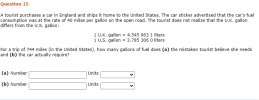 Question 15 A tourist purchases a car in England and ships it home to the United States. The car sticker advertised that the car's fuel consumption was at the rate of 40 miles per gallon on the open road. The tourist does not realize that the U.K. gallon differs from the U.S. gallon: 1 U.K. gallon = 4.545 963 1 liters 1 U.S. gallon = 3.785 306 0 liters For a trip of 744 miles (in the United States), how...
As a result of government and consumer pressure, automobile manufacturers in the United States are deeply...
As a result of government and consumer pressure, automobile manufacturers in the United States are deeply involved in research to improve their products' gasoline mileage. The table below shows the data on the mileage (rounded to the nearest mile for convenience) obtained by test versions of a compact model designed to achieve 40 mpg: 35, 36, 37, 38, 39. 40, 41, 42, 43, 44, 45 freq: 30, 41, 29, 32, 43, 50, 42, 36, 29, 19, 18 What is the...
A liter is 0.264179 gallons. Write a program that will read in the number of liters...
A liter is 0.264179 gallons. Write a program that will read in the number of liters of gasoline consumed by the user's car and the number of miles per gallon the car delivered. Your program should allow the user to repeat this calculation as often as the user wishes. Define a function to compute the number of miles per gallon. Your program should use a globally defined constant for the number of liters per gallon. After doing this... Modify your...
Problem 1 Time standards are now based on atomic clocks. A promising second standard is based...
 Problem 1 Time standards are now based on atomic clocks. A promising second standard is based on pulsars, which are rotating neutron stars (highly compact stars consisting only of neutrons). Some rotate at a rate that is highly stable, sending out a radio beacon that sweeps briefly across Earth once with each rotation, like a lighthouse beacon. Pulsar PSR 1937+21 is an example; it rotates once every 1.55780644887275 +3ms, where the trailing +3ms indicates the uncertainty in the last decimal...
Consider a cloudless day on which the sun shines down across the United States. If 2333...
 Consider a cloudless day on which the sun shines down across the United States. If 2333 kJ of energy reaches a square meter (mº) of the United States in one hour, how much total solar energy reaches the entire United States per hour? The entire area of the United States is 9,158,960 km. kJ/h Attempt 2 Suppose you have 50.0 cm of a substance with a density of 30.0 g/L and you want to determine the mass of the substance....
2. Suppose a car travels 108 km at a speed of 20.0 m/s, and uses 2.20...
 2. Suppose a car travels 108 km at a speed of 20.0 m/s, and uses
2.20 gallons of gasoline. Only 30% of the gasoline goes into useful
work by the force that keeps the car moving at constant speed
despite friction. (The energy content of gasoline is 1.3 ✕
108 J per gallon.)
(a) What is the force exerted to keep the car moving at constant
speed?
N
(b) If the required force is directly proportional to speed, how
many...
2. Suppose a car travels 108 km at a speed of 20.0 m/s, and uses
2.20 gallons of gasoline. Only 30% of the gasoline goes into useful
work by the force that keeps the car moving at constant speed
despite friction. (The energy content of gasoline is 1.3 ✕
108 J per gallon.)
(a) What is the force exerted to keep the car moving at constant
speed?
N
(b) If the required force is directly proportional to speed, how
many...
 Question 15 A tourist purchases a car in England and ships it home to the United States. The car sticker advertised that the car's fuel consumption was at the rate of 40 miles per gallon on the open road. The tourist does not realize that the U.K. gallon differs from the U.S. gallon: 1 U.K. gallon = 4.545 963 1 liters 1 U.S. gallon = 3.785 306 0 liters For a trip of 744 miles (in the United States), how...
 Problem 1 Time standards are now based on atomic clocks. A promising second standard is based on pulsars, which are rotating neutron stars (highly compact stars consisting only of neutrons). Some rotate at a rate that is highly stable, sending out a radio beacon that sweeps briefly across Earth once with each rotation, like a lighthouse beacon. Pulsar PSR 1937+21 is an example; it rotates once every 1.55780644887275 +3ms, where the trailing +3ms indicates the uncertainty in the last decimal...
 Consider a cloudless day on which the sun shines down across the United States. If 2333 kJ of energy reaches a square meter (mº) of the United States in one hour, how much total solar energy reaches the entire United States per hour? The entire area of the United States is 9,158,960 km. kJ/h Attempt 2 Suppose you have 50.0 cm of a substance with a density of 30.0 g/L and you want to determine the mass of the substance....
 2. Suppose a car travels 108 km at a speed of 20.0 m/s, and uses
2.20 gallons of gasoline. Only 30% of the gasoline goes into useful
work by the force that keeps the car moving at constant speed
despite friction. (The energy content of gasoline is 1.3 ✕
108 J per gallon.)
(a) What is the force exerted to keep the car moving at constant
speed?
N
(b) If the required force is directly proportional to speed, how
many...
2. Suppose a car travels 108 km at a speed of 20.0 m/s, and uses
2.20 gallons of gasoline. Only 30% of the gasoline goes into useful
work by the force that keeps the car moving at constant speed
despite friction. (The energy content of gasoline is 1.3 ✕
108 J per gallon.)
(a) What is the force exerted to keep the car moving at constant
speed?
N
(b) If the required force is directly proportional to speed, how
many...
Most questions answered within 3 hours.
-
Where is the error in this code sequence?
String s1 = "Hello";
String s2 = "ello";...
asked 10 months ago -
Financial data for Joel de Paris, Inc., for last year
follow:
Joel de Paris, Inc.
Balance...
asked 10 months ago -
Consider this reaction:
Al2(SO4)3 (aq)+ BaCl3
(aq) Al2Cl6 (aq)- +
3BaSO4(s) . What is the...
asked 10 months ago -
Suppose that Savneet is considering increasing her
recent random sample from 20 car rentals to 40...
asked 10 months ago -
Trucks arrive at an unloading terminal at an average rate of 120
per hour.
Trucks arrive...
asked 10 months ago -
Why are methanol and ethanol completely soluble in water while
octanol is not very little soluble....
asked 10 months ago -
A facilities manager at a university reads in a research report
that the mean amount of...
asked 10 months ago -
When the CuSO4 is rehydrated by adding water to the anhydrous
compound, is this an endothermic...
asked 10 months ago -
A ray of sunlight is passing from diamond into crown glass; the
angle of incidence is...
asked 10 months ago -
A block of mass 0.249 kg is placed on top of a light, vertical
spring of...
asked 10 months ago -
how do the kidneys compensate in the presences of acidosis
a) trigger hyperventilate
b) reserve acid...
asked 10 months ago -
Question 501 pts
The rental rate of capital to the firm increases. Which of the
following...
asked 10 months ago