

Homework Answers
7. a) Butyraldehyde or butanol can be produced by hydroformylation of 1-propene.
CH3CH2CH=CH2 + CO + H2 = CH3CH2CH2CHO
b) n-hexane can be prepared by wurtz reaction from propyl bromide.
2 CH3CH2CH2-Br + Na metal + Dry ether (solvent) = CH3CH2CH2-CH2CH2CH3
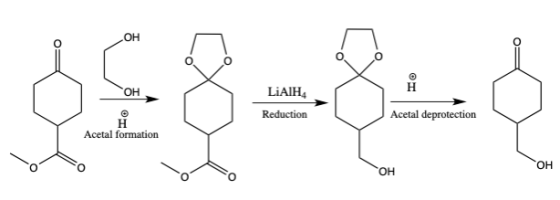
8. When we need to perform a reaction preferentially on a functional group, in presence of ketone group, we need to protect the carbonyl group before we proceed. Acetal protection of ketone is one of such methodologies.
Following is an example, where a preferential reduction of ester is performed in presence of ketone moiety.
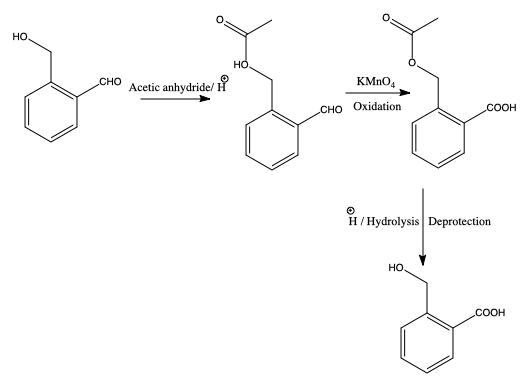
9. Alcohols can be protected by acetate formation and can be deprotected by acid or base hydrolysis.
10.
Add Answer to:
can you solve everything please
Short Answer 7. Show how you could synthesize these compounds from...
can you please solve everything 9 Give an example of a synthesis that requires the protection...
 can you please solve everything
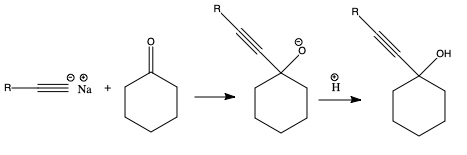
9 Give an example of a synthesis that requires the protection of an alcohol. You may use any reaction, any organic compounds. You must show the reaction that does the protecting. Acetylide ion reacts with cyclohexanone, followed by acid workup. Write a complete mechanism. 10. Identify the compound that gives this NMR spectrum. The compound has carbons. 11. 4
can you please solve everything
9 Give an example of a synthesis that requires the protection of an alcohol. You may use any reaction, any organic compounds. You must show the reaction that does the protecting. Acetylide ion reacts with cyclohexanone, followed by acid workup. Write a complete mechanism. 10. Identify the compound that gives this NMR spectrum. The compound has carbons. 11. 4
can many re c essary, but keep to the three care Сн, снен, с-н сненсн, снен,...
 can many re c essary, but keep to the three care Сн, снен, с-н сненсн, снен, сн. 8. Give an example of a synthesis that requires the protection of an ketone. You may use any reaction, any organic compounds. You must show the reaction that does the protecting.
7. Synthesis Problem (15 points) Show how you would synthesize 3 of the 4 following compounds...
 7. Synthesis Problem (15 points) Show how you would synthesize 3 of the 4 following compounds in one chemical reaction. You may use any starting material you wish and any organic and inorganic reagents. Clearly indicate which ones you want graded by circling the molecules н, осн, Br ОН
3) Devise a synthesis of the following compound using the given compounds (you may use each...
 3) Devise a synthesis of the following compound using the given compounds (you may use each one more than once if needed). You may also use any needed inorganic or organic reagents but all of the carbons in the target molecule must come from the given starting materials. Hint: this synthesis will require you to use ozonolysis and a reaction that starts with the letter DI
Draw the complete synthesis of the compounds Question 44 (10 points) Pick One! Draw the complete,...
 Draw the complete synthesis of the compounds
Question 44 (10 points) Pick One! Draw the complete, detailed synthesis of one of the three compounds below on your paper. You may use benzene, cyclohexane, or cyclohexanone as one of your starting compounds. You can use any monofunctional organic compound with one or two carbons. You can use any inorganic reagents of your choice. Up to 3 points will be awarded for each additional synthesis problem done correctly. (10 points) < Paragraph...
Draw the complete synthesis of the compounds
Question 44 (10 points) Pick One! Draw the complete, detailed synthesis of one of the three compounds below on your paper. You may use benzene, cyclohexane, or cyclohexanone as one of your starting compounds. You can use any monofunctional organic compound with one or two carbons. You can use any inorganic reagents of your choice. Up to 3 points will be awarded for each additional synthesis problem done correctly. (10 points) < Paragraph...
show stepwise how you would prepare the following compounds from the provided starting material and any...
 show stepwise how you would prepare the following compounds
from the provided starting material and any other organic or
inorganic compound.
in order to have full credit you mush show all the reactions
conditions and the structure of your oroducts in each
transformation
(30 points) Show stepwise how would you prepare the following compounds from the provided starting material and any other organic or inorganic compound. In order to have full credit you must show all the reaction conditions and...
show stepwise how you would prepare the following compounds
from the provided starting material and any other organic or
inorganic compound.
in order to have full credit you mush show all the reactions
conditions and the structure of your oroducts in each
transformation
(30 points) Show stepwise how would you prepare the following compounds from the provided starting material and any other organic or inorganic compound. In order to have full credit you must show all the reaction conditions and...
Devise a synthesis of the following compound using the given compounds
 Devise a synthesis of the following compound using the given compounds (you may use each one more than once if needed). You may also use any needed inorganic or organic reagents but all of the carbons in the target molecule must come from the given starting materials.
Show how you would synthesize the following compound starting with acetylene and compounds containing no more...
 Show how you would synthesize the following compound starting
with acetylene and compounds containing no more than two carbon
atoms as organic starting material. You may use any additional
reagents you need
Br H H Br
Show how you would synthesize the following compound starting
with acetylene and compounds containing no more than two carbon
atoms as organic starting material. You may use any additional
reagents you need
Br H H Br
V. Synthesis (Extra Credit) Indicate how the following compounds might be prepared from their starting compound....
 V. Synthesis (Extra Credit) Indicate how the following compounds might be prepared from their starting compound. In addition to the starting compound shown below, you may use any inorganie reagent(s) or organic compound(s) that contains five or less carbons. A. (4 pts) A B . (4 pts) HC-EC-CH CH C. (6 pts) HCICH
Devise a synthesis of these compounds starting with 3-carbon alkyl halides. Show any necessary reagents and...
Devise a synthesis of these compounds starting with 3-carbon alkyl halides. Show any necessary reagents and reaction conditions. All carbons must ultimately come from the 3-carbon alkyl halides. Once you have made a new compound, you may reuse it without making it again. a) Propanone b) Butanoic acid c) 3-hexene
 can you please solve everything
9 Give an example of a synthesis that requires the protection of an alcohol. You may use any reaction, any organic compounds. You must show the reaction that does the protecting. Acetylide ion reacts with cyclohexanone, followed by acid workup. Write a complete mechanism. 10. Identify the compound that gives this NMR spectrum. The compound has carbons. 11. 4
can you please solve everything
9 Give an example of a synthesis that requires the protection of an alcohol. You may use any reaction, any organic compounds. You must show the reaction that does the protecting. Acetylide ion reacts with cyclohexanone, followed by acid workup. Write a complete mechanism. 10. Identify the compound that gives this NMR spectrum. The compound has carbons. 11. 4
 can many re c essary, but keep to the three care Сн, снен, с-н сненсн, снен, сн. 8. Give an example of a synthesis that requires the protection of an ketone. You may use any reaction, any organic compounds. You must show the reaction that does the protecting.
 7. Synthesis Problem (15 points) Show how you would synthesize 3 of the 4 following compounds in one chemical reaction. You may use any starting material you wish and any organic and inorganic reagents. Clearly indicate which ones you want graded by circling the molecules н, осн, Br ОН
 3) Devise a synthesis of the following compound using the given compounds (you may use each one more than once if needed). You may also use any needed inorganic or organic reagents but all of the carbons in the target molecule must come from the given starting materials. Hint: this synthesis will require you to use ozonolysis and a reaction that starts with the letter DI
 Draw the complete synthesis of the compounds
Question 44 (10 points) Pick One! Draw the complete, detailed synthesis of one of the three compounds below on your paper. You may use benzene, cyclohexane, or cyclohexanone as one of your starting compounds. You can use any monofunctional organic compound with one or two carbons. You can use any inorganic reagents of your choice. Up to 3 points will be awarded for each additional synthesis problem done correctly. (10 points) < Paragraph...
Draw the complete synthesis of the compounds
Question 44 (10 points) Pick One! Draw the complete, detailed synthesis of one of the three compounds below on your paper. You may use benzene, cyclohexane, or cyclohexanone as one of your starting compounds. You can use any monofunctional organic compound with one or two carbons. You can use any inorganic reagents of your choice. Up to 3 points will be awarded for each additional synthesis problem done correctly. (10 points) < Paragraph...
 show stepwise how you would prepare the following compounds
from the provided starting material and any other organic or
inorganic compound.
in order to have full credit you mush show all the reactions
conditions and the structure of your oroducts in each
transformation
(30 points) Show stepwise how would you prepare the following compounds from the provided starting material and any other organic or inorganic compound. In order to have full credit you must show all the reaction conditions and...
show stepwise how you would prepare the following compounds
from the provided starting material and any other organic or
inorganic compound.
in order to have full credit you mush show all the reactions
conditions and the structure of your oroducts in each
transformation
(30 points) Show stepwise how would you prepare the following compounds from the provided starting material and any other organic or inorganic compound. In order to have full credit you must show all the reaction conditions and...
 Show how you would synthesize the following compound starting
with acetylene and compounds containing no more than two carbon
atoms as organic starting material. You may use any additional
reagents you need
Br H H Br
Show how you would synthesize the following compound starting
with acetylene and compounds containing no more than two carbon
atoms as organic starting material. You may use any additional
reagents you need
Br H H Br
 V. Synthesis (Extra Credit) Indicate how the following compounds might be prepared from their starting compound. In addition to the starting compound shown below, you may use any inorganie reagent(s) or organic compound(s) that contains five or less carbons. A. (4 pts) A B . (4 pts) HC-EC-CH CH C. (6 pts) HCICH
Most questions answered within 3 hours.
-
Where is the error in this code sequence?
String s1 = "Hello";
String s2 = "ello";...
asked 10 months ago -
Financial data for Joel de Paris, Inc., for last year
follow:
Joel de Paris, Inc.
Balance...
asked 10 months ago -
Consider this reaction:
Al2(SO4)3 (aq)+ BaCl3
(aq) Al2Cl6 (aq)- +
3BaSO4(s) . What is the...
asked 10 months ago -
Suppose that Savneet is considering increasing her
recent random sample from 20 car rentals to 40...
asked 10 months ago -
Trucks arrive at an unloading terminal at an average rate of 120
per hour.
Trucks arrive...
asked 10 months ago -
Why are methanol and ethanol completely soluble in water while
octanol is not very little soluble....
asked 10 months ago -
A facilities manager at a university reads in a research report
that the mean amount of...
asked 10 months ago -
When the CuSO4 is rehydrated by adding water to the anhydrous
compound, is this an endothermic...
asked 10 months ago -
A ray of sunlight is passing from diamond into crown glass; the
angle of incidence is...
asked 10 months ago -
A block of mass 0.249 kg is placed on top of a light, vertical
spring of...
asked 10 months ago -
how do the kidneys compensate in the presences of acidosis
a) trigger hyperventilate
b) reserve acid...
asked 10 months ago -
Question 501 pts
The rental rate of capital to the firm increases. Which of the
following...
asked 10 months ago