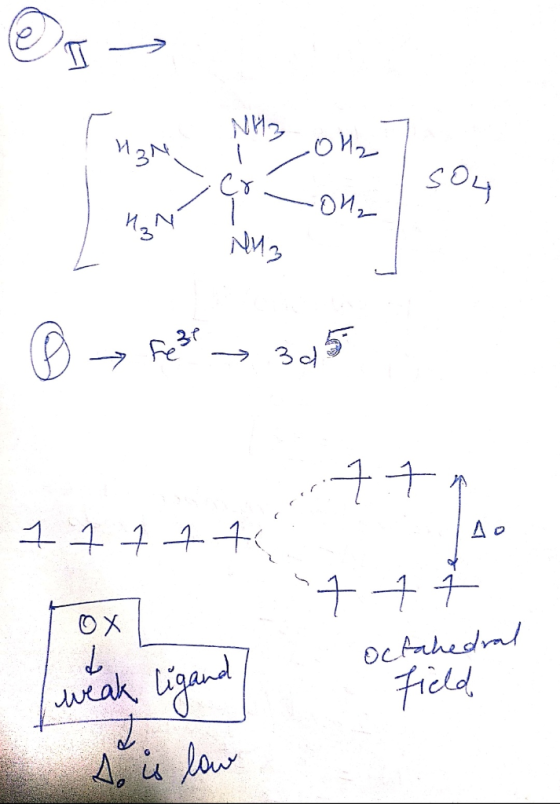
![4. Consider the following complexes. Na, [Fe(ox),] [Cr(H2O) (NHJ) SO, [Pt(en)(ONO)CI] Write the coordination sphere for the c](http://img.homeworklib.com/questions/cff88660-7128-11ea-8e7f-d75cb25913ad.png?x-oss-process=image/resize,w_560)
Homework Answers
![22+ a) I → [fe cox)137 - I [Cr (H₂O)q(NH3)4] ²7 li> [ft (en) (ono) ] b) I-Na₂ [re (ox) 3] 3(+1) +x+3(²2) = 0 x=+3 oxidation 1](http://img.homeworklib.com/questions/d0cea7f0-7128-11ea-b016-45f31a3b1de4.png?x-oss-process=image/resize,w_560)
![D -> [cr (H₂O)(NH3)4] 504 xtaxot uxo-2=0 Q-2=0 1 = +2) fo → [pt (en) (ono) ] ato 4 (-1)+(-1)=0 2-2=0 [x=+2] (C) Coordination](http://img.homeworklib.com/questions/d166bdc0-7128-11ea-9d5d-835252baf08f.png?x-oss-process=image/resize,w_560)
![) -> [cv (120) 2(NH3)4 ] 504 (N=2 + 4 = 6 II) – [pt len) (ono) c] (N= 2 +1+ 1=4 e ens 2 / ligand od) I → - Sodiun trioxalato](http://img.homeworklib.com/questions/d22cb340-7128-11ea-af0c-01f5998fe571.png?x-oss-process=image/resize,w_560)
Add Answer to:
4. Consider the following complexes. Na, [Fe(ox),] [Cr(H2O) (NHJ) SO, [Pt(en)(ONO)CI] Write the coordination sphere for...
Please answer Name and Draw each of the following coordination compounds. ③ K₃ [Cr (C₂O4)2 CI] ③ [Cu (en) ] Sot © Cs [F...
 Please answer
Name and Draw each of the following coordination compounds. ③ K₃ [Cr (C₂O4)2 CI] ③ [Cu (en) ] Sot © Cs [Fe Clu] ③ [Co (en), (H₂O) Br] Brz Zn [Pt C16] F Fe (NH), ] [Cr (CN).]
Please answer
Name and Draw each of the following coordination compounds. ③ K₃ [Cr (C₂O4)2 CI] ③ [Cu (en) ] Sot © Cs [Fe Clu] ③ [Co (en), (H₂O) Br] Brz Zn [Pt C16] F Fe (NH), ] [Cr (CN).]
4. a. List THREE (3) properties that characterize a d-block metal. [3 marks] b. Consider the...
 4. a. List THREE (3) properties that characterize a d-block metal. [3 marks] b. Consider the following complexes: [Mn(CN). [Co(en),Cl1 [PCUP [Co(NH),CI LIPICI For each of the complexes I to IV, determine the oxidation state of the metal and its d"configuration. [5 marks) Name the complexes II and IV using IUPAC system, [3 marks) Suggest possible isomers for complex Il and draw the structures of the isomers. [3 marks) Using Crystal Field Theory, determine the number of unpaired spin in...
1. Determine the following for the complex; [Cr(CI),(en),](NO), Coordination number: Oxidation number of the metal: (Show...
 1. Determine the following for the complex; [Cr(CI),(en),](NO), Coordination number: Oxidation number of the metal: (Show your work) number of d electrons on the metal: 2. An aqueous solution of a metal complex absorbs light at 420 nm. What is the color of the solution? What is the energy of the electron transition? (Show your work)
1. (a) Give the systematic IUPAC names for each of the following complexes/ions (1) (NH4) [NiCl4]...
 1. (a) Give the systematic IUPAC names for each of the following complexes/ions (1) (NH4) [NiCl4] (ii) [Cr(H204(NH3)2]2+ (iii) [Ru(en)(OH)2]* (iv) Nas[Co(ONO)5] (v) [Rh(ONO)(OX)2]* (vi) [FeBrz(en)2]* (vii) [Ag(y)][AgCl4] (viii) K[Pt(ONO)3(NO2)3] (ix) [Co(SO4)(NH3)s]* (x) Naz[PdCl4]
Part C: Structural Isomers - Coordination Sphere Isomers [Co(H2O),Br]CI and (Co(H2O),CIJBr examples of coordination sphere isomers....
 Part C: Structural Isomers - Coordination Sphere Isomers [Co(H2O),Br]CI and (Co(H2O),CIJBr examples of coordination sphere isomers. compounds with the same chemical formula, but with one or more different bonds. In this example, notice the Cl and Br' are either a ligand or a counter ion. Assuming tetrahedral geometry for these cobalt(II) complexes, build a model for only the first (Co(H2O),Br]CI) complex ion. Use a silver (SN-4, tetrahedral) atom for cobalt, use a green terminal atom for Cl, use a yellow...
4. Give chemical names for the following coordination complexes. a) [Cu(NH3)4]2+ b) [Pt(NH3). Cl]* c) [Mn(CN):)"....
 4. Give chemical names for the following coordination complexes. a) [Cu(NH3)4]2+ b) [Pt(NH3). Cl]* c) [Mn(CN):)". d) (Co(en)2(PPha)]PO... e) [Ni(bipy)](NO3)2. 5. Give chemical formulas for the following coordination complexes. a) Triammineaquadichlorocobalt(III) chloride. b) Potassium diaquabis(oxalate)manganate(III). c) Tris(acetylacetonato Jiron(III). d) Tri--carbonylbis(tricarbonyliron(O)). e) Li-oxo-bis(pentaamminechromium(III)). 5. Draw a d-orbital energy-level diagram, and predict the number of unpaired electrons. a) [Fe(CN).] b) [Fe(H20):] c) (CoCil (tetrahedral) 6. Of the two complexes (a) (CoFs] and (b) (Coſen)] + one appears yellow and the other appears...
(i) explain how they differ. b. (ii) Explain how the following reaction was used to deduce the mechanism of inner sphere electron transfer. [Co(NH,),Cl]Cr(Hd+SH,OCo(H,O)+ [Cr(HO),ci+5NH 8 marks]...
 (i) explain how they differ. b. (ii) Explain how the following reaction was used to deduce the mechanism of inner sphere electron transfer. [Co(NH,),Cl]Cr(Hd+SH,OCo(H,O)+ [Cr(HO),ci+5NH 8 marks] (i) Given the following ligands, suggest which one you would use as a chelating agent to treat an excess of Fe(III). Explain your choice. c. HS SH он HS NH2 Ci) Assuming an octahedral geometry, draw the strueture (inecluding any possible isomers) of the neutral Fe(III) complex that would be formed if it...
What is the coordination number for each of the following complexes or compounds? [Co(NH3)4Cl2]+ [Ca(EDTA)]2− [Pt(NH3)4]2+...
 What is the coordination number for each of the following
complexes or compounds?
[Co(NH3)4Cl2]+
[Ca(EDTA)]2−
[Pt(NH3)4]2+
Na[Ag(CN)2]
Enter the coordination numbers, in the order that the complexes
are listed, as four integers separated by commas (e.g.,
1,2,3,4).
What is the charge on each of the following complex ions?
hexaaquairon(II), [Fe(H2O)6]?
tris(carbonato)aluminate(III), [Al(CO3)3]?
amminepentachloroplatinate(IV), [Pt(NH3)Cl5]?
Express the charges numerically, in the order that the complexes
are listed, separated by commas. For a nonzero charge, be sure to
include the sign (e.g.,...
What is the coordination number for each of the following
complexes or compounds?
[Co(NH3)4Cl2]+
[Ca(EDTA)]2−
[Pt(NH3)4]2+
Na[Ag(CN)2]
Enter the coordination numbers, in the order that the complexes
are listed, as four integers separated by commas (e.g.,
1,2,3,4).
What is the charge on each of the following complex ions?
hexaaquairon(II), [Fe(H2O)6]?
tris(carbonato)aluminate(III), [Al(CO3)3]?
amminepentachloroplatinate(IV), [Pt(NH3)Cl5]?
Express the charges numerically, in the order that the complexes
are listed, separated by commas. For a nonzero charge, be sure to
include the sign (e.g.,...
SYNTHESIS OF TRANSITION METAL COORDINATION COM 3. Ethylenediamine ("en" in short-hand notation) has two amine group...
 SYNTHESIS OF TRANSITION METAL COORDINATION COM 3. Ethylenediamine ("en" in short-hand notation) has two amine groups, one at each end of a two-carbon chain, NH,CH,CH,NH. Each nitrogen in NH,CH,CH_NH, has a lone pair that coordinates to the metal. Thus, one NH CH CH NH, ligand, takes up two coordina- tion sites. a) Draw and label the structures of the cis and trans isomers of Co(en),C1,CI. b) What is the coordination number for (Coſen),C1,CI? c) Determine the oxidation state of the...
For each of the following complexes, draw the molecular structure and determine the effective ato...
 please do answer all the questions below. thank you
For each of the following complexes, draw the molecular structure and determine the effective atomic numbers. (i) Na[Fe(CN)s(NH3)3l (i) [Cr(H2O)2(NH3)2(en)]Cl (ii) [Co(o-phen)2(NHs)(NCS))CI (iv) (n3-C3Hs)Co(CO)2] (v) [Fe(diphos)(CO)sl in which diphos Ph2PCH2CH2PPh2 and Ph CsHs (10 marks) (i)/ The K for Fe(OH)4]2-is found to be higher than that found in (5 marks) Zn(OH)4]2-and [Cr(OHM. Explain . Cho and coworkers used the following ligand to react with cobalt. Predict how this ligand would bind...
please do answer all the questions below. thank you
For each of the following complexes, draw the molecular structure and determine the effective atomic numbers. (i) Na[Fe(CN)s(NH3)3l (i) [Cr(H2O)2(NH3)2(en)]Cl (ii) [Co(o-phen)2(NHs)(NCS))CI (iv) (n3-C3Hs)Co(CO)2] (v) [Fe(diphos)(CO)sl in which diphos Ph2PCH2CH2PPh2 and Ph CsHs (10 marks) (i)/ The K for Fe(OH)4]2-is found to be higher than that found in (5 marks) Zn(OH)4]2-and [Cr(OHM. Explain . Cho and coworkers used the following ligand to react with cobalt. Predict how this ligand would bind...
 Please answer
Name and Draw each of the following coordination compounds. ③ K₃ [Cr (C₂O4)2 CI] ③ [Cu (en) ] Sot © Cs [Fe Clu] ③ [Co (en), (H₂O) Br] Brz Zn [Pt C16] F Fe (NH), ] [Cr (CN).]
Please answer
Name and Draw each of the following coordination compounds. ③ K₃ [Cr (C₂O4)2 CI] ③ [Cu (en) ] Sot © Cs [Fe Clu] ③ [Co (en), (H₂O) Br] Brz Zn [Pt C16] F Fe (NH), ] [Cr (CN).]
 4. a. List THREE (3) properties that characterize a d-block metal. [3 marks] b. Consider the following complexes: [Mn(CN). [Co(en),Cl1 [PCUP [Co(NH),CI LIPICI For each of the complexes I to IV, determine the oxidation state of the metal and its d"configuration. [5 marks) Name the complexes II and IV using IUPAC system, [3 marks) Suggest possible isomers for complex Il and draw the structures of the isomers. [3 marks) Using Crystal Field Theory, determine the number of unpaired spin in...
 1. Determine the following for the complex; [Cr(CI),(en),](NO), Coordination number: Oxidation number of the metal: (Show your work) number of d electrons on the metal: 2. An aqueous solution of a metal complex absorbs light at 420 nm. What is the color of the solution? What is the energy of the electron transition? (Show your work)
 1. (a) Give the systematic IUPAC names for each of the following complexes/ions (1) (NH4) [NiCl4] (ii) [Cr(H204(NH3)2]2+ (iii) [Ru(en)(OH)2]* (iv) Nas[Co(ONO)5] (v) [Rh(ONO)(OX)2]* (vi) [FeBrz(en)2]* (vii) [Ag(y)][AgCl4] (viii) K[Pt(ONO)3(NO2)3] (ix) [Co(SO4)(NH3)s]* (x) Naz[PdCl4]
 Part C: Structural Isomers - Coordination Sphere Isomers [Co(H2O),Br]CI and (Co(H2O),CIJBr examples of coordination sphere isomers. compounds with the same chemical formula, but with one or more different bonds. In this example, notice the Cl and Br' are either a ligand or a counter ion. Assuming tetrahedral geometry for these cobalt(II) complexes, build a model for only the first (Co(H2O),Br]CI) complex ion. Use a silver (SN-4, tetrahedral) atom for cobalt, use a green terminal atom for Cl, use a yellow...
 4. Give chemical names for the following coordination complexes. a) [Cu(NH3)4]2+ b) [Pt(NH3). Cl]* c) [Mn(CN):)". d) (Co(en)2(PPha)]PO... e) [Ni(bipy)](NO3)2. 5. Give chemical formulas for the following coordination complexes. a) Triammineaquadichlorocobalt(III) chloride. b) Potassium diaquabis(oxalate)manganate(III). c) Tris(acetylacetonato Jiron(III). d) Tri--carbonylbis(tricarbonyliron(O)). e) Li-oxo-bis(pentaamminechromium(III)). 5. Draw a d-orbital energy-level diagram, and predict the number of unpaired electrons. a) [Fe(CN).] b) [Fe(H20):] c) (CoCil (tetrahedral) 6. Of the two complexes (a) (CoFs] and (b) (Coſen)] + one appears yellow and the other appears...
 (i) explain how they differ. b. (ii) Explain how the following reaction was used to deduce the mechanism of inner sphere electron transfer. [Co(NH,),Cl]Cr(Hd+SH,OCo(H,O)+ [Cr(HO),ci+5NH 8 marks] (i) Given the following ligands, suggest which one you would use as a chelating agent to treat an excess of Fe(III). Explain your choice. c. HS SH он HS NH2 Ci) Assuming an octahedral geometry, draw the strueture (inecluding any possible isomers) of the neutral Fe(III) complex that would be formed if it...
 What is the coordination number for each of the following
complexes or compounds?
[Co(NH3)4Cl2]+
[Ca(EDTA)]2−
[Pt(NH3)4]2+
Na[Ag(CN)2]
Enter the coordination numbers, in the order that the complexes
are listed, as four integers separated by commas (e.g.,
1,2,3,4).
What is the charge on each of the following complex ions?
hexaaquairon(II), [Fe(H2O)6]?
tris(carbonato)aluminate(III), [Al(CO3)3]?
amminepentachloroplatinate(IV), [Pt(NH3)Cl5]?
Express the charges numerically, in the order that the complexes
are listed, separated by commas. For a nonzero charge, be sure to
include the sign (e.g.,...
What is the coordination number for each of the following
complexes or compounds?
[Co(NH3)4Cl2]+
[Ca(EDTA)]2−
[Pt(NH3)4]2+
Na[Ag(CN)2]
Enter the coordination numbers, in the order that the complexes
are listed, as four integers separated by commas (e.g.,
1,2,3,4).
What is the charge on each of the following complex ions?
hexaaquairon(II), [Fe(H2O)6]?
tris(carbonato)aluminate(III), [Al(CO3)3]?
amminepentachloroplatinate(IV), [Pt(NH3)Cl5]?
Express the charges numerically, in the order that the complexes
are listed, separated by commas. For a nonzero charge, be sure to
include the sign (e.g.,...
 SYNTHESIS OF TRANSITION METAL COORDINATION COM 3. Ethylenediamine ("en" in short-hand notation) has two amine groups, one at each end of a two-carbon chain, NH,CH,CH,NH. Each nitrogen in NH,CH,CH_NH, has a lone pair that coordinates to the metal. Thus, one NH CH CH NH, ligand, takes up two coordina- tion sites. a) Draw and label the structures of the cis and trans isomers of Co(en),C1,CI. b) What is the coordination number for (Coſen),C1,CI? c) Determine the oxidation state of the...
 please do answer all the questions below. thank you
For each of the following complexes, draw the molecular structure and determine the effective atomic numbers. (i) Na[Fe(CN)s(NH3)3l (i) [Cr(H2O)2(NH3)2(en)]Cl (ii) [Co(o-phen)2(NHs)(NCS))CI (iv) (n3-C3Hs)Co(CO)2] (v) [Fe(diphos)(CO)sl in which diphos Ph2PCH2CH2PPh2 and Ph CsHs (10 marks) (i)/ The K for Fe(OH)4]2-is found to be higher than that found in (5 marks) Zn(OH)4]2-and [Cr(OHM. Explain . Cho and coworkers used the following ligand to react with cobalt. Predict how this ligand would bind...
please do answer all the questions below. thank you
For each of the following complexes, draw the molecular structure and determine the effective atomic numbers. (i) Na[Fe(CN)s(NH3)3l (i) [Cr(H2O)2(NH3)2(en)]Cl (ii) [Co(o-phen)2(NHs)(NCS))CI (iv) (n3-C3Hs)Co(CO)2] (v) [Fe(diphos)(CO)sl in which diphos Ph2PCH2CH2PPh2 and Ph CsHs (10 marks) (i)/ The K for Fe(OH)4]2-is found to be higher than that found in (5 marks) Zn(OH)4]2-and [Cr(OHM. Explain . Cho and coworkers used the following ligand to react with cobalt. Predict how this ligand would bind...
Most questions answered within 3 hours.
-
Where is the error in this code sequence?
String s1 = "Hello";
String s2 = "ello";...
asked 10 months ago -
Financial data for Joel de Paris, Inc., for last year
follow:
Joel de Paris, Inc.
Balance...
asked 10 months ago -
Consider this reaction:
Al2(SO4)3 (aq)+ BaCl3
(aq) Al2Cl6 (aq)- +
3BaSO4(s) . What is the...
asked 10 months ago -
Suppose that Savneet is considering increasing her
recent random sample from 20 car rentals to 40...
asked 10 months ago -
Trucks arrive at an unloading terminal at an average rate of 120
per hour.
Trucks arrive...
asked 10 months ago -
Why are methanol and ethanol completely soluble in water while
octanol is not very little soluble....
asked 10 months ago -
A facilities manager at a university reads in a research report
that the mean amount of...
asked 10 months ago -
When the CuSO4 is rehydrated by adding water to the anhydrous
compound, is this an endothermic...
asked 10 months ago -
A ray of sunlight is passing from diamond into crown glass; the
angle of incidence is...
asked 10 months ago -
A block of mass 0.249 kg is placed on top of a light, vertical
spring of...
asked 10 months ago -
how do the kidneys compensate in the presences of acidosis
a) trigger hyperventilate
b) reserve acid...
asked 10 months ago -
Question 501 pts
The rental rate of capital to the firm increases. Which of the
following...
asked 10 months ago