
Homework Answers
Both the peaks in the spectrum are associated with one molecular
vibration, i.e. asymmetric stretching. Now, the asymmetric
stretching can occur in two different manners as shown below. That
is why we are getting two peaks.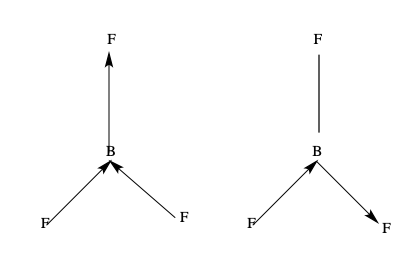
Add Answer to:
100 ле spectrum for gaseous BFs between 80 2500 and 500 cm is shown to the...
IR Worksheet 1. For each spectrum below: 1) Label the major peaks with their approximate frequency....
 IR Worksheet 1. For each spectrum below: 1) Label the major peaks with their approximate frequency. 2) Identify the bond vibration and possible functional group associated with each peak. 3) Match the spectra to one of these possible compounds: NH2 TRANSMITTANCE[%] pobo edo "2060 bo zdoo 160 Tobo 560 WAVENUMBER [cm-1] oot 08 TRANSMITTANCE [%] 09 01 02 4000 3500 3000 2500 2000 WAVENUMBER (cm-1] 1500 1000 500 οοο TRANSMITTANCE (6) οο οο οε 4000 3500 3000 1500 1000 2500...
2) FT-IR spectrum of H Sal (1) 90 80 70 Transmittance [%] 60 50 용 15555...
 2) FT-IR spectrum of H Sal (1) 90 80 70 Transmittance [%] 60 50 용 15555 9992 8 1284.18 1029:57 = 858.07 750.01 3500 3000 1500 1000 500 2500 2000 Wavenumber cm-1 HO EN N- OH Assign the peaks with wavenumber from 1600 - 4000cm-1 (10 points) Wavenumber (cm-1) Intensity (s/m/w) Assignment ܒܢܰ CEN stretching C=C stretching Saturated C-H stretching Unsaturated =C-H stretching O-H stretching 3) FT-IR of H.Sal (2) 80 70 09 Transmittance [%] 50 40 30 20 IS...
HELP B) Interpret IR spectrum of product (shown below) and provide a table listing functional groups...
 HELP
B) Interpret IR spectrum of product (shown below) and provide a table listing functional groups and peak intensity. Microns (um) 2.5 3.0 3.5 4.0 6.0 8 10 15 20 Transmittance (%) 1838 cm-19 -V1759 cm-111 TTTTTTTTT 4000 3500 3000 2500 2000 1500 1000 Wavenumber (cm-1) 500
HELP
B) Interpret IR spectrum of product (shown below) and provide a table listing functional groups and peak intensity. Microns (um) 2.5 3.0 3.5 4.0 6.0 8 10 15 20 Transmittance (%) 1838 cm-19 -V1759 cm-111 TTTTTTTTT 4000 3500 3000 2500 2000 1500 1000 Wavenumber (cm-1) 500
2. Analysis of IR Data (4 marks) IR peak value Shape/Intensity (cm) Functional Group Molecular Formula...
 2. Analysis of IR Data (4 marks) IR peak value Shape/Intensity (cm) Functional Group Molecular Formula CgH19N IR spectrum 3410 Transmittance 1132 1461 2810 3500 3000 2500 2000 Wavenumber(cm-1) 1500 1000
Two infrared spectra are shown with the molecular formula CH10. One is the spectrum of cyclohexene,...
 Two infrared spectra are shown with the molecular formula CH10. One is the spectrum of cyclohexene, and the other is the spectrum of 2-hexyne. Identify each and explain your reasons for making the identification. Spectrum A Spectrum B 08 DA 06 DS TRANSMITTANCE Re Trance 02 DSCH 4000 1900 NESTO Waverunteront NEST Christy Bottom goriche Which of the following compounds gives an infrared spectrum with peaks at 3300 cm (strong, broad peak) and 1640 cm-- (sharp, weak peak)? OH OH...
Identify as many peaks as possible for each spectrum in the set you choose. Then determine...
 Identify as many peaks as possible for each spectrum in the set you
choose. Then determine the structure of the unknown which will be
one of the following: Allyl alcohol, benzaldehyde, cyclohexane,
ethylbenzoate, 2-pentanone, toluene, 1-octene, propanoic acid.
% Transmittance 4000 3500 3000 2500 2000 Wavenumber (cm-") 1500 1000 500
Identify as many peaks as possible for each spectrum in the set you
choose. Then determine the structure of the unknown which will be
one of the following: Allyl alcohol, benzaldehyde, cyclohexane,
ethylbenzoate, 2-pentanone, toluene, 1-octene, propanoic acid.
% Transmittance 4000 3500 3000 2500 2000 Wavenumber (cm-") 1500 1000 500
analyze the following IR spectrum 20 30 40 Transmittance [%] 50 60 70 80 90 8...
 analyze the following IR spectrum
20 30 40 Transmittance [%] 50 60 70 80 90 8 BRUKER 3500 3320.11 3158.60 3000 2792.90 2587.95 249390 2500 Wavenumber cm-1 2000 1876.76 1500 1000 8888888889143888888 500
analyze the following IR spectrum
20 30 40 Transmittance [%] 50 60 70 80 90 8 BRUKER 3500 3320.11 3158.60 3000 2792.90 2587.95 249390 2500 Wavenumber cm-1 2000 1876.76 1500 1000 8888888889143888888 500
Label all peaks of this IR spectrum. Please help me. 3500 3000 2961.48 2869.66 2500 Wavenumbers...
 Label all peaks of this IR spectrum. Please help
me.
3500 3000 2961.48 2869.66 2500 Wavenumbers (cm-1) 2000 1745.65 1500 1387.86 1368.87 1229.55 1000 500 Infrared Peak (cm) Structural Assignment
Label all peaks of this IR spectrum. Please help
me.
3500 3000 2961.48 2869.66 2500 Wavenumbers (cm-1) 2000 1745.65 1500 1387.86 1368.87 1229.55 1000 500 Infrared Peak (cm) Structural Assignment
May someone help me label all peaks of this IR spectrum. 3500 3000 2961.48 2869.66 2500...
 May someone help me label all peaks of this IR
spectrum.
3500 3000 2961.48 2869.66 2500 Wavenumbers (cm-1) 2000 1745.65 1500 1387.86 1368.87 1229.55 1000 500 Infrared Peak (cm) Structural Assignment
May someone help me label all peaks of this IR
spectrum.
3500 3000 2961.48 2869.66 2500 Wavenumbers (cm-1) 2000 1745.65 1500 1387.86 1368.87 1229.55 1000 500 Infrared Peak (cm) Structural Assignment
3. (3 pts.) Shown below is the IR spectrum 2-acetylcyclohexanone (the structure is provided in the...
 3. (3 pts.) Shown below is the IR spectrum 2-acetylcyclohexanone (the structure is provided in the spectrum). 2- acetylcyclohexanone exists as an equilibrium mixture of diketone and two enol forms. Both the diketone and enol forms can be seen in the provide IR spectrum, although the 2 different enols cannot be distinguished. The IR spectra of both enols is essentially identical and so do not be concerned with distinguishing the enols, just assign peaks to a “generic" enol. On the...
 IR Worksheet 1. For each spectrum below: 1) Label the major peaks with their approximate frequency. 2) Identify the bond vibration and possible functional group associated with each peak. 3) Match the spectra to one of these possible compounds: NH2 TRANSMITTANCE[%] pobo edo "2060 bo zdoo 160 Tobo 560 WAVENUMBER [cm-1] oot 08 TRANSMITTANCE [%] 09 01 02 4000 3500 3000 2500 2000 WAVENUMBER (cm-1] 1500 1000 500 οοο TRANSMITTANCE (6) οο οο οε 4000 3500 3000 1500 1000 2500...
 2) FT-IR spectrum of H Sal (1) 90 80 70 Transmittance [%] 60 50 용 15555 9992 8 1284.18 1029:57 = 858.07 750.01 3500 3000 1500 1000 500 2500 2000 Wavenumber cm-1 HO EN N- OH Assign the peaks with wavenumber from 1600 - 4000cm-1 (10 points) Wavenumber (cm-1) Intensity (s/m/w) Assignment ܒܢܰ CEN stretching C=C stretching Saturated C-H stretching Unsaturated =C-H stretching O-H stretching 3) FT-IR of H.Sal (2) 80 70 09 Transmittance [%] 50 40 30 20 IS...
 HELP
B) Interpret IR spectrum of product (shown below) and provide a table listing functional groups and peak intensity. Microns (um) 2.5 3.0 3.5 4.0 6.0 8 10 15 20 Transmittance (%) 1838 cm-19 -V1759 cm-111 TTTTTTTTT 4000 3500 3000 2500 2000 1500 1000 Wavenumber (cm-1) 500
HELP
B) Interpret IR spectrum of product (shown below) and provide a table listing functional groups and peak intensity. Microns (um) 2.5 3.0 3.5 4.0 6.0 8 10 15 20 Transmittance (%) 1838 cm-19 -V1759 cm-111 TTTTTTTTT 4000 3500 3000 2500 2000 1500 1000 Wavenumber (cm-1) 500
 2. Analysis of IR Data (4 marks) IR peak value Shape/Intensity (cm) Functional Group Molecular Formula CgH19N IR spectrum 3410 Transmittance 1132 1461 2810 3500 3000 2500 2000 Wavenumber(cm-1) 1500 1000
 Two infrared spectra are shown with the molecular formula CH10. One is the spectrum of cyclohexene, and the other is the spectrum of 2-hexyne. Identify each and explain your reasons for making the identification. Spectrum A Spectrum B 08 DA 06 DS TRANSMITTANCE Re Trance 02 DSCH 4000 1900 NESTO Waverunteront NEST Christy Bottom goriche Which of the following compounds gives an infrared spectrum with peaks at 3300 cm (strong, broad peak) and 1640 cm-- (sharp, weak peak)? OH OH...
 Identify as many peaks as possible for each spectrum in the set you
choose. Then determine the structure of the unknown which will be
one of the following: Allyl alcohol, benzaldehyde, cyclohexane,
ethylbenzoate, 2-pentanone, toluene, 1-octene, propanoic acid.
% Transmittance 4000 3500 3000 2500 2000 Wavenumber (cm-") 1500 1000 500
Identify as many peaks as possible for each spectrum in the set you
choose. Then determine the structure of the unknown which will be
one of the following: Allyl alcohol, benzaldehyde, cyclohexane,
ethylbenzoate, 2-pentanone, toluene, 1-octene, propanoic acid.
% Transmittance 4000 3500 3000 2500 2000 Wavenumber (cm-") 1500 1000 500
 analyze the following IR spectrum
20 30 40 Transmittance [%] 50 60 70 80 90 8 BRUKER 3500 3320.11 3158.60 3000 2792.90 2587.95 249390 2500 Wavenumber cm-1 2000 1876.76 1500 1000 8888888889143888888 500
analyze the following IR spectrum
20 30 40 Transmittance [%] 50 60 70 80 90 8 BRUKER 3500 3320.11 3158.60 3000 2792.90 2587.95 249390 2500 Wavenumber cm-1 2000 1876.76 1500 1000 8888888889143888888 500
 Label all peaks of this IR spectrum. Please help
me.
3500 3000 2961.48 2869.66 2500 Wavenumbers (cm-1) 2000 1745.65 1500 1387.86 1368.87 1229.55 1000 500 Infrared Peak (cm) Structural Assignment
Label all peaks of this IR spectrum. Please help
me.
3500 3000 2961.48 2869.66 2500 Wavenumbers (cm-1) 2000 1745.65 1500 1387.86 1368.87 1229.55 1000 500 Infrared Peak (cm) Structural Assignment
 May someone help me label all peaks of this IR
spectrum.
3500 3000 2961.48 2869.66 2500 Wavenumbers (cm-1) 2000 1745.65 1500 1387.86 1368.87 1229.55 1000 500 Infrared Peak (cm) Structural Assignment
May someone help me label all peaks of this IR
spectrum.
3500 3000 2961.48 2869.66 2500 Wavenumbers (cm-1) 2000 1745.65 1500 1387.86 1368.87 1229.55 1000 500 Infrared Peak (cm) Structural Assignment
 3. (3 pts.) Shown below is the IR spectrum 2-acetylcyclohexanone (the structure is provided in the spectrum). 2- acetylcyclohexanone exists as an equilibrium mixture of diketone and two enol forms. Both the diketone and enol forms can be seen in the provide IR spectrum, although the 2 different enols cannot be distinguished. The IR spectra of both enols is essentially identical and so do not be concerned with distinguishing the enols, just assign peaks to a “generic" enol. On the...
Most questions answered within 3 hours.
-
Where is the error in this code sequence?
String s1 = "Hello";
String s2 = "ello";...
asked 10 months ago -
Financial data for Joel de Paris, Inc., for last year
follow:
Joel de Paris, Inc.
Balance...
asked 10 months ago -
Consider this reaction:
Al2(SO4)3 (aq)+ BaCl3
(aq) Al2Cl6 (aq)- +
3BaSO4(s) . What is the...
asked 10 months ago -
Suppose that Savneet is considering increasing her
recent random sample from 20 car rentals to 40...
asked 10 months ago -
Trucks arrive at an unloading terminal at an average rate of 120
per hour.
Trucks arrive...
asked 10 months ago -
Why are methanol and ethanol completely soluble in water while
octanol is not very little soluble....
asked 10 months ago -
A facilities manager at a university reads in a research report
that the mean amount of...
asked 10 months ago -
When the CuSO4 is rehydrated by adding water to the anhydrous
compound, is this an endothermic...
asked 10 months ago -
A ray of sunlight is passing from diamond into crown glass; the
angle of incidence is...
asked 10 months ago -
A block of mass 0.249 kg is placed on top of a light, vertical
spring of...
asked 10 months ago -
how do the kidneys compensate in the presences of acidosis
a) trigger hyperventilate
b) reserve acid...
asked 10 months ago -
Question 501 pts
The rental rate of capital to the firm increases. Which of the
following...
asked 10 months ago