An open flask sitting in a lab refrigerator looks empty, but it is actually filled with...
An open flask sitting in a lab refrigerator looks empty, but it is actually filled with a mixture of gases called air. If the flask volume is 1.50 L, and the air is at standard temperature and pressure, how many gaseous molecules does the flask contain? number of gaseous molecules:
Homework Answers
Molecules are calculated:
molecules = P * V * NA / R * T = 1 atm * 1.5 L * 6.02x10 ^ 23 molecules / mol / 0.082 atm * L / mol * K * 273 K = 4.03x10 ^ 22 air molecules.
If you liked the answer, please rate it in a positive way, you would help me a lot, thank you.
Add Answer to:
An open flask sitting in a lab refrigerator looks empty, but it
is actually filled with...
An open flask sitting in a lab refrigerator looks empty, but it is actually filled with...
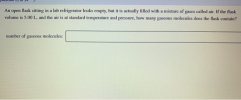 An open flask sitting in a lab refrigerator looks empty, but it is actually filled with a mixture of gases called air. If the flask volume is 5.00 L, and the air is at standard temperature and pressure, how many gascous molecules does the flask contain? number of gaseous molecules:
Open flask sitting in a lab refrigerator looks empty but it is actually filled with a mixture of gases called air it's...
Open flask sitting in a lab refrigerator looks empty but it is actually filled with a mixture of gases called air it's a flask volume is 4.00L and the air is that standard temperature and pressure how many gaseous molecules does the flacs contain? number of gaseous molecules
An open flask of air is heated, stoppered in the heated condition, and then allowed to...
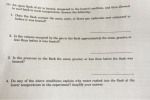 An open flask of air is heated, stoppered in the heated condition, and then allowed to cool back to room temperature. Does the flask contain the same, more, or fewer gas molecules now compared to before it was heated? Is the volume occupied by the gas in the flask approximately the same, greater, or less than before it was heated? Is the pressure in the flask the same, greater, or less than before the flask was heated? Do any of...
your Pre-Lab. 1. A 125 mL sample of dry air at 230.0°C is cooled to 100.0°C...
 your Pre-Lab. 1. A 125 mL sample of dry air at 230.0°C is cooled to 100.0°C at constant pressure. What volume with the air occupy at 100.0°C? 2. A 250.0 mL container of gas is at 150.0°C. At what temperature will the gas occupy a volume of 125 mL? (assume constant pressure) 3. An open flask of air is cooled Does it contain more gas molecules before or after cooling? a. Is the pressure the same, greater or less than...
760 You perform the Dumas method experiment. The mass of the empty flask with a boiling...
 760 You perform the Dumas method experiment. The mass of the empty flask with a boiling stone it is 32.5500 g. After you add the volatile liquid, heat the flask, and condense the remaining liquid, the mass of the flask with the boiling stone and condensed liquid is 33.8802 . The temperature of the water bath is 99.5°C. Atmospheric pressure when you perform the experiment is 745 mm Hg. The volume of the flask is 272 mL. a) Calculate the...
1. a. The pressure inside a hydrogen-filled container was 2.10 atm at 21 ∘C. What would...
1. a. The pressure inside a hydrogen-filled container was 2.10 atm at 21 ∘C. What would the pressure be if the container was heated to 87 ∘C ? b. At standard temperature and pressure (0 ∘C and 1.00 atm ), 1.00 mol of an ideal gas occupies a volume of 22.4 L. What volume would the same amount of gas occupy at the same pressure and 95 ∘C ? c. Calculate the number of molecules in a deep breath of...
can you answer both questions please. TIA In this lab, you will start off by calculating...
 can you answer both questions please. TIA
In this lab, you will start off by calculating the number of moles of air molecules inside a flask containing 10 mL of water by cooling the flask down to near 0°C and assuming the vapour pressure of water is negligible at that temperature If the volume of the air inside the flask is 148.2 ml, the gas pressure sensors reads 99.6 kPa and the temperature sensor reads 2.7 °C, how many moles...
can you answer both questions please. TIA
In this lab, you will start off by calculating the number of moles of air molecules inside a flask containing 10 mL of water by cooling the flask down to near 0°C and assuming the vapour pressure of water is negligible at that temperature If the volume of the air inside the flask is 148.2 ml, the gas pressure sensors reads 99.6 kPa and the temperature sensor reads 2.7 °C, how many moles...
1a) A sample of neon gas at a pressure of 0.501 atm and a temperature of...
1a) A sample of neon gas at a pressure of 0.501 atm and a temperature of 22.6 °C, occupies a volume of 18.1 liters. If the gas is compressed at constant temperature to a volume of 7.02 liters, the pressure of the gas sample will be ___ atm 1b) How many moles of hydrogen peroxide (H2O2) are needed to produce 11.4 L of oxygen gas according to the following reaction at 0 °C and 1 atm? hydrogen peroxide (H2O2) (aq)...
When conducting an experiment, it is important to have a hypothesis in mind and know what variabl...
 When conducting an experiment, it is important to have a hypothesis in mind and know what variables you will be looking at to help you in your testing. Ordinarily a scientist will perform a sort of experimental design before beginning any lab work. To gain some experience with this type of work, complete and attach an Experimental Design Worksheet for this experiment. Please use the worksheet provided under this experiment on Canvas. An example worksheet can be found under the...
1Q) A nitrogen sample occupies 220. mL at STP. If the same sample were collected over...
1Q) A nitrogen sample occupies 220. mL at STP. If the same sample were collected over water at 25°C and 600. torr, what would be the volume of the gas sample? (Assume that vapor pressure of water at 25°C is 23.8 torr.) Volume =....... mL 2Q) A number of compounds containing the heavier noble gases, and especially xenon, have been prepared. One of these is xenon hexafluoride (XeF6), which can be prepared by heating a mixture of xenon and fluorine...
 An open flask sitting in a lab refrigerator looks empty, but it is actually filled with a mixture of gases called air. If the flask volume is 5.00 L, and the air is at standard temperature and pressure, how many gascous molecules does the flask contain? number of gaseous molecules:
 An open flask of air is heated, stoppered in the heated condition, and then allowed to cool back to room temperature. Does the flask contain the same, more, or fewer gas molecules now compared to before it was heated? Is the volume occupied by the gas in the flask approximately the same, greater, or less than before it was heated? Is the pressure in the flask the same, greater, or less than before the flask was heated? Do any of...
 your Pre-Lab. 1. A 125 mL sample of dry air at 230.0°C is cooled to 100.0°C at constant pressure. What volume with the air occupy at 100.0°C? 2. A 250.0 mL container of gas is at 150.0°C. At what temperature will the gas occupy a volume of 125 mL? (assume constant pressure) 3. An open flask of air is cooled Does it contain more gas molecules before or after cooling? a. Is the pressure the same, greater or less than...
 760 You perform the Dumas method experiment. The mass of the empty flask with a boiling stone it is 32.5500 g. After you add the volatile liquid, heat the flask, and condense the remaining liquid, the mass of the flask with the boiling stone and condensed liquid is 33.8802 . The temperature of the water bath is 99.5°C. Atmospheric pressure when you perform the experiment is 745 mm Hg. The volume of the flask is 272 mL. a) Calculate the...
 can you answer both questions please. TIA
In this lab, you will start off by calculating the number of moles of air molecules inside a flask containing 10 mL of water by cooling the flask down to near 0°C and assuming the vapour pressure of water is negligible at that temperature If the volume of the air inside the flask is 148.2 ml, the gas pressure sensors reads 99.6 kPa and the temperature sensor reads 2.7 °C, how many moles...
can you answer both questions please. TIA
In this lab, you will start off by calculating the number of moles of air molecules inside a flask containing 10 mL of water by cooling the flask down to near 0°C and assuming the vapour pressure of water is negligible at that temperature If the volume of the air inside the flask is 148.2 ml, the gas pressure sensors reads 99.6 kPa and the temperature sensor reads 2.7 °C, how many moles...
 When conducting an experiment, it is important to have a hypothesis in mind and know what variables you will be looking at to help you in your testing. Ordinarily a scientist will perform a sort of experimental design before beginning any lab work. To gain some experience with this type of work, complete and attach an Experimental Design Worksheet for this experiment. Please use the worksheet provided under this experiment on Canvas. An example worksheet can be found under the...
Most questions answered within 3 hours.
-
Where is the error in this code sequence?
String s1 = "Hello";
String s2 = "ello";...
asked 10 months ago -
Financial data for Joel de Paris, Inc., for last year
follow:
Joel de Paris, Inc.
Balance...
asked 10 months ago -
Consider this reaction:
Al2(SO4)3 (aq)+ BaCl3
(aq) Al2Cl6 (aq)- +
3BaSO4(s) . What is the...
asked 10 months ago -
Suppose that Savneet is considering increasing her
recent random sample from 20 car rentals to 40...
asked 10 months ago -
Trucks arrive at an unloading terminal at an average rate of 120
per hour.
Trucks arrive...
asked 10 months ago -
Why are methanol and ethanol completely soluble in water while
octanol is not very little soluble....
asked 10 months ago -
A facilities manager at a university reads in a research report
that the mean amount of...
asked 10 months ago -
When the CuSO4 is rehydrated by adding water to the anhydrous
compound, is this an endothermic...
asked 10 months ago -
A ray of sunlight is passing from diamond into crown glass; the
angle of incidence is...
asked 10 months ago -
A block of mass 0.249 kg is placed on top of a light, vertical
spring of...
asked 10 months ago -
how do the kidneys compensate in the presences of acidosis
a) trigger hyperventilate
b) reserve acid...
asked 10 months ago -
Question 501 pts
The rental rate of capital to the firm increases. Which of the
following...
asked 10 months ago