
Homework Answers
Add Answer to:
22. A solution is prepared by dissolving 6.00 g of an unknown nonelectrolyte in enough water...
I do not know even the formula for this problem A solution is prepared by dissolving...
 I do not know even the formula for this problem
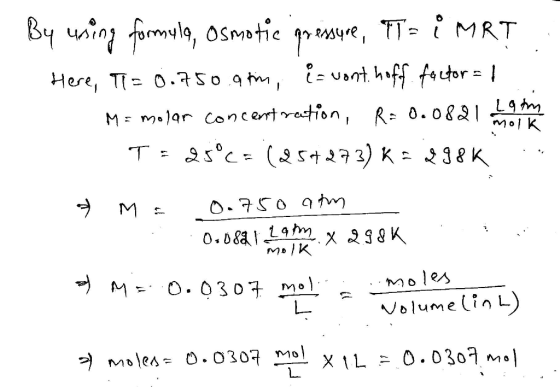
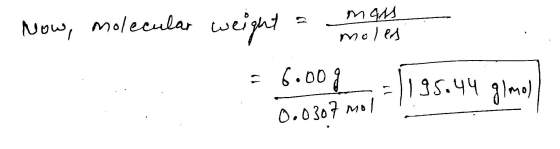
A solution is prepared by dissolving 6.00 g of an unknown nonelectrolyte in enough water to make 1.00 L of solution. The osmotic pressure of this solution is 0.750 atm at 25.0 degree C. What is the molecular weight (g/mol) of the unknown solute?
I do not know even the formula for this problem
A solution is prepared by dissolving 6.00 g of an unknown nonelectrolyte in enough water to make 1.00 L of solution. The osmotic pressure of this solution is 0.750 atm at 25.0 degree C. What is the molecular weight (g/mol) of the unknown solute?
A solution prepared by dissolving 14.5 mg of a nonelectrolyte in water and diluting to a...
A solution prepared by dissolving 14.5 mg of a nonelectrolyte in water and diluting to a volume of 10.0 mL gives an osmotic pressure of 33.8 mmHg at 300. K. What is the molecular weight of the nonelectrolyte in g/mol?
. 0.275 L of solution is prepared by dissolving 2.50 g of an unknown molecular compound...
. 0.275 L of solution is prepared by dissolving 2.50 g of an unknown molecular compound in enough water. The osmotic pressure of this solution is 1.98 atm at 27 °C. (R = 0.08206 L·atm/mol·K) a) Determine the molar mass of the molecular compound. (7 pts) b) If you need to prepare 0.275 L of AlCl3 solution with the same osmotic pressure of the above solution, what mass of AlCl3 (MW = 133.33 g/mol) would you need to weigh out?
A solution of an unknown nonelectrolyte is formed by adding 1.13 g in 250 mL of...
A solution of an unknown nonelectrolyte is formed by adding 1.13 g in 250 mL of water. This generates an osmotic pressure of 0.46 atm at 25 °C. Given R = 0.0821 L-atm/K-mol, calculate the molar mass of the nonelectrolyte (to two significant figures). Please explain step-by-step.
16. For the system CO + CO2(g) → CaCO(s) the equilibrium constant expression is a. [CO]...
 16. For the system CO + CO2(g) → CaCO(s) the equilibrium constant expression is a. [CO] b. 1/[CO] c. COCO/CaCO, d. Cacos/CaoCO 17. The value of K, for the reaction 2NOH). N204) is 1.52 at 319 K. What is the value of ko at this temperature for the reaction N04() → 2NOR ? b. 1.23 c. 5.74 x 10 d. 0.658 18. The value of Ke for the reaction C() + COX() -----2CO(g) is 1.6. What is the equilibrium concentration...
A solution was made by dissolving 5.80 mg of hemoglobin in water to give a final...
A solution was made by dissolving 5.80 mg of hemoglobin in water to give a final volume of 1.00 mL. The osmotic pressure of this solution was 2.22×10⁻³ atm at 25.0°C. Calculate the molar mass of hemoglobin, which is a molecular compound and a nonelectrolyte. = g/mol
6. A 1.07 mg sample of a compound was dissolved in 78.1 mg of camphor. The...
6. A 1.07 mg sample of a compound was dissolved in 78.1 mg of camphor. The resulting solution melted at 176.0 C. What is the molecular mass of the compound? The melting point of pure camphor is 179.5 C. The freezing-point-depression constant for camphor Kf is 40.0 C/m. 7. A solution is prepared by dissolving 5.88 g of an unknown nonelectrolyte in enough water to make 0.355 L of solution. The osmotic pressure of the solution is 1.21 atm at...
A solution was made by dissolving 5.60 mg of hemoglobin in water to give a final...
A solution was made by dissolving 5.60 mg of hemoglobin in water to give a final volume of 1.00 mL. The osmotic pressure of this solution was 2.14×10⁻³ atm at 25.0°C. Calculate the molar mass of hemoglobin, which is a molecular compound and a nonelectrolyte. Give your answer in g/mol.
A solution is made by dissolving 5.61 g of a new polymer in enough water to...
A solution is made by dissolving 5.61 g of a new polymer in enough water to make 260 mL of solution. At 25.0 oC, the osmotic pressure of the solution is 0.174 atm. What is the molar mass of the polymer in g/mol? (Use the E symbolism. e.g., 3123 would be 3.123E3 with 3 significant figures - i.e., 2 after the decimal point.)
Colligative Properties 1a When a solution is made from 25.9 g of an unknown nonelectrolyte dissolved...
Colligative Properties 1a When a solution is made from 25.9 g of an unknown nonelectrolyte dissolved in 167.6 g of solvent, the solution boils at 63.24 °C. The boiling point of the pure solvent and its Kb are 59.02 °C and 2.09 °C/m, respectively. Calculate the molar mass of the unknown electrolyte in g/mol. Report your answer to TWO places past the decimal 1b When a solution is made from 39.5 g of an unknown nonelectrolyte dissolved in 109.1-2.47 °C....
 I do not know even the formula for this problem
A solution is prepared by dissolving 6.00 g of an unknown nonelectrolyte in enough water to make 1.00 L of solution. The osmotic pressure of this solution is 0.750 atm at 25.0 degree C. What is the molecular weight (g/mol) of the unknown solute?
I do not know even the formula for this problem
A solution is prepared by dissolving 6.00 g of an unknown nonelectrolyte in enough water to make 1.00 L of solution. The osmotic pressure of this solution is 0.750 atm at 25.0 degree C. What is the molecular weight (g/mol) of the unknown solute?
 16. For the system CO + CO2(g) → CaCO(s) the equilibrium constant expression is a. [CO] b. 1/[CO] c. COCO/CaCO, d. Cacos/CaoCO 17. The value of K, for the reaction 2NOH). N204) is 1.52 at 319 K. What is the value of ko at this temperature for the reaction N04() → 2NOR ? b. 1.23 c. 5.74 x 10 d. 0.658 18. The value of Ke for the reaction C() + COX() -----2CO(g) is 1.6. What is the equilibrium concentration...
Most questions answered within 3 hours.
-
Where is the error in this code sequence?
String s1 = "Hello";
String s2 = "ello";...
asked 10 months ago -
Financial data for Joel de Paris, Inc., for last year
follow:
Joel de Paris, Inc.
Balance...
asked 10 months ago -
Consider this reaction:
Al2(SO4)3 (aq)+ BaCl3
(aq) Al2Cl6 (aq)- +
3BaSO4(s) . What is the...
asked 10 months ago -
Suppose that Savneet is considering increasing her
recent random sample from 20 car rentals to 40...
asked 10 months ago -
Trucks arrive at an unloading terminal at an average rate of 120
per hour.
Trucks arrive...
asked 10 months ago -
Why are methanol and ethanol completely soluble in water while
octanol is not very little soluble....
asked 10 months ago -
A facilities manager at a university reads in a research report
that the mean amount of...
asked 10 months ago -
When the CuSO4 is rehydrated by adding water to the anhydrous
compound, is this an endothermic...
asked 10 months ago -
A ray of sunlight is passing from diamond into crown glass; the
angle of incidence is...
asked 10 months ago -
A block of mass 0.249 kg is placed on top of a light, vertical
spring of...
asked 10 months ago -
how do the kidneys compensate in the presences of acidosis
a) trigger hyperventilate
b) reserve acid...
asked 10 months ago -
Question 501 pts
The rental rate of capital to the firm increases. Which of the
following...
asked 10 months ago