
Homework Answers
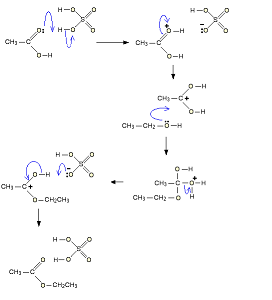
The example of esterification reaction is shown below:

The mechanism is shown below:
Add Answer to:
2) (2 pts) write a balanced equation of the esterification reaction and its mechanism; 3) (2...
Postlab Questions 1. Write a balanced equation for the gas evolution reaction between aqueous solutions of...
 Postlab Questions 1. Write a balanced equation for the gas evolution reaction between aqueous solutions of sodium carbonate and hydrochloric acid. 2. What is the molar ratio of sodium chloride to sodium carbonate from the above balanced equation? Describe how your results (Calculation 1j.) compare to this ratio. 3. Write a balanced equation for the gas evolution reaction between aqueous solutions of sodium bicarbonate and hydrochloric acid. 4. What is the molar ratio of sodium chloride to sodium bicarbonate from...
1. The reaction mixture contains isopentyl acetate, isopentyl alcohol, water, acetic acid and sulfuric acid. a)...
 1. The reaction mixture contains isopentyl acetate, isopentyl alcohol, water, acetic acid and sulfuric acid. a) Why is the reaction mixture extracted with sodium bicarbonate? In other words, what two substances does sodium bicarbonate react with in the reaction mixture and why are these reactions useful? (4 pts) b) Write a balanced chemical equation for each reaction involving sodium bicarbonate. c) When the reaction mixture is extracted with sodium bicarbonate solution, what substances will be in the aqueous layer? What...
2) Determine your percent yield of sodium chloride in reaction A. Show your work for each...
 2) Determine your percent yield of sodium chloride in reaction A. Show your work for each step. Write the balanced equation for reaction A - the reaction between sodium bicarbonate and hydrochloric acid. Using mass-to-mass stoichiometry, calculate the theoretical yield of NaCl for reaction A. Use your initial mass of sodium bicarbonate reactant as a starting point, along with the relevant mole-to-mole ratio from the balanced equation to perform this calculation. . Calculate your percent yield of sodium chloride product....
Please write a word equation for this reaction and briefly describe the reactant and products. Write...
Please write a word equation for this reaction and briefly describe the reactant and products. Write the balanced chemical equation for all of the reactions. D. Double Displacement Reactions Reaction of sodium bicarbonate and hydrochloric acid Reaction of sodium carbonate and calcium chloride Reaction of potassium hydroxide and nickel chloride Reaction of silver nitrate and potassium chloride
SN1 Reaction - Synthesis of t-pentyl chloride PRELAL ACTION-SYNTHESIS OF T-PENTYL CHLORIDE ST REACTION Date Nam...
 SN1 Reaction - Synthesis of t-pentyl chloride
PRELAL ACTION-SYNTHESIS OF T-PENTYL CHLORIDE ST REACTION Date Nam What is the purpose of adding hydrochloric acid to f-pentanol? 2. Why do you leave the separatory funnel unstoppered during the addition of hydrochloric acid 3. You have two layers: organic and aqueous. How do you verify which layer is the aqueous? F 4. Pentyl chloride is soluble in water. T 5. What is the formula of sodium bicarbonate? What is the purpose of...
SN1 Reaction - Synthesis of t-pentyl chloride
PRELAL ACTION-SYNTHESIS OF T-PENTYL CHLORIDE ST REACTION Date Nam What is the purpose of adding hydrochloric acid to f-pentanol? 2. Why do you leave the separatory funnel unstoppered during the addition of hydrochloric acid 3. You have two layers: organic and aqueous. How do you verify which layer is the aqueous? F 4. Pentyl chloride is soluble in water. T 5. What is the formula of sodium bicarbonate? What is the purpose of...
Questions: 1. Write a balanced equation for the reaction of zinc with hydrochloric acid, including states....
 Questions: 1. Write a balanced equation for the reaction of zinc with hydrochloric acid, including states. 2. In a separate reaction, 0.775g of zinc powder was reacted with 8.5 mL of hydrochloric acid solution. The hydrochloric acid solution has a density of 1.09 g/mL. Use this information to answer the questions below. a. What is the theoretical yield of zinc chloride that can be produced from this reaction? Show work. b. What is the limiting reactant? Which reactant is in...
The esterification reaction is a five-step reaction. Draw the curly arrow mechanism for the first two...
The esterification reaction is a five-step reaction. Draw the curly arrow mechanism for the first two steps of this reaction. The steps of the reaction are listed below: Step 1: Acetic acid is protonated by H2SO4. Step 2: The hydroxyl group of the alcohol attacks acetic acid. Step 3: Tautomerism (will be explained in class next semester). Step 4: Water is a good leaving group Step 5: 5% sodium bicarbonate deprotonates the ester to yield the final product.
Write the reaction equation of an Esterification of Butyric acid with Tert-Butyl Alcohol with sulfuric acid...
Write the reaction equation of an Esterification of Butyric acid with Tert-Butyl Alcohol with sulfuric acid as a catalyst and show the products. Balanced equation: (If possible) Write a procedure that would lead to obtaining 5g of the product. Name of Reactant Grams Molar Mass Moles of Reactant Tert-amyl alcohol 88.150 Butyric acid 88.106 NAME OF PRODUCT____________________________________ MOLAR MASS___________ M.P(solid) or B.P.(liquid)__________ THEORETICAL YIELD______________
Write the complete, balanced chemical equation for the reaction of aqueous perchloric acid with sodium bicarbonate....
Write the complete, balanced chemical equation for the reaction of aqueous perchloric acid with sodium bicarbonate. Also provide the ionic reaction and the net ionic reaction. a) Overall balanced reaction: b) ionic reaction: c) net ionic reaction:
1. [05 pts.] Draw the chemical equation for preparation of Aspirin. (No mechanism) 2. [15 pts.)...
 1. [05 pts.] Draw the chemical equation for preparation of Aspirin. (No mechanism) 2. [15 pts.) Show the detailed mechanism movement of electrons. for reaction. Show all arrow to indicate 3. [09 pts.] Briefly explain the roles of Salicylic acid, Acetic anhydride and phosphoric acid in the reaction. 4. [05 pts.] What type of reaction is preparation of Aspirin? 5. [06 pts.] Briefly describe esterification and give an example using Acyl chloride as one of the reactants.
 Postlab Questions 1. Write a balanced equation for the gas evolution reaction between aqueous solutions of sodium carbonate and hydrochloric acid. 2. What is the molar ratio of sodium chloride to sodium carbonate from the above balanced equation? Describe how your results (Calculation 1j.) compare to this ratio. 3. Write a balanced equation for the gas evolution reaction between aqueous solutions of sodium bicarbonate and hydrochloric acid. 4. What is the molar ratio of sodium chloride to sodium bicarbonate from...
 1. The reaction mixture contains isopentyl acetate, isopentyl alcohol, water, acetic acid and sulfuric acid. a) Why is the reaction mixture extracted with sodium bicarbonate? In other words, what two substances does sodium bicarbonate react with in the reaction mixture and why are these reactions useful? (4 pts) b) Write a balanced chemical equation for each reaction involving sodium bicarbonate. c) When the reaction mixture is extracted with sodium bicarbonate solution, what substances will be in the aqueous layer? What...
 2) Determine your percent yield of sodium chloride in reaction A. Show your work for each step. Write the balanced equation for reaction A - the reaction between sodium bicarbonate and hydrochloric acid. Using mass-to-mass stoichiometry, calculate the theoretical yield of NaCl for reaction A. Use your initial mass of sodium bicarbonate reactant as a starting point, along with the relevant mole-to-mole ratio from the balanced equation to perform this calculation. . Calculate your percent yield of sodium chloride product....
 SN1 Reaction - Synthesis of t-pentyl chloride
PRELAL ACTION-SYNTHESIS OF T-PENTYL CHLORIDE ST REACTION Date Nam What is the purpose of adding hydrochloric acid to f-pentanol? 2. Why do you leave the separatory funnel unstoppered during the addition of hydrochloric acid 3. You have two layers: organic and aqueous. How do you verify which layer is the aqueous? F 4. Pentyl chloride is soluble in water. T 5. What is the formula of sodium bicarbonate? What is the purpose of...
SN1 Reaction - Synthesis of t-pentyl chloride
PRELAL ACTION-SYNTHESIS OF T-PENTYL CHLORIDE ST REACTION Date Nam What is the purpose of adding hydrochloric acid to f-pentanol? 2. Why do you leave the separatory funnel unstoppered during the addition of hydrochloric acid 3. You have two layers: organic and aqueous. How do you verify which layer is the aqueous? F 4. Pentyl chloride is soluble in water. T 5. What is the formula of sodium bicarbonate? What is the purpose of...
 Questions: 1. Write a balanced equation for the reaction of zinc with hydrochloric acid, including states. 2. In a separate reaction, 0.775g of zinc powder was reacted with 8.5 mL of hydrochloric acid solution. The hydrochloric acid solution has a density of 1.09 g/mL. Use this information to answer the questions below. a. What is the theoretical yield of zinc chloride that can be produced from this reaction? Show work. b. What is the limiting reactant? Which reactant is in...
 1. [05 pts.] Draw the chemical equation for preparation of Aspirin. (No mechanism) 2. [15 pts.) Show the detailed mechanism movement of electrons. for reaction. Show all arrow to indicate 3. [09 pts.] Briefly explain the roles of Salicylic acid, Acetic anhydride and phosphoric acid in the reaction. 4. [05 pts.] What type of reaction is preparation of Aspirin? 5. [06 pts.] Briefly describe esterification and give an example using Acyl chloride as one of the reactants.
Most questions answered within 3 hours.
-
Where is the error in this code sequence?
String s1 = "Hello";
String s2 = "ello";...
asked 10 months ago -
Financial data for Joel de Paris, Inc., for last year
follow:
Joel de Paris, Inc.
Balance...
asked 10 months ago -
Consider this reaction:
Al2(SO4)3 (aq)+ BaCl3
(aq) Al2Cl6 (aq)- +
3BaSO4(s) . What is the...
asked 10 months ago -
Suppose that Savneet is considering increasing her
recent random sample from 20 car rentals to 40...
asked 10 months ago -
Trucks arrive at an unloading terminal at an average rate of 120
per hour.
Trucks arrive...
asked 10 months ago -
Why are methanol and ethanol completely soluble in water while
octanol is not very little soluble....
asked 10 months ago -
A facilities manager at a university reads in a research report
that the mean amount of...
asked 10 months ago -
When the CuSO4 is rehydrated by adding water to the anhydrous
compound, is this an endothermic...
asked 10 months ago -
A ray of sunlight is passing from diamond into crown glass; the
angle of incidence is...
asked 10 months ago -
A block of mass 0.249 kg is placed on top of a light, vertical
spring of...
asked 10 months ago -
how do the kidneys compensate in the presences of acidosis
a) trigger hyperventilate
b) reserve acid...
asked 10 months ago -
Question 501 pts
The rental rate of capital to the firm increases. Which of the
following...
asked 10 months ago