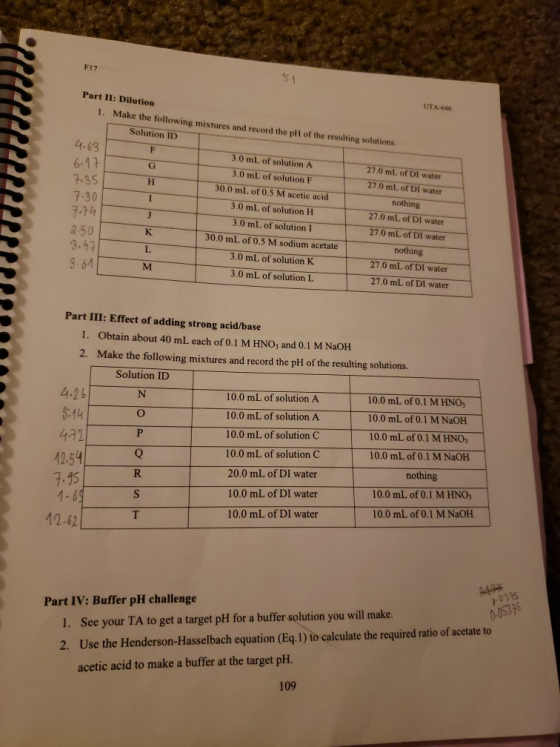
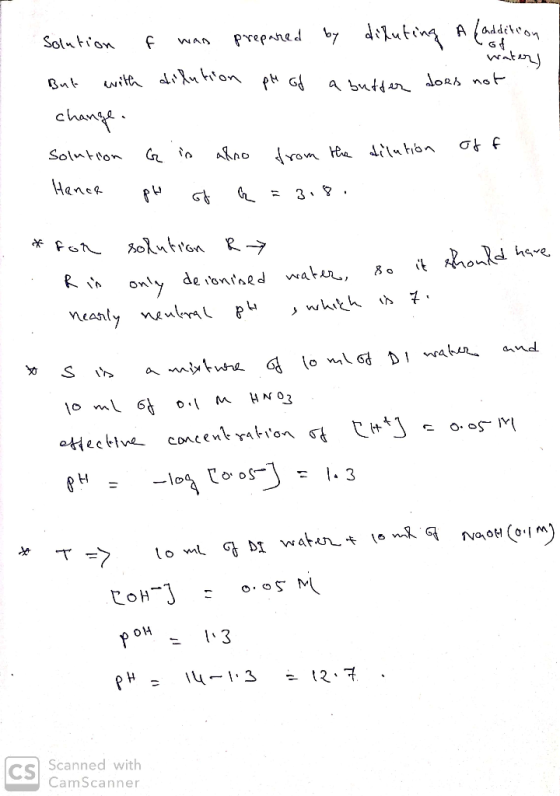
what is the ph for solutions G, R, S ans T?
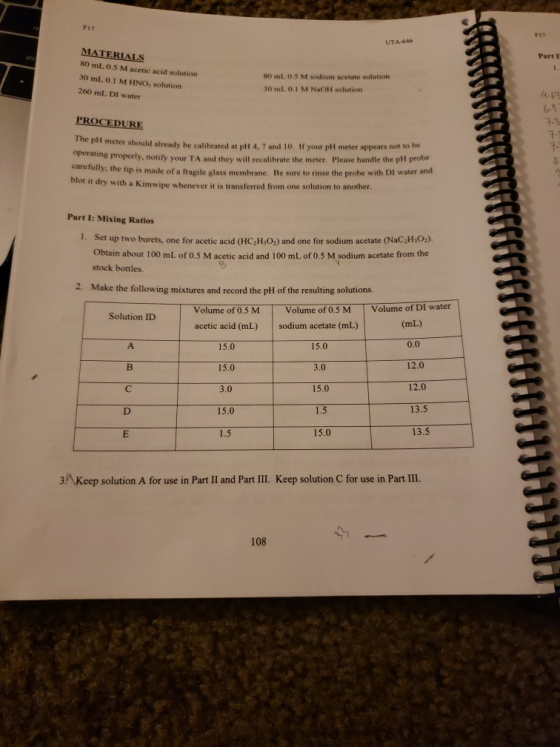
PROCEDURE
The pH meter should already be calibrated at pH 4, 7 and 10. If your pH meter appears not to be operating properly, notify your TA and they will recalibrate the meter. Please handle the pH probe carefully; the tip is made of a fragile glass membrane. Be sure to rinse the probe with DI water and blot it dry with a Kimwipe whenever it is transferred from one solution to another.
Part I: Mixing Ratios
1. Set up two burets, one for acetic acid \(\left(\mathrm{HC}_{2} \mathrm{H}_{3} \mathrm{O}_{2}\right)\) and one for sodium acetate \(\left(\mathrm{NaC}_{2} \mathrm{H}_{3} \mathrm{O}_{2}\right)\). Obtain about \(100 \mathrm{~mL}\) of \(0.5 \mathrm{M}\) acetic acid and \(100 \mathrm{~mL}\) of \(0.5 \mathrm{M}\) sodium acetate from the stock bottles. \(B\)
2. Make the following mixtures and record the pH of the resulting solutions.
3. Keep solution A for use in Part II and Part III. Keep solution C for use in Part III.
Homework Answers
![of an Answer To calculate weak acid pH . the pH of the mixture and its salt, pka in [Acid] . for solution. A, - concentration](http://img.homeworklib.com/questions/f0209b80-7191-11ea-bd2f-07a6da68ecfa.png?x-oss-process=image/resize,w_560)
Add Answer to:
what is the ph for solutions G, R, S ans T?We were unable to transcribe...
what will the ph be for solution Q?? PROCEDURE The pH meter should already be calibrated...
 what will the ph be for solution Q??
PROCEDURE The pH meter should already be calibrated at pH 4, 7 and 10. If your pH meter appears not to be operating properly, notify your TA and they will recalibrate the meter. Please handle the pH probe carefully; the tip is made of a fragile glass membrane. Be sure to rinse the probe with DI water and blot it dry with a Kimwipe whenever it is transferred from one solution to...
what will the ph be for solution Q??
PROCEDURE The pH meter should already be calibrated at pH 4, 7 and 10. If your pH meter appears not to be operating properly, notify your TA and they will recalibrate the meter. Please handle the pH probe carefully; the tip is made of a fragile glass membrane. Be sure to rinse the probe with DI water and blot it dry with a Kimwipe whenever it is transferred from one solution to...
calculate the theoretical ph of solution F and N. MLIM HNO, solution 260 ml. De water...
 calculate the theoretical ph of solution F and N.
MLIM HNO, solution 260 ml. De water 30 mL 0.1 M NaOH solution PROCEDURE The pH meter should already be calibrated at pH 4, 7 and 10. If your pH meter appears not to be operating properly, notify your TA and they will recalibrate the meter. Please handle the pH probe carefully the tip is made of a fragile glass membrane. Be sure to rinse the probe with water and blet...
calculate the theoretical ph of solution F and N.
MLIM HNO, solution 260 ml. De water 30 mL 0.1 M NaOH solution PROCEDURE The pH meter should already be calibrated at pH 4, 7 and 10. If your pH meter appears not to be operating properly, notify your TA and they will recalibrate the meter. Please handle the pH probe carefully the tip is made of a fragile glass membrane. Be sure to rinse the probe with water and blet...
This is from a Study of Buffer Solutions and pH of Salt Solutions Lab. I calculated...
 This is from a Study of Buffer Solutions and pH of Salt
Solutions Lab. I calculated Ka to be 3.2*10^-5. Why is my value
larger than the standard value?
Procedure:
10. How does your calculated value of Ka compare with the standard value of Ka for acetic acid? Discuss why your value may be larger or smaller than the standard value. Caleutats Ka 3.2x 10⁻⁵) Cyato-s Learning Objectives: 1. To test the acidic and basic properties of ionic compounds 2....
This is from a Study of Buffer Solutions and pH of Salt
Solutions Lab. I calculated Ka to be 3.2*10^-5. Why is my value
larger than the standard value?
Procedure:
10. How does your calculated value of Ka compare with the standard value of Ka for acetic acid? Discuss why your value may be larger or smaller than the standard value. Caleutats Ka 3.2x 10⁻⁵) Cyato-s Learning Objectives: 1. To test the acidic and basic properties of ionic compounds 2....
I know some of the measured pH values are a little off due to error in...
 I
know some of the measured pH values are a little off due to error
in the lab, but I need help filling out the “Ion Hydrolyzed” table
and then the “Net Ionic Equation” part. I remember doing net ionic
equations in General Chemistry I, bit don’t see how it applies
here.
Thanks, in advance! (i will rate!)
Learning Objectives: 1. To test the acidic and basic properties of ionic compounds. 2. To create a buffer solution and calculate its...
I
know some of the measured pH values are a little off due to error
in the lab, but I need help filling out the “Ion Hydrolyzed” table
and then the “Net Ionic Equation” part. I remember doing net ionic
equations in General Chemistry I, bit don’t see how it applies
here.
Thanks, in advance! (i will rate!)
Learning Objectives: 1. To test the acidic and basic properties of ionic compounds. 2. To create a buffer solution and calculate its...
1. Determine the number of moles of reagent in the following solutions: a. 25.00 mL of...
 1. Determine the number of moles of reagent in the following solutions: a. 25.00 mL of 0.10 M acetic acid b. 5.55 mL of 0.092 M NaOH C. 0.50 mL of 0.087 M HCI 2. A buffer solution contains 0.120 M acetic acid and 0.150 M sodium acetate. a. How many moles of acetic acid and of sodium acetate are present in 50.0 mL of solution? b. If we add 5.55 mL of 0.092 M NaOH to the solution in...
2. What is the pH when 5.3 g of sodium acetate, NaC H302, is dissolved in...
 2. What is the pH when 5.3 g of sodium acetate, NaC H302, is dissolved in 100.0 mL of water? (The K, of acetic acid, HC H302, is 1.8x10-))
considering data from part D which solution was the most effective at resisting a change in ph when NaOH was added? off...
 considering data from part D which solution was the most
effective at resisting a change in ph when NaOH was added? offer an
explanation for this difference in behavior compared to the other
solutions.
ame Lab 16 ab Partner DATA SHE ab Section Date (conti Part D: Buffer Solutions Testing Buffer Solution pH: HC pH after Addition of 0.1 M HCI Test Tube 0 drops Sample 1 drops 6 drops 11 drops 11 drops + 1 mL 11 drops +2...
considering data from part D which solution was the most
effective at resisting a change in ph when NaOH was added? offer an
explanation for this difference in behavior compared to the other
solutions.
ame Lab 16 ab Partner DATA SHE ab Section Date (conti Part D: Buffer Solutions Testing Buffer Solution pH: HC pH after Addition of 0.1 M HCI Test Tube 0 drops Sample 1 drops 6 drops 11 drops 11 drops + 1 mL 11 drops +2...
With this information what is the PH of the .1 M acetic acid sol and .1...
 With this information what is the PH of the .1 M
acetic acid sol and .1 M acetic acid buffer sol? Please help
solutions to observe that buffers resist pH changes. Burette readings should be made to the nearest 0.1 mL (or 0.05 mL if possible), A. Preparation of Acetic Acid-Acetate Buffer Solution An acetate buffer contains the acid-base pair, acetic acid and the acetate ion (typically added as sodium acetate). For acetic acid, pK, = -log (1.8 x 10-)...
With this information what is the PH of the .1 M
acetic acid sol and .1 M acetic acid buffer sol? Please help
solutions to observe that buffers resist pH changes. Burette readings should be made to the nearest 0.1 mL (or 0.05 mL if possible), A. Preparation of Acetic Acid-Acetate Buffer Solution An acetate buffer contains the acid-base pair, acetic acid and the acetate ion (typically added as sodium acetate). For acetic acid, pK, = -log (1.8 x 10-)...
I need help with the problem in the last photo.. I thought I’d post my lab...
 I need help with the problem in the last photo.. I thought I’d
post my lab explanation and data if that helps you get a better
understanding, but it’s just the question at the end. I know I need
to use the Henderson Hasselbach equation.. so... 4.70 = pKa + log(
[acetate-ion] / [acetic-ion] ) and solve for pKa, then Ka.. but how
do I find the concentrations to put in the log fraction?
Thanks, in advance!
Learning Objectives: 1....
I need help with the problem in the last photo.. I thought I’d
post my lab explanation and data if that helps you get a better
understanding, but it’s just the question at the end. I know I need
to use the Henderson Hasselbach equation.. so... 4.70 = pKa + log(
[acetate-ion] / [acetic-ion] ) and solve for pKa, then Ka.. but how
do I find the concentrations to put in the log fraction?
Thanks, in advance!
Learning Objectives: 1....
In this experiment you will be measuring pH for several different solutions. A pH probe will...
 In this experiment you will be measuring pH for several
different solutions. A pH probe will be used rather than pH paper
as it will be more accurate.
You will be testing the pH of six solutions: deionized water,
0.1 M HCl, 0.1 M HCH3COO, 0.1 M NaCH3COO, 0.1
M NaOH, and a buffer made by mixing equal parts of
HCH3COO and NaCH3COO.
You will measure the pH of each solution three times:
Neat - just the solution
After the...
In this experiment you will be measuring pH for several
different solutions. A pH probe will be used rather than pH paper
as it will be more accurate.
You will be testing the pH of six solutions: deionized water,
0.1 M HCl, 0.1 M HCH3COO, 0.1 M NaCH3COO, 0.1
M NaOH, and a buffer made by mixing equal parts of
HCH3COO and NaCH3COO.
You will measure the pH of each solution three times:
Neat - just the solution
After the...
 what will the ph be for solution Q??
PROCEDURE The pH meter should already be calibrated at pH 4, 7 and 10. If your pH meter appears not to be operating properly, notify your TA and they will recalibrate the meter. Please handle the pH probe carefully; the tip is made of a fragile glass membrane. Be sure to rinse the probe with DI water and blot it dry with a Kimwipe whenever it is transferred from one solution to...
what will the ph be for solution Q??
PROCEDURE The pH meter should already be calibrated at pH 4, 7 and 10. If your pH meter appears not to be operating properly, notify your TA and they will recalibrate the meter. Please handle the pH probe carefully; the tip is made of a fragile glass membrane. Be sure to rinse the probe with DI water and blot it dry with a Kimwipe whenever it is transferred from one solution to...
 calculate the theoretical ph of solution F and N.
MLIM HNO, solution 260 ml. De water 30 mL 0.1 M NaOH solution PROCEDURE The pH meter should already be calibrated at pH 4, 7 and 10. If your pH meter appears not to be operating properly, notify your TA and they will recalibrate the meter. Please handle the pH probe carefully the tip is made of a fragile glass membrane. Be sure to rinse the probe with water and blet...
calculate the theoretical ph of solution F and N.
MLIM HNO, solution 260 ml. De water 30 mL 0.1 M NaOH solution PROCEDURE The pH meter should already be calibrated at pH 4, 7 and 10. If your pH meter appears not to be operating properly, notify your TA and they will recalibrate the meter. Please handle the pH probe carefully the tip is made of a fragile glass membrane. Be sure to rinse the probe with water and blet...
 This is from a Study of Buffer Solutions and pH of Salt
Solutions Lab. I calculated Ka to be 3.2*10^-5. Why is my value
larger than the standard value?
Procedure:
10. How does your calculated value of Ka compare with the standard value of Ka for acetic acid? Discuss why your value may be larger or smaller than the standard value. Caleutats Ka 3.2x 10⁻⁵) Cyato-s Learning Objectives: 1. To test the acidic and basic properties of ionic compounds 2....
This is from a Study of Buffer Solutions and pH of Salt
Solutions Lab. I calculated Ka to be 3.2*10^-5. Why is my value
larger than the standard value?
Procedure:
10. How does your calculated value of Ka compare with the standard value of Ka for acetic acid? Discuss why your value may be larger or smaller than the standard value. Caleutats Ka 3.2x 10⁻⁵) Cyato-s Learning Objectives: 1. To test the acidic and basic properties of ionic compounds 2....
 I
know some of the measured pH values are a little off due to error
in the lab, but I need help filling out the “Ion Hydrolyzed” table
and then the “Net Ionic Equation” part. I remember doing net ionic
equations in General Chemistry I, bit don’t see how it applies
here.
Thanks, in advance! (i will rate!)
Learning Objectives: 1. To test the acidic and basic properties of ionic compounds. 2. To create a buffer solution and calculate its...
I
know some of the measured pH values are a little off due to error
in the lab, but I need help filling out the “Ion Hydrolyzed” table
and then the “Net Ionic Equation” part. I remember doing net ionic
equations in General Chemistry I, bit don’t see how it applies
here.
Thanks, in advance! (i will rate!)
Learning Objectives: 1. To test the acidic and basic properties of ionic compounds. 2. To create a buffer solution and calculate its...
 1. Determine the number of moles of reagent in the following solutions: a. 25.00 mL of 0.10 M acetic acid b. 5.55 mL of 0.092 M NaOH C. 0.50 mL of 0.087 M HCI 2. A buffer solution contains 0.120 M acetic acid and 0.150 M sodium acetate. a. How many moles of acetic acid and of sodium acetate are present in 50.0 mL of solution? b. If we add 5.55 mL of 0.092 M NaOH to the solution in...
 2. What is the pH when 5.3 g of sodium acetate, NaC H302, is dissolved in 100.0 mL of water? (The K, of acetic acid, HC H302, is 1.8x10-))
 considering data from part D which solution was the most
effective at resisting a change in ph when NaOH was added? offer an
explanation for this difference in behavior compared to the other
solutions.
ame Lab 16 ab Partner DATA SHE ab Section Date (conti Part D: Buffer Solutions Testing Buffer Solution pH: HC pH after Addition of 0.1 M HCI Test Tube 0 drops Sample 1 drops 6 drops 11 drops 11 drops + 1 mL 11 drops +2...
considering data from part D which solution was the most
effective at resisting a change in ph when NaOH was added? offer an
explanation for this difference in behavior compared to the other
solutions.
ame Lab 16 ab Partner DATA SHE ab Section Date (conti Part D: Buffer Solutions Testing Buffer Solution pH: HC pH after Addition of 0.1 M HCI Test Tube 0 drops Sample 1 drops 6 drops 11 drops 11 drops + 1 mL 11 drops +2...
 With this information what is the PH of the .1 M
acetic acid sol and .1 M acetic acid buffer sol? Please help
solutions to observe that buffers resist pH changes. Burette readings should be made to the nearest 0.1 mL (or 0.05 mL if possible), A. Preparation of Acetic Acid-Acetate Buffer Solution An acetate buffer contains the acid-base pair, acetic acid and the acetate ion (typically added as sodium acetate). For acetic acid, pK, = -log (1.8 x 10-)...
With this information what is the PH of the .1 M
acetic acid sol and .1 M acetic acid buffer sol? Please help
solutions to observe that buffers resist pH changes. Burette readings should be made to the nearest 0.1 mL (or 0.05 mL if possible), A. Preparation of Acetic Acid-Acetate Buffer Solution An acetate buffer contains the acid-base pair, acetic acid and the acetate ion (typically added as sodium acetate). For acetic acid, pK, = -log (1.8 x 10-)...
 I need help with the problem in the last photo.. I thought I’d
post my lab explanation and data if that helps you get a better
understanding, but it’s just the question at the end. I know I need
to use the Henderson Hasselbach equation.. so... 4.70 = pKa + log(
[acetate-ion] / [acetic-ion] ) and solve for pKa, then Ka.. but how
do I find the concentrations to put in the log fraction?
Thanks, in advance!
Learning Objectives: 1....
I need help with the problem in the last photo.. I thought I’d
post my lab explanation and data if that helps you get a better
understanding, but it’s just the question at the end. I know I need
to use the Henderson Hasselbach equation.. so... 4.70 = pKa + log(
[acetate-ion] / [acetic-ion] ) and solve for pKa, then Ka.. but how
do I find the concentrations to put in the log fraction?
Thanks, in advance!
Learning Objectives: 1....
 In this experiment you will be measuring pH for several
different solutions. A pH probe will be used rather than pH paper
as it will be more accurate.
You will be testing the pH of six solutions: deionized water,
0.1 M HCl, 0.1 M HCH3COO, 0.1 M NaCH3COO, 0.1
M NaOH, and a buffer made by mixing equal parts of
HCH3COO and NaCH3COO.
You will measure the pH of each solution three times:
Neat - just the solution
After the...
In this experiment you will be measuring pH for several
different solutions. A pH probe will be used rather than pH paper
as it will be more accurate.
You will be testing the pH of six solutions: deionized water,
0.1 M HCl, 0.1 M HCH3COO, 0.1 M NaCH3COO, 0.1
M NaOH, and a buffer made by mixing equal parts of
HCH3COO and NaCH3COO.
You will measure the pH of each solution three times:
Neat - just the solution
After the...
Most questions answered within 3 hours.
-
Where is the error in this code sequence?
String s1 = "Hello";
String s2 = "ello";...
asked 11 months ago -
Financial data for Joel de Paris, Inc., for last year
follow:
Joel de Paris, Inc.
Balance...
asked 11 months ago -
Consider this reaction:
Al2(SO4)3 (aq)+ BaCl3
(aq) Al2Cl6 (aq)- +
3BaSO4(s) . What is the...
asked 11 months ago -
Suppose that Savneet is considering increasing her
recent random sample from 20 car rentals to 40...
asked 11 months ago -
Trucks arrive at an unloading terminal at an average rate of 120
per hour.
Trucks arrive...
asked 11 months ago -
Why are methanol and ethanol completely soluble in water while
octanol is not very little soluble....
asked 11 months ago -
A facilities manager at a university reads in a research report
that the mean amount of...
asked 11 months ago -
When the CuSO4 is rehydrated by adding water to the anhydrous
compound, is this an endothermic...
asked 11 months ago -
A ray of sunlight is passing from diamond into crown glass; the
angle of incidence is...
asked 11 months ago -
A block of mass 0.249 kg is placed on top of a light, vertical
spring of...
asked 11 months ago -
how do the kidneys compensate in the presences of acidosis
a) trigger hyperventilate
b) reserve acid...
asked 11 months ago -
Question 501 pts
The rental rate of capital to the firm increases. Which of the
following...
asked 11 months ago