

Homework Answers
Answer 1:
a. The quantity of loanable funds demanded is greater than the quantity of loanable funds supplied and the interest rate is above equilibrium.
Explanation:
When demand of loanable fund is higher than quantity of loanble fund supplied, there will be shortage of loanable funds and interest rate will rise.
Hence option a is correct and other options b, c, and d are incorrect.
Answer 2:
GDP = C + I + G + Net Exports
Net Exports = GDP - C - I - G = 5465 - 3657 - 741 - 1098 = - $31
Net Exports = -$31 billions
Add Answer to:
1. If there is a shortage of loanable funds, then a. the quantity of loanable funds...
6. Assume that a tire company sells four tires to an automobile company for $400, another...
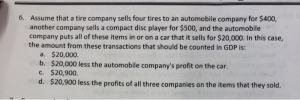 6. Assume that a tire company sells four tires to an automobile company for $400, another company sells a compact disc player for $500, and the automobile company puts all of these items in or on a car that it sells for $20,000. In this case, the amount from these transactions that should be counted in GDP is: a. $20,000. b. $20,000 less the automobile company's profit on the car. c. $20,900. tbut ad nu $20,900 less the profits of...
1. Which statement best predicts the effects of an increase in the supply of loanable funds?...
1. Which statement best predicts the effects of an increase in the supply of loanable funds? a. The interest rate and the real exchange rate both increase. b. The interest rate and the real exchange rate both decrease. c. The interest rate increases, and the real exchange rate decreases. d. The interest rate decreases, and the real exchange rate increases. 2. Which statement is consistent with an above-the-equilibrium exchange rate of the...
6. Suppose there is a surplus in the market for loanable funds. Is the interest rate...
6. Suppose there is a surplus in the market for loanable funds. Is the interest rate above or below its equilibrium level? How do saving and investment at this interest rate be compared? Which one is greater? 7. If at some interest rate desired investment is $400 billion, desired private saving is $600 billion, and the budget deficit is $300 billion, is there a surplus or a shortage in the market for loanable funds? What does this imply would happen...
the If the interest rate in the loanable funds market is currently below the equilibrium level,...
 the If the interest rate in the loanable funds market is currently below the equilibrium level, then the quantity of funds demanded is quantity of funds supplied, and we can expect the interest rate to over time. less than: decrease O greater than: increase greater than: decrease less than: increase
The following graph shows the market for loanable funds in a closed economy.
 The following graph shows the market for loanable funds in a closed economy. The upward-sloping orange line represents the supply of loanable funds, and the downward-sloping blue line represents the demand for loanable funds. Saving is the source of the supply of loanable funds. As the real interest rate rises, the quantity of loanable funds demanded decreases Suppose the real interest rate is 7%. In this case, the quantity of loanable funds supplied is greater than the quantity of loans...
4. Supply and demand for loanable funds The following graph shows the market for loanable funds in a closed economy.
 4. Supply and demand for loanable funds The following graph shows the market for loanable funds in a closed economy. The upward-sloping orange line represents the supply of loanable funds, and the downward-sloping blue line represents the demand for loan funds _______ is the source of the demand for loanable funds. As the interest rate falls, the quantity of loanable funds demanded _______ Suppose the interest rate is 4.5%. Based on the previous graph, the quantity of loanable funds supplied is _______ than...
3. Supply and demand for loanable funds Aa Aa The following graph shows the market for...
 3. Supply and demand for loanable funds The following graph shows the market for loanable funds in a closed economy. The upward-sloping orange line represents the supply of loanable funds, and the downward-sloping blue line represents the demand for loanable funds.Investment is the source of the supply of loanable funds. As the interest rate falls, the quantity of loanable funds supplied increases. Suppose the interest rate is 7%. In this case, the quantity of loanable funds supplied is greater than the quantity of...
For an imaginary economy, when the real interest rate is 7 percent, the quantity of loanable...
For an imaginary economy, when the real interest rate is 7 percent, the quantity of loanable funds demanded is $500 and the quantity of loanable funds supplied is $500. Currently, the nominal interest rate is 9 percent and the inflation rate is 4 percent. Currently, A. the quantity of loanable funds supplied exceeds the quantity of loanable funds demanded, and as a result the real interest rate will rise. B. the quantity of loanable funds supplied exceeds the quantity of...
Interest rate $100 Quantity of loanable funds (billions of dollars) In the Loanable Funds diagram (shown),...
 Interest rate $100 Quantity of loanable funds (billions of dollars) In the Loanable Funds diagram (shown), a decrease in savings by the private sector will shift the curve to the , causing the equilibrium interest rate to
3) Consider the loanable funds market. Use the following supply and demand equations to answer the...
 3) Consider the loanable funds market. Use the following supply and demand equations to answer the questions below. Assume that r is measured as a percentage and Q is the quantity of loans measured in billions. r = 20 -.006Q" r= .5+.004QS a) Assume that T-G = 0, find the equilibrium interest rate and quantity of loans. b) Show equilibrium graphically, label all axes and intercepts. c) Suppose that T-G= -600 and the government borrows the entire amount domestically. Find...
 6. Assume that a tire company sells four tires to an automobile company for $400, another company sells a compact disc player for $500, and the automobile company puts all of these items in or on a car that it sells for $20,000. In this case, the amount from these transactions that should be counted in GDP is: a. $20,000. b. $20,000 less the automobile company's profit on the car. c. $20,900. tbut ad nu $20,900 less the profits of...
 the If the interest rate in the loanable funds market is currently below the equilibrium level, then the quantity of funds demanded is quantity of funds supplied, and we can expect the interest rate to over time. less than: decrease O greater than: increase greater than: decrease less than: increase
 Interest rate $100 Quantity of loanable funds (billions of dollars) In the Loanable Funds diagram (shown), a decrease in savings by the private sector will shift the curve to the , causing the equilibrium interest rate to
 3) Consider the loanable funds market. Use the following supply and demand equations to answer the questions below. Assume that r is measured as a percentage and Q is the quantity of loans measured in billions. r = 20 -.006Q" r= .5+.004QS a) Assume that T-G = 0, find the equilibrium interest rate and quantity of loans. b) Show equilibrium graphically, label all axes and intercepts. c) Suppose that T-G= -600 and the government borrows the entire amount domestically. Find...
Most questions answered within 3 hours.
-
Where is the error in this code sequence?
String s1 = "Hello";
String s2 = "ello";...
asked 11 months ago -
Financial data for Joel de Paris, Inc., for last year
follow:
Joel de Paris, Inc.
Balance...
asked 11 months ago -
Consider this reaction:
Al2(SO4)3 (aq)+ BaCl3
(aq) Al2Cl6 (aq)- +
3BaSO4(s) . What is the...
asked 11 months ago -
Suppose that Savneet is considering increasing her
recent random sample from 20 car rentals to 40...
asked 11 months ago -
Trucks arrive at an unloading terminal at an average rate of 120
per hour.
Trucks arrive...
asked 11 months ago -
Why are methanol and ethanol completely soluble in water while
octanol is not very little soluble....
asked 11 months ago -
A facilities manager at a university reads in a research report
that the mean amount of...
asked 11 months ago -
When the CuSO4 is rehydrated by adding water to the anhydrous
compound, is this an endothermic...
asked 11 months ago -
A ray of sunlight is passing from diamond into crown glass; the
angle of incidence is...
asked 11 months ago -
A block of mass 0.249 kg is placed on top of a light, vertical
spring of...
asked 11 months ago -
how do the kidneys compensate in the presences of acidosis
a) trigger hyperventilate
b) reserve acid...
asked 11 months ago -
Question 501 pts
The rental rate of capital to the firm increases. Which of the
following...
asked 11 months ago