
Homework Answers

Add Answer to:
How do I solve this?
A diatomic gas at 333 K has arn internal energy of...
How do I solve this? 7.33 moles of a diatomic gas are at a temperature of...
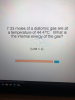 How do I solve this?
7.33 moles of a diatomic gas are at a temperature of 44.4°C. What is the internal energy of the gas? (Unit J)
How do I solve this?
7.33 moles of a diatomic gas are at a temperature of 44.4°C. What is the internal energy of the gas? (Unit J)
General Physics Do parts: i-m and assume the gas is diatomic: U = (5/2)nRT (a) W...
 General Physics
Do parts: i-m and assume the gas is diatomic: U = (5/2)nRT
(a) W = 415.7 J
(b) on the piston
(c) 1039.25 J
(d) Q added = 1454.95 J
(e) W = 0 J
(f) N/A
(g) -1039.25 J
(h) = -1039.25 J
==> DO PARTS i-m
A cyclic process A cylinder contains 0.50 mol of ideal gas at 27.0 °C. First, the gas is heated to 127.0 °C while the pressure is maintained constant at 1.0...
General Physics
Do parts: i-m and assume the gas is diatomic: U = (5/2)nRT
(a) W = 415.7 J
(b) on the piston
(c) 1039.25 J
(d) Q added = 1454.95 J
(e) W = 0 J
(f) N/A
(g) -1039.25 J
(h) = -1039.25 J
==> DO PARTS i-m
A cyclic process A cylinder contains 0.50 mol of ideal gas at 27.0 °C. First, the gas is heated to 127.0 °C while the pressure is maintained constant at 1.0...
How do I solve this? When 597 J of heat are added to a gas, it...
 How do I solve this?
When 597 J of heat are added to a gas, it expands. Its internal energy increases by 318 J. How much work does the gas do? (Be careful with +and - signs. +Wexpansion, +Q-added, +AU temp goes up.) (Unit J)
How do I solve this?
When 597 J of heat are added to a gas, it expands. Its internal energy increases by 318 J. How much work does the gas do? (Be careful with +and - signs. +Wexpansion, +Q-added, +AU temp goes up.) (Unit J)
7. A 0.2 moles of diatomic gas are contained in a cylinder at 300 K and atmospheric pressure 1*10...
7. A 0.2 moles of diatomic gas are contained in a cylinder at 300 K and atmospheric pressure 1*10^5 Pa. The gas receives 1000 J of heat in an ideal adiabatic transformation. Calculate the change of internal energy, the work done on the gas and the final volume and temperature of the gas.
How do I solve this question? Help. PV- nT 7 An 11.2-1 sample of gas is determined to comain 9.50 mol N2 At the sce...
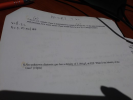 How do I solve this question? Help.
PV- nT 7 An 11.2-1 sample of gas is determined to comain 9.50 mol N2 At the sce epests and pressure, how many moles off gas would there be in a 29-4. g 10p v.zL 10.S0 mo| NG CC NS. 8. An unknown diatomic gas has a density of 3.164 g/L at STP. What is the ideendity of the Gas? (10pts)
How do I solve this question? Help.
PV- nT 7 An 11.2-1 sample of gas is determined to comain 9.50 mol N2 At the sce epests and pressure, how many moles off gas would there be in a 29-4. g 10p v.zL 10.S0 mo| NG CC NS. 8. An unknown diatomic gas has a density of 3.164 g/L at STP. What is the ideendity of the Gas? (10pts)
k How much thermal energy must be added to 7:10 moles of a diatomic ideal gas...
 k
How much thermal energy must be added to 7:10 moles of a diatomic ideal gas to raise its temperature 22.1 K? A) 32603 B) 1960) C) 6523 D) 4570
k
How much thermal energy must be added to 7:10 moles of a diatomic ideal gas to raise its temperature 22.1 K? A) 32603 B) 1960) C) 6523 D) 4570
How do I solve this problem? A classroom has a volume of 165 mA3. How many...
 How do I solve this problem?
A classroom has a volume of 165 mA3. How many moles of gas are in the room if the temperature is 20.0° C and the pressure is 1.00 atm? (Make sure to put P, V, and T in the right units.) (Unit mol)
How do I solve this problem?
A classroom has a volume of 165 mA3. How many moles of gas are in the room if the temperature is 20.0° C and the pressure is 1.00 atm? (Make sure to put P, V, and T in the right units.) (Unit mol)
1. Ideal gas with internal degrees of freedom. Consider a free gas of diatomic molecules at...
 1. Ideal gas with internal degrees of freedom. Consider a free gas of diatomic molecules at temperature 7. Diatomic molecules have internal rotational excitations. The rotational energy levels of a single molecule are given by J(J+1) 2/2 J = 0,1,23 where J is the angular momentum and I is the moment of inertia. The degeneracy of the level J is 2J +1. Neglect any interaction between the molecules in the gas. The temperature is high enough so that the statistic...
General Physics Do parts: e-m and assume the gas is diatomic: U = (5/2)nRT (a) W...
 General Physics
Do parts: e-m and assume the gas is diatomic: U = (5/2)nRT
(a) W = 415.7 J
(b) on the piston
(c) 1039.25 J
(d) Q added = 1454.95 J
------------------Not so sure about part (e) and below
(e) W = 0 J
(f) N/A
(g) -1039.25 J
(g) = -1039.25 J
A cyclic process A cylinder contains 0.50 mol of ideal gas at 27.0 °C. First, the gas is heated to 127.0 °C while the pressure is...
General Physics
Do parts: e-m and assume the gas is diatomic: U = (5/2)nRT
(a) W = 415.7 J
(b) on the piston
(c) 1039.25 J
(d) Q added = 1454.95 J
------------------Not so sure about part (e) and below
(e) W = 0 J
(f) N/A
(g) -1039.25 J
(g) = -1039.25 J
A cyclic process A cylinder contains 0.50 mol of ideal gas at 27.0 °C. First, the gas is heated to 127.0 °C while the pressure is...
The universal gas constant is 8.31451 J/K · mol. Calculate the change in internal energy of...
The universal gas constant is 8.31451 J/K · mol. Calculate the change in internal energy of 4 mol of helium gas when its temperature is increased by 5.2 K. Answer in units of J.
 How do I solve this?
7.33 moles of a diatomic gas are at a temperature of 44.4°C. What is the internal energy of the gas? (Unit J)
How do I solve this?
7.33 moles of a diatomic gas are at a temperature of 44.4°C. What is the internal energy of the gas? (Unit J)
 General Physics
Do parts: i-m and assume the gas is diatomic: U = (5/2)nRT
(a) W = 415.7 J
(b) on the piston
(c) 1039.25 J
(d) Q added = 1454.95 J
(e) W = 0 J
(f) N/A
(g) -1039.25 J
(h) = -1039.25 J
==> DO PARTS i-m
A cyclic process A cylinder contains 0.50 mol of ideal gas at 27.0 °C. First, the gas is heated to 127.0 °C while the pressure is maintained constant at 1.0...
General Physics
Do parts: i-m and assume the gas is diatomic: U = (5/2)nRT
(a) W = 415.7 J
(b) on the piston
(c) 1039.25 J
(d) Q added = 1454.95 J
(e) W = 0 J
(f) N/A
(g) -1039.25 J
(h) = -1039.25 J
==> DO PARTS i-m
A cyclic process A cylinder contains 0.50 mol of ideal gas at 27.0 °C. First, the gas is heated to 127.0 °C while the pressure is maintained constant at 1.0...
 How do I solve this?
When 597 J of heat are added to a gas, it expands. Its internal energy increases by 318 J. How much work does the gas do? (Be careful with +and - signs. +Wexpansion, +Q-added, +AU temp goes up.) (Unit J)
How do I solve this?
When 597 J of heat are added to a gas, it expands. Its internal energy increases by 318 J. How much work does the gas do? (Be careful with +and - signs. +Wexpansion, +Q-added, +AU temp goes up.) (Unit J)
 How do I solve this question? Help.
PV- nT 7 An 11.2-1 sample of gas is determined to comain 9.50 mol N2 At the sce epests and pressure, how many moles off gas would there be in a 29-4. g 10p v.zL 10.S0 mo| NG CC NS. 8. An unknown diatomic gas has a density of 3.164 g/L at STP. What is the ideendity of the Gas? (10pts)
How do I solve this question? Help.
PV- nT 7 An 11.2-1 sample of gas is determined to comain 9.50 mol N2 At the sce epests and pressure, how many moles off gas would there be in a 29-4. g 10p v.zL 10.S0 mo| NG CC NS. 8. An unknown diatomic gas has a density of 3.164 g/L at STP. What is the ideendity of the Gas? (10pts)
 k
How much thermal energy must be added to 7:10 moles of a diatomic ideal gas to raise its temperature 22.1 K? A) 32603 B) 1960) C) 6523 D) 4570
k
How much thermal energy must be added to 7:10 moles of a diatomic ideal gas to raise its temperature 22.1 K? A) 32603 B) 1960) C) 6523 D) 4570
 How do I solve this problem?
A classroom has a volume of 165 mA3. How many moles of gas are in the room if the temperature is 20.0° C and the pressure is 1.00 atm? (Make sure to put P, V, and T in the right units.) (Unit mol)
How do I solve this problem?
A classroom has a volume of 165 mA3. How many moles of gas are in the room if the temperature is 20.0° C and the pressure is 1.00 atm? (Make sure to put P, V, and T in the right units.) (Unit mol)
 1. Ideal gas with internal degrees of freedom. Consider a free gas of diatomic molecules at temperature 7. Diatomic molecules have internal rotational excitations. The rotational energy levels of a single molecule are given by J(J+1) 2/2 J = 0,1,23 where J is the angular momentum and I is the moment of inertia. The degeneracy of the level J is 2J +1. Neglect any interaction between the molecules in the gas. The temperature is high enough so that the statistic...
 General Physics
Do parts: e-m and assume the gas is diatomic: U = (5/2)nRT
(a) W = 415.7 J
(b) on the piston
(c) 1039.25 J
(d) Q added = 1454.95 J
------------------Not so sure about part (e) and below
(e) W = 0 J
(f) N/A
(g) -1039.25 J
(g) = -1039.25 J
A cyclic process A cylinder contains 0.50 mol of ideal gas at 27.0 °C. First, the gas is heated to 127.0 °C while the pressure is...
General Physics
Do parts: e-m and assume the gas is diatomic: U = (5/2)nRT
(a) W = 415.7 J
(b) on the piston
(c) 1039.25 J
(d) Q added = 1454.95 J
------------------Not so sure about part (e) and below
(e) W = 0 J
(f) N/A
(g) -1039.25 J
(g) = -1039.25 J
A cyclic process A cylinder contains 0.50 mol of ideal gas at 27.0 °C. First, the gas is heated to 127.0 °C while the pressure is...
Most questions answered within 3 hours.
-
Where is the error in this code sequence?
String s1 = "Hello";
String s2 = "ello";...
asked 10 months ago -
Financial data for Joel de Paris, Inc., for last year
follow:
Joel de Paris, Inc.
Balance...
asked 10 months ago -
Consider this reaction:
Al2(SO4)3 (aq)+ BaCl3
(aq) Al2Cl6 (aq)- +
3BaSO4(s) . What is the...
asked 10 months ago -
Suppose that Savneet is considering increasing her
recent random sample from 20 car rentals to 40...
asked 10 months ago -
Trucks arrive at an unloading terminal at an average rate of 120
per hour.
Trucks arrive...
asked 10 months ago -
Why are methanol and ethanol completely soluble in water while
octanol is not very little soluble....
asked 10 months ago -
A facilities manager at a university reads in a research report
that the mean amount of...
asked 10 months ago -
When the CuSO4 is rehydrated by adding water to the anhydrous
compound, is this an endothermic...
asked 10 months ago -
A ray of sunlight is passing from diamond into crown glass; the
angle of incidence is...
asked 10 months ago -
A block of mass 0.249 kg is placed on top of a light, vertical
spring of...
asked 10 months ago -
how do the kidneys compensate in the presences of acidosis
a) trigger hyperventilate
b) reserve acid...
asked 10 months ago -
Question 501 pts
The rental rate of capital to the firm increases. Which of the
following...
asked 10 months ago