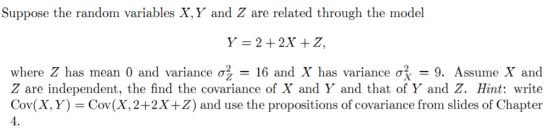
Suppose the random variables X, Y and Z are related through the model
Y = 2 + 2X + Z,
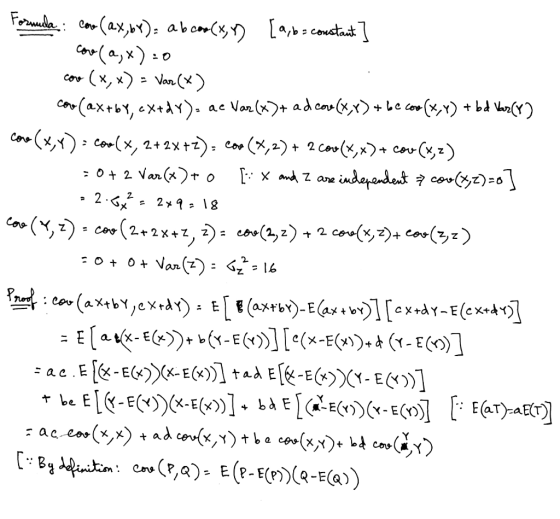
where Z has mean 0 and variance σ2 Z = 16 and X has variance σ2 X = 9. Assume X and Z are independent, the find the covariance of X and Y and that of Y and Z. Hint: write Cov(X, Y ) = Cov(X, 2+2X+Z) and use the propositions of covariance from slides of Chapter 4.
Homework Answers
Add Answer to:
Suppose the random variables X, Y and Z are related through the
model
Y = 2...
5. Suppose the random variables X, Y and Z are related through the model Y =...
 5. Suppose the random variables X, Y and Z are related through the model Y = 2 + 2X + 2, where Z has mean 0 and variance o2 = 16 and X has variance of = 9. Assume X and Z are independent, the find the covariance of X and Y and that of Y and Z. Hint: write Cov(X,Y) = Cov(X, 2+2X+Z) and use the propositions of covariance from slides of Chapter
5. Suppose the random variables X, Y and Z are related through the model Y =...
 5. Suppose the random variables X, Y and Z are related through the model Y = 2 + 2X + Z, where Z has mean 0 and variance o2 = 16 and X has variance of = 9. Assume X and Z are independent, the find the covariance of X and Y and that of Y and Z. Hint: write Cov(X, Y) = Cov(X, 2+2X+Z) and use the propositions of covariance from slides of Chapter
10.3.8 Suppose that Y = E(Y | X) + Z, where X, Y and Z are...
 10.3.8 Suppose that Y = E(Y | X) + Z, where X, Y and Z are random variables. (a) Show that E (Z | X) = 0. (b) Show that Cov(E(Y | X), Ζ) = 0. (Hint. Write Z-Y-E(YİX) and use Theo- rems 3.5.2 and 3.5.4.) (c) Suppose that Z is independent of X. Show that this implies that the conditional distribution of Y given X depends on X only through its conditional mean. (Hint: Evaluate the conditional distribution function...
If the random variables X, Y, and Z have the means ji x = 3, My...
 If the random variables X, Y, and Z have the means ji x = 3, My = -2, and uz = 2, the variances of = 3, o = 3, o2 = 2, the covariances cov(X,Y) = -2, cov(X, Z) = -1, and cov(Y,Z) = 1, U = Y - Z, and V = X - Y + 2Z. (a) Find the mean and the variance of U and V. (b) Find the covariance of U and V.
If the random variables X, Y, and Z have the means ux = 3, uy =...
 If the random variables X, Y, and Z have the means ux = 3, uy = -2, and uz = 2, the variances o = 3, o = 3, o2 = 2, the covariances cov(X,Y) = -2, cov(X, Z) = -1, and cov(Y,Z) = 1, U = Y - Z, and V = X - Y +2Z. (a) Find the mean and the variance of U and V, respectively. (b) Find the covariance of U and V.
Suppose X, Y and Z are independent standard normal random variables. Then W = 2X +...
 Suppose X, Y and Z are independent standard normal random variables. Then W = 2X + Y - Z is a random variable with mean 0 and variance 2, but not necessarily normal distributed. a normal random variable with mean 0 and variance 4. O a random variable with mean 0 and variance 4, but not necessarily normal distributed. a random variable with mean 0 and variance 6, but not necessarily normal distributed. a normal random variable with mean 0...
Suppose X, Y and Z are independent standard normal random variables. Then W = 2X +...
 Suppose X, Y and Z are independent standard normal random variables. Then W = 2X + Y - Z is a random variable with mean 0 and variance 2, but not necessarily normal distributed. a normal random variable with mean 0 and variance 4. O a random variable with mean 0 and variance 4, but not necessarily normal distributed. a random variable with mean 0 and variance 6, but not necessarily normal distributed. a normal random variable with mean 0...
5. The means, standard deviations, and covariance for random variables X, Y, and Z are given...
 5. The means, standard deviations, and covariance for random variables X, Y, and Z are given below. Ux= 3, uy = 5, uz = 7 Ox= 1, OY = 3, oz = 4 cov(X, Y) = 1, cov (X, Z) = 3, and cov (Y,Z) = -3 T= X-28 +3 Z var(T) = 16. For a random variable X with an unknown distribution. The mean of X is u = 22 and tting a randomly chosen value of X
2. Properties of Correlation and Covariance: Two random variables Y and Z are represented by the...
 2. Properties of Correlation and Covariance: Two random variables Y and Z are represented by the following relationships Y = 0.5+0.6X Z = 0.2+0.3x where X is another random variable. You can treat the variance, Var(X), as a given constant. It may help to give Var(X) a name, ie. Var(x)ox2 a. Calcuate var(Y) and Var(Z) as a function of Var(X). Which is hrger? b. Calcuate Cov(Y,Z), Cov(X,Z) and Cov(X,Y) as a function of var(X). c. Calcuate Corr(Y,Z), Corr(X,Z) and Corn(X,Y)...
Suppose X, Y and Z are three different random variables. Let X obey Bernoulli Distribution. The...
Suppose X, Y and Z are three different random variables. Let X obey Bernoulli Distribution. The probability distribution function is p(x) = Let Y obeys the standard Normal (Gaussian) distribution, which can be written as Y ∼ N(0, 1). X and Y are independent. Meanwhile, let Z = XY . (a) What is the Expectation (mean value) of X? (b) Are Y and Z independent? (Just clarify, do not need to prove) (c) Show that Z is also a standard...
 5. Suppose the random variables X, Y and Z are related through the model Y = 2 + 2X + 2, where Z has mean 0 and variance o2 = 16 and X has variance of = 9. Assume X and Z are independent, the find the covariance of X and Y and that of Y and Z. Hint: write Cov(X,Y) = Cov(X, 2+2X+Z) and use the propositions of covariance from slides of Chapter
 5. Suppose the random variables X, Y and Z are related through the model Y = 2 + 2X + Z, where Z has mean 0 and variance o2 = 16 and X has variance of = 9. Assume X and Z are independent, the find the covariance of X and Y and that of Y and Z. Hint: write Cov(X, Y) = Cov(X, 2+2X+Z) and use the propositions of covariance from slides of Chapter
 10.3.8 Suppose that Y = E(Y | X) + Z, where X, Y and Z are random variables. (a) Show that E (Z | X) = 0. (b) Show that Cov(E(Y | X), Ζ) = 0. (Hint. Write Z-Y-E(YİX) and use Theo- rems 3.5.2 and 3.5.4.) (c) Suppose that Z is independent of X. Show that this implies that the conditional distribution of Y given X depends on X only through its conditional mean. (Hint: Evaluate the conditional distribution function...
 If the random variables X, Y, and Z have the means ji x = 3, My = -2, and uz = 2, the variances of = 3, o = 3, o2 = 2, the covariances cov(X,Y) = -2, cov(X, Z) = -1, and cov(Y,Z) = 1, U = Y - Z, and V = X - Y + 2Z. (a) Find the mean and the variance of U and V. (b) Find the covariance of U and V.
 If the random variables X, Y, and Z have the means ux = 3, uy = -2, and uz = 2, the variances o = 3, o = 3, o2 = 2, the covariances cov(X,Y) = -2, cov(X, Z) = -1, and cov(Y,Z) = 1, U = Y - Z, and V = X - Y +2Z. (a) Find the mean and the variance of U and V, respectively. (b) Find the covariance of U and V.
 Suppose X, Y and Z are independent standard normal random variables. Then W = 2X + Y - Z is a random variable with mean 0 and variance 2, but not necessarily normal distributed. a normal random variable with mean 0 and variance 4. O a random variable with mean 0 and variance 4, but not necessarily normal distributed. a random variable with mean 0 and variance 6, but not necessarily normal distributed. a normal random variable with mean 0...
 Suppose X, Y and Z are independent standard normal random variables. Then W = 2X + Y - Z is a random variable with mean 0 and variance 2, but not necessarily normal distributed. a normal random variable with mean 0 and variance 4. O a random variable with mean 0 and variance 4, but not necessarily normal distributed. a random variable with mean 0 and variance 6, but not necessarily normal distributed. a normal random variable with mean 0...
 5. The means, standard deviations, and covariance for random variables X, Y, and Z are given below. Ux= 3, uy = 5, uz = 7 Ox= 1, OY = 3, oz = 4 cov(X, Y) = 1, cov (X, Z) = 3, and cov (Y,Z) = -3 T= X-28 +3 Z var(T) = 16. For a random variable X with an unknown distribution. The mean of X is u = 22 and tting a randomly chosen value of X
 2. Properties of Correlation and Covariance: Two random variables Y and Z are represented by the following relationships Y = 0.5+0.6X Z = 0.2+0.3x where X is another random variable. You can treat the variance, Var(X), as a given constant. It may help to give Var(X) a name, ie. Var(x)ox2 a. Calcuate var(Y) and Var(Z) as a function of Var(X). Which is hrger? b. Calcuate Cov(Y,Z), Cov(X,Z) and Cov(X,Y) as a function of var(X). c. Calcuate Corr(Y,Z), Corr(X,Z) and Corn(X,Y)...
Most questions answered within 3 hours.
-
Where is the error in this code sequence?
String s1 = "Hello";
String s2 = "ello";...
asked 10 months ago -
Financial data for Joel de Paris, Inc., for last year
follow:
Joel de Paris, Inc.
Balance...
asked 10 months ago -
Consider this reaction:
Al2(SO4)3 (aq)+ BaCl3
(aq) Al2Cl6 (aq)- +
3BaSO4(s) . What is the...
asked 10 months ago -
Suppose that Savneet is considering increasing her
recent random sample from 20 car rentals to 40...
asked 10 months ago -
Trucks arrive at an unloading terminal at an average rate of 120
per hour.
Trucks arrive...
asked 10 months ago -
Why are methanol and ethanol completely soluble in water while
octanol is not very little soluble....
asked 10 months ago -
A facilities manager at a university reads in a research report
that the mean amount of...
asked 10 months ago -
When the CuSO4 is rehydrated by adding water to the anhydrous
compound, is this an endothermic...
asked 10 months ago -
A ray of sunlight is passing from diamond into crown glass; the
angle of incidence is...
asked 10 months ago -
A block of mass 0.249 kg is placed on top of a light, vertical
spring of...
asked 10 months ago -
how do the kidneys compensate in the presences of acidosis
a) trigger hyperventilate
b) reserve acid...
asked 10 months ago -
Question 501 pts
The rental rate of capital to the firm increases. Which of the
following...
asked 10 months ago