
Homework Answers
Add Answer to:
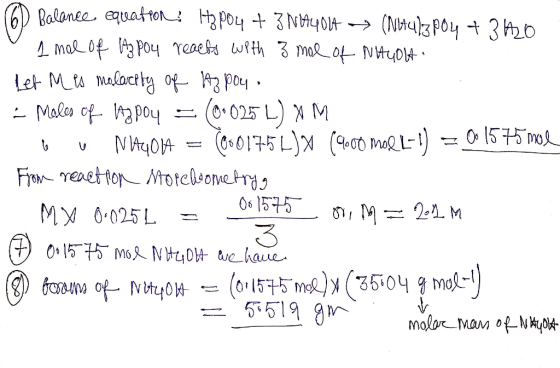
(617.5 ml of 9.00 M NHAOH were added to 25.0 ml of H3PO4 to reach the...
urgent!!! The neutralization reaction between ammonium hydroxide (NH4OH, MM = 35.04 g/mol) and phosphoric acid (H3PO4,...
 urgent!!!
The neutralization reaction between ammonium hydroxide (NH4OH, MM = 35.04 g/mol) and phosphoric acid (H3PO4, MM = 98.00 g/mol) proceeds according to the following balanced eqation: 3NH4OH(aq) + H3PO4(aq) ->3H20(1) + (NH4)3PO4(aq) What is the final molarity of the ammonium ion (NH4+, MM = 18.05 g/mol) when 25.0 mL of 1.20 molar ammonium hydroxide is reacted with 25.0 mL of 2.00 molar phosphoric acid?
urgent!!!
The neutralization reaction between ammonium hydroxide (NH4OH, MM = 35.04 g/mol) and phosphoric acid (H3PO4, MM = 98.00 g/mol) proceeds according to the following balanced eqation: 3NH4OH(aq) + H3PO4(aq) ->3H20(1) + (NH4)3PO4(aq) What is the final molarity of the ammonium ion (NH4+, MM = 18.05 g/mol) when 25.0 mL of 1.20 molar ammonium hydroxide is reacted with 25.0 mL of 2.00 molar phosphoric acid?
final molarity of ammonium The neutralization reaction between ammonium hydroxide (NH4OH, MM = 35.04 g/mol) and...
 final molarity of ammonium
The neutralization reaction between ammonium hydroxide (NH4OH, MM = 35.04 g/mol) and phosphoric acid (H3PO4, MM 98.00 g/mol) proceeds according to the following balanced eqation: 3NH2OH(aq) + H3PO4(aq)->3H20(1) + (NH4)3PO4(aq) What is the final molarity of the ammonium ion (NH4+. MM = 18.05 g/mol) when 25.0 mL of 1.20 molar ammonium hydroxide is reacted with 25.0 mL of 2.00 molar phosphoric acid?
final molarity of ammonium
The neutralization reaction between ammonium hydroxide (NH4OH, MM = 35.04 g/mol) and phosphoric acid (H3PO4, MM 98.00 g/mol) proceeds according to the following balanced eqation: 3NH2OH(aq) + H3PO4(aq)->3H20(1) + (NH4)3PO4(aq) What is the final molarity of the ammonium ion (NH4+. MM = 18.05 g/mol) when 25.0 mL of 1.20 molar ammonium hydroxide is reacted with 25.0 mL of 2.00 molar phosphoric acid?
An aqueous solution of Ca(OH)2with a concentration of 0.143 M was used to titrate 25.00 mL...
 An aqueous solution of Ca(OH)2with a concentration of
0.143 M was used to titrate 25.00 mL of aqueous HCl. 14.73
mL of the Ca(OH)2was required to reach the endpoint of
the titration.
How many moles of base were required to react completely with the
acid in this reaction?
How many moles of HCl were present in the original 25.00 mL of
acid?
What is the molarity of the original HCl solution?
04 Question (a points) aSee page 166 Watch the...
An aqueous solution of Ca(OH)2with a concentration of
0.143 M was used to titrate 25.00 mL of aqueous HCl. 14.73
mL of the Ca(OH)2was required to reach the endpoint of
the titration.
How many moles of base were required to react completely with the
acid in this reaction?
How many moles of HCl were present in the original 25.00 mL of
acid?
What is the molarity of the original HCl solution?
04 Question (a points) aSee page 166 Watch the...
→ X COD Data: & p 029 A 25.0 mL volume of 0.235 M Sr(NO3)2 is...
 → X COD Data: & p 029 A 25.0 mL volume of 0.235 M Sr(NO3)2 is added to 20.0 mL 0.300 M (NH4)3PO4. What is the maximum amount of solid product that can be collected? XI FIRE, ALT+F10 (PC) ER ALT+FN+F10 (Mac). TT TT Arial 3 (12pt) E.E. T. % DO Q E SE T' T, mq - - - O fx Mashups - 16 @ @ % :p 105 10 A 25.0 ml volume of 0.235 M Sr(NO3)2 is...
9. a If 25.0 mL of KOH solution is neutralized by 13.31 mL of 0.111 M...
 9. a If 25.0 mL of KOH solution is neutralized by 13.31 mL of 0.111 M H3PO4, what is the molarity of the KOH? State formula, of course you were going to do that, right? b) How many mL of 0.123 M H2SO4 solution is needed to neutralize 25,0 mL of 0.250 M KOH solution?
25.0 mL of 0.100 M NiSO4 solution is added to 50.0-mL of a 0.080 M NaOH...
25.0 mL of 0.100 M NiSO4 solution is added to 50.0-mL of a 0.080 M NaOH solution. NiSO4(aq) + 2 NaOH(aq) -> Ni(OH)2(s) + Na2SO4(aq) a. What is the limiting reagent? b. What is the mass of precipitate formed? c. After the reaction is complete, calculate the concentration of the reactant remaining in solution. ( NiSO4 = 158.8 g/mol | NaOH = 40.0 g/mol | Ni(OH)2 = 92.7 g/mol )
Suppose you have 50.5 mL of a solution of H3PO4. You titrate it with a 0.10...
Suppose you have 50.5 mL of a solution of H3PO4. You titrate it with a 0.10 M solution of Sr(OH)2 and use 15.3 mL to reach the endpoint. What is the concentration of H3PO4? What was the pH of the original H3PO4 solution?
An aqueous solution of Ca(OH)2with a concentration of 0.161 M was used to titrate 25.00 mL...
 An aqueous solution of Ca(OH)2with a concentration of
0.161 M was used to titrate 25.00 mL of aqueous HCl. 18.63
mL of the Ca(OH)2was required to reach the endpoint of
the titration.
Part 1 (1 point) How many moles of base were required to react completely with the acid in this reaction? x 10 mol Ca(OH)2 -- Part 2 (1 point) How many moles of HCl were present in the original 25.00 mL of acid? x 10 mol HCl +...
An aqueous solution of Ca(OH)2with a concentration of
0.161 M was used to titrate 25.00 mL of aqueous HCl. 18.63
mL of the Ca(OH)2was required to reach the endpoint of
the titration.
Part 1 (1 point) How many moles of base were required to react completely with the acid in this reaction? x 10 mol Ca(OH)2 -- Part 2 (1 point) How many moles of HCl were present in the original 25.00 mL of acid? x 10 mol HCl +...
A 15.44 mL sample of acetic acid requires 32.10 mL of 0.0500 M Ba(OH)2 to reach...
A 15.44 mL sample of acetic acid requires 32.10 mL of 0.0500 M Ba(OH)2 to reach the endpoint. a) Calculate the molarity of the unknown acid b) what is the theoretical pH when 15.8 mL of Ba(OH)2 is added? c) What is the theoretical pH at the point when a total of 32.10 mL Ba(OH)2 is added?
Calculate the molarity of H2SO4 that results after 10.0 mL of H2O are added to 25.0...
Calculate the molarity of H2SO4 that results after 10.0 mL of H2O are added to 25.0 mL of 0.500 M H2SO4 in preparation for the following reaction. Assume the volumes are additive. H2SO4(aq)+ 2NaOH—> Na2SO4(aq) + 2H2O(l) answer is: 0.357 M
 urgent!!!
The neutralization reaction between ammonium hydroxide (NH4OH, MM = 35.04 g/mol) and phosphoric acid (H3PO4, MM = 98.00 g/mol) proceeds according to the following balanced eqation: 3NH4OH(aq) + H3PO4(aq) ->3H20(1) + (NH4)3PO4(aq) What is the final molarity of the ammonium ion (NH4+, MM = 18.05 g/mol) when 25.0 mL of 1.20 molar ammonium hydroxide is reacted with 25.0 mL of 2.00 molar phosphoric acid?
urgent!!!
The neutralization reaction between ammonium hydroxide (NH4OH, MM = 35.04 g/mol) and phosphoric acid (H3PO4, MM = 98.00 g/mol) proceeds according to the following balanced eqation: 3NH4OH(aq) + H3PO4(aq) ->3H20(1) + (NH4)3PO4(aq) What is the final molarity of the ammonium ion (NH4+, MM = 18.05 g/mol) when 25.0 mL of 1.20 molar ammonium hydroxide is reacted with 25.0 mL of 2.00 molar phosphoric acid?
 final molarity of ammonium
The neutralization reaction between ammonium hydroxide (NH4OH, MM = 35.04 g/mol) and phosphoric acid (H3PO4, MM 98.00 g/mol) proceeds according to the following balanced eqation: 3NH2OH(aq) + H3PO4(aq)->3H20(1) + (NH4)3PO4(aq) What is the final molarity of the ammonium ion (NH4+. MM = 18.05 g/mol) when 25.0 mL of 1.20 molar ammonium hydroxide is reacted with 25.0 mL of 2.00 molar phosphoric acid?
final molarity of ammonium
The neutralization reaction between ammonium hydroxide (NH4OH, MM = 35.04 g/mol) and phosphoric acid (H3PO4, MM 98.00 g/mol) proceeds according to the following balanced eqation: 3NH2OH(aq) + H3PO4(aq)->3H20(1) + (NH4)3PO4(aq) What is the final molarity of the ammonium ion (NH4+. MM = 18.05 g/mol) when 25.0 mL of 1.20 molar ammonium hydroxide is reacted with 25.0 mL of 2.00 molar phosphoric acid?
 An aqueous solution of Ca(OH)2with a concentration of
0.143 M was used to titrate 25.00 mL of aqueous HCl. 14.73
mL of the Ca(OH)2was required to reach the endpoint of
the titration.
How many moles of base were required to react completely with the
acid in this reaction?
How many moles of HCl were present in the original 25.00 mL of
acid?
What is the molarity of the original HCl solution?
04 Question (a points) aSee page 166 Watch the...
An aqueous solution of Ca(OH)2with a concentration of
0.143 M was used to titrate 25.00 mL of aqueous HCl. 14.73
mL of the Ca(OH)2was required to reach the endpoint of
the titration.
How many moles of base were required to react completely with the
acid in this reaction?
How many moles of HCl were present in the original 25.00 mL of
acid?
What is the molarity of the original HCl solution?
04 Question (a points) aSee page 166 Watch the...
 → X COD Data: & p 029 A 25.0 mL volume of 0.235 M Sr(NO3)2 is added to 20.0 mL 0.300 M (NH4)3PO4. What is the maximum amount of solid product that can be collected? XI FIRE, ALT+F10 (PC) ER ALT+FN+F10 (Mac). TT TT Arial 3 (12pt) E.E. T. % DO Q E SE T' T, mq - - - O fx Mashups - 16 @ @ % :p 105 10 A 25.0 ml volume of 0.235 M Sr(NO3)2 is...
 9. a If 25.0 mL of KOH solution is neutralized by 13.31 mL of 0.111 M H3PO4, what is the molarity of the KOH? State formula, of course you were going to do that, right? b) How many mL of 0.123 M H2SO4 solution is needed to neutralize 25,0 mL of 0.250 M KOH solution?
 An aqueous solution of Ca(OH)2with a concentration of
0.161 M was used to titrate 25.00 mL of aqueous HCl. 18.63
mL of the Ca(OH)2was required to reach the endpoint of
the titration.
Part 1 (1 point) How many moles of base were required to react completely with the acid in this reaction? x 10 mol Ca(OH)2 -- Part 2 (1 point) How many moles of HCl were present in the original 25.00 mL of acid? x 10 mol HCl +...
An aqueous solution of Ca(OH)2with a concentration of
0.161 M was used to titrate 25.00 mL of aqueous HCl. 18.63
mL of the Ca(OH)2was required to reach the endpoint of
the titration.
Part 1 (1 point) How many moles of base were required to react completely with the acid in this reaction? x 10 mol Ca(OH)2 -- Part 2 (1 point) How many moles of HCl were present in the original 25.00 mL of acid? x 10 mol HCl +...
Most questions answered within 3 hours.
-
Where is the error in this code sequence?
String s1 = "Hello";
String s2 = "ello";...
asked 11 months ago -
Financial data for Joel de Paris, Inc., for last year
follow:
Joel de Paris, Inc.
Balance...
asked 11 months ago -
Consider this reaction:
Al2(SO4)3 (aq)+ BaCl3
(aq) Al2Cl6 (aq)- +
3BaSO4(s) . What is the...
asked 11 months ago -
Suppose that Savneet is considering increasing her
recent random sample from 20 car rentals to 40...
asked 11 months ago -
Trucks arrive at an unloading terminal at an average rate of 120
per hour.
Trucks arrive...
asked 11 months ago -
Why are methanol and ethanol completely soluble in water while
octanol is not very little soluble....
asked 11 months ago -
A facilities manager at a university reads in a research report
that the mean amount of...
asked 11 months ago -
When the CuSO4 is rehydrated by adding water to the anhydrous
compound, is this an endothermic...
asked 11 months ago -
A ray of sunlight is passing from diamond into crown glass; the
angle of incidence is...
asked 11 months ago -
A block of mass 0.249 kg is placed on top of a light, vertical
spring of...
asked 11 months ago -
how do the kidneys compensate in the presences of acidosis
a) trigger hyperventilate
b) reserve acid...
asked 11 months ago -
Question 501 pts
The rental rate of capital to the firm increases. Which of the
following...
asked 11 months ago