
Homework Answers
Solution:
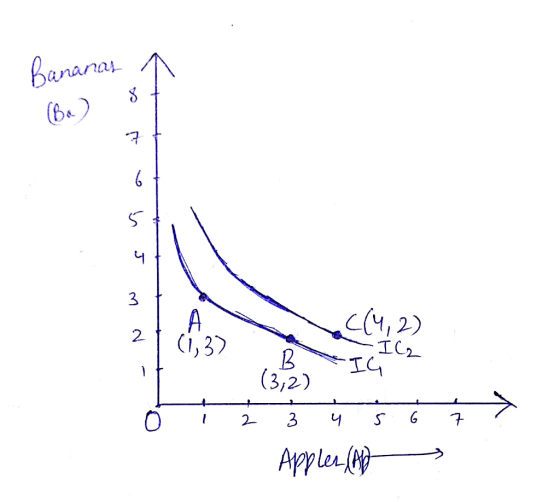
Consumption bundles faced by Prof. Wu: A = (1 apple, 3 bananas), B = (3 apples, 2 bananas) and C = (4 apples, 2 bananas)
We are also given that Prof. Wu is indifferent between A and B, and prefers C to B.
1) Since, Prof. Wu is rational, he has to satisfy the conditions of rationality. Rational preferences are the one which satisfy both the conditions, condition of completeness and condition of transitivity.
Under completeness, Prof. Wu can always compare any 2 given consumption bundles. That is whenever faced with 2 consumption choices, he can always decide whether he prefers either one over the other or is indifferent between the two. We already know from the question that how the prof. compares bundles A and B, and how he compares bundles B and C. Completeness property tells that the prof can also always compare bundles A and C.
Under transitivity, we mainly refer to the consistency of preferences. Like under completeness we claimed that prof can compare A and C, under transitivity we can figure out the order of comparison. So, given any 3 bundles choices, if we know how any 2 of the pairs are compared by a person, with principle of transitivity we can always learn the comparison of the third remaining pair. So, for consistency, if Prof. Wu prefers C over B and is indifferent between B and A, it must be that he prefers C over A. In notations, this means
If (C (curly) > B) and (B ~ A), then (C (curly) > A).
2) Since, Prof. Wu is indifferent between bundles A and B, they both must lie on the same indifference curve. Correspondingly, since bundle C is preferred to bundle B (and bundle A as well), bundle C must lie lie on an indifference curve lying higher (in direction of 1st quadrant, that is up and right to the origin) to the one carrying bundles A and B.
Following is the required graph:
3) We are given price of an apple, Pa = $1 and price of banana, Pb = $1, income to be spend on food, M = $5, and denoting apples by Ap and bananas by Ba
So, the budget line becomes: Pa*Ap + Pb*Ba = M
1*Ap + 1*Ba = 5
Ap + Ba = 5
Taking apples on the horizontal axis and bananas on the vertical axis, Ap/5 + Ba/5 = 1, gives us horizontal intercept as 5 and vertical intercept as 5.
To maximize the satisfaction, Prof. Wu will always consume ON the budget line. So, among the three consumption bundles and given the budget line, it will choose the bundle where Ap and Ba are such that Ap + Ba = 5 (so, subject to the budget constraint).
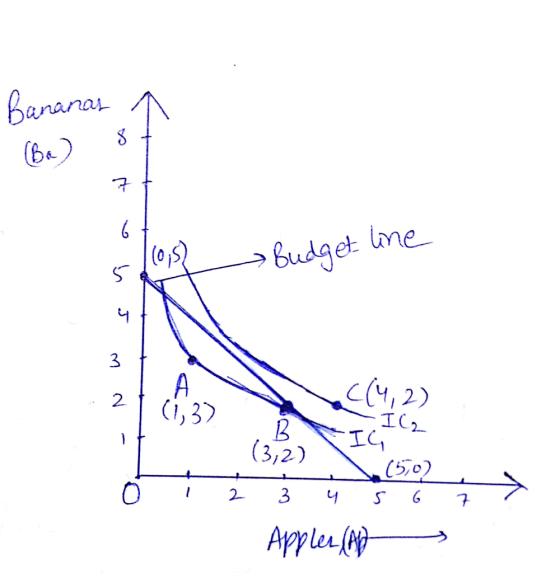
Among the given 3 bundles, this equation/condition is satisfied only when bundle B is chosen (Ap = 3, Ba = 2, and Ap + Ba = 3 + 2 = 5). So, Prof. Wu would choose bundle B.
Add Answer to:
Problem 2 Suppose that Prof. Wu faces three consumption bundles A-1 apples,3 bananas), . B (3...
3. Consider Charlie who consumes apples (xi) and bananas (2). Suppose that he consumes one apple...
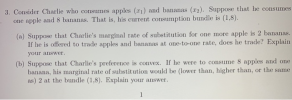 3. Consider Charlie who consumes apples (xi) and bananas (2). Suppose that he consumes one apple and 8 bananas. That is, his current consumption bundle is (1,8). (a) Suppose that Charlie's marginal rate of substitution for one more apple is 2 bananas. If he is offered to trade apples and bananas at one-to-one rate, does he trade? Explain your answer. (b) Suppose that Charlie's preference is convex. If he were to consume 8 apples and one banana, his marginal rate...
3. Craig likes both apples and bananas. He consumes nothing else. The consumption bundle where Craig...
 3. Craig likes both apples and bananas. He consumes nothing else. The consumption bundle where Craig consumes x, bushels of apples per year and Xg bushels of bananas per year is written as (X4, Xg). Last year, Craig consumed 20 bushels of apples and 5 bushels of bananas. It happens that the set of consumption bundles (XA, Xg) such that Craig is indifferent between (XA, Xg) and 0,5) is the set of all bundles such that Xg = 100/XA. The...
1. Charlie’s utility function for weekly consumption of bananas (B) and Apples (A) is given by...
1. Charlie’s utility function for weekly consumption of bananas (B) and Apples (A) is given by U = BA . a. Suppose Charlie consumes 20 bananas and 10 apples in a week. Sketch his indifference curve through that bundle on a diagram. (While it doesn’t really matter which good is on the horizontal axis, for consistency with our classwork, assume bananas are on the horizontal axis.) b. Use calculus (partial derivatives) to derive formulas for the marginal utilities (MU) of...
2. Mike's preferences are represented by the utility function U(A, B) A+2B. He has an income...
 2. Mike's preferences are represented by the utility function U(A, B) A+2B. He has an income of $20. Consider each of the following combination of prices of goods. On the same graph, (i) graph a family of indifference curves for the consumer, (ü) graph the budget lines for each combination of prices, (i cakculate and label the optimal consumption choice(s) for each combination of prices, and (iv) cakulate the utility Mike derives from consuming the optimal consumption choice. bananas 20...
2. Mike's preferences are represented by the utility function U(A, B) A+2B. He has an income...
 2. Mike's preferences are represented by the utility function U(A, B) A+2B. He has an income of S20. Consider each of the following combination of prices of goods. On the same graph, (i) graph a family of indifference curves for the consumer, (ii) graph the budget lines for each combination of prices, (iii) calculate and label the optimal consumption choice(s) for each combination of prices, and (iv) calculate the utility Mike derives from consuming the optimal consumption choice. bananas 20...
2. Mike's preferences are represented by the utility function U(A, B)- A+2B. He has an income...
 2. Mike's preferences are represented by the utility function U(A, B)- A+2B. He has an income of $20. Consider each of the following combination of prices of goods. On the same graph, (i) graph a family of indifference curves for the consumer, (ii) graph the budget lines for each combination of prices, (iii) calculate and label the optimal consumption choice(s) for each combination of prices, and (iv) calculate the utility Mike derives from consuming the optimal consumption choice bananas (a)...
1. Suppose Skippy is indifferent between the following bundles of Apples and Oranges: Units of apple...
1. Suppose Skippy is indifferent between the following bundles of Apples and Oranges: Units of apple Units of Oranges 1 16 2 10 3 6 4 4 Graph Skippy's indifference curve. What is Skippy's MRS between each point on the curve? What happens to the MRS as he consumes more apples? Explain.
I only need answers for e and f. Problem 3: Suppose your utility function (i.e. level...
I only need answers for e and f. Problem 3: Suppose your utility function (i.e. level of satisfaction from consuming a and b) is given by ?(a, b)=?1/3?2/3 where a represents apple and b represents banana. Your total income is $500. The price of apple is $5 and the price of banana is $10.(a) Write your Budget Constraint (BC).(b) Write your Rational Choice (RC). (c) Find the consumption combination of bananas and apples that maximizes your satisfaction given your budget...
Charlie’s utility function is U(xA, xB) = xAxB. Suppose that the price of apples is 1,...
Charlie’s utility function is U(xA, xB) = xAxB. Suppose that the price of apples is 1, the price of bananas is 2, and Charlie’s income is 40. (a) On a graph, use blue ink to draw Charlie’s budget line. (Use a ruler and try to make this line accurate.) Plot a few points on the indifference curve that gives Charlie a utility of 150 and sketch this curve with red ink. Now plot a few points on the indifference curve...
2. Consider the following four consumers (C1,C2,C3,C4) with the following utility functions: Consumer Utility Function C1...
2. Consider the following four consumers (C1,C2,C3,C4) with the following utility functions: Consumer Utility Function C1 u(x,y) = 2x+2y C2 u(x,y) = x^3/4y^1/4 C3 u(x,y) = min(x,y) C4 u(x,y) = min(4x,3y) On the appropriate graph, draw each consumer’s indifference curves through the following points: (2,2), (4,4), (6,6) and (8,8), AND label the utility level of each curve. Hint: Each grid should have 4 curves on it representing the same preferences but with different utility levels. 3. In the following parts,...
 3. Consider Charlie who consumes apples (xi) and bananas (2). Suppose that he consumes one apple and 8 bananas. That is, his current consumption bundle is (1,8). (a) Suppose that Charlie's marginal rate of substitution for one more apple is 2 bananas. If he is offered to trade apples and bananas at one-to-one rate, does he trade? Explain your answer. (b) Suppose that Charlie's preference is convex. If he were to consume 8 apples and one banana, his marginal rate...
 3. Craig likes both apples and bananas. He consumes nothing else. The consumption bundle where Craig consumes x, bushels of apples per year and Xg bushels of bananas per year is written as (X4, Xg). Last year, Craig consumed 20 bushels of apples and 5 bushels of bananas. It happens that the set of consumption bundles (XA, Xg) such that Craig is indifferent between (XA, Xg) and 0,5) is the set of all bundles such that Xg = 100/XA. The...
 2. Mike's preferences are represented by the utility function U(A, B) A+2B. He has an income of $20. Consider each of the following combination of prices of goods. On the same graph, (i) graph a family of indifference curves for the consumer, (ü) graph the budget lines for each combination of prices, (i cakculate and label the optimal consumption choice(s) for each combination of prices, and (iv) cakulate the utility Mike derives from consuming the optimal consumption choice. bananas 20...
 2. Mike's preferences are represented by the utility function U(A, B) A+2B. He has an income of S20. Consider each of the following combination of prices of goods. On the same graph, (i) graph a family of indifference curves for the consumer, (ii) graph the budget lines for each combination of prices, (iii) calculate and label the optimal consumption choice(s) for each combination of prices, and (iv) calculate the utility Mike derives from consuming the optimal consumption choice. bananas 20...
 2. Mike's preferences are represented by the utility function U(A, B)- A+2B. He has an income of $20. Consider each of the following combination of prices of goods. On the same graph, (i) graph a family of indifference curves for the consumer, (ii) graph the budget lines for each combination of prices, (iii) calculate and label the optimal consumption choice(s) for each combination of prices, and (iv) calculate the utility Mike derives from consuming the optimal consumption choice bananas (a)...
Most questions answered within 3 hours.
-
Where is the error in this code sequence?
String s1 = "Hello";
String s2 = "ello";...
asked 10 months ago -
Financial data for Joel de Paris, Inc., for last year
follow:
Joel de Paris, Inc.
Balance...
asked 10 months ago -
Consider this reaction:
Al2(SO4)3 (aq)+ BaCl3
(aq) Al2Cl6 (aq)- +
3BaSO4(s) . What is the...
asked 10 months ago -
Suppose that Savneet is considering increasing her
recent random sample from 20 car rentals to 40...
asked 10 months ago -
Trucks arrive at an unloading terminal at an average rate of 120
per hour.
Trucks arrive...
asked 10 months ago -
Why are methanol and ethanol completely soluble in water while
octanol is not very little soluble....
asked 10 months ago -
A facilities manager at a university reads in a research report
that the mean amount of...
asked 10 months ago -
When the CuSO4 is rehydrated by adding water to the anhydrous
compound, is this an endothermic...
asked 10 months ago -
A ray of sunlight is passing from diamond into crown glass; the
angle of incidence is...
asked 10 months ago -
A block of mass 0.249 kg is placed on top of a light, vertical
spring of...
asked 10 months ago -
how do the kidneys compensate in the presences of acidosis
a) trigger hyperventilate
b) reserve acid...
asked 10 months ago -
Question 501 pts
The rental rate of capital to the firm increases. Which of the
following...
asked 10 months ago