
Homework Answers
Answer (a) : Marginal Rate of substitution refers to the rate at which a consumer is willing to sacrifice one unit of a product in order to get one more unit of another product, thereby maintaining his same level of utility. In this case, Charlie consumes two products, apples (x1) and Bananas ( x2). His consumption bundle (i.e. the amount of the products he consumes to attain maximum satisfaction out of both the products) is given as (1 : 8 ) i.e. when Charlie consumes 1 unit of Apple and 8 units of Bananas, he gets totally satisfied. It is also given that Charlie’s marginal rate of substitution for one more unit of apple (i.e. after consumption of 1 unit of apple, the utility that Charlie derives from the consumption of the Second unit of Apple) is equal to the consumption of 2 bananas. This means, if after the consumption of the total 1 apple + 8 bananas, Charlie further consumes 1 apple or 2 bananas, he would be satisfied, or in other words, for consuming one more unit of apple, Charlie s ready to give up 2 bananas, or in order to consume 2 more unit of bananas, Charlie is ready to give up one unit of Apple. The Law of diminishing rate of marginal returns states that with the increased consumption of one good, his marginal rate of substitution of the good will decrease in comparison to the other good. i.e. Charlie initially consumes 1 apple and 8 bananas, but h is ready to give up one apple now for 2 more bananas, i.e. his marginal rate of substitute is decreasing. Since human nature always wants to search for t optimal equilibrium ( equilibrium rate of substitution means when the marginal of substitution for the both the products is the same ) , therefore Charlie will be ready to trade.
Answer (b) : If Charlie’s preferences are convex and he now consumes 8 apples and 1 banana, this means that in order to attain the equilibrium rate of marginal substitution, Charlie would have the desire to have more bananas than apples. The marginal rate of substitution for one apple will be lower than 2 at the bundle. This is because, earlier, Charlie consumed 8 bananas and only one apple. Thus, his desire for more apple made him to agree on substituting 2 bananas for it. However, now Charlie has 8 apples and only 1 banana, therefore, in order to have one more unit of apple, Charlie will no longer be ready to give up 2 bananas. He may be ready to give up lower units of bananas, may be 1 banana or half a banana or may be lower than that. This is because, the equilibrium rate of marginal rate of substitution states that every consumer wants to consume products at a level which satisfies him the most and much that he consumes both the products equally. Therefore, Charlie’s marginal rate of substitution would be lower than 2 at the bundle (1,8).
Add Answer to:
3. Consider Charlie who consumes apples (xi) and bananas (2). Suppose that he consumes one apple...
4. Charlie likes both apples and bananas. He consumes nothing else. Charlie consumes x bushels of apples per year...
 4. Charlie likes both apples and bananas. He consumes nothing else. Charlie consumes x bushels of apples per year and x bushels of bananas per year. Suppose that Charlie's preference is represented in the following utility function: u(x,,Xy)-x,Xy . Suppose that the price of apples is S1, the price of bananas is S2, and Charlie's income is $40. (14 points) a. Draw Charlie's budget line. Plot a few points on the indifference curve that gives Charlie a utility of 150...
7. Charlie consumes apples and bananas. We had a look at two of his indifference curves....
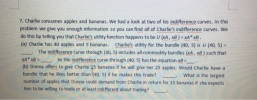 7. Charlie consumes apples and bananas. We had a look at two of his indifference curves. In this problem we give you enough information so you can find all of Charlie's indifference curves. We do this by telling you that Charlie's utility function happens to be U (XA, xB ) = xA* x8 (a) Charlie has 40 apples and 5 bananas. Charlie's utility for the bundle (40, 5) is U (40 5)- The indifference curve through (40, 5) includes all...
An economy has two people, Charlie and Doris. There are two goods, apples and bananas. Charlie...
An economy has two people, Charlie and Doris. There are two goods, apples and bananas. Charlie has an initial endowment of 3 apples and 4 bananas. Doris has an initial endowment of 6 apples and 2 bananas. Charlie’s utility function is U(AC, BC) = ACBC, where AC is his apple consumption and BC is his banana consumption. Doris’s utility function is U(AD, BD) = ADBD, where AD and BD are her apple and banana consumptions. Charlie claims that at every...
Charlie consumes apples and bananas. His utility function is: U(xA; xB) xAxB. The price of apples...
 Charlie consumes apples and bananas. His utility function is: U(xA; xB) xAxB. The price of apples is $1, the price of bananas is $2, and Charlie's income is $40 a day. The price of bananas suddenly falls to $1. Find the substitution and income effect of the price change for apples and bananas.
1. Charlie’s utility function for weekly consumption of bananas (B) and Apples (A) is given by...
1. Charlie’s utility function for weekly consumption of bananas (B) and Apples (A) is given by U = BA . a. Suppose Charlie consumes 20 bananas and 10 apples in a week. Sketch his indifference curve through that bundle on a diagram. (While it doesn’t really matter which good is on the horizontal axis, for consistency with our classwork, assume bananas are on the horizontal axis.) b. Use calculus (partial derivatives) to derive formulas for the marginal utilities (MU) of...
3. Craig likes both apples and bananas. He consumes nothing else. The consumption bundle where Craig...
 3. Craig likes both apples and bananas. He consumes nothing else. The consumption bundle where Craig consumes x, bushels of apples per year and Xg bushels of bananas per year is written as (X4, Xg). Last year, Craig consumed 20 bushels of apples and 5 bushels of bananas. It happens that the set of consumption bundles (XA, Xg) such that Craig is indifferent between (XA, Xg) and 0,5) is the set of all bundles such that Xg = 100/XA. The...
Problem 2 Suppose that Prof. Wu faces three consumption bundles A-1 apples,3 bananas), . B (3...
 Problem 2 Suppose that Prof. Wu faces three consumption bundles A-1 apples,3 bananas), . B (3 apple, 2 bananas), . C (4 apples, 2 bananas) Assume that Prof. Wu prefers C to B and he is indifferent between Λ and B 1) If Prof. Wu is rational, what additional conditions you need to impose on Prof. Wu's pref erences? Explain why after adding those conditions, we can say Prof. Wu is rational 2) Depict the three consumption bundles on a...
Charlie’s utility function is U(xA, xB) = xAxB. Suppose that the price of apples is 1,...
Charlie’s utility function is U(xA, xB) = xAxB. Suppose that the price of apples is 1, the price of bananas is 2, and Charlie’s income is 40. (a) On a graph, use blue ink to draw Charlie’s budget line. (Use a ruler and try to make this line accurate.) Plot a few points on the indifference curve that gives Charlie a utility of 150 and sketch this curve with red ink. Now plot a few points on the indifference curve...
1. Charlotte loves apples and hates bananas. Her utility function is U (a,b) a-b2/4, where a...
 1. Charlotte loves apples and hates bananas. Her utility function is U (a,b) a-b2/4, where a is the number of apples she consumes and b is the num- ber of bananas she consumes. Assume that Charlotte's income is y • What are the demand functions for Charlotte ? • What are the Engel curves for Charlotte? 2. Wilbur likes both apples and bananas. His utility function is U(a,b) = ab1/2. Assume Wilbur's budget is m, the price of apple is...
3) (4pts. Consider a consumer who spends all his income on two goods, say 804 that...
 3) (4pts. Consider a consumer who spends all his income on two goods, say 804 that good 1 is an inferior good at the current prices and income). If the price and also the income of the consumer doubles, how does his demand for good at all. Explain. all his income on two goods, say good 1 and good 2. Assume ces and income). If the price of both goods double w does his demand for good 1 change, if...
 4. Charlie likes both apples and bananas. He consumes nothing else. Charlie consumes x bushels of apples per year and x bushels of bananas per year. Suppose that Charlie's preference is represented in the following utility function: u(x,,Xy)-x,Xy . Suppose that the price of apples is S1, the price of bananas is S2, and Charlie's income is $40. (14 points) a. Draw Charlie's budget line. Plot a few points on the indifference curve that gives Charlie a utility of 150...
 7. Charlie consumes apples and bananas. We had a look at two of his indifference curves. In this problem we give you enough information so you can find all of Charlie's indifference curves. We do this by telling you that Charlie's utility function happens to be U (XA, xB ) = xA* x8 (a) Charlie has 40 apples and 5 bananas. Charlie's utility for the bundle (40, 5) is U (40 5)- The indifference curve through (40, 5) includes all...
 Charlie consumes apples and bananas. His utility function is: U(xA; xB) xAxB. The price of apples is $1, the price of bananas is $2, and Charlie's income is $40 a day. The price of bananas suddenly falls to $1. Find the substitution and income effect of the price change for apples and bananas.
 3. Craig likes both apples and bananas. He consumes nothing else. The consumption bundle where Craig consumes x, bushels of apples per year and Xg bushels of bananas per year is written as (X4, Xg). Last year, Craig consumed 20 bushels of apples and 5 bushels of bananas. It happens that the set of consumption bundles (XA, Xg) such that Craig is indifferent between (XA, Xg) and 0,5) is the set of all bundles such that Xg = 100/XA. The...
 Problem 2 Suppose that Prof. Wu faces three consumption bundles A-1 apples,3 bananas), . B (3 apple, 2 bananas), . C (4 apples, 2 bananas) Assume that Prof. Wu prefers C to B and he is indifferent between Λ and B 1) If Prof. Wu is rational, what additional conditions you need to impose on Prof. Wu's pref erences? Explain why after adding those conditions, we can say Prof. Wu is rational 2) Depict the three consumption bundles on a...
 1. Charlotte loves apples and hates bananas. Her utility function is U (a,b) a-b2/4, where a is the number of apples she consumes and b is the num- ber of bananas she consumes. Assume that Charlotte's income is y • What are the demand functions for Charlotte ? • What are the Engel curves for Charlotte? 2. Wilbur likes both apples and bananas. His utility function is U(a,b) = ab1/2. Assume Wilbur's budget is m, the price of apple is...
 3) (4pts. Consider a consumer who spends all his income on two goods, say 804 that good 1 is an inferior good at the current prices and income). If the price and also the income of the consumer doubles, how does his demand for good at all. Explain. all his income on two goods, say good 1 and good 2. Assume ces and income). If the price of both goods double w does his demand for good 1 change, if...
Most questions answered within 3 hours.
-
Where is the error in this code sequence?
String s1 = "Hello";
String s2 = "ello";...
asked 11 months ago -
Financial data for Joel de Paris, Inc., for last year
follow:
Joel de Paris, Inc.
Balance...
asked 11 months ago -
Consider this reaction:
Al2(SO4)3 (aq)+ BaCl3
(aq) Al2Cl6 (aq)- +
3BaSO4(s) . What is the...
asked 11 months ago -
Suppose that Savneet is considering increasing her
recent random sample from 20 car rentals to 40...
asked 11 months ago -
Trucks arrive at an unloading terminal at an average rate of 120
per hour.
Trucks arrive...
asked 11 months ago -
Why are methanol and ethanol completely soluble in water while
octanol is not very little soluble....
asked 11 months ago -
A facilities manager at a university reads in a research report
that the mean amount of...
asked 11 months ago -
When the CuSO4 is rehydrated by adding water to the anhydrous
compound, is this an endothermic...
asked 11 months ago -
A ray of sunlight is passing from diamond into crown glass; the
angle of incidence is...
asked 11 months ago -
A block of mass 0.249 kg is placed on top of a light, vertical
spring of...
asked 11 months ago -
how do the kidneys compensate in the presences of acidosis
a) trigger hyperventilate
b) reserve acid...
asked 11 months ago -
Question 501 pts
The rental rate of capital to the firm increases. Which of the
following...
asked 11 months ago