
Homework Answers
Add Answer to:
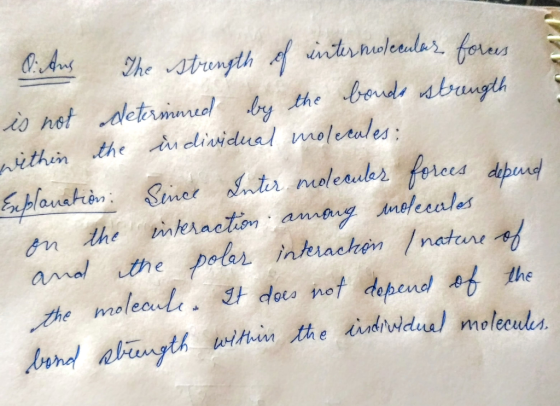
9. Is the strength of intermolecular forces determined by the bond strengths within the individual molecules?...
In the context of small molecules with similar molar masses, arrange these intermolecular forces by strength...
In the context of small molecules with similar molar masses, arrange these intermolecular forces by strength (hydrogen bonding - London dispersion forces - dipole-dipole interactions) Strongest ----> weakest
INTERMOLECULAR FORCES INTRODUCTION LEARNING OBJECTIVES To relate the effecet of intermolecular fo...
 INTERMOLECULAR FORCES INTRODUCTION LEARNING OBJECTIVES To relate the effecet of intermolecular forces on relative melting points and vapour pressures of some organic substances THEORY Weak attractive forces that occur between individual molecules in substances are called intermolecular forces. These include London dispersion forces, dipole-dipole forces and hydrogen-bonding forces. Collectively, the three types of intermolecular forces are referred to as Van der Waals forces. These attractive forces are much weaker than the chemical bonds between atoms in a molecule. Note that...
"Arrange the molecules in order of decreasing strength of Intermolecular Forces in Gases: N2, CH4, Ar,...
"Arrange the molecules in order of decreasing strength of Intermolecular Forces in Gases: N2, CH4, Ar, NH3, H2S, N2O4,C3,H8,C4H9F, C4H10, CO, SO2"
This is regarding intermolecular forces. Which is the only type of intermolecular force present between molecules...
This is regarding intermolecular forces. Which is the only type of intermolecular force present between molecules of hydrogen (H2)? Is it covalent bond, dipole-dipole forces, hydrogen bond, or dispersion forces? Which of the following is an intermolecular force? Is it covalent bond, ionic bond, metallic bond, or hydrogen bond? Also, rank these 4 forces in order from weakest to strongest: Disperson forces, Dipole-dipole forces, hydrogen bonds, Chemical bonds
Order the three types of intermolecular forces: dipole-dipole, London force, hydrogen bonds in terms of strength...
 Order the three types of intermolecular forces: dipole-dipole, London force, hydrogen bonds in terms of strength from weakest to strongest. Give a brief description of each of the different intermolecular forces. Question 24 (6 points) The boiling points for H2O (BP = 100°C) and HS (BP-60°C) are drastically different despite oxygen and sulfur being next to each other on the periodic table. Explain these differences in boiling points utilizing your labels of intermolecular forces and the relative strength of the...
Chemistry 2 help with lab questions! Intermolecular forces are not chemical bonds. Explain the difference. When...
Chemistry 2 help with lab questions! Intermolecular forces are not chemical bonds. Explain the difference. When answering the rest of the essay questions, use language that clearly distinguishes between chemical bonds and intermolecular forces. Why do compounds with higher intermolecular forces have higher boiling points? Show that you understand why a higher temperature is needed to boil a compound that has stronger intermolecular forces. Which has greater dispersion forces, hexane or pentane? How can you use their molecular formulas to...
Intermolecular forces (IMPs) are the forces of attraction (or sometimes repulsion) that act between neighboring molecules...
 Intermolecular forces (IMPs) are the forces of attraction (or sometimes repulsion) that act between neighboring molecules All IMPs are based on etectrostatic interaction and are relatively weak compared to the Intramolecular forces that hold the atoms within a molecular together. In today, workshop you will practice to identify IMFs and predict their effect on boiling point melting point, vapor pressure and enthalpy of vaporisation (Delta Hvap). The Delta Hvap for a given molecule is the energy required to transform a...
What conclusions can you draw about the relative strengths of the intermolecular attractive forces between acetone...
 What conclusions can you draw about the relative strengths of the
intermolecular attractive forces between acetone and water
molecules?
QUESTION 13 What conclusions can you draw about the relative strengths of the intermolecular attractive forces between acetone and water molecules? the forces of attraction between water-water and acetone - acetone are very strong, while the forces of attraction between water - acetone are very strong the forces of attraction between water water and acetone-acetone are very strong, while the forces...
What conclusions can you draw about the relative strengths of the
intermolecular attractive forces between acetone and water
molecules?
QUESTION 13 What conclusions can you draw about the relative strengths of the intermolecular attractive forces between acetone and water molecules? the forces of attraction between water-water and acetone - acetone are very strong, while the forces of attraction between water - acetone are very strong the forces of attraction between water water and acetone-acetone are very strong, while the forces...
Lab #22; Intermolecular Forces Pre-Laboratory Questions Name: 1. Read about intermolecular forces in your textbook, pages...
 Lab #22; Intermolecular Forces Pre-Laboratory Questions Name: 1. Read about intermolecular forces in your textbook, pages 467-472 Construct a table comparing the following intermolecular forces: dipole- dipole interactions, hydrogen bonds and London Forces. Force 5Do oe 6 nd then bout 2. Read example 11.10 on page 470 in your textbook. Then do problem 11.89 on page 484. But instead of just answering "yes" for the molecules 7 Ob that can hydrogen bond, draw each molecule twice and show the hydrogen...
20. Intermolecular forces exist between molecules. Describe the intermolecular forces that exist in the following examples:...
 20. Intermolecular forces exist between molecules. Describe the intermolecular forces that exist in the following examples: a) water (describe how many (at least 2) water molecules would interact) b) hexane (describe how many (at least 2) hexane molecules would interact) c) acetone (describe how many acetone ( at least 2) molecules would interact)
 INTERMOLECULAR FORCES INTRODUCTION LEARNING OBJECTIVES To relate the effecet of intermolecular forces on relative melting points and vapour pressures of some organic substances THEORY Weak attractive forces that occur between individual molecules in substances are called intermolecular forces. These include London dispersion forces, dipole-dipole forces and hydrogen-bonding forces. Collectively, the three types of intermolecular forces are referred to as Van der Waals forces. These attractive forces are much weaker than the chemical bonds between atoms in a molecule. Note that...
 Order the three types of intermolecular forces: dipole-dipole, London force, hydrogen bonds in terms of strength from weakest to strongest. Give a brief description of each of the different intermolecular forces. Question 24 (6 points) The boiling points for H2O (BP = 100°C) and HS (BP-60°C) are drastically different despite oxygen and sulfur being next to each other on the periodic table. Explain these differences in boiling points utilizing your labels of intermolecular forces and the relative strength of the...
 Intermolecular forces (IMPs) are the forces of attraction (or sometimes repulsion) that act between neighboring molecules All IMPs are based on etectrostatic interaction and are relatively weak compared to the Intramolecular forces that hold the atoms within a molecular together. In today, workshop you will practice to identify IMFs and predict their effect on boiling point melting point, vapor pressure and enthalpy of vaporisation (Delta Hvap). The Delta Hvap for a given molecule is the energy required to transform a...
 What conclusions can you draw about the relative strengths of the
intermolecular attractive forces between acetone and water
molecules?
QUESTION 13 What conclusions can you draw about the relative strengths of the intermolecular attractive forces between acetone and water molecules? the forces of attraction between water-water and acetone - acetone are very strong, while the forces of attraction between water - acetone are very strong the forces of attraction between water water and acetone-acetone are very strong, while the forces...
What conclusions can you draw about the relative strengths of the
intermolecular attractive forces between acetone and water
molecules?
QUESTION 13 What conclusions can you draw about the relative strengths of the intermolecular attractive forces between acetone and water molecules? the forces of attraction between water-water and acetone - acetone are very strong, while the forces of attraction between water - acetone are very strong the forces of attraction between water water and acetone-acetone are very strong, while the forces...
 Lab #22; Intermolecular Forces Pre-Laboratory Questions Name: 1. Read about intermolecular forces in your textbook, pages 467-472 Construct a table comparing the following intermolecular forces: dipole- dipole interactions, hydrogen bonds and London Forces. Force 5Do oe 6 nd then bout 2. Read example 11.10 on page 470 in your textbook. Then do problem 11.89 on page 484. But instead of just answering "yes" for the molecules 7 Ob that can hydrogen bond, draw each molecule twice and show the hydrogen...
 20. Intermolecular forces exist between molecules. Describe the intermolecular forces that exist in the following examples: a) water (describe how many (at least 2) water molecules would interact) b) hexane (describe how many (at least 2) hexane molecules would interact) c) acetone (describe how many acetone ( at least 2) molecules would interact)
Most questions answered within 3 hours.
-
Where is the error in this code sequence?
String s1 = "Hello";
String s2 = "ello";...
asked 10 months ago -
Financial data for Joel de Paris, Inc., for last year
follow:
Joel de Paris, Inc.
Balance...
asked 10 months ago -
Consider this reaction:
Al2(SO4)3 (aq)+ BaCl3
(aq) Al2Cl6 (aq)- +
3BaSO4(s) . What is the...
asked 10 months ago -
Suppose that Savneet is considering increasing her
recent random sample from 20 car rentals to 40...
asked 10 months ago -
Trucks arrive at an unloading terminal at an average rate of 120
per hour.
Trucks arrive...
asked 10 months ago -
Why are methanol and ethanol completely soluble in water while
octanol is not very little soluble....
asked 10 months ago -
A facilities manager at a university reads in a research report
that the mean amount of...
asked 10 months ago -
When the CuSO4 is rehydrated by adding water to the anhydrous
compound, is this an endothermic...
asked 10 months ago -
A ray of sunlight is passing from diamond into crown glass; the
angle of incidence is...
asked 10 months ago -
A block of mass 0.249 kg is placed on top of a light, vertical
spring of...
asked 10 months ago -
how do the kidneys compensate in the presences of acidosis
a) trigger hyperventilate
b) reserve acid...
asked 10 months ago -
Question 501 pts
The rental rate of capital to the firm increases. Which of the
following...
asked 10 months ago