
Homework Answers
Add Answer to:
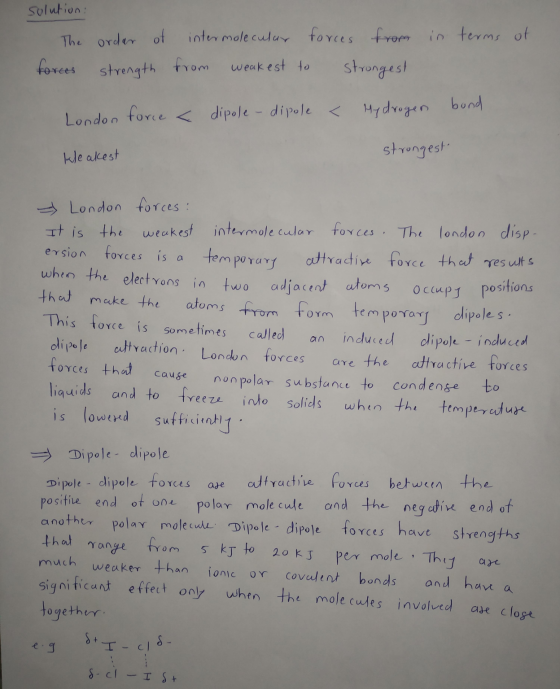
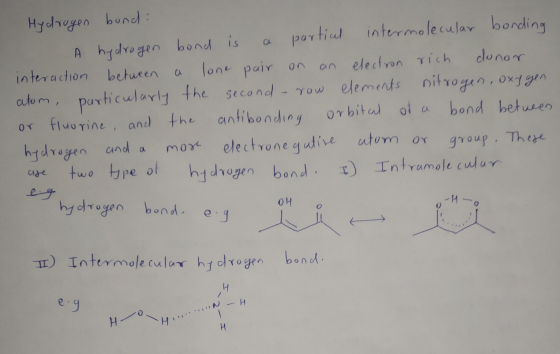
Order the three types of intermolecular forces: dipole-dipole, London force, hydrogen bonds in terms of strength...
In the context of small molecules with similar molar masses, arrange these intermolecular forces by strength...
In the context of small molecules with similar molar masses, arrange these intermolecular forces by strength (hydrogen bonding - London dispersion forces - dipole-dipole interactions) Strongest ----> weakest
construct a table comparing the fiollowing intermolecular forces, dipole-dipoleinteractions, hydrogen bonds, and London Forces
construct a table comparing the fiollowing intermolecular forces, dipole-dipoleinteractions, hydrogen bonds, and London Forces
2. Identify the strongest type of intermolecular forces in acetone, ethanol, water and hexane. (Structures listed...
 2. Identify the strongest type of intermolecular forces in acetone, ethanol, water and hexane. (Structures listed on page 15.) Experiment 2 Intermolecular Forces There are three general types of intermolecular forces. All substances exhibit London Dispersion Forces (LDF), and they are generally the weakest of the three types. These London forces are due to the attractions between small, temporary dipoles that arise from the constant, random movement of the electrons in a substance. As molar mass increases, the size of...
Which type of intermolecular forces are between molecules of methane, CH4? Dipole-Dipole London Forces Hydrogen bonding...
Which type of intermolecular forces are between molecules of methane, CH4? Dipole-Dipole London Forces Hydrogen bonding molecule-ion attraction
Identify the strongest intermolecular force in the compound KHSO4 O lonic forces Dipole-dipole Hydrogen bonding O...
 Identify the strongest intermolecular force in the compound KHSO4 O lonic forces Dipole-dipole Hydrogen bonding O lon-dipole London dispersion forces Question 23 1.5 pts What intermolecular force or bond is responsible for the density of solid water (ice) being less than that of liquid water? O London dispersion forces Olonic bonding O Covalent bonding O Dipole-dipole forces Hydrogen bonding In which of the following molecules and ions does the central carbon atom or sulfur atom have sp hybridization: Cl,CO, SO32-,...
Identify the strongest intermolecular force in the compound KHSO4. Ionic forces O Dipole-dipole O Hydrogen bonding...
 Identify the strongest intermolecular force in the compound KHSO4. Ionic forces O Dipole-dipole O Hydrogen bonding Olon-dipole London dispersion forces Which of the following compounds would have the strongest intermolecular attractive forces ? © CH3-NH-CH2-CH3 CH3-CH2-CH2-OH OCH3-CH2-O-CH3 O CH3-CH2-CO2H O CO2
Rank the strength of the three kinds of intermolecular forces studied in this experiment. Note: Hydrogen...
Rank the strength of the three kinds of intermolecular forces studied in this experiment. Note: Hydrogen bonding is a form of dipole-dipole interaction. Group of answer choices (storngest, middle, weakest) disperson (induced dipole-induced dipole) hydrogen bonding dipole-dipole
dentify the predominant intermolecular force in each of these substances. Hydrogen bonding Dipole-dipole Dispersion (London) forces...
 dentify the predominant intermolecular force in each of these substances. Hydrogen bonding Dipole-dipole Dispersion (London) forces Answer Bank CH OH CHECCH) OH CH,COCH about us Careers privacy policy terms of use contact us help
Hydrogen bonds are essentially a stronger version of which int force? 5. a. Ion-dipole forces b....
 Hydrogen bonds are essentially a stronger version of which int force? 5. a. Ion-dipole forces b. London forces c. Dipole-dipole foces d. lon-ion forces 6. Increasing the pressure by 1000-fold on a solid or liquid dramatically decreases its volume. a. causes it to undergo thermal expansion. b. significantly decreases the density. c. does not have a significant effect on the volume. d. 7. A gas at 550 torr and 1.2 liters is allowed to expand to 4.3 liters. What is...
1. What types of intermolecular forces (dipole-dipole, London dispersion, and hydrogen bonding) would be expected for...
1. What types of intermolecular forces (dipole-dipole, London dispersion, and hydrogen bonding) would be expected for urea with ethanol, water, hexanes, and 1,2-dimethoxyethane? 2. A sample was isolated that contained both cholesterol and urea. 1,2-dimethoxyethane was added and the solution was heated for 5 minutes. The solution was filtered and the organic layer evaporated. What compound is likely to be isolated from the organic layer? 2a. What compound is likely the solid residue?
 2. Identify the strongest type of intermolecular forces in acetone, ethanol, water and hexane. (Structures listed on page 15.) Experiment 2 Intermolecular Forces There are three general types of intermolecular forces. All substances exhibit London Dispersion Forces (LDF), and they are generally the weakest of the three types. These London forces are due to the attractions between small, temporary dipoles that arise from the constant, random movement of the electrons in a substance. As molar mass increases, the size of...
 Identify the strongest intermolecular force in the compound KHSO4 O lonic forces Dipole-dipole Hydrogen bonding O lon-dipole London dispersion forces Question 23 1.5 pts What intermolecular force or bond is responsible for the density of solid water (ice) being less than that of liquid water? O London dispersion forces Olonic bonding O Covalent bonding O Dipole-dipole forces Hydrogen bonding In which of the following molecules and ions does the central carbon atom or sulfur atom have sp hybridization: Cl,CO, SO32-,...
 Identify the strongest intermolecular force in the compound KHSO4. Ionic forces O Dipole-dipole O Hydrogen bonding Olon-dipole London dispersion forces Which of the following compounds would have the strongest intermolecular attractive forces ? © CH3-NH-CH2-CH3 CH3-CH2-CH2-OH OCH3-CH2-O-CH3 O CH3-CH2-CO2H O CO2
 dentify the predominant intermolecular force in each of these substances. Hydrogen bonding Dipole-dipole Dispersion (London) forces Answer Bank CH OH CHECCH) OH CH,COCH about us Careers privacy policy terms of use contact us help
 Hydrogen bonds are essentially a stronger version of which int force? 5. a. Ion-dipole forces b. London forces c. Dipole-dipole foces d. lon-ion forces 6. Increasing the pressure by 1000-fold on a solid or liquid dramatically decreases its volume. a. causes it to undergo thermal expansion. b. significantly decreases the density. c. does not have a significant effect on the volume. d. 7. A gas at 550 torr and 1.2 liters is allowed to expand to 4.3 liters. What is...
Most questions answered within 3 hours.
-
Where is the error in this code sequence?
String s1 = "Hello";
String s2 = "ello";...
asked 10 months ago -
Financial data for Joel de Paris, Inc., for last year
follow:
Joel de Paris, Inc.
Balance...
asked 10 months ago -
Consider this reaction:
Al2(SO4)3 (aq)+ BaCl3
(aq) Al2Cl6 (aq)- +
3BaSO4(s) . What is the...
asked 10 months ago -
Suppose that Savneet is considering increasing her
recent random sample from 20 car rentals to 40...
asked 10 months ago -
Trucks arrive at an unloading terminal at an average rate of 120
per hour.
Trucks arrive...
asked 10 months ago -
Why are methanol and ethanol completely soluble in water while
octanol is not very little soluble....
asked 10 months ago -
A facilities manager at a university reads in a research report
that the mean amount of...
asked 10 months ago -
When the CuSO4 is rehydrated by adding water to the anhydrous
compound, is this an endothermic...
asked 10 months ago -
A ray of sunlight is passing from diamond into crown glass; the
angle of incidence is...
asked 10 months ago -
A block of mass 0.249 kg is placed on top of a light, vertical
spring of...
asked 10 months ago -
how do the kidneys compensate in the presences of acidosis
a) trigger hyperventilate
b) reserve acid...
asked 10 months ago -
Question 501 pts
The rental rate of capital to the firm increases. Which of the
following...
asked 10 months ago