
Homework Answers
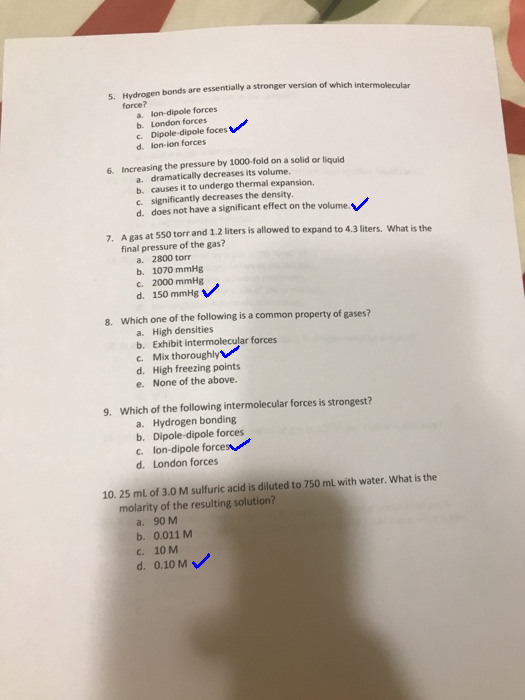
Questions 5, 6, 8 , and 9 are by definition.
7.
PV = constant, boyle's law
P1 = 550 torr = 0.72 atm; V1 = 1.2 L; V2 = 4.3L; P2 = ?
P2 = (P1V1) / V2 = (0.72*1.2L) / 4.3L = 0.197 atm = 150 torr = 150 mmHg
------------------------------------------------------------------------------------------------------------------------
10. Use M1V1 = M2V2 dilution formula
M1 = 3M; V1 = 25 mL; M2 = ?; V2 = 750 mL
M2 = (M1V1/V2) = (3 x 25 mL) / (750 mL) = 0.1 M
molarity = 0.1M
------------------------------------------------------------------------------------------------------------------------
Hope this helped you!
Thank You So Much! Please Rate this answer as you wish.("Thumbs Up")
Add Answer to:
Hydrogen bonds are essentially a stronger version of which int force? 5. a. Ion-dipole forces b....
The higher the molar mass, the higher which of these intermolecular forces? A. ion-dipole forces B....
 The higher the molar mass, the higher which of these intermolecular forces? A. ion-dipole forces B. London dispersion forces C. dipole-dipole forces D. hydrogen bonding
pudry - Dipole - dipole Iteractions- - Ion- dipole interaction - 15 strongest london dispenssion force...
 pudry - Dipole - dipole Iteractions- - Ion- dipole interaction - 15 strongest london dispenssion force is the weakest forces of inter 5. A sample of 80.0 mL of krypton gas, Kr, is at 756 torr and 18.5°C. What is the new volume if the pressure is decreased to 185 torr and the temperature is decreased to - 11.0°C? 6. A 5.00 L container of nitrogen (Nill 105 5. A sample of 80.0 mL of krypton gas, Kr, is at...
500. mL, a pressure in its closed container of What was the new volume of the...
 500. mL, a pressure in its closed container of What was the new volume of the gas when the temperature 6) A sample of nitrogen gas had a volume of 740 torr, and a temperature of 25 °C. was changed to 50 C and the new pressure was 760 torr, if the amount of gas does not change? A) 530 mL B) 450 mlL C) 970 mL. D) 240 mL E) 400 mL 7) The predominant intermolecular force in (CH3)2NH...
1. True or False: Hydrogen bonding is a type of dipole-ion interaction 2.True or False: A...
1. True or False: Hydrogen bonding is a type of dipole-ion interaction 2.True or False: A noble gas can exhibit London Foces. 3. is the resistance to flow, reflecting how easily molecules move past one another Select one: a. Vapor Pressure b. Cohesion c. Surface Tension d. Viscosity
What is the strongest intermolecular force for CaCl2? a. Hydrogen bonding b. Dipole-dipole forces c. Ionic...
What is the strongest intermolecular force for CaCl2? a. Hydrogen bonding b. Dipole-dipole forces c. Ionic bond d. Ion-dipole forces e. Dispersion force
Order the three types of intermolecular forces: dipole-dipole, London force, hydrogen bonds in terms of strength...
 Order the three types of intermolecular forces: dipole-dipole, London force, hydrogen bonds in terms of strength from weakest to strongest. Give a brief description of each of the different intermolecular forces. Question 24 (6 points) The boiling points for H2O (BP = 100°C) and HS (BP-60°C) are drastically different despite oxygen and sulfur being next to each other on the periodic table. Explain these differences in boiling points utilizing your labels of intermolecular forces and the relative strength of the...
Choose hydrogen bonding, dispersion forces, dipole-dipole or ion-dipole for A-C (A) What are the most important...
Choose hydrogen bonding, dispersion forces, dipole-dipole or ion-dipole for A-C (A) What are the most important intermolecular attractions in a solution of lithium chloride in water? (B) What are the most important intermolecular attractions in a solution of hexane and propanoic acid? (C) What are the most important intermolecular attractions in a solution of oxygen gas in water? (D) Which of the following behave like electrolytes in aqueous solutions? (Can choose 1+) calcium hydroxde, 1-butanol, AlCl3, glucose, ethanoic acid, magnesium...
9. Which intermolecular forces are found in CO2? A) dispersion forces and dipole-dipole forces B) hydrogen bonding  
9. Which intermolecular forces are found in CO2? A) dispersion forces and dipole-dipole forces B) hydrogen bonding C) dipole-dipole forces D) dispersion forces E) none of the above
What intermolecular forces exist between molecules of ethanol? A. Dispersion B. Dipole-induced dipole C. Hydrogen bonding...
What intermolecular forces exist between molecules of ethanol? A. Dispersion B. Dipole-induced dipole C. Hydrogen bonding D. Ion-dipole E. Dipole-dipole
Identify the strongest intermolecular force in the compound KHSO4. O lonic forces Dipole-dipole Hydrogen bonding lon-dipole...
 Identify the strongest intermolecular force in the compound KHSO4. O lonic forces Dipole-dipole Hydrogen bonding lon-dipole London dispersion forces What intermolecular force or bond is responsible for the density of solid water (ice) being less than that of liquid water? London dispersion forces O lonic bonding Covalent bonding Dipole-dipole forces Hydrogen bonding Which of the following compounds would have the strongest intermolecular attractive forces ? 0 CH3-NH-CH2-CH3 CH3-CH2-CH2-OH O CH3-CH2-O-CH3 O CH3-CH2-CO2H CO2 A 0.258-9 sample of a pure triprotic...
 The higher the molar mass, the higher which of these intermolecular forces? A. ion-dipole forces B. London dispersion forces C. dipole-dipole forces D. hydrogen bonding
 pudry - Dipole - dipole Iteractions- - Ion- dipole interaction - 15 strongest london dispenssion force is the weakest forces of inter 5. A sample of 80.0 mL of krypton gas, Kr, is at 756 torr and 18.5°C. What is the new volume if the pressure is decreased to 185 torr and the temperature is decreased to - 11.0°C? 6. A 5.00 L container of nitrogen (Nill 105 5. A sample of 80.0 mL of krypton gas, Kr, is at...
 500. mL, a pressure in its closed container of What was the new volume of the gas when the temperature 6) A sample of nitrogen gas had a volume of 740 torr, and a temperature of 25 °C. was changed to 50 C and the new pressure was 760 torr, if the amount of gas does not change? A) 530 mL B) 450 mlL C) 970 mL. D) 240 mL E) 400 mL 7) The predominant intermolecular force in (CH3)2NH...
 Order the three types of intermolecular forces: dipole-dipole, London force, hydrogen bonds in terms of strength from weakest to strongest. Give a brief description of each of the different intermolecular forces. Question 24 (6 points) The boiling points for H2O (BP = 100°C) and HS (BP-60°C) are drastically different despite oxygen and sulfur being next to each other on the periodic table. Explain these differences in boiling points utilizing your labels of intermolecular forces and the relative strength of the...
 Identify the strongest intermolecular force in the compound KHSO4. O lonic forces Dipole-dipole Hydrogen bonding lon-dipole London dispersion forces What intermolecular force or bond is responsible for the density of solid water (ice) being less than that of liquid water? London dispersion forces O lonic bonding Covalent bonding Dipole-dipole forces Hydrogen bonding Which of the following compounds would have the strongest intermolecular attractive forces ? 0 CH3-NH-CH2-CH3 CH3-CH2-CH2-OH O CH3-CH2-O-CH3 O CH3-CH2-CO2H CO2 A 0.258-9 sample of a pure triprotic...
Most questions answered within 3 hours.
-
Where is the error in this code sequence?
String s1 = "Hello";
String s2 = "ello";...
asked 10 months ago -
Financial data for Joel de Paris, Inc., for last year
follow:
Joel de Paris, Inc.
Balance...
asked 10 months ago -
Consider this reaction:
Al2(SO4)3 (aq)+ BaCl3
(aq) Al2Cl6 (aq)- +
3BaSO4(s) . What is the...
asked 10 months ago -
Suppose that Savneet is considering increasing her
recent random sample from 20 car rentals to 40...
asked 10 months ago -
Trucks arrive at an unloading terminal at an average rate of 120
per hour.
Trucks arrive...
asked 10 months ago -
Why are methanol and ethanol completely soluble in water while
octanol is not very little soluble....
asked 10 months ago -
A facilities manager at a university reads in a research report
that the mean amount of...
asked 10 months ago -
When the CuSO4 is rehydrated by adding water to the anhydrous
compound, is this an endothermic...
asked 10 months ago -
A ray of sunlight is passing from diamond into crown glass; the
angle of incidence is...
asked 10 months ago -
A block of mass 0.249 kg is placed on top of a light, vertical
spring of...
asked 10 months ago -
how do the kidneys compensate in the presences of acidosis
a) trigger hyperventilate
b) reserve acid...
asked 10 months ago -
Question 501 pts
The rental rate of capital to the firm increases. Which of the
following...
asked 10 months ago