1. A 10.0 L gas sample is heated to 400 ◦C at P = constant. The...
1. A 10.0 L gas sample is heated to 400 ◦C at P = constant. The final volume is 20.0 L. What is the initial temperature of this gas? Assume ideal-gas behavior and a constant amount of gas throughout the process (n, P = constant). T(K) = T(◦C) + 273.
(A) 63.5 ◦C
(B) 73 ◦C
(C) 200 ◦C
(D) 336.5 ◦C
(E) 609.5 ◦C
2. A gas cylinder can safely handle pressures up to 75.0 atm. If the gas pressure in the cylinder is 63.3 atm at 15 ◦C, what is the highest safe temperature for this cylinder? Assume ideal-gas behavior and V, n = constant. T(K) = T(◦C) + 273.
(A) 17.8 ◦C (B) 68 ◦C (C) 243 ◦C (D) 291 ◦C (E) 341 ◦C
3. At 1 atm, dioxygen O2 is solid below −218.8 ◦C, liquid between −218.8 and −183.0 ◦C, and gaseous above −183.0 ◦C. At 1 atm, O2 will follow the ideal-gas law most closely
(A) above +80.0 ◦C. (B) between −20.0 and +10.0 ◦C. (C) between −183.0 and −80.0 ◦C.(D) close to −183.0 ◦C. (E) below −183.0 ◦C.
Homework Answers
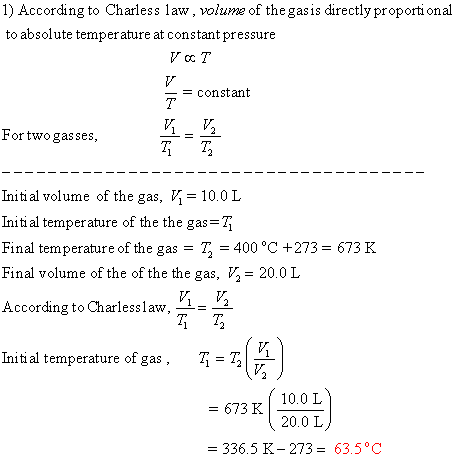
A 10.0 L gas sample is heated to 400 ◦C at P = constant. The final...
A 10.0 L gas sample is heated to 400 ◦C at P = constant. The final volume is 20.0 L. What is the initial temperature of this gas? Assume ideal-gas behavior and a constant amount of gas throughout the process (n, P = constant). T(K) = T(◦C) + 273. (A) 63.5 ◦C (B) 73 ◦C (C) 200 ◦C (D) 336.5 ◦C (E) 609.5 ◦C
At 1 atm, dioxygen O2 is solid below −218.8 ◦C, liquid between −218.8 and −183.0 ◦C,...
At 1 atm, dioxygen O2 is solid below −218.8 ◦C, liquid between −218.8 and −183.0 ◦C, and gaseous above −183.0 ◦C. At 1 atm, O2 will follow the ideal-gas law most closely (A) above +80.0 ◦C. (B) between −20.0 and +10.0 ◦C. (C) between −183.0 and −80.0 ◦C. (D) close to −183.0 ◦C. (E) below −183.0 ◦C. lmk if u have questions
A gas cylinder can safely handle pressures up to 75.0 atm. If the gas pressure in the cylinder is 63.3 atm at 15 ◦C, wha...
A gas cylinder can safely handle pressures up to 75.0 atm. If the gas pressure in the cylinder is 63.3 atm at 15 ◦C, what is the highest safe temperature for this cylinder? Assume ideal-gas behavior and V, n = constant. T(K) = T(◦C) + 273. (A) 17.8 ◦C (B) 68 ◦C (C) 243 ◦C (D) 291 ◦C (E) 341 ◦C
(III) If 3.25 L of gas at 16.0 °C and 1.00 atm is compressed at a...
 (III) If 3.25 L of gas at 16.0 °C and 1.00 atm is compressed at a pressure of 125 atm at 20.0 °C, calculate the new volume of the gas. (IV) Calculate its volume (in liters) of 88.4 g of CO2 at STP. (V) H20 and CH4 are gases at 150 °C. Which exhibits more ideal behavior? Why? (VI) Assume that you have a cylinder with a movable piston. What would happen to the gas pressure inside the cylinder if...
19. At atmospheric pressure, a sample of oxygen gas has a volume of 1.5 liters at...
 19. At atmospheric pressure, a sample of oxygen gas has a volume of 1.5 liters at 20°C. What volume, in liters will this gas occupy if the temperature is raised to 80 C? Assume ideal gas behavior a. 1.8 t b. 2.7L c. 3.9 L d. 6.0L e. 9.0L 20. How many grams of hydrogen, H2, are present in a 10.0 L gas cylinder at 25 C when the H2 pressure is 4.0 atm? Assume ideal gas behavior. a. 1.7...
Consider a sample containing 7.00 moles of a monatomic ideal gas at 10.0 °C and an...
 Consider a sample containing 7.00 moles of a monatomic ideal gas at 10.0 °C and an initial pressure of 20.0 atm. Suppose the external pressure is lowered to 7.00 atm in a reversible, adiabatic manner. Calculate the final temperature. Select one: a. -6.6°C O 6.-87°c c. 10.0°C O d. 3.50 °C e. 6.6 °C
A 45.0-L steel tank at 20.0°C contains acetylene gas, C2H2, at a pressure of 1.39 atm....
 A 45.0-L steel tank at 20.0°C contains acetylene gas, C2H2, at a pressure of 1.39 atm. Assuming ideal behavior, how many moles of acetylene are in the tank? De Formulas you MAY need. PV=nRT R -0.0821 atm.L/mol.K K - T°C + 273 latm - 760 mmHg
At a temperature of 20.0 °C, a compressed gas cylinder contains 10.0 L of carbon dioxide...
At a temperature of 20.0 °C, a compressed gas cylinder contains 10.0 L of carbon dioxide gas and the pressure gauge reads 2.0*10⌃5 Pa. How many moles of gas does the cylinder contain? (A) 0.82 mol (B) 12.0 mol (C) 821 mol (D) 8.2*10⌃4 mol (E) 1.20*10⌃4 mol
The Ideal Gas Law 808 Review Constants Periodic Table The ideal gas law describes the relationship...
 The Ideal Gas Law 808 Review Constants Periodic Table The ideal gas law describes the relationship among the pressure P. volume V number of moles , and absolute temperature T of an ideal gas. Here is the relationship expressed mathematically PV = nRT Part A How many air molecules are in a 13,5 x 12.0 x 10.0 ft room (28.2 L = 1 ft)? Assume atmospheric pressure of 1.00 atm, a room temperature of 20.0 C, and ideal behavior where...
1)a If a sample of oxygen gas has a volume of 4.89 L at 20.0 °C...
1)a If a sample of oxygen gas has a volume of 4.89 L at 20.0 °C and a pressure of 1.20 atm. If the temperature was increased to 56.0 °C then what would its resultant volume be (in L?) Assume the new pressure is 1.20 atm. b At STP, 297.0 mL of a certain gas has a mass of 0.366 g. What is a possible identity of this gas? Select one: a. O3 b. Cl2 c. C2H6 d. O2 e....
 (III) If 3.25 L of gas at 16.0 °C and 1.00 atm is compressed at a pressure of 125 atm at 20.0 °C, calculate the new volume of the gas. (IV) Calculate its volume (in liters) of 88.4 g of CO2 at STP. (V) H20 and CH4 are gases at 150 °C. Which exhibits more ideal behavior? Why? (VI) Assume that you have a cylinder with a movable piston. What would happen to the gas pressure inside the cylinder if...
 19. At atmospheric pressure, a sample of oxygen gas has a volume of 1.5 liters at 20°C. What volume, in liters will this gas occupy if the temperature is raised to 80 C? Assume ideal gas behavior a. 1.8 t b. 2.7L c. 3.9 L d. 6.0L e. 9.0L 20. How many grams of hydrogen, H2, are present in a 10.0 L gas cylinder at 25 C when the H2 pressure is 4.0 atm? Assume ideal gas behavior. a. 1.7...
 Consider a sample containing 7.00 moles of a monatomic ideal gas at 10.0 °C and an initial pressure of 20.0 atm. Suppose the external pressure is lowered to 7.00 atm in a reversible, adiabatic manner. Calculate the final temperature. Select one: a. -6.6°C O 6.-87°c c. 10.0°C O d. 3.50 °C e. 6.6 °C
 A 45.0-L steel tank at 20.0°C contains acetylene gas, C2H2, at a pressure of 1.39 atm. Assuming ideal behavior, how many moles of acetylene are in the tank? De Formulas you MAY need. PV=nRT R -0.0821 atm.L/mol.K K - T°C + 273 latm - 760 mmHg
 The Ideal Gas Law 808 Review Constants Periodic Table The ideal gas law describes the relationship among the pressure P. volume V number of moles , and absolute temperature T of an ideal gas. Here is the relationship expressed mathematically PV = nRT Part A How many air molecules are in a 13,5 x 12.0 x 10.0 ft room (28.2 L = 1 ft)? Assume atmospheric pressure of 1.00 atm, a room temperature of 20.0 C, and ideal behavior where...
Most questions answered within 3 hours.
-
Where is the error in this code sequence?
String s1 = "Hello";
String s2 = "ello";...
asked 11 months ago -
Financial data for Joel de Paris, Inc., for last year
follow:
Joel de Paris, Inc.
Balance...
asked 11 months ago -
Consider this reaction:
Al2(SO4)3 (aq)+ BaCl3
(aq) Al2Cl6 (aq)- +
3BaSO4(s) . What is the...
asked 11 months ago -
Suppose that Savneet is considering increasing her
recent random sample from 20 car rentals to 40...
asked 11 months ago -
Trucks arrive at an unloading terminal at an average rate of 120
per hour.
Trucks arrive...
asked 11 months ago -
Why are methanol and ethanol completely soluble in water while
octanol is not very little soluble....
asked 11 months ago -
A facilities manager at a university reads in a research report
that the mean amount of...
asked 11 months ago -
When the CuSO4 is rehydrated by adding water to the anhydrous
compound, is this an endothermic...
asked 11 months ago -
A ray of sunlight is passing from diamond into crown glass; the
angle of incidence is...
asked 11 months ago -
A block of mass 0.249 kg is placed on top of a light, vertical
spring of...
asked 11 months ago -
how do the kidneys compensate in the presences of acidosis
a) trigger hyperventilate
b) reserve acid...
asked 11 months ago -
Question 501 pts
The rental rate of capital to the firm increases. Which of the
following...
asked 11 months ago