HBsAg : positive HBeAg: positive Anti-HBc: negative Anti-HBc IgM: positive Anti-HBs: negative Anti-Hbe: negative 1. Please...
HBsAg : positive
HBeAg: positive
Anti-HBc: negative
Anti-HBc IgM: positive
Anti-HBs: negative
Anti-Hbe: negative
1. Please interpret the results.
2. Explain why there are different antigens to test for, when it is just one virus.
Homework Answers
1. Please interpret the results.
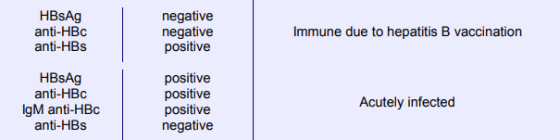
2. Explain why there are different antigens to test for, when it is just one virus.
Hepatitis B surface antigen (HBsAg): A protein on the surface of the hepatitis B infection (HBV); it very well may be recognized in abnormal states in serum amid intense or perpetual HBV contamination. The nearness of HBsAg shows that the individual is irresistible. The body ordinarily creates antibodies to HBsAg as a component of the typical resistant reaction to contamination. HBsAg is the antigen used to make Hepatitis B immunization.
Hepatitis B surface immune response (enemies of HBs): The nearness of enemies of HBs is for the most part deciphered as showing recuperation and invulnerability from HBV contamination. Enemies of HBs additionally creates in a man who has been effectively immunized against hepatitis B.
Add up to hepatitis B center immune response (hostile to HBc): Appears at the beginning of side effects in intense hepatitis B disease and perseveres forever. The nearness of hostile to HBc demonstrates past or continuous contamination with HBV in a vague time period.
IgM antibody to hepatitis B core antigen (IgM anti-HBc): Positivity indicates recent infection with HBV (≤6 months). Its presence usually indicates acute infection.
Add Answer to:
HBsAg : positive
HBeAg: positive
Anti-HBc: negative
Anti-HBc IgM: positive
Anti-HBs: negative
Anti-Hbe: negative
1. Please...
66. Interpret the following test results: HBsAg: Positive, HBeAg: Positive, Anti-HBc IgM: Positive 67. Interpret the...
66. Interpret the following test results: HBsAg: Positive, HBeAg: Positive, Anti-HBc IgM: Positive 67. Interpret the following test results: HBsAg: negative, HBeAg: negative, Anti-HBc: positive, Anti-HBs: Positive, Anti-HBe: Positive 68. Interpret the following test results: HBsAg: Positive, HBeAg: Positive, Anti-HBc: Positive, Anti-HBs: negative, Anti-HBe: negative 69. Why is there heightened concern about HCV? 70. Who should be screened for hepatitis C? 71. How is hepatitis C diagnosed? 72. Which type of hepatitis is extremely severe and only found in patients...
49. Interpret the following EBV-specific antibody results: IgM anti-VCA Negative IgG anti-VCA Positive Anti-EA Positive Anti-EBNA...
49. Interpret the following EBV-specific antibody results: IgM anti-VCA Negative IgG anti-VCA Positive Anti-EA Positive Anti-EBNA Positive 50. What is the major target of EBV? 51. When is the cold agglutinin titer increased? 52. What reagents and specimens are required for a cold agglutinin titer? 53. A newly hired third shift phlebotomist drew a specimen for a cold agglutinin and placed the uncentrifuged tube of blood in the refrigerator overnight. How would this affect the results of the test? 54....
Answer as much as you can please 1. Deficiency of this molecule results in angioedema: ?...
 Answer as much as you can please
1. Deficiency of this molecule results in angioedema: ? a. IL-2 b. CI INH c . properdind . decay accelerating factor 2. Which is a biologic function of complement? a. promotes antigen presentation to CD4+ cells b. opsonin-mediated phagocytosis c. retention of immune complexes d. inhibition of histamine release 3. Which method quantifies antigen: a. Ouchterlony technique b.radial immunodiffusion c. Westem blot d. SDS-PAGE 4. IgG antibodies are predominant in causing? a negative...
Answer as much as you can please
1. Deficiency of this molecule results in angioedema: ? a. IL-2 b. CI INH c . properdind . decay accelerating factor 2. Which is a biologic function of complement? a. promotes antigen presentation to CD4+ cells b. opsonin-mediated phagocytosis c. retention of immune complexes d. inhibition of histamine release 3. Which method quantifies antigen: a. Ouchterlony technique b.radial immunodiffusion c. Westem blot d. SDS-PAGE 4. IgG antibodies are predominant in causing? a negative...
please help me out! Negative and positive controls Tube 1: 1 ml Catalase + 3 ml...
 please help me out!
Negative and positive controls Tube 1: 1 ml Catalase + 3 ml distilled water Tube 2: 1 ml Catalase + 3 ml sucrose Tube 3: 1 ml Catalase + 3 ml H,O, Positive test produces bubbles; negative reaction does not bubble Question #1: State the NUMBER of the ONE tube that is the negative control: Question #2: Explain why no bubbles will appear in Tube 2: Effect of concentration - Tube 4: 1 ml catalase +...
please help me out!
Negative and positive controls Tube 1: 1 ml Catalase + 3 ml distilled water Tube 2: 1 ml Catalase + 3 ml sucrose Tube 3: 1 ml Catalase + 3 ml H,O, Positive test produces bubbles; negative reaction does not bubble Question #1: State the NUMBER of the ONE tube that is the negative control: Question #2: Explain why no bubbles will appear in Tube 2: Effect of concentration - Tube 4: 1 ml catalase +...
! Body Text ListParagraph No Spacing Table Paragr. Heading 1 Mary B., a 30-year-old woman with...
 ! Body Text ListParagraph No Spacing Table Paragr. Heading 1 Mary B., a 30-year-old woman with a history of intravenous (IV) drug use, was seen at a health clinic with complaints of swollen glands, fatigue, fever, weight loss, fre- quent vaginal yeast infections, and a persistent skin rash that had not responded to treatment. The physician ordered the laboratory tests shown in Tables 4...5 to 4.7. is Table 4-5 COMPLETE BLOOD COUNT Mary B. WBC RBC Hb Het MCV MCH...
1-For the following correlations write if they are Positive or Negative. Please only write either Positive...
1-For the following correlations write if they are Positive or Negative. Please only write either Positive or Negative in the parenthesis provided. 1A- People who have less years of education tend to have lower salaries ( ) 1B- Babies who are held more tend to cry less ( ) 2- For the following correlations write if they are positive or negative. Please only write either Positive or Negative in the Parenthesis provided. 2A- Students who spend less time watching TV tend...
80. How is Western blot for HIV reported? 81. Interpret the following results: Anti-HIV by ELISA:...
80. How is Western blot for HIV reported? 81. Interpret the following results: Anti-HIV by ELISA: Positive twice, Western blot: Negative 82. What is the name of the method in which viral DNA from infected cells is amplified, then identified using a labeled nucleic acid probe? 83. What level of CD4 cells is diagnostic of AIDS? 84. What is the CD4:CD8 ratio in AIDS? 85. Which test provides an estimate of the AIDS patient’s immune system and risk of opportunistic...
please help me to answer all these questions please please!!! Home Work Micro Fall 2019. Chapts...
 please help me to answer all these questions please please!!!
Home Work Micro Fall 2019. Chapts 6 and 12 Answer 10 questions = 50 points 1. Every virus can infect any organism. True or False-Explain your answer. 2. Penicillinase enzyme produced by drug resistant bacteria makes them resistant to penicillin. How it works. How some modified penicillin (like Amoxicillin or Ampicillin still kills penicillin resistant bacteria? 3. What is the difference between lysogeny and lytic cycle of a virus, explain....
please help me to answer all these questions please please!!!
Home Work Micro Fall 2019. Chapts 6 and 12 Answer 10 questions = 50 points 1. Every virus can infect any organism. True or False-Explain your answer. 2. Penicillinase enzyme produced by drug resistant bacteria makes them resistant to penicillin. How it works. How some modified penicillin (like Amoxicillin or Ampicillin still kills penicillin resistant bacteria? 3. What is the difference between lysogeny and lytic cycle of a virus, explain....
lor tests v2 - Word Search View Help B: Color Tests Positive or Negative? Observations Biuret...
 lor tests v2 - Word Search View Help B: Color Tests Positive or Negative? Observations Biuret Test (for oligopeptides and larger peptides) 1% Egg albumin solution 1% Glycine solution Page 2 of 7 Student: LAB DAY: D i lot Oligopeptide Help a protein is completely digested (hydrolyzed) component amino acids, what would be the It of a Biuret test? atom of the carboxyl group. When protein hydrolyzed the peptide bonds wil break and form present amino acids. Because the peptide...
Question #1 Explain what is meant by a positive relationship between two variables and a negative...
 Question #1 Explain what is meant by a positive relationship between two variables and a negative relationship between two variables. Describe examples of situations in which one would expect to find a positive relationship and when one would expect to find a negative relationship. Can one assign direction when both variables in a table are dichotomous?
 Answer as much as you can please
1. Deficiency of this molecule results in angioedema: ? a. IL-2 b. CI INH c . properdind . decay accelerating factor 2. Which is a biologic function of complement? a. promotes antigen presentation to CD4+ cells b. opsonin-mediated phagocytosis c. retention of immune complexes d. inhibition of histamine release 3. Which method quantifies antigen: a. Ouchterlony technique b.radial immunodiffusion c. Westem blot d. SDS-PAGE 4. IgG antibodies are predominant in causing? a negative...
Answer as much as you can please
1. Deficiency of this molecule results in angioedema: ? a. IL-2 b. CI INH c . properdind . decay accelerating factor 2. Which is a biologic function of complement? a. promotes antigen presentation to CD4+ cells b. opsonin-mediated phagocytosis c. retention of immune complexes d. inhibition of histamine release 3. Which method quantifies antigen: a. Ouchterlony technique b.radial immunodiffusion c. Westem blot d. SDS-PAGE 4. IgG antibodies are predominant in causing? a negative...
 please help me out!
Negative and positive controls Tube 1: 1 ml Catalase + 3 ml distilled water Tube 2: 1 ml Catalase + 3 ml sucrose Tube 3: 1 ml Catalase + 3 ml H,O, Positive test produces bubbles; negative reaction does not bubble Question #1: State the NUMBER of the ONE tube that is the negative control: Question #2: Explain why no bubbles will appear in Tube 2: Effect of concentration - Tube 4: 1 ml catalase +...
please help me out!
Negative and positive controls Tube 1: 1 ml Catalase + 3 ml distilled water Tube 2: 1 ml Catalase + 3 ml sucrose Tube 3: 1 ml Catalase + 3 ml H,O, Positive test produces bubbles; negative reaction does not bubble Question #1: State the NUMBER of the ONE tube that is the negative control: Question #2: Explain why no bubbles will appear in Tube 2: Effect of concentration - Tube 4: 1 ml catalase +...
 ! Body Text ListParagraph No Spacing Table Paragr. Heading 1 Mary B., a 30-year-old woman with a history of intravenous (IV) drug use, was seen at a health clinic with complaints of swollen glands, fatigue, fever, weight loss, fre- quent vaginal yeast infections, and a persistent skin rash that had not responded to treatment. The physician ordered the laboratory tests shown in Tables 4...5 to 4.7. is Table 4-5 COMPLETE BLOOD COUNT Mary B. WBC RBC Hb Het MCV MCH...
 please help me to answer all these questions please please!!!
Home Work Micro Fall 2019. Chapts 6 and 12 Answer 10 questions = 50 points 1. Every virus can infect any organism. True or False-Explain your answer. 2. Penicillinase enzyme produced by drug resistant bacteria makes them resistant to penicillin. How it works. How some modified penicillin (like Amoxicillin or Ampicillin still kills penicillin resistant bacteria? 3. What is the difference between lysogeny and lytic cycle of a virus, explain....
please help me to answer all these questions please please!!!
Home Work Micro Fall 2019. Chapts 6 and 12 Answer 10 questions = 50 points 1. Every virus can infect any organism. True or False-Explain your answer. 2. Penicillinase enzyme produced by drug resistant bacteria makes them resistant to penicillin. How it works. How some modified penicillin (like Amoxicillin or Ampicillin still kills penicillin resistant bacteria? 3. What is the difference between lysogeny and lytic cycle of a virus, explain....
 lor tests v2 - Word Search View Help B: Color Tests Positive or Negative? Observations Biuret Test (for oligopeptides and larger peptides) 1% Egg albumin solution 1% Glycine solution Page 2 of 7 Student: LAB DAY: D i lot Oligopeptide Help a protein is completely digested (hydrolyzed) component amino acids, what would be the It of a Biuret test? atom of the carboxyl group. When protein hydrolyzed the peptide bonds wil break and form present amino acids. Because the peptide...
 Question #1 Explain what is meant by a positive relationship between two variables and a negative relationship between two variables. Describe examples of situations in which one would expect to find a positive relationship and when one would expect to find a negative relationship. Can one assign direction when both variables in a table are dichotomous?
Most questions answered within 3 hours.
-
Where is the error in this code sequence?
String s1 = "Hello";
String s2 = "ello";...
asked 11 months ago -
Financial data for Joel de Paris, Inc., for last year
follow:
Joel de Paris, Inc.
Balance...
asked 11 months ago -
Consider this reaction:
Al2(SO4)3 (aq)+ BaCl3
(aq) Al2Cl6 (aq)- +
3BaSO4(s) . What is the...
asked 11 months ago -
Suppose that Savneet is considering increasing her
recent random sample from 20 car rentals to 40...
asked 11 months ago -
Trucks arrive at an unloading terminal at an average rate of 120
per hour.
Trucks arrive...
asked 11 months ago -
Why are methanol and ethanol completely soluble in water while
octanol is not very little soluble....
asked 11 months ago -
A facilities manager at a university reads in a research report
that the mean amount of...
asked 11 months ago -
When the CuSO4 is rehydrated by adding water to the anhydrous
compound, is this an endothermic...
asked 11 months ago -
A ray of sunlight is passing from diamond into crown glass; the
angle of incidence is...
asked 11 months ago -
A block of mass 0.249 kg is placed on top of a light, vertical
spring of...
asked 11 months ago -
how do the kidneys compensate in the presences of acidosis
a) trigger hyperventilate
b) reserve acid...
asked 11 months ago -
Question 501 pts
The rental rate of capital to the firm increases. Which of the
following...
asked 11 months ago