----------------------------------------------------------------------------------------------------------------------------------------------------------------------------

Homework Answers

Add Answer to:
----------------------------------------------------------------------------------------------------------------------------------------------------------------------------
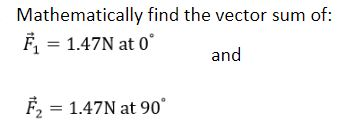
Mathematically find the vector sum of: F 1.47N at o and F2 1.47N at 90...
Mathematically find the vector sum of: F 1.47N at o and F2 1.47N at 90
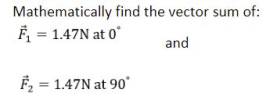 Mathematically find the vector sum of: F 1.47N at o and F2 1.47N at 90
a)find graphically the vector sum is R=A+B+C. b)and also find mathematically (adding by components) the vector...
a)find graphically the vector sum is R=A+B+C. b)and also find mathematically (adding by components) the vector sum is R= A+B+C
FRis the sum (resultant) force vector of two force vectors of F1 and F2. We know...
FRis the sum (resultant) force vector of two force vectors of F1 and F2. We know that F1 = 26 i + 25 j. Also, FR makes an angle of 27 deg with the positive x axis, and the magnitude of the resultant force is FR = 21.4 N. What is the magnitude of force F2? a. 10.2 N b. 14.5 N c. 22.3 N d.16.8 N Part 2: What is the angle of F2 in the previous question? a. 4.29...
Show all workout please. 2. v . F3 600 N F, 700 N 450 F2 -900...
 Show all workout please.
2. v . F3 600 N F, 700 N 450 F2 -900 N o Resolve each force acting on the gusset plate into its x and y components, and express the force Fi as a Cartesian vector o Express the force F2 as a Cartesian vector o Express the force F3 as Cartesian vector 。The magnitude ofthe resultant force, FR IN i+l j) N j) N o The direction of the resultant force, measured counterclockwise from...
Show all workout please.
2. v . F3 600 N F, 700 N 450 F2 -900 N o Resolve each force acting on the gusset plate into its x and y components, and express the force Fi as a Cartesian vector o Express the force F2 as a Cartesian vector o Express the force F3 as Cartesian vector 。The magnitude ofthe resultant force, FR IN i+l j) N j) N o The direction of the resultant force, measured counterclockwise from...
(Part b) Write the vector sum F1+F2 +F3 in terms of the unit vectors i and...
 (Part b) Write the vector sum F1+F2 +F3 in terms of the unit vectors i and j. Use Fi = Fi), F, = |F2), and F3 = |F3| to be the magnitude of the vectors Fi, F2, and F3, respectively. Drag the appropriate terms to construct the correct expression. Pay attention to the difference between a and in the trigonometric functions. Ē + F2 + Fz (F1 + F2 + F3 + + F2 + F3 · α E +X...
The sum of the forces on an object is directly proportional to the mass of the...
 The sum of the forces on an object is directly proportional to
the mass of the object and directly proportional to the
acceleration of the object. The second law is expressed by the
equation: (1) F=ma
If the mass is in kg and the acceleration in m/s2,
then the force is in Newtons.
In (1), F is the net applied force, m is the mass of the object
on which the force is applied, and a is the acceleration of...
The sum of the forces on an object is directly proportional to
the mass of the object and directly proportional to the
acceleration of the object. The second law is expressed by the
equation: (1) F=ma
If the mass is in kg and the acceleration in m/s2,
then the force is in Newtons.
In (1), F is the net applied force, m is the mass of the object
on which the force is applied, and a is the acceleration of...
Ah arbnrary number nents, and all 2-companents separately to f of vector ately to find x-, y"r z-...
 how do you do 7 and 8 ?
ah arbnrary number nents, and all 2-companents separately to f of vector ately to find x-, y"r z-components of the resultant vector. B) Break the (given) vectors down into their x-, y, and 2-componerto c) Combine total x, y-, and z-components using Pythagorean Thetee sine the resultant vector and use tangent to determine its angle. and cosines nd the magnitude of Graphical Representation of Vectors You will need o ruler, graph poper,...
how do you do 7 and 8 ?
ah arbnrary number nents, and all 2-companents separately to f of vector ately to find x-, y"r z-components of the resultant vector. B) Break the (given) vectors down into their x-, y, and 2-componerto c) Combine total x, y-, and z-components using Pythagorean Thetee sine the resultant vector and use tangent to determine its angle. and cosines nd the magnitude of Graphical Representation of Vectors You will need o ruler, graph poper,...
Find the net force F net on the object (the sum of the forces)
 Three different forces act on an object. They are:→F1=<5,3>F→1=<5,3>→F2=<−6,−4>F→2=<-6,-4>→F3=<−1,8>F→3=<-1,8>Find the net force FnetFnet on the object (the sum of the forces) and Find what fourth force, F4F4 would need to be added so the object feels no force, that is, so Fnet=0
If F, = 200 N. F2 = 400 N and F3 = 350 N. determine the...
 If F, = 200 N. F2 = 400 N and F3 = 350 N. determine the magnitude and coordinate direction angles of the force required for equilibrium of particle at O.
sketch the graphical addition and find the vector sum force magnitude Part 2 Algebraic addition Vector...
 sketch the graphical addition and find the vector sum
force magnitude
Part 2 Algebraic addition Vector magnitude angle y-component component 2-1나 133 Sum xxxxxxxxxxX xxxxxxxxx Sample calculations show Vector sum force magnitude: calculation) Conclusions We were unable to transcribe this image
sketch the graphical addition and find the vector sum
force magnitude
Part 2 Algebraic addition Vector magnitude angle y-component component 2-1나 133 Sum xxxxxxxxxxX xxxxxxxxx Sample calculations show Vector sum force magnitude: calculation) Conclusions We were unable to transcribe this image
 Mathematically find the vector sum of: F 1.47N at o and F2 1.47N at 90
 Show all workout please.
2. v . F3 600 N F, 700 N 450 F2 -900 N o Resolve each force acting on the gusset plate into its x and y components, and express the force Fi as a Cartesian vector o Express the force F2 as a Cartesian vector o Express the force F3 as Cartesian vector 。The magnitude ofthe resultant force, FR IN i+l j) N j) N o The direction of the resultant force, measured counterclockwise from...
Show all workout please.
2. v . F3 600 N F, 700 N 450 F2 -900 N o Resolve each force acting on the gusset plate into its x and y components, and express the force Fi as a Cartesian vector o Express the force F2 as a Cartesian vector o Express the force F3 as Cartesian vector 。The magnitude ofthe resultant force, FR IN i+l j) N j) N o The direction of the resultant force, measured counterclockwise from...
 (Part b) Write the vector sum F1+F2 +F3 in terms of the unit vectors i and j. Use Fi = Fi), F, = |F2), and F3 = |F3| to be the magnitude of the vectors Fi, F2, and F3, respectively. Drag the appropriate terms to construct the correct expression. Pay attention to the difference between a and in the trigonometric functions. Ē + F2 + Fz (F1 + F2 + F3 + + F2 + F3 · α E +X...
 The sum of the forces on an object is directly proportional to
the mass of the object and directly proportional to the
acceleration of the object. The second law is expressed by the
equation: (1) F=ma
If the mass is in kg and the acceleration in m/s2,
then the force is in Newtons.
In (1), F is the net applied force, m is the mass of the object
on which the force is applied, and a is the acceleration of...
The sum of the forces on an object is directly proportional to
the mass of the object and directly proportional to the
acceleration of the object. The second law is expressed by the
equation: (1) F=ma
If the mass is in kg and the acceleration in m/s2,
then the force is in Newtons.
In (1), F is the net applied force, m is the mass of the object
on which the force is applied, and a is the acceleration of...
 how do you do 7 and 8 ?
ah arbnrary number nents, and all 2-companents separately to f of vector ately to find x-, y"r z-components of the resultant vector. B) Break the (given) vectors down into their x-, y, and 2-componerto c) Combine total x, y-, and z-components using Pythagorean Thetee sine the resultant vector and use tangent to determine its angle. and cosines nd the magnitude of Graphical Representation of Vectors You will need o ruler, graph poper,...
how do you do 7 and 8 ?
ah arbnrary number nents, and all 2-companents separately to f of vector ately to find x-, y"r z-components of the resultant vector. B) Break the (given) vectors down into their x-, y, and 2-componerto c) Combine total x, y-, and z-components using Pythagorean Thetee sine the resultant vector and use tangent to determine its angle. and cosines nd the magnitude of Graphical Representation of Vectors You will need o ruler, graph poper,...
 If F, = 200 N. F2 = 400 N and F3 = 350 N. determine the magnitude and coordinate direction angles of the force required for equilibrium of particle at O.
 sketch the graphical addition and find the vector sum
force magnitude
Part 2 Algebraic addition Vector magnitude angle y-component component 2-1나 133 Sum xxxxxxxxxxX xxxxxxxxx Sample calculations show Vector sum force magnitude: calculation) Conclusions We were unable to transcribe this image
sketch the graphical addition and find the vector sum
force magnitude
Part 2 Algebraic addition Vector magnitude angle y-component component 2-1나 133 Sum xxxxxxxxxxX xxxxxxxxx Sample calculations show Vector sum force magnitude: calculation) Conclusions We were unable to transcribe this image
Most questions answered within 3 hours.
-
Where is the error in this code sequence?
String s1 = "Hello";
String s2 = "ello";...
asked 11 months ago -
Financial data for Joel de Paris, Inc., for last year
follow:
Joel de Paris, Inc.
Balance...
asked 11 months ago -
Consider this reaction:
Al2(SO4)3 (aq)+ BaCl3
(aq) Al2Cl6 (aq)- +
3BaSO4(s) . What is the...
asked 11 months ago -
Suppose that Savneet is considering increasing her
recent random sample from 20 car rentals to 40...
asked 11 months ago -
Trucks arrive at an unloading terminal at an average rate of 120
per hour.
Trucks arrive...
asked 11 months ago -
Why are methanol and ethanol completely soluble in water while
octanol is not very little soluble....
asked 11 months ago -
A facilities manager at a university reads in a research report
that the mean amount of...
asked 11 months ago -
When the CuSO4 is rehydrated by adding water to the anhydrous
compound, is this an endothermic...
asked 11 months ago -
A ray of sunlight is passing from diamond into crown glass; the
angle of incidence is...
asked 11 months ago -
A block of mass 0.249 kg is placed on top of a light, vertical
spring of...
asked 11 months ago -
how do the kidneys compensate in the presences of acidosis
a) trigger hyperventilate
b) reserve acid...
asked 11 months ago -
Question 501 pts
The rental rate of capital to the firm increases. Which of the
following...
asked 11 months ago