You are driving at 30m/s and hit your breaks, skidding to a stop. The static coefficient...
You are driving at 30m/s and hit your breaks, skidding to a stop. The static coefficient of friction between your tires and the road is μs = 0.7. The mass of your car is 1500 kg.
a) What is your initial kinetic energy right before you hit the breaks?
b) What is the magnitude of the static friction force acting on the car?
c) Does the friction do positive or negative work on the car? Explain your reasoning.
d) Use the work-energy theorem to calculate how far you will skid before stopping.
Homework Answers

Add Answer to:
You are driving at 30m/s and hit your breaks, skidding to a
stop. The static coefficient...
A Review Constants Periodic Table Part A You are driving your 1400 kg car at 19...
 A Review Constants Periodic Table Part A You are driving your 1400 kg car at 19 m/s down a hill with a 5.0° slope when a deer suddenly jumps out onto the roadway. You slam on your brakes, skidding to a stop. How far do you skid before stopping if the kinetic friction force between your tires and the road is 1.1x10⁴ N ? Solve this problem using conservation of energy. Express your answer with the appropriate units. μΑ 2)...
Slide 14-9 Problem 10.30 When skidding to a stop on a bike by the back tires,...
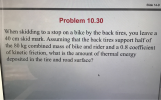 Slide 14-9 Problem 10.30 When skidding to a stop on a bike by the back tires, you leave a 40 cm skid mark. Assuming that the back tires support half of the 80 kg combined mass of bike and rider and a 0.8 coefficient of kinetic friction, what is the amount of thermal energy deposited in the tire and road surface?
2. A 2500 kg car is driving at 65.0 km/h on a horizontal level road. As...
 2. A 2500 kg car is driving at 65.0 km/h on a horizontal level road. As it approaches a stoplight the light turns red so the brakes are applied as the car hits a patch ofice. With the brakes locked, the car travels 55.0 m before coming to a stop. A) What is the initial kinetic energy of the car? B) How much work is done by friction in stopping the car? c) What is the force of friction stopping...
Please answer parts A and C to the question. Thank you. 3. You are driving on...
 Please answer parts A and C to the question. Thank you.
3. You are driving on the freeway at 80 mph, trailing the car in front of you by two seconds. Suddenly, the car in front of you - also traveling at 80 mph brakes to stop; its tires are new, with a friction coefficient of 0.8. Your car, on the other hand, has poor tires with a coefficient of 0.5. Due to distracting music and passengers, you do not...
Please answer parts A and C to the question. Thank you.
3. You are driving on the freeway at 80 mph, trailing the car in front of you by two seconds. Suddenly, the car in front of you - also traveling at 80 mph brakes to stop; its tires are new, with a friction coefficient of 0.8. Your car, on the other hand, has poor tires with a coefficient of 0.5. Due to distracting music and passengers, you do not...
2.) A person is pushing a 750 kg car a distance of 30m with a constant...
 2.) A person is pushing a 750 kg car a distance of 30m with a constant pushing force of 550 N that is parallel to the ground. If the car is accelerated from rest to a speed of 1.5 m/s, find the coefficient of kinetic friction between the tires and the road. Use the Work kinetic energy theorem.
The driver of a car of mass M which is moving along a straight road with...
The driver of a car of mass M which is moving along a straight road with initial speed v0 sees a deer in her headlights, and reacts quickly, lifting her foot of the gas and applying the brake pedal with maximum force. The anti-lock brakes cause the largest possible static friction force to be applied on the tires by the road, which continue to roll so the car does not skid. The coefficient of static friction between the tires and...
a 1,100 kg car is moving on a horizontal road at 21 m/s when it's breaks...
a 1,100 kg car is moving on a horizontal road at 21 m/s when it's breaks are applied and the car skids to a stop at 36m. Use the concepts of work and energy to find the friction force between the car's tires and the road.
You are driving your car along a flat, curved road; the curve in the road is...
You are driving your car along a flat, curved road; the curve in the road is a segment of a circle with radius 50 meters. (We call this a "radius of curvature"). How fast can the car drive around the curve if the coefficient of static friction between the tires and the road is 1.0 (tires on dry pavement)? What if the coefficient of friction is 0.2 (tires on ice)?
Insurance claim. Your friend has just been in a car wreck and is trying to get...
Insurance claim. Your friend has just been in a car wreck and is trying to get the insurance company of the other driver to pay for fixing her car. She believes that she was driving within the speed limit and the other driver was speeding, and so the accident was the other driver's fault. She hopes that you can use your command of physics to prove her conjecture. She takes you out to the scene and describes what happened. She...
You are testing out your driving ability in an empty parking lot. You drive at 85...
You are testing out your driving ability in an empty parking lot. You drive at 85 km/hr towards a solid wall. When you are 62 m away from the wall, you begin to brake. What minimum coefficient of friction between the road and the tires is required so you stop before hitting the wall?
 A Review Constants Periodic Table Part A You are driving your 1400 kg car at 19 m/s down a hill with a 5.0° slope when a deer suddenly jumps out onto the roadway. You slam on your brakes, skidding to a stop. How far do you skid before stopping if the kinetic friction force between your tires and the road is 1.1x10⁴ N ? Solve this problem using conservation of energy. Express your answer with the appropriate units. μΑ 2)...
 Slide 14-9 Problem 10.30 When skidding to a stop on a bike by the back tires, you leave a 40 cm skid mark. Assuming that the back tires support half of the 80 kg combined mass of bike and rider and a 0.8 coefficient of kinetic friction, what is the amount of thermal energy deposited in the tire and road surface?
 2. A 2500 kg car is driving at 65.0 km/h on a horizontal level road. As it approaches a stoplight the light turns red so the brakes are applied as the car hits a patch ofice. With the brakes locked, the car travels 55.0 m before coming to a stop. A) What is the initial kinetic energy of the car? B) How much work is done by friction in stopping the car? c) What is the force of friction stopping...
 Please answer parts A and C to the question. Thank you.
3. You are driving on the freeway at 80 mph, trailing the car in front of you by two seconds. Suddenly, the car in front of you - also traveling at 80 mph brakes to stop; its tires are new, with a friction coefficient of 0.8. Your car, on the other hand, has poor tires with a coefficient of 0.5. Due to distracting music and passengers, you do not...
Please answer parts A and C to the question. Thank you.
3. You are driving on the freeway at 80 mph, trailing the car in front of you by two seconds. Suddenly, the car in front of you - also traveling at 80 mph brakes to stop; its tires are new, with a friction coefficient of 0.8. Your car, on the other hand, has poor tires with a coefficient of 0.5. Due to distracting music and passengers, you do not...
 2.) A person is pushing a 750 kg car a distance of 30m with a constant pushing force of 550 N that is parallel to the ground. If the car is accelerated from rest to a speed of 1.5 m/s, find the coefficient of kinetic friction between the tires and the road. Use the Work kinetic energy theorem.
Most questions answered within 3 hours.
-
Where is the error in this code sequence?
String s1 = "Hello";
String s2 = "ello";...
asked 10 months ago -
Financial data for Joel de Paris, Inc., for last year
follow:
Joel de Paris, Inc.
Balance...
asked 10 months ago -
Consider this reaction:
Al2(SO4)3 (aq)+ BaCl3
(aq) Al2Cl6 (aq)- +
3BaSO4(s) . What is the...
asked 10 months ago -
Suppose that Savneet is considering increasing her
recent random sample from 20 car rentals to 40...
asked 10 months ago -
Trucks arrive at an unloading terminal at an average rate of 120
per hour.
Trucks arrive...
asked 10 months ago -
Why are methanol and ethanol completely soluble in water while
octanol is not very little soluble....
asked 10 months ago -
A facilities manager at a university reads in a research report
that the mean amount of...
asked 10 months ago -
When the CuSO4 is rehydrated by adding water to the anhydrous
compound, is this an endothermic...
asked 10 months ago -
A ray of sunlight is passing from diamond into crown glass; the
angle of incidence is...
asked 10 months ago -
A block of mass 0.249 kg is placed on top of a light, vertical
spring of...
asked 10 months ago -
how do the kidneys compensate in the presences of acidosis
a) trigger hyperventilate
b) reserve acid...
asked 10 months ago -
Question 501 pts
The rental rate of capital to the firm increases. Which of the
following...
asked 10 months ago