Cathode rays (which we now know to be beams of electrons) can be deflected by Select...
Cathode rays (which we now know to be beams of electrons) can be deflected by
Select one or more:
a. an electric field
b. a magnetic field
Homework Answers
cathode rays are moving electrons and we know that moving charge experience force in electric as well as magnetic field .
Hence both options are correct
Add Answer to:
Cathode rays (which we
now know to be beams of electrons) can be deflected by
Select...
In a cathode-ray tube, a beam of electrons (the cathode ray) is deflected in a region...
In a cathode-ray tube, a beam of electrons (the cathode ray) is deflected in a region of electric field on its way to a fluorescent screen, as shown in the figure. Consider the parallel-plate arrangement in the figure, and assume that the electric field E = 400 N/C is uniform between the plates and that E = 0outside the plates. The beam of electrons is injected horizontally with velocity v0 = 5.0 × 10⁶ m/s. If the width of the...
To create X-rays, a strong electric field is placed between an anode and a cathode. Electrons...
 To create X-rays, a strong electric field is placed between an anode and a cathode. Electrons are then disconnected from the cathode and accelerated toward the anode. When they enter the anode, X-rays are created. In this case, the cathode is placed in x = 0, and the anode in x = 90 cm. The voltage between them is Uka 90 kV. You can assume that the electric field is homogeneous Determine the potential electrical energy of the electron W...
To create X-rays, a strong electric field is placed between an anode and a cathode. Electrons...
 To create X-rays, a strong electric field is placed between an anode and a cathode. Electrons are then disconnected from the cathode and accelerated toward the anode. When they enter the anode, X-rays are created. In this case, the cathode is placed in x = 0, and the anode in x-90 cm. The voltage between them is Uka-90 kV. You can assume that the electric field is homogeneous. Create a vector that contains 10 different values along the x-axis, x...
A beam of electrons passes through a magnetic field without being deflected. What can you conclude...
A beam of electrons passes through a magnetic field without being deflected. What can you conclude about the orientation of the beam relative to the magnetic field? (Ignore any other fields.)
4. Before television screens were all flat, they used to work by boiling off electrons ("cathode rays") from plates a hot filament and accelerating them towards a phosphor-coated screen. The...
 4. Before television screens were all flat, they used to work by boiling off electrons ("cathode rays") from plates a hot filament and accelerating them towards a phosphor-coated screen. The acceleration was performed with a pair of charged parallel plates, as in a capacitor, with small holes to allow the beam to pass through. The beam was steered horizontally and vertically across the screen by varying the magnetic fields in deflecting coils. By varying these deflecting fields, the beam was...
Part B please? A cathode ray tube (CRT) is used to accelerate electrons in some televisions,...
 Part B please?
A cathode ray tube (CRT) is used to accelerate electrons in some televisions, computer monitors, oscilloscopes, and x- ray tubes. Electrons from a heated filament pass through a hole in the cathode; they are then accelerated by an electric field between the cathode and the anode (see the figure below). + Assist Che ry View Show Guid rcal deflertion Print Ques Repa te) 1 out of 3 attempts Atter the electrons pass through the anode, they are...
Part B please?
A cathode ray tube (CRT) is used to accelerate electrons in some televisions, computer monitors, oscilloscopes, and x- ray tubes. Electrons from a heated filament pass through a hole in the cathode; they are then accelerated by an electric field between the cathode and the anode (see the figure below). + Assist Che ry View Show Guid rcal deflertion Print Ques Repa te) 1 out of 3 attempts Atter the electrons pass through the anode, they are...
please show calculations and explanation when necessary In a cathode ray tube, electrons with a velocity...
 please show calculations and explanation when
necessary
In a cathode ray tube, electrons with a velocity of 4.5 x 10 m/s in the k direction are deflected by a magnetic field of B = (1.4 x 10⁻⁴ T)i - (2.6 x 10⁻⁴ T)ý. a) What is the force (magnitude and direction) on a single electron? b) A 10 cm long wire is placed in a magnetic field of the same magnitude, such that it makes a 30° angle with the...
please show calculations and explanation when
necessary
In a cathode ray tube, electrons with a velocity of 4.5 x 10 m/s in the k direction are deflected by a magnetic field of B = (1.4 x 10⁻⁴ T)i - (2.6 x 10⁻⁴ T)ý. a) What is the force (magnitude and direction) on a single electron? b) A 10 cm long wire is placed in a magnetic field of the same magnitude, such that it makes a 30° angle with the...
A current-carrying wire in a magnetic field Select one: a. may be deflected. b. may experience...
A current-carrying wire in a magnetic field Select one: a. may be deflected. b. may experience a force. c. both of these d. neither of these
3. Fill the blanks and the Proof - J.J. Thomson's experiment to fine the charge-to-mass ratio of the tt) (25 po...
 3. Fill the blanks and the Proof - J.J. Thomson's experiment to fine the charge-to-mass ratio of the tt) (25 points) electron (i.e. e/m; The first is the experiment of Joseph John Thomson, who first demonstrated that atoms are actually composed of aggregates of charged particles. Prior to his work, it was believed that atoms were the fundamental building blocks of matter. The first evidence contrary to this notion came when people began studying the properties of atoms in large...
Which of the following conclusions most closely followed the discovery that cathode rays consist of charged...
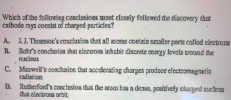 Which of the following conclusions most closely followed the discovery that cathode rays consist of charged particles? A. J.L. Thomson's conclusion that all aloms contain smaller parts called electrons B. Bohr's conclusion that electrons inhabit discrete energy levels around the nucleus C. Maxwell's conclusion that accelerating charges produce electromagnetic radiation D. Rutherford's conclusion that the atom has a dense, positively charged mucleus that electrons orbit
 To create X-rays, a strong electric field is placed between an anode and a cathode. Electrons are then disconnected from the cathode and accelerated toward the anode. When they enter the anode, X-rays are created. In this case, the cathode is placed in x = 0, and the anode in x = 90 cm. The voltage between them is Uka 90 kV. You can assume that the electric field is homogeneous Determine the potential electrical energy of the electron W...
 To create X-rays, a strong electric field is placed between an anode and a cathode. Electrons are then disconnected from the cathode and accelerated toward the anode. When they enter the anode, X-rays are created. In this case, the cathode is placed in x = 0, and the anode in x-90 cm. The voltage between them is Uka-90 kV. You can assume that the electric field is homogeneous. Create a vector that contains 10 different values along the x-axis, x...
 4. Before television screens were all flat, they used to work by boiling off electrons ("cathode rays") from plates a hot filament and accelerating them towards a phosphor-coated screen. The acceleration was performed with a pair of charged parallel plates, as in a capacitor, with small holes to allow the beam to pass through. The beam was steered horizontally and vertically across the screen by varying the magnetic fields in deflecting coils. By varying these deflecting fields, the beam was...
 Part B please?
A cathode ray tube (CRT) is used to accelerate electrons in some televisions, computer monitors, oscilloscopes, and x- ray tubes. Electrons from a heated filament pass through a hole in the cathode; they are then accelerated by an electric field between the cathode and the anode (see the figure below). + Assist Che ry View Show Guid rcal deflertion Print Ques Repa te) 1 out of 3 attempts Atter the electrons pass through the anode, they are...
Part B please?
A cathode ray tube (CRT) is used to accelerate electrons in some televisions, computer monitors, oscilloscopes, and x- ray tubes. Electrons from a heated filament pass through a hole in the cathode; they are then accelerated by an electric field between the cathode and the anode (see the figure below). + Assist Che ry View Show Guid rcal deflertion Print Ques Repa te) 1 out of 3 attempts Atter the electrons pass through the anode, they are...
 please show calculations and explanation when
necessary
In a cathode ray tube, electrons with a velocity of 4.5 x 10 m/s in the k direction are deflected by a magnetic field of B = (1.4 x 10⁻⁴ T)i - (2.6 x 10⁻⁴ T)ý. a) What is the force (magnitude and direction) on a single electron? b) A 10 cm long wire is placed in a magnetic field of the same magnitude, such that it makes a 30° angle with the...
please show calculations and explanation when
necessary
In a cathode ray tube, electrons with a velocity of 4.5 x 10 m/s in the k direction are deflected by a magnetic field of B = (1.4 x 10⁻⁴ T)i - (2.6 x 10⁻⁴ T)ý. a) What is the force (magnitude and direction) on a single electron? b) A 10 cm long wire is placed in a magnetic field of the same magnitude, such that it makes a 30° angle with the...
 3. Fill the blanks and the Proof - J.J. Thomson's experiment to fine the charge-to-mass ratio of the tt) (25 points) electron (i.e. e/m; The first is the experiment of Joseph John Thomson, who first demonstrated that atoms are actually composed of aggregates of charged particles. Prior to his work, it was believed that atoms were the fundamental building blocks of matter. The first evidence contrary to this notion came when people began studying the properties of atoms in large...
 Which of the following conclusions most closely followed the discovery that cathode rays consist of charged particles? A. J.L. Thomson's conclusion that all aloms contain smaller parts called electrons B. Bohr's conclusion that electrons inhabit discrete energy levels around the nucleus C. Maxwell's conclusion that accelerating charges produce electromagnetic radiation D. Rutherford's conclusion that the atom has a dense, positively charged mucleus that electrons orbit
Most questions answered within 3 hours.
-
Where is the error in this code sequence?
String s1 = "Hello";
String s2 = "ello";...
asked 10 months ago -
Financial data for Joel de Paris, Inc., for last year
follow:
Joel de Paris, Inc.
Balance...
asked 10 months ago -
Consider this reaction:
Al2(SO4)3 (aq)+ BaCl3
(aq) Al2Cl6 (aq)- +
3BaSO4(s) . What is the...
asked 10 months ago -
Suppose that Savneet is considering increasing her
recent random sample from 20 car rentals to 40...
asked 10 months ago -
Trucks arrive at an unloading terminal at an average rate of 120
per hour.
Trucks arrive...
asked 10 months ago -
Why are methanol and ethanol completely soluble in water while
octanol is not very little soluble....
asked 10 months ago -
A facilities manager at a university reads in a research report
that the mean amount of...
asked 10 months ago -
When the CuSO4 is rehydrated by adding water to the anhydrous
compound, is this an endothermic...
asked 10 months ago -
A ray of sunlight is passing from diamond into crown glass; the
angle of incidence is...
asked 10 months ago -
A block of mass 0.249 kg is placed on top of a light, vertical
spring of...
asked 10 months ago -
how do the kidneys compensate in the presences of acidosis
a) trigger hyperventilate
b) reserve acid...
asked 10 months ago -
Question 501 pts
The rental rate of capital to the firm increases. Which of the
following...
asked 10 months ago