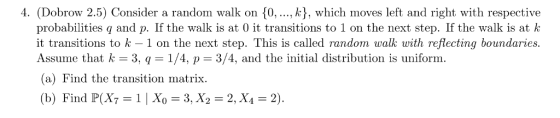
4. (Dobrow 2.5) Consider a random walk on {0,...,k}, which moves left and right with respective probabilities q and p. If the walk is at 0 it transitions to 1 on the next step. If the walk is at k it transitions to k−1 on the next step. This is called random walk with reflecting boundaries. Assume that k = 3, q = 1/4, p = 3/4, and the initial distribution is uniform.
(a) Find the transition matrix.
(b) Find P(X7 = 1 | X0 = 3,X2 = 2,X4 = 2).
Homework Answers


Add Answer to:
4. (Dobrow 2.5) Consider a random walk on {0,...,k}, which moves
left and right with respective...
2. Problem 2.5. Consider a random walk on 10..... which movies left and right with respective...
 2. Problem 2.5. Consider a random walk on 10..... which movies left and right with respective probabilities a and p. If the walk is at 0 it transitions to 1 on the next step. If the walk is at k it transitions to k-1 on the next step. This is called random walk with reflecting boundaries. Assume that k 3, =1/4, p = 3/4, and the initial distribution is uniform. For the following, use technology if needed. (a) (10.1.X2 }...
The answer is one of the following: Please be descriptive! Thank you :) 4. (Dobrow 2.5)...
 The answer is one of the following:
Please be descriptive! Thank
you :)
4. (Dobrow 2.5) Consider a random walk on [0,., k), which moves left and right with respective probabilities q and p. If the walk is at 0 it transitions to 1 on the next step. If the walk is at k it transitions to k 1 on the next step. This is called random walk with reflecting boundaries. Assume that k 3, q1/4, p 3/4, and the...
The answer is one of the following:
Please be descriptive! Thank
you :)
4. (Dobrow 2.5) Consider a random walk on [0,., k), which moves left and right with respective probabilities q and p. If the walk is at 0 it transitions to 1 on the next step. If the walk is at k it transitions to k 1 on the next step. This is called random walk with reflecting boundaries. Assume that k 3, q1/4, p 3/4, and the...
Consider a random walk on {0, 1, . . . , N } with jump probabilities...
 Consider a random walk on {0, 1, . . . , N } with jump
probabilities p(x,x+1)=1/3, p(x,x−1)=2/3 for1≤x≤N−1 p(0,0)=1−c,
p(0,1)=c, p(N,N)=1−c, p(N,N−1)=c with p(x, y) = 0 for all other
cases. (Here c is a fixed number in (0, 1).) Find the expected
return time to 0 if we start the process there.
please answer it asap due in 10 hours. thanks
Consider a random walk on {0,1,...,N} with jump probabilities p(л, т + 1) — 1/3, p(х,т —...
Consider a random walk on {0, 1, . . . , N } with jump
probabilities p(x,x+1)=1/3, p(x,x−1)=2/3 for1≤x≤N−1 p(0,0)=1−c,
p(0,1)=c, p(N,N)=1−c, p(N,N−1)=c with p(x, y) = 0 for all other
cases. (Here c is a fixed number in (0, 1).) Find the expected
return time to 0 if we start the process there.
please answer it asap due in 10 hours. thanks
Consider a random walk on {0,1,...,N} with jump probabilities p(л, т + 1) — 1/3, p(х,т —...
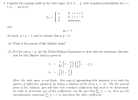
need help with (b) 4. Consider the random walk on the state space 10,1,2, ...^, with transition probabilities for i - ,4,. . ., given by if j=1+1 otherwise, 0 an Pol 1 . As usual, p+q 1, and we assum...
 need help with (b)
4. Consider the random walk on the state space 10,1,2, ...^, with transition probabilities for i - ,4,. . ., given by if j=1+1 otherwise, 0 an Pol 1 . As usual, p+q 1, and we assume that p, q > O (a) What is the period of this Markov chain? (b) For the case p < q, use the Global Balance Equations to show that the stationary distribu- tion for this Markov chain is given...
need help with (b)
4. Consider the random walk on the state space 10,1,2, ...^, with transition probabilities for i - ,4,. . ., given by if j=1+1 otherwise, 0 an Pol 1 . As usual, p+q 1, and we assume that p, q > O (a) What is the period of this Markov chain? (b) For the case p < q, use the Global Balance Equations to show that the stationary distribu- tion for this Markov chain is given...
Problem 4: Maze A mouse travels in a maze (shown in figure). At each discrete time-step, the mouse chooses one of the doors from the room it is curently in (uniformly at random), and moves to the cho...
 Problem 4: Maze A mouse travels in a maze (shown in figure). At each discrete time-step, the mouse chooses one of the doors from the room it is curently in (uniformly at random), and moves to the chosen neighboring room. Room three has a block of cheese in it (reward for the mouse (a) Model the location of mouse as a DTMC. Ist irreducible and aperiodic? Justify your answers b) Write the one-step probability transition matrix (c) Find the steady...
Please answer this in specific way,thanks. 1. A Markov chain X = (X2) >0 with state...
 Please answer this in specific way,thanks.
1. A Markov chain X = (X2) >0 with state space I = {A, B, C} has a one-step transition matrix P given by 70 2/3 1/3) P= 1/3 0 2/3 (1/6 1/3 1/2) (a) Find the eigenvalues 11, 12, 13 of P. (b) Deduce pn can be written as pn = 10 + XU, + Aug (n > 0) and determine the matrices U1, U2, U3 by using the equations n = 0,1,2....
Please answer this in specific way,thanks.
1. A Markov chain X = (X2) >0 with state space I = {A, B, C} has a one-step transition matrix P given by 70 2/3 1/3) P= 1/3 0 2/3 (1/6 1/3 1/2) (a) Find the eigenvalues 11, 12, 13 of P. (b) Deduce pn can be written as pn = 10 + XU, + Aug (n > 0) and determine the matrices U1, U2, U3 by using the equations n = 0,1,2....
Question 4 A shown at right. A random walker on G has transition probabilities to and from vertex 1 equal to /4, and al...
 Question 4 A shown at right. A random walker on G has transition probabilities to and from vertex 1 equal to /4, and all other transition to probabilities equal to 3/s. Let G be the digraph with adjacency matrix 0 1 1 1 1 1010 1 1 1010 A= 1 010 1 11010 (a) Draw the graph and mark on it the transition probabilities. (b) Compile the transition matrix T and verify that it is stochastic. (c) On average over...
Suppose Alice is sitting at a circular table with 4 chairs labeled {1, 2, 3, 4} and sitting initially at a random chair. Every minute she moves to her left or right at random with equal probability. C...
 Suppose Alice is sitting at a circular table with 4 chairs
labeled {1, 2, 3, 4} and sitting initially at a random chair. Every
minute she moves to her left or right at random with equal
probability. Consider the Markov chain associated to the sequence
of her positions X0, X1, . . . .
1. Write the state space, the distribution of X0 and the
distribution of X1.
2. Write the transition matrix.
3. Assume she is at chair one...
Suppose Alice is sitting at a circular table with 4 chairs
labeled {1, 2, 3, 4} and sitting initially at a random chair. Every
minute she moves to her left or right at random with equal
probability. Consider the Markov chain associated to the sequence
of her positions X0, X1, . . . .
1. Write the state space, the distribution of X0 and the
distribution of X1.
2. Write the transition matrix.
3. Assume she is at chair one...
Q4 and Q5 thanks! 4. Consider the Markov chain on S (1,2,3,4,5] running according to the...
 Q4 and Q5
thanks!
4. Consider the Markov chain on S (1,2,3,4,5] running according to the transition probability matrix 1/3 1/3 0 1/3 0 0 1/2 0 0 1/2 P=10 0 1/43/40 0 0 1/2 1/2 0 0 1/2 0 0 1/2 (a) Find inn p k for j, k#1, 2, ,5 (b) If the chain starts in state 1, what is the expected number of times the chain -+00 spends in state 1? (including the starting point). (c) If...
Q4 and Q5
thanks!
4. Consider the Markov chain on S (1,2,3,4,5] running according to the transition probability matrix 1/3 1/3 0 1/3 0 0 1/2 0 0 1/2 P=10 0 1/43/40 0 0 1/2 1/2 0 0 1/2 0 0 1/2 (a) Find inn p k for j, k#1, 2, ,5 (b) If the chain starts in state 1, what is the expected number of times the chain -+00 spends in state 1? (including the starting point). (c) If...
Topic 3 (About CLT and Bayes'Theorem: 10 marks] A particle moves along the line in a random walk....
 Topic 3 (About CLT and Bayes'Theorem: 10 marks] A particle moves along the line in a random walk. That is, the particle starts at the origin (position 0) and moves either 2 units to the right or I unit to the left in independent steps. If the particle moves to the right with probability 2/3, its movement at the ih step is a random variable X, with distribution P(x+2)-2/3 P(X,-)=13 The position of the particle after 400 steps is the...
 2. Problem 2.5. Consider a random walk on 10..... which movies left and right with respective probabilities a and p. If the walk is at 0 it transitions to 1 on the next step. If the walk is at k it transitions to k-1 on the next step. This is called random walk with reflecting boundaries. Assume that k 3, =1/4, p = 3/4, and the initial distribution is uniform. For the following, use technology if needed. (a) (10.1.X2 }...
 The answer is one of the following:
Please be descriptive! Thank
you :)
4. (Dobrow 2.5) Consider a random walk on [0,., k), which moves left and right with respective probabilities q and p. If the walk is at 0 it transitions to 1 on the next step. If the walk is at k it transitions to k 1 on the next step. This is called random walk with reflecting boundaries. Assume that k 3, q1/4, p 3/4, and the...
The answer is one of the following:
Please be descriptive! Thank
you :)
4. (Dobrow 2.5) Consider a random walk on [0,., k), which moves left and right with respective probabilities q and p. If the walk is at 0 it transitions to 1 on the next step. If the walk is at k it transitions to k 1 on the next step. This is called random walk with reflecting boundaries. Assume that k 3, q1/4, p 3/4, and the...
 Consider a random walk on {0, 1, . . . , N } with jump
probabilities p(x,x+1)=1/3, p(x,x−1)=2/3 for1≤x≤N−1 p(0,0)=1−c,
p(0,1)=c, p(N,N)=1−c, p(N,N−1)=c with p(x, y) = 0 for all other
cases. (Here c is a fixed number in (0, 1).) Find the expected
return time to 0 if we start the process there.
please answer it asap due in 10 hours. thanks
Consider a random walk on {0,1,...,N} with jump probabilities p(л, т + 1) — 1/3, p(х,т —...
Consider a random walk on {0, 1, . . . , N } with jump
probabilities p(x,x+1)=1/3, p(x,x−1)=2/3 for1≤x≤N−1 p(0,0)=1−c,
p(0,1)=c, p(N,N)=1−c, p(N,N−1)=c with p(x, y) = 0 for all other
cases. (Here c is a fixed number in (0, 1).) Find the expected
return time to 0 if we start the process there.
please answer it asap due in 10 hours. thanks
Consider a random walk on {0,1,...,N} with jump probabilities p(л, т + 1) — 1/3, p(х,т —...
 need help with (b)
4. Consider the random walk on the state space 10,1,2, ...^, with transition probabilities for i - ,4,. . ., given by if j=1+1 otherwise, 0 an Pol 1 . As usual, p+q 1, and we assume that p, q > O (a) What is the period of this Markov chain? (b) For the case p < q, use the Global Balance Equations to show that the stationary distribu- tion for this Markov chain is given...
need help with (b)
4. Consider the random walk on the state space 10,1,2, ...^, with transition probabilities for i - ,4,. . ., given by if j=1+1 otherwise, 0 an Pol 1 . As usual, p+q 1, and we assume that p, q > O (a) What is the period of this Markov chain? (b) For the case p < q, use the Global Balance Equations to show that the stationary distribu- tion for this Markov chain is given...
 Problem 4: Maze A mouse travels in a maze (shown in figure). At each discrete time-step, the mouse chooses one of the doors from the room it is curently in (uniformly at random), and moves to the chosen neighboring room. Room three has a block of cheese in it (reward for the mouse (a) Model the location of mouse as a DTMC. Ist irreducible and aperiodic? Justify your answers b) Write the one-step probability transition matrix (c) Find the steady...
 Please answer this in specific way,thanks.
1. A Markov chain X = (X2) >0 with state space I = {A, B, C} has a one-step transition matrix P given by 70 2/3 1/3) P= 1/3 0 2/3 (1/6 1/3 1/2) (a) Find the eigenvalues 11, 12, 13 of P. (b) Deduce pn can be written as pn = 10 + XU, + Aug (n > 0) and determine the matrices U1, U2, U3 by using the equations n = 0,1,2....
Please answer this in specific way,thanks.
1. A Markov chain X = (X2) >0 with state space I = {A, B, C} has a one-step transition matrix P given by 70 2/3 1/3) P= 1/3 0 2/3 (1/6 1/3 1/2) (a) Find the eigenvalues 11, 12, 13 of P. (b) Deduce pn can be written as pn = 10 + XU, + Aug (n > 0) and determine the matrices U1, U2, U3 by using the equations n = 0,1,2....
 Question 4 A shown at right. A random walker on G has transition probabilities to and from vertex 1 equal to /4, and all other transition to probabilities equal to 3/s. Let G be the digraph with adjacency matrix 0 1 1 1 1 1010 1 1 1010 A= 1 010 1 11010 (a) Draw the graph and mark on it the transition probabilities. (b) Compile the transition matrix T and verify that it is stochastic. (c) On average over...
 Suppose Alice is sitting at a circular table with 4 chairs
labeled {1, 2, 3, 4} and sitting initially at a random chair. Every
minute she moves to her left or right at random with equal
probability. Consider the Markov chain associated to the sequence
of her positions X0, X1, . . . .
1. Write the state space, the distribution of X0 and the
distribution of X1.
2. Write the transition matrix.
3. Assume she is at chair one...
Suppose Alice is sitting at a circular table with 4 chairs
labeled {1, 2, 3, 4} and sitting initially at a random chair. Every
minute she moves to her left or right at random with equal
probability. Consider the Markov chain associated to the sequence
of her positions X0, X1, . . . .
1. Write the state space, the distribution of X0 and the
distribution of X1.
2. Write the transition matrix.
3. Assume she is at chair one...
 Q4 and Q5
thanks!
4. Consider the Markov chain on S (1,2,3,4,5] running according to the transition probability matrix 1/3 1/3 0 1/3 0 0 1/2 0 0 1/2 P=10 0 1/43/40 0 0 1/2 1/2 0 0 1/2 0 0 1/2 (a) Find inn p k for j, k#1, 2, ,5 (b) If the chain starts in state 1, what is the expected number of times the chain -+00 spends in state 1? (including the starting point). (c) If...
Q4 and Q5
thanks!
4. Consider the Markov chain on S (1,2,3,4,5] running according to the transition probability matrix 1/3 1/3 0 1/3 0 0 1/2 0 0 1/2 P=10 0 1/43/40 0 0 1/2 1/2 0 0 1/2 0 0 1/2 (a) Find inn p k for j, k#1, 2, ,5 (b) If the chain starts in state 1, what is the expected number of times the chain -+00 spends in state 1? (including the starting point). (c) If...
 Topic 3 (About CLT and Bayes'Theorem: 10 marks] A particle moves along the line in a random walk. That is, the particle starts at the origin (position 0) and moves either 2 units to the right or I unit to the left in independent steps. If the particle moves to the right with probability 2/3, its movement at the ih step is a random variable X, with distribution P(x+2)-2/3 P(X,-)=13 The position of the particle after 400 steps is the...
Most questions answered within 3 hours.
-
Where is the error in this code sequence?
String s1 = "Hello";
String s2 = "ello";...
asked 11 months ago -
Financial data for Joel de Paris, Inc., for last year
follow:
Joel de Paris, Inc.
Balance...
asked 11 months ago -
Consider this reaction:
Al2(SO4)3 (aq)+ BaCl3
(aq) Al2Cl6 (aq)- +
3BaSO4(s) . What is the...
asked 11 months ago -
Suppose that Savneet is considering increasing her
recent random sample from 20 car rentals to 40...
asked 11 months ago -
Trucks arrive at an unloading terminal at an average rate of 120
per hour.
Trucks arrive...
asked 11 months ago -
Why are methanol and ethanol completely soluble in water while
octanol is not very little soluble....
asked 11 months ago -
A facilities manager at a university reads in a research report
that the mean amount of...
asked 11 months ago -
When the CuSO4 is rehydrated by adding water to the anhydrous
compound, is this an endothermic...
asked 11 months ago -
A ray of sunlight is passing from diamond into crown glass; the
angle of incidence is...
asked 11 months ago -
A block of mass 0.249 kg is placed on top of a light, vertical
spring of...
asked 11 months ago -
how do the kidneys compensate in the presences of acidosis
a) trigger hyperventilate
b) reserve acid...
asked 11 months ago -
Question 501 pts
The rental rate of capital to the firm increases. Which of the
following...
asked 11 months ago