1. In a one-period model, the share price starts at S and in one month’s time...
Homework Answers

Add Answer to:
1. In a one-period model, the share price starts at S and in
one month’s time...
An economist writes a 1-period expectation model for valuing options. The model assumes that the stock...
An economist writes a 1-period expectation model for valuing options. The model assumes that the stock starts at S and moves to 2S or 0.5S in 1 year’s time with equal probability. Assume rates are zero. (a) Using this expectation model what is the value of a call option struck at K? (b) Now use the 1-period binomial model to calculate the risk-neutral probabilities and thus calculate the risk-neutral value of this call op- tion? (c) Is there an arbitrage...
1. Consider a model with only one time period. Assume that there exist a stock and...
 1. Consider a model with only one time period. Assume that there exist a stock and a cash bond in the model. The initial price of the stock is $40. The investor believes that with probability 1/5 the stock price will drop to $20 and with probability 4/5 the stock price will rise to $80 at the end of the time period. The cash bond has an initial price of $100 and it will with certainty deliver $110 at the...
Consider a model with only one time period. Assume that there exist a stock and a...
Consider a model with only one time period. Assume that there exist a stock and a cash bond in the model. The initial price of the stock is $50. The investor believes that with probability 1/3 the stock price will drop to $30 and with probability 2/3 the stock price will rise to $90 at the end of the time period. The cash bond has an initial price of $100 and it will with certainty deliver $110 at the end...
1.1. Suppose that you have a stock in the one-period binomial model with fixed u, d,...
 1.1. Suppose that you have a stock in the one-period binomial model with fixed u, d, and r such that 0< d< 1 +r < u. Suppose that there are positive numbers pi and such that pi, qi < 1, pi + q-1, and (1 + r)So = PiSi (H) + qi Si (T). Show that pi = p ad qi = q. Hint: You know that the risk-neutral probabilities satisfy these equations as well.
5. Consider a binomial tree model for a stock price, S(n) as above. Find a probability...
 5. Consider a binomial tree model for a stock price, S(n) as above. Find a probability value p, in the case when the risk free assest has a continuous compounding rate of r. What are the bounds on e', that is, what is the smallest and largest value it can be in terms of u and d which prevent arbitrage? S(n) is a stock price where K1)u with probability p and K(1d with probability 1-p and K(1). K(n) are independent...
Consider the following one-period binomial model for stock price. At t = 0 the stock price...
Consider the following one-period binomial model for stock price. At t = 0 the stock price is $80 and at t = 1 (t is in years) it could be $70 with probability p > 0 and $y with probability 1 − p. The interest rate is assumed to be 8%. (1) Determine the range of values for y that precludes arbitrage in this model. (2) Assume that y = $83. Construct an arbitrage strategy for this model.1
1. (Put-call parity) A stock currently costs So per share. In each time period, the value...
 1. (Put-call parity) A stock currently costs So per share. In each time period, the value of the stock will either increase or decrease by u and d respectively, and the risk-free interest rate is r. Let Sn be the price of the stock at t n, for O < n < V, and consider three derivatives which expire at t- N, a call option Vall-(SN-K)+, a put option Vpul-(K-Sy)+, ad a forward contract Fv -SN -K (a) The forward...
1. (Put-call parity) A stock currently costs So per share. In each time period, the value...
 1. (Put-call parity) A stock currently costs So per share. In each time period, the value of the stock will either increase or decrease by u and d respectively, and the risk-free interest rate is r. Let Sn be the price of the stock at t-n, for O < n < N, and consider three derivatives which expire at t - V, a cal option Voll-(SN-K)+, a put option VNut-(X-Sy)+, and a forward option VN(SN contract FN SN N) ,...
1) In a two period model, a stock starts at 150. It either goes up by...
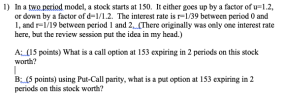 1) In a two period model, a stock starts at 150. It either goes up by a factor of u=1.2, or down by a factor of d 1/1.2. The interest rate isr=1/39 between period 0 and 1, and r1/19 between period 1 and 2There originally was only one interest rate here, but the review session put the idea in my head.) A(15 points) What is a call option at 153 expiring in 2 periods on this stock worth? B(5 points)...
1. Consider the following discrete time one-period market model. The savings account is given by Bo 1 and B1 1.1. The stock price is given by So 1 and S,-ξ where ξ is a random variable taking two pos...
 1. Consider the following discrete time one-period market model. The savings account is given by Bo 1 and B1 1.1. The stock price is given by So 1 and S,-ξ where ξ is a random variable taking two possible values u 1.2 and d = 0.9. Consider a put option whose payoff at time l is P = (1-S)+. (a) Find a replicating strategy for this option. By considering the value of the replicating strategy, find the time 0 price...
 1. Consider a model with only one time period. Assume that there exist a stock and a cash bond in the model. The initial price of the stock is $40. The investor believes that with probability 1/5 the stock price will drop to $20 and with probability 4/5 the stock price will rise to $80 at the end of the time period. The cash bond has an initial price of $100 and it will with certainty deliver $110 at the...
 1.1. Suppose that you have a stock in the one-period binomial model with fixed u, d, and r such that 0< d< 1 +r < u. Suppose that there are positive numbers pi and such that pi, qi < 1, pi + q-1, and (1 + r)So = PiSi (H) + qi Si (T). Show that pi = p ad qi = q. Hint: You know that the risk-neutral probabilities satisfy these equations as well.
 5. Consider a binomial tree model for a stock price, S(n) as above. Find a probability value p, in the case when the risk free assest has a continuous compounding rate of r. What are the bounds on e', that is, what is the smallest and largest value it can be in terms of u and d which prevent arbitrage? S(n) is a stock price where K1)u with probability p and K(1d with probability 1-p and K(1). K(n) are independent...
 1. (Put-call parity) A stock currently costs So per share. In each time period, the value of the stock will either increase or decrease by u and d respectively, and the risk-free interest rate is r. Let Sn be the price of the stock at t n, for O < n < V, and consider three derivatives which expire at t- N, a call option Vall-(SN-K)+, a put option Vpul-(K-Sy)+, ad a forward contract Fv -SN -K (a) The forward...
 1. (Put-call parity) A stock currently costs So per share. In each time period, the value of the stock will either increase or decrease by u and d respectively, and the risk-free interest rate is r. Let Sn be the price of the stock at t-n, for O < n < N, and consider three derivatives which expire at t - V, a cal option Voll-(SN-K)+, a put option VNut-(X-Sy)+, and a forward option VN(SN contract FN SN N) ,...
 1) In a two period model, a stock starts at 150. It either goes up by a factor of u=1.2, or down by a factor of d 1/1.2. The interest rate isr=1/39 between period 0 and 1, and r1/19 between period 1 and 2There originally was only one interest rate here, but the review session put the idea in my head.) A(15 points) What is a call option at 153 expiring in 2 periods on this stock worth? B(5 points)...
 1. Consider the following discrete time one-period market model. The savings account is given by Bo 1 and B1 1.1. The stock price is given by So 1 and S,-ξ where ξ is a random variable taking two possible values u 1.2 and d = 0.9. Consider a put option whose payoff at time l is P = (1-S)+. (a) Find a replicating strategy for this option. By considering the value of the replicating strategy, find the time 0 price...
Most questions answered within 3 hours.
-
Where is the error in this code sequence?
String s1 = "Hello";
String s2 = "ello";...
asked 11 months ago -
Financial data for Joel de Paris, Inc., for last year
follow:
Joel de Paris, Inc.
Balance...
asked 11 months ago -
Consider this reaction:
Al2(SO4)3 (aq)+ BaCl3
(aq) Al2Cl6 (aq)- +
3BaSO4(s) . What is the...
asked 11 months ago -
Suppose that Savneet is considering increasing her
recent random sample from 20 car rentals to 40...
asked 11 months ago -
Trucks arrive at an unloading terminal at an average rate of 120
per hour.
Trucks arrive...
asked 11 months ago -
Why are methanol and ethanol completely soluble in water while
octanol is not very little soluble....
asked 11 months ago -
A facilities manager at a university reads in a research report
that the mean amount of...
asked 11 months ago -
When the CuSO4 is rehydrated by adding water to the anhydrous
compound, is this an endothermic...
asked 11 months ago -
A ray of sunlight is passing from diamond into crown glass; the
angle of incidence is...
asked 11 months ago -
A block of mass 0.249 kg is placed on top of a light, vertical
spring of...
asked 11 months ago -
how do the kidneys compensate in the presences of acidosis
a) trigger hyperventilate
b) reserve acid...
asked 11 months ago -
Question 501 pts
The rental rate of capital to the firm increases. Which of the
following...
asked 11 months ago