
Homework Answers
Add Answer to:
5. Consider a binomial tree model for a stock price, S(n) as above. Find a probability...
3. Let K(1)., K(n) be independent identically distributed one step returns rates on a binomial tree...
 3. Let K(1)., K(n) be independent identically distributed one step returns rates on a binomial tree model for a stock price, S(n). Here K(1) = u with probability p and K(1) with probability 1 p. For which values of n and what conditions on u and d can (n) S(0)
Consider a binomial tree model for a stock price, S(n). Let r be the risk free...
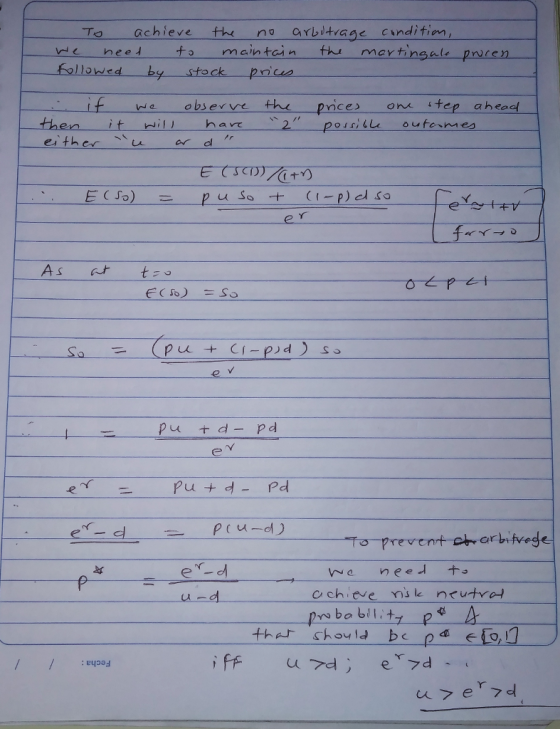
Consider a binomial tree model for a stock price, S(n). Let r be the risk free rate of interest and p∗ the probability for which E∗(K(1)) =r. Find the conditional expectation E∗(S(n)|S(1)) for any value of n.
Consider the following one-period binomial model for stock price. At t = 0 the stock price...
Consider the following one-period binomial model for stock price. At t = 0 the stock price is $80 and at t = 1 (t is in years) it could be $70 with probability p > 0 and $y with probability 1 − p. The interest rate is assumed to be 8%. (1) Determine the range of values for y that precludes arbitrage in this model. (2) Assume that y = $83. Construct an arbitrage strategy for this model.1
Consider the binomial model for an American call and put on a stock whose price is...
Consider the binomial model for an American call and put on a stock whose price is $90. The exercise price for both the put and the call is $65. The standard deviation of the stock returns is 25 percent per annum, and the risk-free rate is 6 percent per annum. The options expire in 120 days. The stock will pay a dividend equal to 4 percent of its value in 60 days. (a) Draw the three-period stock tree and the...
2. Consider a two-period (T = 2) binomial model with initial stock price So = $8,...
 2. Consider a two-period (T = 2) binomial model with initial stock price So = $8, u= 2, d=1/2, and “real world” up probability p=1/3. (a) Draw the binary tree illustrating the possible paths followed by the stock price process. (b) The sample space for this problem can be listed as N = {dd, jdu, ud, uu}. List the probabilities associated with the individual elements of the sample space 12. (c) List the events (i.e., the subsets of N2) making...
Let S = $80, K = $70, r = 6% (continuously compounded), d = 2%, s...
Let S = $80, K = $70, r = 6% (continuously compounded), d = 2%, s = 40%, T = 1, and n = 2. In this situation, the appropriate values of u and d are 1.35370 and 0.76886, respectively. What is the value of p*, the risk-neutral probability of an upward movement in the stock price at any node of the binomial tree? Option D is the correct answer, but how? Answers: a. 0.4882 b. 0.5097 c. 0.3533 d....
5. Consider the single period binomial model as in Section 1.2.2. Suppose that d <1+r <u....
 5. Consider the single period binomial model as in Section 1.2.2. Suppose that d <1+r <u. Show that if there exists an arbitrage opportunity (as in Definition 1.5), then one can find an arbitrage opportunity with V = 0. This means that there is no net cash flow at time 0. (Note: This is a step in the proof of Proposition 1.7 which you should go through carefully.) 1.2.2 Formal logical content The theory we build will be a mathematical...
Problem 5. Indicator variables S points possible (graded) Consider a sequence of n 1 independent tosses...
 Problem 5. Indicator variables S points possible (graded) Consider a sequence of n 1 independent tosses of a biased coin, at times k = 0,1,2,...,n On each toss, the probability of Heads is p, and the probability of Tails is 1 -p {1,2,.., at time for E resulted in Tails and the toss at time - 1 resulted in A reward of one unit is given if the toss at time Heads. Otherwise, no reward is given at time Let...
Q8-Part I (6 marks) The current price of a non-dividend-paying stock is $42. Over the next...
 Q8-Part I (6 marks) The current price of a non-dividend-paying stock is $42. Over the next year it is expected to rise to-$44. or fall to $39. An investor buys put options with a strike price of $43. To hedge the position, should (and by how many) the investor buy or sell the underlying share (s) for each put option purchased? (6 marks) 08-Part II (9 marks) The current price of a non-dividend paying stock is $49. Use a two-step...
Black-Scholes 1. C8: Provide a formula for the forward price based on the stock price S,...
 Black-Scholes
1. C8: Provide a formula for the forward price based on the
stock price S, the risk-free rate r and the time to expiration
T.
2. Columns N, O: Provide formulas for the future value (at
expiration) value of the option premiums using the BlackScholes
option prices C(K,T) and P(K,T), the risk free rate r and the time
to expiration T.
Black-Scholes 2.45-Y 100% Q- Search in Sheet Home Layout Tables Charts SmartArt Formulas Data Review Edit Font Number...
Black-Scholes
1. C8: Provide a formula for the forward price based on the
stock price S, the risk-free rate r and the time to expiration
T.
2. Columns N, O: Provide formulas for the future value (at
expiration) value of the option premiums using the BlackScholes
option prices C(K,T) and P(K,T), the risk free rate r and the time
to expiration T.
Black-Scholes 2.45-Y 100% Q- Search in Sheet Home Layout Tables Charts SmartArt Formulas Data Review Edit Font Number...
 3. Let K(1)., K(n) be independent identically distributed one step returns rates on a binomial tree model for a stock price, S(n). Here K(1) = u with probability p and K(1) with probability 1 p. For which values of n and what conditions on u and d can (n) S(0)
 2. Consider a two-period (T = 2) binomial model with initial stock price So = $8, u= 2, d=1/2, and “real world” up probability p=1/3. (a) Draw the binary tree illustrating the possible paths followed by the stock price process. (b) The sample space for this problem can be listed as N = {dd, jdu, ud, uu}. List the probabilities associated with the individual elements of the sample space 12. (c) List the events (i.e., the subsets of N2) making...
 5. Consider the single period binomial model as in Section 1.2.2. Suppose that d <1+r <u. Show that if there exists an arbitrage opportunity (as in Definition 1.5), then one can find an arbitrage opportunity with V = 0. This means that there is no net cash flow at time 0. (Note: This is a step in the proof of Proposition 1.7 which you should go through carefully.) 1.2.2 Formal logical content The theory we build will be a mathematical...
 Problem 5. Indicator variables S points possible (graded) Consider a sequence of n 1 independent tosses of a biased coin, at times k = 0,1,2,...,n On each toss, the probability of Heads is p, and the probability of Tails is 1 -p {1,2,.., at time for E resulted in Tails and the toss at time - 1 resulted in A reward of one unit is given if the toss at time Heads. Otherwise, no reward is given at time Let...
 Q8-Part I (6 marks) The current price of a non-dividend-paying stock is $42. Over the next year it is expected to rise to-$44. or fall to $39. An investor buys put options with a strike price of $43. To hedge the position, should (and by how many) the investor buy or sell the underlying share (s) for each put option purchased? (6 marks) 08-Part II (9 marks) The current price of a non-dividend paying stock is $49. Use a two-step...
 Black-Scholes
1. C8: Provide a formula for the forward price based on the
stock price S, the risk-free rate r and the time to expiration
T.
2. Columns N, O: Provide formulas for the future value (at
expiration) value of the option premiums using the BlackScholes
option prices C(K,T) and P(K,T), the risk free rate r and the time
to expiration T.
Black-Scholes 2.45-Y 100% Q- Search in Sheet Home Layout Tables Charts SmartArt Formulas Data Review Edit Font Number...
Black-Scholes
1. C8: Provide a formula for the forward price based on the
stock price S, the risk-free rate r and the time to expiration
T.
2. Columns N, O: Provide formulas for the future value (at
expiration) value of the option premiums using the BlackScholes
option prices C(K,T) and P(K,T), the risk free rate r and the time
to expiration T.
Black-Scholes 2.45-Y 100% Q- Search in Sheet Home Layout Tables Charts SmartArt Formulas Data Review Edit Font Number...
Most questions answered within 3 hours.
-
Where is the error in this code sequence?
String s1 = "Hello";
String s2 = "ello";...
asked 1 year ago -
Financial data for Joel de Paris, Inc., for last year
follow:
Joel de Paris, Inc.
Balance...
asked 1 year ago -
Consider this reaction:
Al2(SO4)3 (aq)+ BaCl3
(aq) Al2Cl6 (aq)- +
3BaSO4(s) . What is the...
asked 1 year ago -
Suppose that Savneet is considering increasing her
recent random sample from 20 car rentals to 40...
asked 1 year ago -
Trucks arrive at an unloading terminal at an average rate of 120
per hour.
Trucks arrive...
asked 1 year ago -
Why are methanol and ethanol completely soluble in water while
octanol is not very little soluble....
asked 1 year ago -
A facilities manager at a university reads in a research report
that the mean amount of...
asked 1 year ago -
When the CuSO4 is rehydrated by adding water to the anhydrous
compound, is this an endothermic...
asked 1 year ago -
A ray of sunlight is passing from diamond into crown glass; the
angle of incidence is...
asked 1 year ago -
A block of mass 0.249 kg is placed on top of a light, vertical
spring of...
asked 1 year ago -
how do the kidneys compensate in the presences of acidosis
a) trigger hyperventilate
b) reserve acid...
asked 1 year ago -
Question 501 pts
The rental rate of capital to the firm increases. Which of the
following...
asked 1 year ago