
Homework Answers
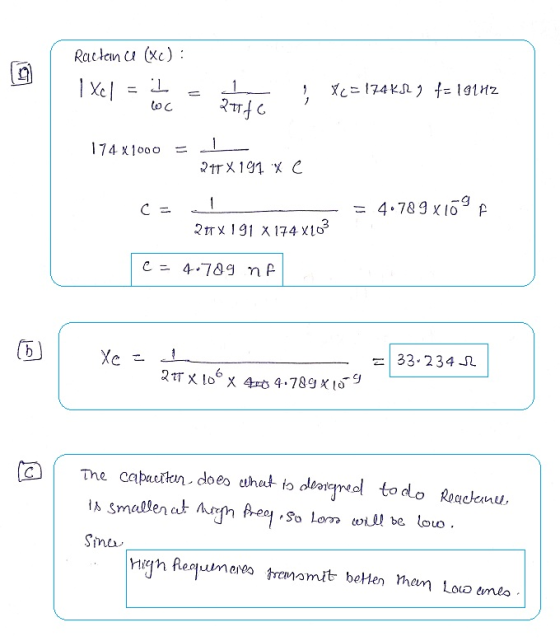
Please rate
if any mistake in this answer please comment i will clarify your
doubt . thank you
Add Answer to:
The capacitor in the figure below is designed to filter low-frequency signals, impeding their transmission between...
A certain type of capacitor is designed to filter low-frequency signals, impeding their transmission between circuits....
 A certain type of capacitor is designed to filter low-frequency signals, impeding their transmission between circuits. a) What capacitance is needed to produce a 92 kq reactance at a frequency of 121 Hz? nF b) What would its reactance be at 0.96 MHz? Ω
The capacitor in the figure below is designed to filter high-frequency signals by shorting them to...
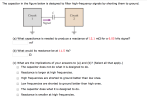 The capacitor in the figure below is designed to filter high-frequency signals by shorting them to ground. Circuit Circuit 1 Signal (a) What capacitance is needed to produce a reactance of 12.1 m 2 for a 6.05 kHz signal? mF (b) What would its reactance be at 11.5 Hz? Ω (c) What are the implications of your answers to (a) and (b)? (Select all that apply.) The capacitor does not do what it is designed to do. Reactance is larger...
The capacitor in the figure below is designed to filter high-frequency signals by shorting them to...
 The capacitor in the figure below is designed to filter high-frequency signals by shorting them to ground. Circuit Circuit Signal (a) What capacitance is needed to produce a reactance of 14.7 m 2 for a 4.70 kHz signal? mF (b) What would its reactance be at 14.6 Hz? (c) What are the implications of your answers to (a) and (b)? (Select all that apply.) Low frequencies are shorted to ground better than high ones. Reactance is larger at high frequencies....
QuestionThree useful circuit combinations in AC circuits are high-pass,"low-pass," and band-pass" filters. In the first case,...
 QuestionThree useful circuit combinations in AC circuits are
high-pass,"low-pass," and band-pass" filters. In the first case,
high frequency signals are allow to through the filter while low
frequencies are not while the opposite is true in the second case.
The third case allows Jonly limited region of frequencies through
the filter. Examine the series RLC circuit and iden tify what
behaves in the circuit like the different filter
combinations.
0.8 H 0000 Reactance XL (12) W 1.0 kN2 100 101...
QuestionThree useful circuit combinations in AC circuits are
high-pass,"low-pass," and band-pass" filters. In the first case,
high frequency signals are allow to through the filter while low
frequencies are not while the opposite is true in the second case.
The third case allows Jonly limited region of frequencies through
the filter. Examine the series RLC circuit and iden tify what
behaves in the circuit like the different filter
combinations.
0.8 H 0000 Reactance XL (12) W 1.0 kN2 100 101...
1. Read the laboratory supplement entitled “Frequency Response". 2. Read the remainder of this handout. 3....
 1. Read the laboratory supplement entitled “Frequency Response". 2. Read the remainder of this handout. 3. In Multisim, build the circuit shown in Figure 1 with C=0.22 uF and R = 2.2 k12. This circuit looks like a simple voltage divider except that one of the resistors is replaced by a capacitor. Il Figure 1: RC network. F Set up Vin to be a 1 Vpp sinusoid with 0 VDC Offset using a function generator. 2. Connect the oscilloscope in...
Determine the complex transfer function T(s) = V/V; for the circuit shown below. Specify it as...
 Determine the complex transfer function T(s) = V/V; for the circuit shown below. Specify it as a function of the complex frequency, s, and the symbols for the resistors and capacitor. On the attached graph, plot the magnitude of the complex transfer function T(jw) in decibels as a function of the frequency f of the source as f varies from 1 Hz to 1 MHz. Assume that the op amp is ideal. Use as the numerical values for the resistors...
What is the answer to question 23.1? 23.1 Active low-pass filter You can make a low-pass...
 What is the answer to question
23.1?
23.1 Active low-pass filter You can make a low-pass filter by putting a capacitor Cr and resistor Rf in parallel for Zj as shown in Figure 23.1. At low frequencies (well below the corner frequency), the feedback impedance is approximately Rf and the gain of a non-inverting amplifier is is 1 +R//R,. At high frequencies (well above the corner frequency),the impedance is approx- imately 1/(jwCs), and the gain of a non-inverting amplifier is...
What is the answer to question
23.1?
23.1 Active low-pass filter You can make a low-pass filter by putting a capacitor Cr and resistor Rf in parallel for Zj as shown in Figure 23.1. At low frequencies (well below the corner frequency), the feedback impedance is approximately Rf and the gain of a non-inverting amplifier is is 1 +R//R,. At high frequencies (well above the corner frequency),the impedance is approx- imately 1/(jwCs), and the gain of a non-inverting amplifier is...
3. With the aid of a diagram, briefly explain th ing principle of a Successive a) Approximation Analog-to-Digital Conve...
 3. With the aid of a diagram, briefly explain th ing principle of a Successive a) Approximation Analog-to-Digital Converter (ADC) b) An ADC has to be designed to convert voltages in the range from -5 V to +5 V, with a resolution below (better than) 1 mV. What is the minimum number of bits required to meet this design specification? An ADC has to be designed to convert input voltage signals with frequency c) components less than or equal o...
Problem Consider a voltage amplifier having a frequency response of the low-pass STC 1ype with a de gain of 60 dB a...
 Problem Consider a voltage amplifier having a frequency response of the low-pass STC 1ype with a de gain of 60 dB and a 3-dB frequency of 1000 Hz Find the gain in dB at f- 10 Hz, 10kHz, 100 kHz, and 1 MHz Problem For the circuit shown below first, evalusteand the coresponding comer froquency. Second evalmt and the corresponding comer froquency. At the end caloulate overall transfer function T(w)= and reurite it in the standard fom ( and draw...
skipped part. Tutorial Exercise The RC high-pass filter shown in the figure below has a resistance...
 skipped part. Tutorial Exercise The RC high-pass filter shown in the figure below has a resistance R -0.500 n and a capacitance C = 673 pF. What is the ratio of the amplitude of the output voltage to that of the input voltage for this filter for a source frequency of 583 Hz? R Scout Step 1 The source frequency given in this problem is not an especially high audio frequency so we might guess that the voltage transfer ratio...
 A certain type of capacitor is designed to filter low-frequency signals, impeding their transmission between circuits. a) What capacitance is needed to produce a 92 kq reactance at a frequency of 121 Hz? nF b) What would its reactance be at 0.96 MHz? Ω
 The capacitor in the figure below is designed to filter high-frequency signals by shorting them to ground. Circuit Circuit 1 Signal (a) What capacitance is needed to produce a reactance of 12.1 m 2 for a 6.05 kHz signal? mF (b) What would its reactance be at 11.5 Hz? Ω (c) What are the implications of your answers to (a) and (b)? (Select all that apply.) The capacitor does not do what it is designed to do. Reactance is larger...
 The capacitor in the figure below is designed to filter high-frequency signals by shorting them to ground. Circuit Circuit Signal (a) What capacitance is needed to produce a reactance of 14.7 m 2 for a 4.70 kHz signal? mF (b) What would its reactance be at 14.6 Hz? (c) What are the implications of your answers to (a) and (b)? (Select all that apply.) Low frequencies are shorted to ground better than high ones. Reactance is larger at high frequencies....
 QuestionThree useful circuit combinations in AC circuits are
high-pass,"low-pass," and band-pass" filters. In the first case,
high frequency signals are allow to through the filter while low
frequencies are not while the opposite is true in the second case.
The third case allows Jonly limited region of frequencies through
the filter. Examine the series RLC circuit and iden tify what
behaves in the circuit like the different filter
combinations.
0.8 H 0000 Reactance XL (12) W 1.0 kN2 100 101...
QuestionThree useful circuit combinations in AC circuits are
high-pass,"low-pass," and band-pass" filters. In the first case,
high frequency signals are allow to through the filter while low
frequencies are not while the opposite is true in the second case.
The third case allows Jonly limited region of frequencies through
the filter. Examine the series RLC circuit and iden tify what
behaves in the circuit like the different filter
combinations.
0.8 H 0000 Reactance XL (12) W 1.0 kN2 100 101...
 1. Read the laboratory supplement entitled “Frequency Response". 2. Read the remainder of this handout. 3. In Multisim, build the circuit shown in Figure 1 with C=0.22 uF and R = 2.2 k12. This circuit looks like a simple voltage divider except that one of the resistors is replaced by a capacitor. Il Figure 1: RC network. F Set up Vin to be a 1 Vpp sinusoid with 0 VDC Offset using a function generator. 2. Connect the oscilloscope in...
 Determine the complex transfer function T(s) = V/V; for the circuit shown below. Specify it as a function of the complex frequency, s, and the symbols for the resistors and capacitor. On the attached graph, plot the magnitude of the complex transfer function T(jw) in decibels as a function of the frequency f of the source as f varies from 1 Hz to 1 MHz. Assume that the op amp is ideal. Use as the numerical values for the resistors...
 What is the answer to question
23.1?
23.1 Active low-pass filter You can make a low-pass filter by putting a capacitor Cr and resistor Rf in parallel for Zj as shown in Figure 23.1. At low frequencies (well below the corner frequency), the feedback impedance is approximately Rf and the gain of a non-inverting amplifier is is 1 +R//R,. At high frequencies (well above the corner frequency),the impedance is approx- imately 1/(jwCs), and the gain of a non-inverting amplifier is...
What is the answer to question
23.1?
23.1 Active low-pass filter You can make a low-pass filter by putting a capacitor Cr and resistor Rf in parallel for Zj as shown in Figure 23.1. At low frequencies (well below the corner frequency), the feedback impedance is approximately Rf and the gain of a non-inverting amplifier is is 1 +R//R,. At high frequencies (well above the corner frequency),the impedance is approx- imately 1/(jwCs), and the gain of a non-inverting amplifier is...
 3. With the aid of a diagram, briefly explain th ing principle of a Successive a) Approximation Analog-to-Digital Converter (ADC) b) An ADC has to be designed to convert voltages in the range from -5 V to +5 V, with a resolution below (better than) 1 mV. What is the minimum number of bits required to meet this design specification? An ADC has to be designed to convert input voltage signals with frequency c) components less than or equal o...
 Problem Consider a voltage amplifier having a frequency response of the low-pass STC 1ype with a de gain of 60 dB and a 3-dB frequency of 1000 Hz Find the gain in dB at f- 10 Hz, 10kHz, 100 kHz, and 1 MHz Problem For the circuit shown below first, evalusteand the coresponding comer froquency. Second evalmt and the corresponding comer froquency. At the end caloulate overall transfer function T(w)= and reurite it in the standard fom ( and draw...
 skipped part. Tutorial Exercise The RC high-pass filter shown in the figure below has a resistance R -0.500 n and a capacitance C = 673 pF. What is the ratio of the amplitude of the output voltage to that of the input voltage for this filter for a source frequency of 583 Hz? R Scout Step 1 The source frequency given in this problem is not an especially high audio frequency so we might guess that the voltage transfer ratio...
Most questions answered within 3 hours.
-
Where is the error in this code sequence?
String s1 = "Hello";
String s2 = "ello";...
asked 10 months ago -
Financial data for Joel de Paris, Inc., for last year
follow:
Joel de Paris, Inc.
Balance...
asked 10 months ago -
Consider this reaction:
Al2(SO4)3 (aq)+ BaCl3
(aq) Al2Cl6 (aq)- +
3BaSO4(s) . What is the...
asked 10 months ago -
Suppose that Savneet is considering increasing her
recent random sample from 20 car rentals to 40...
asked 10 months ago -
Trucks arrive at an unloading terminal at an average rate of 120
per hour.
Trucks arrive...
asked 10 months ago -
Why are methanol and ethanol completely soluble in water while
octanol is not very little soluble....
asked 10 months ago -
A facilities manager at a university reads in a research report
that the mean amount of...
asked 10 months ago -
When the CuSO4 is rehydrated by adding water to the anhydrous
compound, is this an endothermic...
asked 10 months ago -
A ray of sunlight is passing from diamond into crown glass; the
angle of incidence is...
asked 10 months ago -
A block of mass 0.249 kg is placed on top of a light, vertical
spring of...
asked 10 months ago -
how do the kidneys compensate in the presences of acidosis
a) trigger hyperventilate
b) reserve acid...
asked 10 months ago -
Question 501 pts
The rental rate of capital to the firm increases. Which of the
following...
asked 10 months ago