
Homework Answers
The circuit is wired as follows
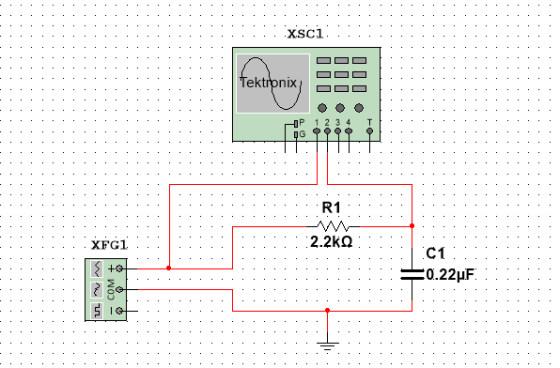
Now the input frequency is changed using the function generator and the output voltage is noted for the given frequencies
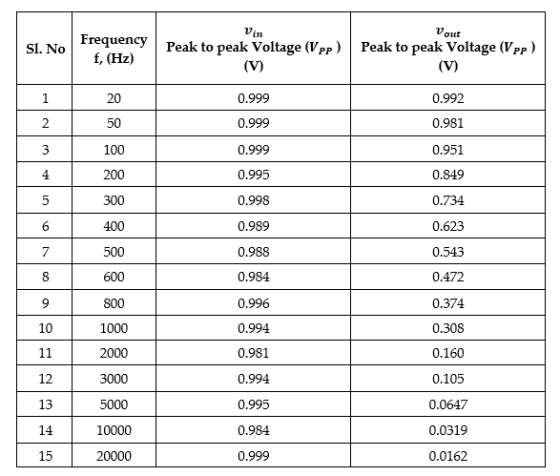
The graph was then plotted.
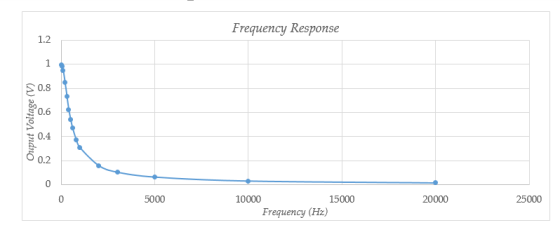
From the graph, we can say that the circuit behaves as a low pass filter as it passes low frequencies and stops high frequencies
Add Answer to:
1. Read the laboratory supplement entitled “Frequency Response". 2. Read the remainder of this handout. 3....
EE 3342 Pre-Lab Exercises for Experiment 7: Passive Analog Filters Read the handout for Experimen...
 E7.1
E7.2
EE 3342 Pre-Lab Exercises for Experiment 7: Passive Analog Filters Read the handout for Experiment 7. Questions: 1. Use the nominal values of the resistor and capacitor components to determine theoretical gain (magnitude) and phase for the LP filter of Figure E7.1 at frequencies of 50 Hz, 200 Hz, I kHz, and 5 kHz. Show all calculations in detail. 2. Using one of the graph paper sheets provided, mark the four points calculated in question Save a copy...
E7.1
E7.2
EE 3342 Pre-Lab Exercises for Experiment 7: Passive Analog Filters Read the handout for Experiment 7. Questions: 1. Use the nominal values of the resistor and capacitor components to determine theoretical gain (magnitude) and phase for the LP filter of Figure E7.1 at frequencies of 50 Hz, 200 Hz, I kHz, and 5 kHz. Show all calculations in detail. 2. Using one of the graph paper sheets provided, mark the four points calculated in question Save a copy...
A) Design a low-pass filter using the given circuitry with a cut-off value of 1 kHz and plot the ...
 a) Design a low-pass filter using the given circuitry with a cut-off value of 1 kHz and plot the frequency response curve on the given axes 1.0 0.7 0.5 in out 0.0 101 102 103 104 10s Hz b) Design a band-pass filter using the given circuitry with a bandwidth of 500 Hz and a lower cut-off value of 100 Hz, and draw the frequency response curve. Keep all resistors at the same value (i.e. Ri-R-R3-R4). 1.0 0.7 0.5 0.0...
3. With the aid of a diagram, briefly explain th ing principle of a Successive a) Approximation Analog-to-Digital Conve...
 3. With the aid of a diagram, briefly explain th ing principle of a Successive a) Approximation Analog-to-Digital Converter (ADC) b) An ADC has to be designed to convert voltages in the range from -5 V to +5 V, with a resolution below (better than) 1 mV. What is the minimum number of bits required to meet this design specification? An ADC has to be designed to convert input voltage signals with frequency c) components less than or equal o...
The capacitor in the figure below is designed to filter high-frequency signals by shorting them to...
 The capacitor in the figure below is designed to filter high-frequency signals by shorting them to ground. Circuit Circuit 1 Signal (a) What capacitance is needed to produce a reactance of 12.1 m 2 for a 6.05 kHz signal? mF (b) What would its reactance be at 11.5 Hz? Ω (c) What are the implications of your answers to (a) and (b)? (Select all that apply.) The capacitor does not do what it is designed to do. Reactance is larger...
QUESTION 1 Barry the Biologist has asked for your help to build an amplifier and filter to take small signals from his...
 QUESTION 1 Barry the Biologist has asked for your help to build an amplifier and filter to take small signals from his bird sensing microphones and amplify them so that he can capture the signals on his PC. The microphone produces AC signals at varying frequencies with 10 mV magnitude. His PC requires the signals to be 1 V magnitude. The signals that Barry is interested in are above 1 kHz Hz. He would like the filter to attenuate signals...
Part A: Design the power supply component of your amplifier and filter. You will need to...
 Part A:
Design the power supply component of your amplifier and filter.
You will need to produce a dual-sided power supply with +10V, 0V
and –10V using the 12 VAC plugpack as an AC source. Assume that
your amplifier and filter will draw around 10 mA of current on both
the positive and negative voltage supplies. Your design should
include components to minimise voltage ripple. Show calculations
for the selection of components where practical. Show a circuit
diagram for the...
Part A:
Design the power supply component of your amplifier and filter.
You will need to produce a dual-sided power supply with +10V, 0V
and –10V using the 12 VAC plugpack as an AC source. Assume that
your amplifier and filter will draw around 10 mA of current on both
the positive and negative voltage supplies. Your design should
include components to minimise voltage ripple. Show calculations
for the selection of components where practical. Show a circuit
diagram for the...
The capacitor in the figure below is designed to filter high-frequency signals by shorting them to...
 The capacitor in the figure below is designed to filter high-frequency signals by shorting them to ground. Circuit Circuit Signal (a) What capacitance is needed to produce a reactance of 14.7 m 2 for a 4.70 kHz signal? mF (b) What would its reactance be at 14.6 Hz? (c) What are the implications of your answers to (a) and (b)? (Select all that apply.) Low frequencies are shorted to ground better than high ones. Reactance is larger at high frequencies....
Active Low-pass and High-pass Filters for Crossover Circuitry (PSPICE) Design a first order active high-pass filter...
 Active Low-pass and High-pass Filters for Crossover Circuitry
(PSPICE)
Design a first order active high-pass filter with cut-off
frequency of 1 kHz & gain 20dB.
Design a first order active low-pass filter with cut-off
frequency of 1 kHz & gain 20dB.
Plot the magnitude and phase responses of the active high-pass
and low-pass filters you have designed using PSpice (Use UA741 Op
amp and ±12V dual supply).
Connect your active low-pass and high-pass filters as shown in
Fig. 1-b. Assume...
Active Low-pass and High-pass Filters for Crossover Circuitry
(PSPICE)
Design a first order active high-pass filter with cut-off
frequency of 1 kHz & gain 20dB.
Design a first order active low-pass filter with cut-off
frequency of 1 kHz & gain 20dB.
Plot the magnitude and phase responses of the active high-pass
and low-pass filters you have designed using PSpice (Use UA741 Op
amp and ±12V dual supply).
Connect your active low-pass and high-pass filters as shown in
Fig. 1-b. Assume...
QUESTION Barry the Biologist has asked for your help to build an amplifier and filter to take small signals from hi...
 QUESTION Barry the Biologist has asked for your help to build an amplifier and filter to take small signals from his bird sensing microphones and amplify them so that he can capture the signals on his PC. The microphone produces AC signals at varying frequencies with 10 mV magnitude. His PC requires the signals to be 1 V magnitude. The signals that Bary is interested in are above 1 kHz Hz. He would like the filter to attenuate signals at...
please read thr question carefully and answer everything please label answer please asap For the circuit below Design a band-pass (R-C) circuit 30. t that allows frequencies only within the range...
 please read thr question carefully and answer everything
please label answer please asap
For the circuit below Design a band-pass (R-C) circuit 30. t that allows frequencies only within the range of 2 KJHz and 4 KHz and allows 31. Assuming the resonant frequency is half-way through the cutoff frequencies, calculate the Quality Facto (Q) for this filter. Is it a Low/Medium/High Q? Sketch the normalized plots of both the high-pass and the low-pass fil provided below ters using a...
please read thr question carefully and answer everything
please label answer please asap
For the circuit below Design a band-pass (R-C) circuit 30. t that allows frequencies only within the range of 2 KJHz and 4 KHz and allows 31. Assuming the resonant frequency is half-way through the cutoff frequencies, calculate the Quality Facto (Q) for this filter. Is it a Low/Medium/High Q? Sketch the normalized plots of both the high-pass and the low-pass fil provided below ters using a...
 E7.1
E7.2
EE 3342 Pre-Lab Exercises for Experiment 7: Passive Analog Filters Read the handout for Experiment 7. Questions: 1. Use the nominal values of the resistor and capacitor components to determine theoretical gain (magnitude) and phase for the LP filter of Figure E7.1 at frequencies of 50 Hz, 200 Hz, I kHz, and 5 kHz. Show all calculations in detail. 2. Using one of the graph paper sheets provided, mark the four points calculated in question Save a copy...
E7.1
E7.2
EE 3342 Pre-Lab Exercises for Experiment 7: Passive Analog Filters Read the handout for Experiment 7. Questions: 1. Use the nominal values of the resistor and capacitor components to determine theoretical gain (magnitude) and phase for the LP filter of Figure E7.1 at frequencies of 50 Hz, 200 Hz, I kHz, and 5 kHz. Show all calculations in detail. 2. Using one of the graph paper sheets provided, mark the four points calculated in question Save a copy...
 a) Design a low-pass filter using the given circuitry with a cut-off value of 1 kHz and plot the frequency response curve on the given axes 1.0 0.7 0.5 in out 0.0 101 102 103 104 10s Hz b) Design a band-pass filter using the given circuitry with a bandwidth of 500 Hz and a lower cut-off value of 100 Hz, and draw the frequency response curve. Keep all resistors at the same value (i.e. Ri-R-R3-R4). 1.0 0.7 0.5 0.0...
 3. With the aid of a diagram, briefly explain th ing principle of a Successive a) Approximation Analog-to-Digital Converter (ADC) b) An ADC has to be designed to convert voltages in the range from -5 V to +5 V, with a resolution below (better than) 1 mV. What is the minimum number of bits required to meet this design specification? An ADC has to be designed to convert input voltage signals with frequency c) components less than or equal o...
 The capacitor in the figure below is designed to filter high-frequency signals by shorting them to ground. Circuit Circuit 1 Signal (a) What capacitance is needed to produce a reactance of 12.1 m 2 for a 6.05 kHz signal? mF (b) What would its reactance be at 11.5 Hz? Ω (c) What are the implications of your answers to (a) and (b)? (Select all that apply.) The capacitor does not do what it is designed to do. Reactance is larger...
 QUESTION 1 Barry the Biologist has asked for your help to build an amplifier and filter to take small signals from his bird sensing microphones and amplify them so that he can capture the signals on his PC. The microphone produces AC signals at varying frequencies with 10 mV magnitude. His PC requires the signals to be 1 V magnitude. The signals that Barry is interested in are above 1 kHz Hz. He would like the filter to attenuate signals...
 Part A:
Design the power supply component of your amplifier and filter.
You will need to produce a dual-sided power supply with +10V, 0V
and –10V using the 12 VAC plugpack as an AC source. Assume that
your amplifier and filter will draw around 10 mA of current on both
the positive and negative voltage supplies. Your design should
include components to minimise voltage ripple. Show calculations
for the selection of components where practical. Show a circuit
diagram for the...
Part A:
Design the power supply component of your amplifier and filter.
You will need to produce a dual-sided power supply with +10V, 0V
and –10V using the 12 VAC plugpack as an AC source. Assume that
your amplifier and filter will draw around 10 mA of current on both
the positive and negative voltage supplies. Your design should
include components to minimise voltage ripple. Show calculations
for the selection of components where practical. Show a circuit
diagram for the...
 The capacitor in the figure below is designed to filter high-frequency signals by shorting them to ground. Circuit Circuit Signal (a) What capacitance is needed to produce a reactance of 14.7 m 2 for a 4.70 kHz signal? mF (b) What would its reactance be at 14.6 Hz? (c) What are the implications of your answers to (a) and (b)? (Select all that apply.) Low frequencies are shorted to ground better than high ones. Reactance is larger at high frequencies....
 Active Low-pass and High-pass Filters for Crossover Circuitry
(PSPICE)
Design a first order active high-pass filter with cut-off
frequency of 1 kHz & gain 20dB.
Design a first order active low-pass filter with cut-off
frequency of 1 kHz & gain 20dB.
Plot the magnitude and phase responses of the active high-pass
and low-pass filters you have designed using PSpice (Use UA741 Op
amp and ±12V dual supply).
Connect your active low-pass and high-pass filters as shown in
Fig. 1-b. Assume...
Active Low-pass and High-pass Filters for Crossover Circuitry
(PSPICE)
Design a first order active high-pass filter with cut-off
frequency of 1 kHz & gain 20dB.
Design a first order active low-pass filter with cut-off
frequency of 1 kHz & gain 20dB.
Plot the magnitude and phase responses of the active high-pass
and low-pass filters you have designed using PSpice (Use UA741 Op
amp and ±12V dual supply).
Connect your active low-pass and high-pass filters as shown in
Fig. 1-b. Assume...
 QUESTION Barry the Biologist has asked for your help to build an amplifier and filter to take small signals from his bird sensing microphones and amplify them so that he can capture the signals on his PC. The microphone produces AC signals at varying frequencies with 10 mV magnitude. His PC requires the signals to be 1 V magnitude. The signals that Bary is interested in are above 1 kHz Hz. He would like the filter to attenuate signals at...
 please read thr question carefully and answer everything
please label answer please asap
For the circuit below Design a band-pass (R-C) circuit 30. t that allows frequencies only within the range of 2 KJHz and 4 KHz and allows 31. Assuming the resonant frequency is half-way through the cutoff frequencies, calculate the Quality Facto (Q) for this filter. Is it a Low/Medium/High Q? Sketch the normalized plots of both the high-pass and the low-pass fil provided below ters using a...
please read thr question carefully and answer everything
please label answer please asap
For the circuit below Design a band-pass (R-C) circuit 30. t that allows frequencies only within the range of 2 KJHz and 4 KHz and allows 31. Assuming the resonant frequency is half-way through the cutoff frequencies, calculate the Quality Facto (Q) for this filter. Is it a Low/Medium/High Q? Sketch the normalized plots of both the high-pass and the low-pass fil provided below ters using a...
Most questions answered within 3 hours.
-
Where is the error in this code sequence?
String s1 = "Hello";
String s2 = "ello";...
asked 11 months ago -
Financial data for Joel de Paris, Inc., for last year
follow:
Joel de Paris, Inc.
Balance...
asked 11 months ago -
Consider this reaction:
Al2(SO4)3 (aq)+ BaCl3
(aq) Al2Cl6 (aq)- +
3BaSO4(s) . What is the...
asked 11 months ago -
Suppose that Savneet is considering increasing her
recent random sample from 20 car rentals to 40...
asked 11 months ago -
Trucks arrive at an unloading terminal at an average rate of 120
per hour.
Trucks arrive...
asked 11 months ago -
Why are methanol and ethanol completely soluble in water while
octanol is not very little soluble....
asked 11 months ago -
A facilities manager at a university reads in a research report
that the mean amount of...
asked 11 months ago -
When the CuSO4 is rehydrated by adding water to the anhydrous
compound, is this an endothermic...
asked 11 months ago -
A ray of sunlight is passing from diamond into crown glass; the
angle of incidence is...
asked 11 months ago -
A block of mass 0.249 kg is placed on top of a light, vertical
spring of...
asked 11 months ago -
how do the kidneys compensate in the presences of acidosis
a) trigger hyperventilate
b) reserve acid...
asked 11 months ago -
Question 501 pts
The rental rate of capital to the firm increases. Which of the
following...
asked 11 months ago