
Homework Answers

Add Answer to:
QUESTION 1 Barry the Biologist has asked for your help to build an amplifier and filter to take small signals from his...
QUESTION Barry the Biologist has asked for your help to build an amplifier and filter to take small signals from hi...
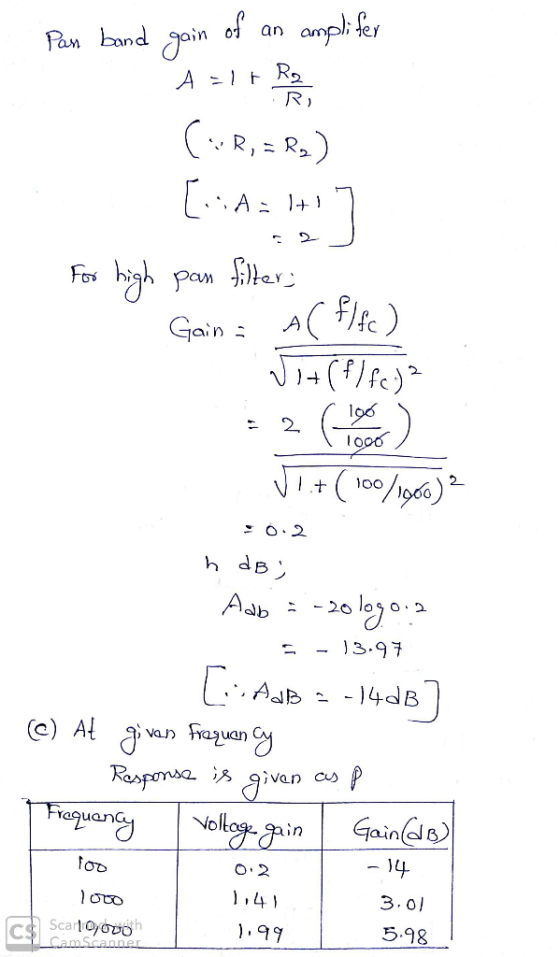
 QUESTION Barry the Biologist has asked for your help to build an amplifier and filter to take small signals from his bird sensing microphones and amplify them so that he can capture the signals on his PC. The microphone produces AC signals at varying frequencies with 10 mV magnitude. His PC requires the signals to be 1 V magnitude. The signals that Bary is interested in are above 1 kHz Hz. He would like the filter to attenuate signals at...
A Biologist needs your help to build an amplifier and filter to take small signals from...
 A Biologist needs your help to build an amplifier and filter to
take small signals from his bird sensing microphones and amplify
them so that he can capture the signals on his PC. The microphone
produces AC signals at varying frequencies with 10 mV magnitude.
His PC requires the signals to be 1 V magnitude. The signals that
Barry is interested in are above 1 kHz Hz. He would like the filter
to attenuate signals at frequencies below 1 kHz....
A Biologist needs your help to build an amplifier and filter to
take small signals from his bird sensing microphones and amplify
them so that he can capture the signals on his PC. The microphone
produces AC signals at varying frequencies with 10 mV magnitude.
His PC requires the signals to be 1 V magnitude. The signals that
Barry is interested in are above 1 kHz Hz. He would like the filter
to attenuate signals at frequencies below 1 kHz....
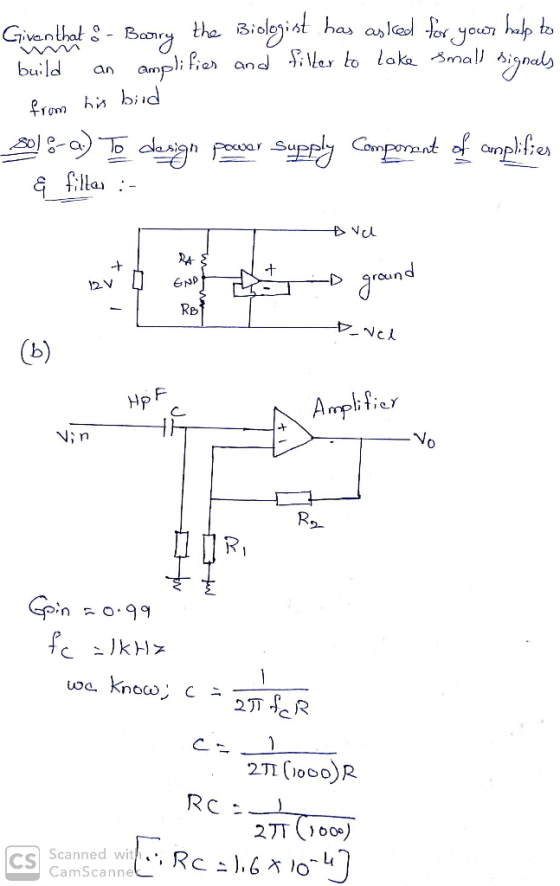
Part A: Design the power supply component of your amplifier and filter. You will need to...
 Part A:
Design the power supply component of your amplifier and filter.
You will need to produce a dual-sided power supply with +10V, 0V
and –10V using the 12 VAC plugpack as an AC source. Assume that
your amplifier and filter will draw around 10 mA of current on both
the positive and negative voltage supplies. Your design should
include components to minimise voltage ripple. Show calculations
for the selection of components where practical. Show a circuit
diagram for the...
Part A:
Design the power supply component of your amplifier and filter.
You will need to produce a dual-sided power supply with +10V, 0V
and –10V using the 12 VAC plugpack as an AC source. Assume that
your amplifier and filter will draw around 10 mA of current on both
the positive and negative voltage supplies. Your design should
include components to minimise voltage ripple. Show calculations
for the selection of components where practical. Show a circuit
diagram for the...
QUESTION 1 Anna the Audiophile has asked for your help to build an amplifier and filter...
 QUESTION 1 Anna the Audiophile has asked for your help to build an amplifier and filter to take small signals from her hifi system and amplify them so that she can drive her new subwoofer. The hifi system produces AC signals at varying frequencies with 250mVrms maximum magnitude Her subwoofer requires the signals to be 20 Vrms maximum magnitude. The signals that Anna is interested in are below 200 Hz. She would like the filter to attenuate signals at frequencies...
ONLY NEED HELP WITH III and IV PLEASE (e) A second stage, shown in Figure 3, is cascaded directly after the output of the circuit in Figure 1 R4 Figure 3 (i) Show that the combined response of the c...
 ONLY NEED HELP WITH III and IV PLEASE
(e) A second stage, shown in Figure 3, is cascaded directly after the output of the circuit in Figure 1 R4 Figure 3 (i) Show that the combined response of the complete circuit is given by: (4 marks) (ii) The two cascaded stages form a bandpass filter, which only amplifies a specific range of frequencies. This range of frequencies is known as the passband. Using the values chosen in (a) for Figure...
ONLY NEED HELP WITH III and IV PLEASE
(e) A second stage, shown in Figure 3, is cascaded directly after the output of the circuit in Figure 1 R4 Figure 3 (i) Show that the combined response of the complete circuit is given by: (4 marks) (ii) The two cascaded stages form a bandpass filter, which only amplifies a specific range of frequencies. This range of frequencies is known as the passband. Using the values chosen in (a) for Figure...
Laboratory 1: operation amplifier characteristics A. Objectives: 1. To study the basic characteri...
 thanks
Laboratory 1: operation amplifier characteristics A. Objectives: 1. To study the basic characteristics of an operational amplifier 2. To study the bias circuit of an operational amplifier B. Apparatus: 1. DC Power supply 2. Experimental board and corresponding components 3. Electronic calculator (prepared by students) 4. Digital camera (prepared by students for photo taking of the experimental results) 5. Laptop computer with the software PicoScope 6 and Microsoft Word installed. 6. PicoScope PC Oscilloscope and its accessories. 7. Multimeter...
thanks
Laboratory 1: operation amplifier characteristics A. Objectives: 1. To study the basic characteristics of an operational amplifier 2. To study the bias circuit of an operational amplifier B. Apparatus: 1. DC Power supply 2. Experimental board and corresponding components 3. Electronic calculator (prepared by students) 4. Digital camera (prepared by students for photo taking of the experimental results) 5. Laptop computer with the software PicoScope 6 and Microsoft Word installed. 6. PicoScope PC Oscilloscope and its accessories. 7. Multimeter...
Laboratory 2: Transistor circuit characteristics A. Objectives: 1. To study the basic characteris...
 Laboratory 2: Transistor circuit characteristics A. Objectives: 1. To study the basic characteristics of a transistor circuit. 2. To study the bias circuit of a transistor circuit. B. Apparatus: 1. DC Power supply 2. Experimental boards and corresponding components 3. Electronic calculator (prepared by students) 4. Digital camera (prepared by students for photo taking of the experimental results) 5. Laptop computer with the software PicoScope 6 and Microsoft Word installed. 6. PicoScope PC Oscilloscope and its accessories. 7. Digital multi-meter....
A common source amplifier circuit based on a single n-channel MOSFET is shown in Figure 4b. Assume that the transconductance gm-60 mS (equivalent to mA/ V) and drain source resistance, os,...
 A common source amplifier circuit based on a single n-channel MOSFET is shown in Figure 4b. Assume that the transconductance gm-60 mS (equivalent to mA/ V) and drain source resistance, os, is so large it may be neglected. 0) Calculate the open circuit voltage gain Av Yout/ Vis. i) The amplifier has a load of 10 k2. Determine the current gain Va. = 12 V 150k 4k3 Vout Vin 200k GND = 0 V Figure 4b a) State the name...
Yes, this is one problem. Please solve ALL PARTS. Guaranteed thumbs up for the person who solves it. 3 1. Photodiode...
 Yes, this is one problem. Please solve ALL PARTS. Guaranteed
thumbs up for the person who solves it.
3 1. Photodiode amplifier circuit You are designinga CF photosensor circuit for a light detection and ranging LiDAR) system in autonomous vehicles. The circuit utilizes a transimpedance amplifier to convert low-level RF photodiode current signal to a usable voltage output. It consists of a photodiode, an amplifier, and feedback capacitor/resistor pair as shown in Figure 1. We will derive simple equations to...
Yes, this is one problem. Please solve ALL PARTS. Guaranteed
thumbs up for the person who solves it.
3 1. Photodiode amplifier circuit You are designinga CF photosensor circuit for a light detection and ranging LiDAR) system in autonomous vehicles. The circuit utilizes a transimpedance amplifier to convert low-level RF photodiode current signal to a usable voltage output. It consists of a photodiode, an amplifier, and feedback capacitor/resistor pair as shown in Figure 1. We will derive simple equations to...
 QUESTION Barry the Biologist has asked for your help to build an amplifier and filter to take small signals from his bird sensing microphones and amplify them so that he can capture the signals on his PC. The microphone produces AC signals at varying frequencies with 10 mV magnitude. His PC requires the signals to be 1 V magnitude. The signals that Bary is interested in are above 1 kHz Hz. He would like the filter to attenuate signals at...
 A Biologist needs your help to build an amplifier and filter to
take small signals from his bird sensing microphones and amplify
them so that he can capture the signals on his PC. The microphone
produces AC signals at varying frequencies with 10 mV magnitude.
His PC requires the signals to be 1 V magnitude. The signals that
Barry is interested in are above 1 kHz Hz. He would like the filter
to attenuate signals at frequencies below 1 kHz....
A Biologist needs your help to build an amplifier and filter to
take small signals from his bird sensing microphones and amplify
them so that he can capture the signals on his PC. The microphone
produces AC signals at varying frequencies with 10 mV magnitude.
His PC requires the signals to be 1 V magnitude. The signals that
Barry is interested in are above 1 kHz Hz. He would like the filter
to attenuate signals at frequencies below 1 kHz....
 Part A:
Design the power supply component of your amplifier and filter.
You will need to produce a dual-sided power supply with +10V, 0V
and –10V using the 12 VAC plugpack as an AC source. Assume that
your amplifier and filter will draw around 10 mA of current on both
the positive and negative voltage supplies. Your design should
include components to minimise voltage ripple. Show calculations
for the selection of components where practical. Show a circuit
diagram for the...
Part A:
Design the power supply component of your amplifier and filter.
You will need to produce a dual-sided power supply with +10V, 0V
and –10V using the 12 VAC plugpack as an AC source. Assume that
your amplifier and filter will draw around 10 mA of current on both
the positive and negative voltage supplies. Your design should
include components to minimise voltage ripple. Show calculations
for the selection of components where practical. Show a circuit
diagram for the...
 QUESTION 1 Anna the Audiophile has asked for your help to build an amplifier and filter to take small signals from her hifi system and amplify them so that she can drive her new subwoofer. The hifi system produces AC signals at varying frequencies with 250mVrms maximum magnitude Her subwoofer requires the signals to be 20 Vrms maximum magnitude. The signals that Anna is interested in are below 200 Hz. She would like the filter to attenuate signals at frequencies...
 ONLY NEED HELP WITH III and IV PLEASE
(e) A second stage, shown in Figure 3, is cascaded directly after the output of the circuit in Figure 1 R4 Figure 3 (i) Show that the combined response of the complete circuit is given by: (4 marks) (ii) The two cascaded stages form a bandpass filter, which only amplifies a specific range of frequencies. This range of frequencies is known as the passband. Using the values chosen in (a) for Figure...
ONLY NEED HELP WITH III and IV PLEASE
(e) A second stage, shown in Figure 3, is cascaded directly after the output of the circuit in Figure 1 R4 Figure 3 (i) Show that the combined response of the complete circuit is given by: (4 marks) (ii) The two cascaded stages form a bandpass filter, which only amplifies a specific range of frequencies. This range of frequencies is known as the passband. Using the values chosen in (a) for Figure...
 thanks
Laboratory 1: operation amplifier characteristics A. Objectives: 1. To study the basic characteristics of an operational amplifier 2. To study the bias circuit of an operational amplifier B. Apparatus: 1. DC Power supply 2. Experimental board and corresponding components 3. Electronic calculator (prepared by students) 4. Digital camera (prepared by students for photo taking of the experimental results) 5. Laptop computer with the software PicoScope 6 and Microsoft Word installed. 6. PicoScope PC Oscilloscope and its accessories. 7. Multimeter...
thanks
Laboratory 1: operation amplifier characteristics A. Objectives: 1. To study the basic characteristics of an operational amplifier 2. To study the bias circuit of an operational amplifier B. Apparatus: 1. DC Power supply 2. Experimental board and corresponding components 3. Electronic calculator (prepared by students) 4. Digital camera (prepared by students for photo taking of the experimental results) 5. Laptop computer with the software PicoScope 6 and Microsoft Word installed. 6. PicoScope PC Oscilloscope and its accessories. 7. Multimeter...
 Laboratory 2: Transistor circuit characteristics A. Objectives: 1. To study the basic characteristics of a transistor circuit. 2. To study the bias circuit of a transistor circuit. B. Apparatus: 1. DC Power supply 2. Experimental boards and corresponding components 3. Electronic calculator (prepared by students) 4. Digital camera (prepared by students for photo taking of the experimental results) 5. Laptop computer with the software PicoScope 6 and Microsoft Word installed. 6. PicoScope PC Oscilloscope and its accessories. 7. Digital multi-meter....
 A common source amplifier circuit based on a single n-channel MOSFET is shown in Figure 4b. Assume that the transconductance gm-60 mS (equivalent to mA/ V) and drain source resistance, os, is so large it may be neglected. 0) Calculate the open circuit voltage gain Av Yout/ Vis. i) The amplifier has a load of 10 k2. Determine the current gain Va. = 12 V 150k 4k3 Vout Vin 200k GND = 0 V Figure 4b a) State the name...
 Yes, this is one problem. Please solve ALL PARTS. Guaranteed
thumbs up for the person who solves it.
3 1. Photodiode amplifier circuit You are designinga CF photosensor circuit for a light detection and ranging LiDAR) system in autonomous vehicles. The circuit utilizes a transimpedance amplifier to convert low-level RF photodiode current signal to a usable voltage output. It consists of a photodiode, an amplifier, and feedback capacitor/resistor pair as shown in Figure 1. We will derive simple equations to...
Yes, this is one problem. Please solve ALL PARTS. Guaranteed
thumbs up for the person who solves it.
3 1. Photodiode amplifier circuit You are designinga CF photosensor circuit for a light detection and ranging LiDAR) system in autonomous vehicles. The circuit utilizes a transimpedance amplifier to convert low-level RF photodiode current signal to a usable voltage output. It consists of a photodiode, an amplifier, and feedback capacitor/resistor pair as shown in Figure 1. We will derive simple equations to...
Most questions answered within 3 hours.
-
Where is the error in this code sequence?
String s1 = "Hello";
String s2 = "ello";...
asked 10 months ago -
Financial data for Joel de Paris, Inc., for last year
follow:
Joel de Paris, Inc.
Balance...
asked 10 months ago -
Consider this reaction:
Al2(SO4)3 (aq)+ BaCl3
(aq) Al2Cl6 (aq)- +
3BaSO4(s) . What is the...
asked 10 months ago -
Suppose that Savneet is considering increasing her
recent random sample from 20 car rentals to 40...
asked 10 months ago -
Trucks arrive at an unloading terminal at an average rate of 120
per hour.
Trucks arrive...
asked 10 months ago -
Why are methanol and ethanol completely soluble in water while
octanol is not very little soluble....
asked 10 months ago -
A facilities manager at a university reads in a research report
that the mean amount of...
asked 10 months ago -
When the CuSO4 is rehydrated by adding water to the anhydrous
compound, is this an endothermic...
asked 10 months ago -
A ray of sunlight is passing from diamond into crown glass; the
angle of incidence is...
asked 10 months ago -
A block of mass 0.249 kg is placed on top of a light, vertical
spring of...
asked 10 months ago -
how do the kidneys compensate in the presences of acidosis
a) trigger hyperventilate
b) reserve acid...
asked 10 months ago -
Question 501 pts
The rental rate of capital to the firm increases. Which of the
following...
asked 10 months ago