
Homework Answers
Cp is always greater than Cv because heat added at constant pressure will change internal energy and do work but at constant volume work done is zero and added heat will only increase internal energy.
No, Cp is less than Cv is not valid for liquids, it is always greater than or equal to Cv.
A. Compute Cp-Cv for a gas described by the equation of state p= RT/V-b B. For...
A. Compute Cp-Cv for a gas described by the equation of state p= RT/V-b B. For this equation of state, does a measurement of Cp-Cv reveal non-ideal behavior (give ≈ 1 sen- tence justification why or why not)?
Show that for an ideal gas Cp=yR/(y-1), Cv=R/(Y-1) and Cp-Cv=R
 Show that for an ideal gas Cp=yR/(y-1), Cv=R/(Y-1) and Cp-Cv=R
Which of the following statements are true about the relationship between C P,mand CV, m? Check all that apply. o C...
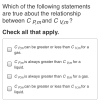 Which of the following statements are true about the relationship between C P,mand CV, m? Check all that apply. o CP,m can be greater or less than C v.m for a gas. CP.mis always greater than C V.m for a liquid. CP,mis always greater than C v,m for a gas. CP,m can be greater or less than C v,m for a liquid.
Derive how you can get Cp=KR/K-1 and Cv=R/K-1 from Cp/Cv = K
Derive how you can get Cp=KR/K-1 and Cv=R/K-1 from Cp/Cv = K
When dealing with specific heat of an ideal gas. For the example of finding Cp=a+bT+cT^2+dT^3 what...
When dealing with specific heat of an ideal gas. For the example of finding Cp=a+bT+cT^2+dT^3 what is the relation of the coefficients to the universal gas constant Ru? For example when finding Cv instead Cv=(a-Ru)+bT+cT^2..... why is only 'a' affected by Ru?
Useful constant: R-0.08315L.bar/K.mol, 0.08206L.atm/K.mol or 8.314J/K.mol, Cv(any monoatomic gas) 3R/2 and Cp-Cv+ R for an ideal...
 Useful constant: R-0.08315L.bar/K.mol, 0.08206L.atm/K.mol or 8.314J/K.mol, Cv(any monoatomic gas) 3R/2 and Cp-Cv+ R for an ideal gas. Section I 1. Assuming that CO2 is an ideal gas, calculate ASo (in the unit, J K:1) for the following process 1 CO (g, 298 K, 1 bar) 1 CO (g, 1000 K, 1 bar) Given that: Cv 18.334 + 42.262 x 10³ T - 142.4 x 10⁻⁷ T2 (where Cv is in of JK-1)
For a gas compressor compresses gas (Cv= 718 J/KgK and Cp= 1005 J/KgK) adiabatically from 1...
For a gas compressor compresses gas (Cv= 718 J/KgK and Cp= 1005 J/KgK) adiabatically from 1 bar and 15 ºC to 10 bar with an isentropic efficiency of 0.89. The gas flow rate is 5 kg/s. Calculate the temperature after compression and the power input
For a real gas obeying van der Waals equation CP-CV is a)R b)zero c) > R...
For a real gas obeying van der Waals equation CP-CV is a)R b)zero c) > R d)< R
Consider a reversible adiabetic compression of an ideal gas with CV,m = 3R/2 and CP,m =...
Consider a reversible adiabetic compression of an ideal gas with CV,m = 3R/2 and CP,m = 5R/2. 3.0 mol of this ideal gas with a volume of 30.0 L changes from an initial temperature of 300 K to a final temperature of 600 K. For this process, compute the final volume.
2. One mole of an ideal gas, CP - (7/2)R and CV - (5/2)R, is compressed...
 2. One mole of an ideal gas, CP - (7/2)R and CV - (5/2)R, is compressed adiabatically in a piston/cylinder device from 2 bar and 25°C to 7 bar. The process is irreversible and requires 35% more work than a reversible, adiabatic compression from the same initial state to the same final pressure. What is the entropy change of the gas?
 Show that for an ideal gas Cp=yR/(y-1), Cv=R/(Y-1) and Cp-Cv=R
 Which of the following statements are true about the relationship between C P,mand CV, m? Check all that apply. o CP,m can be greater or less than C v.m for a gas. CP.mis always greater than C V.m for a liquid. CP,mis always greater than C v,m for a gas. CP,m can be greater or less than C v,m for a liquid.
 Useful constant: R-0.08315L.bar/K.mol, 0.08206L.atm/K.mol or 8.314J/K.mol, Cv(any monoatomic gas) 3R/2 and Cp-Cv+ R for an ideal gas. Section I 1. Assuming that CO2 is an ideal gas, calculate ASo (in the unit, J K:1) for the following process 1 CO (g, 298 K, 1 bar) 1 CO (g, 1000 K, 1 bar) Given that: Cv 18.334 + 42.262 x 10³ T - 142.4 x 10⁻⁷ T2 (where Cv is in of JK-1)
 2. One mole of an ideal gas, CP - (7/2)R and CV - (5/2)R, is compressed adiabatically in a piston/cylinder device from 2 bar and 25°C to 7 bar. The process is irreversible and requires 35% more work than a reversible, adiabatic compression from the same initial state to the same final pressure. What is the entropy change of the gas?
Most questions answered within 3 hours.
-
Where is the error in this code sequence?
String s1 = "Hello";
String s2 = "ello";...
asked 10 months ago -
Financial data for Joel de Paris, Inc., for last year
follow:
Joel de Paris, Inc.
Balance...
asked 10 months ago -
Consider this reaction:
Al2(SO4)3 (aq)+ BaCl3
(aq) Al2Cl6 (aq)- +
3BaSO4(s) . What is the...
asked 10 months ago -
Suppose that Savneet is considering increasing her
recent random sample from 20 car rentals to 40...
asked 10 months ago -
Trucks arrive at an unloading terminal at an average rate of 120
per hour.
Trucks arrive...
asked 10 months ago -
Why are methanol and ethanol completely soluble in water while
octanol is not very little soluble....
asked 10 months ago -
A facilities manager at a university reads in a research report
that the mean amount of...
asked 10 months ago -
When the CuSO4 is rehydrated by adding water to the anhydrous
compound, is this an endothermic...
asked 10 months ago -
A ray of sunlight is passing from diamond into crown glass; the
angle of incidence is...
asked 10 months ago -
A block of mass 0.249 kg is placed on top of a light, vertical
spring of...
asked 10 months ago -
how do the kidneys compensate in the presences of acidosis
a) trigger hyperventilate
b) reserve acid...
asked 10 months ago -
Question 501 pts
The rental rate of capital to the firm increases. Which of the
following...
asked 10 months ago