Homework Answers
![c) z iel meisty - sme el. It is a primary substrate. - ress20. 66] Ht I mesi auglic Ration) . = sme : Stable by resono auyli](http://img.homeworklib.com/questions/baeed240-71d7-11ea-b70e-b3ed075133b7.png?x-oss-process=image/resize,w_560)
Add Answer to:
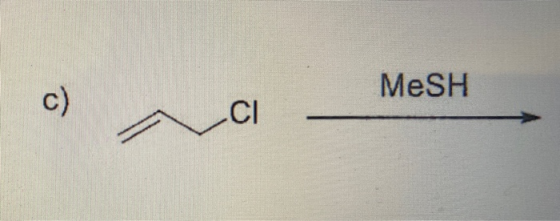
isnt it an primary substrate ? why its an SN1 rxn ? and how
MeSH c)...
For both the Sn2 and Sn1 reaction conditions: Structure | Rxn (Y/N) at room T° Rxn...
For both the Sn2 and Sn1 reaction conditions: Structure | Rxn (Y/N) at room T° Rxn time | Rxn (Y/N) at increased T° Rxn time | Agreement with theory a. Construct a table in landscape layout with the headings described above. The structure of the compound must be provided for each test. If a reaction occurs indicate if room temperature or increased temperature were the conditions necessary. If no reaction occurs at all under any conditions, then indicate only the...
2. Predict the product(s) of each of the reaction conditions below. Specify the substrate type (primary,...
 2. Predict the product(s) of each of the reaction conditions
below. Specify the substrate type (primary, secondary, or tertiary
alkyl halide), nucleophile (strong or poor), and the solvent type
(protic or aptrotic). Specify the type of reaction mechanism (SN1
or SN2), show the curved arrow mechanism and draw the products as
3D structures to illustrate stereochemistry.
Predict the product(s) of each of the reaction conditions below. Specify the substrate type (1º, 2º, or 3 alkyl halide). mucleophile (strong or poor),...
2. Predict the product(s) of each of the reaction conditions
below. Specify the substrate type (primary, secondary, or tertiary
alkyl halide), nucleophile (strong or poor), and the solvent type
(protic or aptrotic). Specify the type of reaction mechanism (SN1
or SN2), show the curved arrow mechanism and draw the products as
3D structures to illustrate stereochemistry.
Predict the product(s) of each of the reaction conditions below. Specify the substrate type (1º, 2º, or 3 alkyl halide). mucleophile (strong or poor),...
sn1,sn2,e1,e2 please help! a)asses substrate b) classify reagents (nuc/base, strong or weak) c)solvent used if not...
 sn1,sn2,e1,e2
please help! a)asses substrate b) classify reagents (nuc/base, strong or weak) c)solvent used if not indicated d)mechanism type e)major & minor products including stereochemistry & geometry 15. 1. НаО* 2. EtOH Он 16. OTs
sn1,sn2,e1,e2
please help! a)asses substrate b) classify reagents (nuc/base, strong or weak) c)solvent used if not indicated d)mechanism type e)major & minor products including stereochemistry & geometry 15. 1. НаО* 2. EtOH Он 16. OTs
VI. Some more assignments for practice. See how understanding of Sn1, SN2, E1, E2 is essential...
 VI. Some more assignments for practice. See how understanding of Sn1, SN2, E1, E2 is essential here. • the substrate produces a cyclized product in presence of acid/base (circle one) • draw the structure of the cyclized product Сн,он olyo CHOW .no optical activity in the product explain why einen H3PO4 heat NaOEt product and configuration? (E2) EtOH, heat NaOH why no reaction?
how many primary carbone? and why? and determine them please? Chz c Lett
 how many primary carbone? and why? and
determine them please?
Chz c Lett
how many primary carbone? and why? and
determine them please?
Chz c Lett
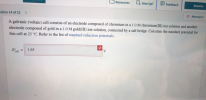
isnt 0.91+0.74= 1.65? for E cell i dont get why its wrong. Did I skip a...
 isnt 0.91+0.74= 1.65? for E cell i dont get why its wrong. Did
I skip a step?
Resources Ex Give Up? Feedback Resume stion 14 of 22 > Attempt 2 A galvanic (voltaic) cell consists of an electrode composed of chromium in a 1.0 M chromium(III)ion solution and another electrode composed of gold in a LO M gold(III) ion solution, connected by a salt bridge. Calculate the standard potential for this cell at 25 °C. Refer to the list of...
isnt 0.91+0.74= 1.65? for E cell i dont get why its wrong. Did
I skip a step?
Resources Ex Give Up? Feedback Resume stion 14 of 22 > Attempt 2 A galvanic (voltaic) cell consists of an electrode composed of chromium in a 1.0 M chromium(III)ion solution and another electrode composed of gold in a LO M gold(III) ion solution, connected by a salt bridge. Calculate the standard potential for this cell at 25 °C. Refer to the list of...
c) Draw all the resonance forms that explain why a benzylic halide is able to undergo...
 c) Draw all the resonance forms that explain why a benzylic halide is able to undergo SN1 type of reactions even though it is considered a primary alkyl halide.
Why might we make enzymes that work on the same substrate, but with different enzyme kinetics?...
Why might we make enzymes that work on the same substrate, but with different enzyme kinetics? How do the different hexokinase isozymes of liver and muscle reflect the different roles of these organs in carbohydrate metabolism? Why is the fact how hexokinase 4 is not inhibited by glucose 6-phosphate, instead being inhibited by reversible binding of a regulatory protein specific to liver be important in its function?
Compare and contrast SN1, SN2, E1 and E2 reactions. What are some obvious similarities and differences...
Compare and contrast SN1, SN2, E1 and E2 reactions. What are some obvious similarities and differences between each reaction pathway? What are the requirements for each reaction to work? Discuss why SN2 is in direct competition with E2 while SN1 is in direct competition with the E1 reaction pathway. What is the rate expression for each? Which reactions are concerted? Which reactions are step-wise? Which reactions are stereospecific and what is the stereospecificity of each that are? How do the...
identify necessary reagents and state why it's either sn1 or sn2 for (c) and (g) Ore...
 identify necessary reagents and state why it's either sn1 or sn2
for (c) and (g)
Ore TEDCONS. skill 7.33 Identify the reagents you would use to accon transformations: ОН WM 7.34 What reagents would you use to accomplish a sut ration, for example: OH
identify necessary reagents and state why it's either sn1 or sn2
for (c) and (g)
Ore TEDCONS. skill 7.33 Identify the reagents you would use to accon transformations: ОН WM 7.34 What reagents would you use to accomplish a sut ration, for example: OH
 2. Predict the product(s) of each of the reaction conditions
below. Specify the substrate type (primary, secondary, or tertiary
alkyl halide), nucleophile (strong or poor), and the solvent type
(protic or aptrotic). Specify the type of reaction mechanism (SN1
or SN2), show the curved arrow mechanism and draw the products as
3D structures to illustrate stereochemistry.
Predict the product(s) of each of the reaction conditions below. Specify the substrate type (1º, 2º, or 3 alkyl halide). mucleophile (strong or poor),...
2. Predict the product(s) of each of the reaction conditions
below. Specify the substrate type (primary, secondary, or tertiary
alkyl halide), nucleophile (strong or poor), and the solvent type
(protic or aptrotic). Specify the type of reaction mechanism (SN1
or SN2), show the curved arrow mechanism and draw the products as
3D structures to illustrate stereochemistry.
Predict the product(s) of each of the reaction conditions below. Specify the substrate type (1º, 2º, or 3 alkyl halide). mucleophile (strong or poor),...
 sn1,sn2,e1,e2
please help! a)asses substrate b) classify reagents (nuc/base, strong or weak) c)solvent used if not indicated d)mechanism type e)major & minor products including stereochemistry & geometry 15. 1. НаО* 2. EtOH Он 16. OTs
sn1,sn2,e1,e2
please help! a)asses substrate b) classify reagents (nuc/base, strong or weak) c)solvent used if not indicated d)mechanism type e)major & minor products including stereochemistry & geometry 15. 1. НаО* 2. EtOH Он 16. OTs
 VI. Some more assignments for practice. See how understanding of Sn1, SN2, E1, E2 is essential here. • the substrate produces a cyclized product in presence of acid/base (circle one) • draw the structure of the cyclized product Сн,он olyo CHOW .no optical activity in the product explain why einen H3PO4 heat NaOEt product and configuration? (E2) EtOH, heat NaOH why no reaction?
 how many primary carbone? and why? and
determine them please?
Chz c Lett
how many primary carbone? and why? and
determine them please?
Chz c Lett
 isnt 0.91+0.74= 1.65? for E cell i dont get why its wrong. Did
I skip a step?
Resources Ex Give Up? Feedback Resume stion 14 of 22 > Attempt 2 A galvanic (voltaic) cell consists of an electrode composed of chromium in a 1.0 M chromium(III)ion solution and another electrode composed of gold in a LO M gold(III) ion solution, connected by a salt bridge. Calculate the standard potential for this cell at 25 °C. Refer to the list of...
isnt 0.91+0.74= 1.65? for E cell i dont get why its wrong. Did
I skip a step?
Resources Ex Give Up? Feedback Resume stion 14 of 22 > Attempt 2 A galvanic (voltaic) cell consists of an electrode composed of chromium in a 1.0 M chromium(III)ion solution and another electrode composed of gold in a LO M gold(III) ion solution, connected by a salt bridge. Calculate the standard potential for this cell at 25 °C. Refer to the list of...
 c) Draw all the resonance forms that explain why a benzylic halide is able to undergo SN1 type of reactions even though it is considered a primary alkyl halide.
 identify necessary reagents and state why it's either sn1 or sn2
for (c) and (g)
Ore TEDCONS. skill 7.33 Identify the reagents you would use to accon transformations: ОН WM 7.34 What reagents would you use to accomplish a sut ration, for example: OH
identify necessary reagents and state why it's either sn1 or sn2
for (c) and (g)
Ore TEDCONS. skill 7.33 Identify the reagents you would use to accon transformations: ОН WM 7.34 What reagents would you use to accomplish a sut ration, for example: OH
Most questions answered within 3 hours.
-
Where is the error in this code sequence?
String s1 = "Hello";
String s2 = "ello";...
asked 10 months ago -
Financial data for Joel de Paris, Inc., for last year
follow:
Joel de Paris, Inc.
Balance...
asked 10 months ago -
Consider this reaction:
Al2(SO4)3 (aq)+ BaCl3
(aq) Al2Cl6 (aq)- +
3BaSO4(s) . What is the...
asked 10 months ago -
Suppose that Savneet is considering increasing her
recent random sample from 20 car rentals to 40...
asked 10 months ago -
Trucks arrive at an unloading terminal at an average rate of 120
per hour.
Trucks arrive...
asked 10 months ago -
Why are methanol and ethanol completely soluble in water while
octanol is not very little soluble....
asked 10 months ago -
A facilities manager at a university reads in a research report
that the mean amount of...
asked 10 months ago -
When the CuSO4 is rehydrated by adding water to the anhydrous
compound, is this an endothermic...
asked 10 months ago -
A ray of sunlight is passing from diamond into crown glass; the
angle of incidence is...
asked 10 months ago -
A block of mass 0.249 kg is placed on top of a light, vertical
spring of...
asked 10 months ago -
how do the kidneys compensate in the presences of acidosis
a) trigger hyperventilate
b) reserve acid...
asked 10 months ago -
Question 501 pts
The rental rate of capital to the firm increases. Which of the
following...
asked 10 months ago