
Homework Answers
Add Answer to:
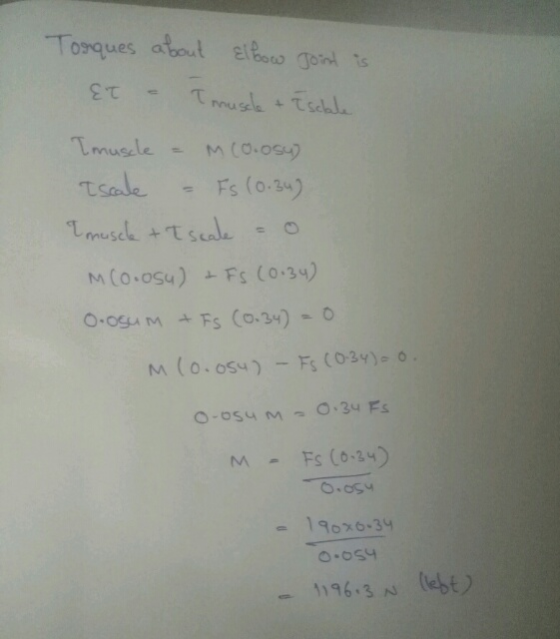
Interactive Solution 9.15 illustrates how to model this type of problem. A person exerts a horizontal...
QUESTION 3 A uniform lunch tray is being held in one hand, as the drawing illustrates....
 QUESTION 3 A uniform lunch tray is being held in one hand, as the drawing illustrates. The mass of the tray is 0.11 kg On the tray is a 1 kg plate of food and a 0.28 kg cup of coffee Obtain the following force F-T Express your answer in Sl units with 3 or more significant figures 40 cm 38 cm 24 cm 10 cm 6 cm QUESTION 4 A person exerts a horizontal force of 190 N in...
QUESTION 2 The drawing shows a person mass-59 kg. doing push-ups. Find the force exerted by...
 QUESTION 2 The drawing shows a person mass-59 kg. doing push-ups. Find the force exerted by the floor on each foot, assuming that the person holds this position. Express your answer is Sl units with 3 or more significant figures 0.90 m 1.50 m QUESTION 3 A uniform lunch tray is being held in one hand, as the drawing illustrates. The mass of the tray is 0.11 kg. On the tray is a 1 kg plate of food and a...
QUESTION 1 A wrench is used to loosen a nut as shown below by applying a...
 QUESTION 1 A wrench is used to loosen a nut as shown below by applying a force 13 N. Determine the torque (magnitude and direction:+for CCW and for CW) about the nut joint Express your answer in Sl units with 3 or more significant figures 0.28 m QUESTION 2 The drawing shows a person mass 59 kg. doing push-ups. Find the force exerted by the floor on each foot assuming that the person holds this position Express your answer in...
A man holds a 182-N ball in his hand, with the forearm horizontal (see the figure)....
 A man holds a 182-N ball in his hand, with the forearm horizontal (see the figure). He can support the ball in this position because of the flexor muscle force M, which is applied perpendicular to the forearm. The forearm weighs 19.3 N and has a center of gravity as indicated. Find (a) the magnitude of and the (b) magnitude and (c) direction (as a positive angle counterclockwise from horizontal) of the force applied by the upper arm bone to...
A man holds a 194-N ball in his hand, with the forearm horizontal (see the figure)....
 A man holds a 194-N ball in his hand, with the forearm horizontal (see the figure). He can support the ball in this position because of the flexor muscle force M, which is applied perpendicular to the forearm. The forearm weighs 18.5 N and has a center of gravity as indicated. Find (a) the magnitude of M and the (b) magnitude and (c) direction (as a positive angle counterclockwise from horizontal) of the force applied by the upper arm bone...
A man holds a 183-N ball in his hand, with the forearm horizontal (see the figure)....
 A man holds a 183-N ball in his hand, with the forearm horizontal (see the figure). He can support the ball in this position because of the flexor muscle force Mn, which is applied perpendicular to the forearm. The forearm weighs 20.3 N and has a center of gravity as indicated. Find (a) the magnitude of M - and the (b) magnitude and (c) direction (as a positive angle counterclockwise from horizontal) of the force applied by the upper arm...
A man holds a 178-N ball in his hand, with the forearm horizontal (see the figure)....
A man holds a 178-N ball in his hand, with the forearm horizontal (see the figure). He can support the ball in this position because of the flexor muscle force , which is applied perpendicular to the forearm. The forearm weighs 19.5 N and has a center of gravity as indicated. Find (a) the magnitude of and the (b) magnitude and (c) direction (as a positive angle counterclockwise from horizontal) of the force applied by the upper arm bone to...
A man holds a 195-N ball in his hand, with the forearm horizontal (see the figure)....
A man holds a 195-N ball in his hand, with the forearm horizontal (see the figure). He can support the ball in this position because of the flexor muscle force , which is applied perpendicular to the forearm. The forearm weighs 24.6 N and has a center of gravity as indicated. Find (b) magnitude and (c) direction (as a positive angle counterclockwise from horizontal) of the force applied by the upper arm bone to the forearm at the elbow joint
2. A person is holding a weight (100 N) in their hand. The weight is a...
2. A person is holding a weight (100 N) in their hand. The weight is a distance of 0.3 meters from the center of rotation of the elbow. If the forearm is parallel to the ground, what is the torque about the elbow due to the weight? If the forearm has an angle of 30° above the horizontal (hand is higher than elbow), what is the torque about the elbow due to the weight? c. If an elbow flexor muscle...
Constants A 71.0 kg weight lifter is doing arm raises using a 7.50 kg weight in...
 Constants A 71.0 kg weight lifter is doing arm raises using a 7.50 kg weight in her hand. Her arm pivots around the elbow joint, starting 40.0 below the horizontal. (See the figure(Figure 1).) Biometric measurements have shown that both forearms and the hands together account for 6.40 % of a person's weight. Since the upper arm is held vertically, the biceps muscle always acts vertically and is attached to the bones of the forearm 5.50 cm from the elbow...
 QUESTION 3 A uniform lunch tray is being held in one hand, as the drawing illustrates. The mass of the tray is 0.11 kg On the tray is a 1 kg plate of food and a 0.28 kg cup of coffee Obtain the following force F-T Express your answer in Sl units with 3 or more significant figures 40 cm 38 cm 24 cm 10 cm 6 cm QUESTION 4 A person exerts a horizontal force of 190 N in...
 QUESTION 2 The drawing shows a person mass-59 kg. doing push-ups. Find the force exerted by the floor on each foot, assuming that the person holds this position. Express your answer is Sl units with 3 or more significant figures 0.90 m 1.50 m QUESTION 3 A uniform lunch tray is being held in one hand, as the drawing illustrates. The mass of the tray is 0.11 kg. On the tray is a 1 kg plate of food and a...
 QUESTION 1 A wrench is used to loosen a nut as shown below by applying a force 13 N. Determine the torque (magnitude and direction:+for CCW and for CW) about the nut joint Express your answer in Sl units with 3 or more significant figures 0.28 m QUESTION 2 The drawing shows a person mass 59 kg. doing push-ups. Find the force exerted by the floor on each foot assuming that the person holds this position Express your answer in...
 A man holds a 182-N ball in his hand, with the forearm horizontal (see the figure). He can support the ball in this position because of the flexor muscle force M, which is applied perpendicular to the forearm. The forearm weighs 19.3 N and has a center of gravity as indicated. Find (a) the magnitude of and the (b) magnitude and (c) direction (as a positive angle counterclockwise from horizontal) of the force applied by the upper arm bone to...
 A man holds a 194-N ball in his hand, with the forearm horizontal (see the figure). He can support the ball in this position because of the flexor muscle force M, which is applied perpendicular to the forearm. The forearm weighs 18.5 N and has a center of gravity as indicated. Find (a) the magnitude of M and the (b) magnitude and (c) direction (as a positive angle counterclockwise from horizontal) of the force applied by the upper arm bone...
 A man holds a 183-N ball in his hand, with the forearm horizontal (see the figure). He can support the ball in this position because of the flexor muscle force Mn, which is applied perpendicular to the forearm. The forearm weighs 20.3 N and has a center of gravity as indicated. Find (a) the magnitude of M - and the (b) magnitude and (c) direction (as a positive angle counterclockwise from horizontal) of the force applied by the upper arm...
 Constants A 71.0 kg weight lifter is doing arm raises using a 7.50 kg weight in her hand. Her arm pivots around the elbow joint, starting 40.0 below the horizontal. (See the figure(Figure 1).) Biometric measurements have shown that both forearms and the hands together account for 6.40 % of a person's weight. Since the upper arm is held vertically, the biceps muscle always acts vertically and is attached to the bones of the forearm 5.50 cm from the elbow...
Most questions answered within 3 hours.
-
Where is the error in this code sequence?
String s1 = "Hello";
String s2 = "ello";...
asked 10 months ago -
Financial data for Joel de Paris, Inc., for last year
follow:
Joel de Paris, Inc.
Balance...
asked 10 months ago -
Consider this reaction:
Al2(SO4)3 (aq)+ BaCl3
(aq) Al2Cl6 (aq)- +
3BaSO4(s) . What is the...
asked 10 months ago -
Suppose that Savneet is considering increasing her
recent random sample from 20 car rentals to 40...
asked 10 months ago -
Trucks arrive at an unloading terminal at an average rate of 120
per hour.
Trucks arrive...
asked 10 months ago -
Why are methanol and ethanol completely soluble in water while
octanol is not very little soluble....
asked 10 months ago -
A facilities manager at a university reads in a research report
that the mean amount of...
asked 10 months ago -
When the CuSO4 is rehydrated by adding water to the anhydrous
compound, is this an endothermic...
asked 10 months ago -
A ray of sunlight is passing from diamond into crown glass; the
angle of incidence is...
asked 10 months ago -
A block of mass 0.249 kg is placed on top of a light, vertical
spring of...
asked 10 months ago -
how do the kidneys compensate in the presences of acidosis
a) trigger hyperventilate
b) reserve acid...
asked 10 months ago -
Question 501 pts
The rental rate of capital to the firm increases. Which of the
following...
asked 10 months ago