
Homework Answers
Add Answer to:
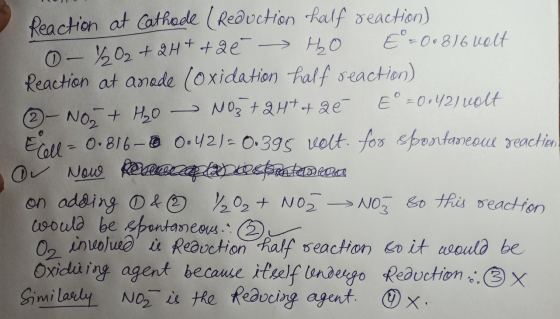
Question 2 (1 point) Given the following half reactions with their corresponding standard reduction potentials, which...
Question 2 (1 point) Given the following half reactions with their corresponding standard reduction potentials, which...
 Question 2 (1 point) Given the following half reactions with their corresponding standard reduction potentials, which of the following is/are true for the overall reaction happening under standard conditions? S+ 2H+ + 2e + H2S E' = -0.243 V Fe3+ + e + Fe2+ E'' - 0.771 V (CHECK THE ONE(S) THAT IS/ARE CORRECT) 1) Fe3+ has a greater affinity for electrons than S. 2) AE'O = 1.014 V for the spontaneous reaction. 3) Fe2+ is the reducing agent. 4)...
pls explain in great detail why Consider the following standard reduction potentials Reduction Half-Reaction A1+ (aq)...
 pls explain in great detail why
Consider the following standard reduction potentials Reduction Half-Reaction A1+ (aq) + 3e A1(s) Fe2+ (aq) + 2e-Fe(s) Sn2+ (aq) + 2e - Sn(s) E (volts) -1.66 0.44 0.14 The AIAP half-reaction can be paired with the other two to produce voltaic cells because Als* is a more powerful reducing agent OOO Al is a more powerful oxidizing agent o Fe and Sn are readily oxidized Al is a more powerful reducing agent AB+ is...
pls explain in great detail why
Consider the following standard reduction potentials Reduction Half-Reaction A1+ (aq) + 3e A1(s) Fe2+ (aq) + 2e-Fe(s) Sn2+ (aq) + 2e - Sn(s) E (volts) -1.66 0.44 0.14 The AIAP half-reaction can be paired with the other two to produce voltaic cells because Als* is a more powerful reducing agent OOO Al is a more powerful oxidizing agent o Fe and Sn are readily oxidized Al is a more powerful reducing agent AB+ is...
Oxidizing agent Reducing agent termine which half-cell elect the potentials, note that are them is to...
 Oxidizing agent Reducing agent termine which half-cell elect the potentials, note that are them is to note that Pb the more negative reductie + 2e Ph. The half en offis reversed. iting both potentials: 14. Mno + SO, + HO SO M hali Oxidation Half Reaction: Reduction: Cu Oxidation Pb Reduction Hall Reaction: the reaction with respect either (or both) half rea te in both half reactions Add the two half-rear Oxidizing agent: Reducing agent + 15. 10. + HSO,...
Oxidizing agent Reducing agent termine which half-cell elect the potentials, note that are them is to...
 Oxidizing agent Reducing agent termine which half-cell elect the potentials, note that are them is to note that Pb the more negative reductie + 2e Ph. The half en offis reversed. iting both potentials: 14. Mno + SO, + HO SO M hali Oxidation Half Reaction: Reduction: Cu Oxidation Pb Reduction Hall Reaction: the reaction with respect either (or both) half rea te in both half reactions Add the two half-rear Oxidizing agent: Reducing agent + 15. 10. + HSO,...
Oxidizing agent Reducing agent termine which half-cell elect the potentials, note that are them is to...
 Oxidizing agent Reducing agent termine which half-cell elect the potentials, note that are them is to note that Pb the more negative reductie + 2e Ph. The half en offis reversed. iting both potentials: 14. Mno + SO, + HO SO M hali Oxidation Half Reaction: Reduction: Cu Oxidation Pb Reduction Hall Reaction: the reaction with respect either (or both) half rea te in both half reactions Add the two half-rear Oxidizing agent: Reducing agent + 15. 10. + HSO,...
consider the following standard reduction potentials. Reduction Half-Reaction Eo (volts) Al3+(aq) + 3e− → Al(s) −...
consider the following standard reduction potentials. Reduction Half-Reaction Eo (volts) Al3+(aq) + 3e− → Al(s) − 1.66 Fe2+(aq) + 2e− → Fe(s) − 0.44 Sn2+(aq) + 2e− → Sn(s) − 0.14 The Al/Al3+ half-reaction can be paired with the other two to produce voltaic cells because ________ A) Al is a more powerful oxidizing agent B) Fe and Sn are readily oxidized Al is a more powerful reducing agent C) Al3+ is a more powerful oxidizing agent D) Al3+...
Selective Reduction The standard reduction potential for the half-reaction: Sn4+ + 2e - Sn2+ is +0.15...
 Selective Reduction The standard reduction potential for the half-reaction: Sn4+ + 2e - Sn2+ is +0.15 V. Consider data from the table of standard reduction potentials for common half-reactions, in your text. For a galvanic cell under standard conditions, which of the following anodic half reactions would produce, at the cathode a spontaneous reduction of Sn4+ to Sn2+ but not Sn2+ to Sn. no yes yes yes yes yes Fe — Fe2+ + 2e- Sn2+ Sn4+ + 2e- Sn Sn2+...
Using the table of reduction potentials (Eo) for the half-reactions shown, match the given redox reactions...
 Using the table of reduction potentials (Eo) for the half-reactions shown, match the given redox reactions with their Eo and predict the change in free energy by stating whether the reactions will be exergonic or endergonic Exergonic 1.14 V 1.00 V 0.15 V 1.24 V 1.24 V Endergonic Reaction Free Energy Eo (Volts) CO2/glucose [-0.43] -0.5 -0.4 NAD /NADH 0.32 -0.3 NADH H 12 OH.ONAD 2HH2 -0.42] CO2/methanol [-0.38] Co2/acetate [-0.28] FADFADH2[-0.18] Pyruvatelactate [-0.19] 6CO, + 6H,O → 60, +...
help with these please Consider the following half-reactions: Half-reaction Eo (V) F2(g)+ 2e 2F (aq) 2.870V...
 help with these please
Consider the following half-reactions: Half-reaction Eo (V) F2(g)+ 2e 2F (aq) 2.870V Sn2 (aq) + 2e- Sn(s) 0.140V Cr3 (aq) + 3e° _ Cr(s)-0.740V (1) The strongest oxidizing agent is: enter formula (2) The weakest oxidizing agent is: (3) The weakest reducing agent is: (4) The strongest reducing agent is: (5) Will F2(g) oxidize Cr(s) to Cr3 (aq)? (6) Which species can be oxidized by Sn2 (aq)? If none, leave box blank. Consider the following half-reactions:...
help with these please
Consider the following half-reactions: Half-reaction Eo (V) F2(g)+ 2e 2F (aq) 2.870V Sn2 (aq) + 2e- Sn(s) 0.140V Cr3 (aq) + 3e° _ Cr(s)-0.740V (1) The strongest oxidizing agent is: enter formula (2) The weakest oxidizing agent is: (3) The weakest reducing agent is: (4) The strongest reducing agent is: (5) Will F2(g) oxidize Cr(s) to Cr3 (aq)? (6) Which species can be oxidized by Sn2 (aq)? If none, leave box blank. Consider the following half-reactions:...
use Table 1 in the background section to determine the 2 half-reactions and standard reduction potentials...
 use Table 1 in the background section to
determine the 2 half-reactions and standard reduction potentials
for the redox reaction occurring in your galvanic cell. Record the
half reactions, identifying which is the oxidation and which is the
reduction half-reaction. Also record the corresponding reduction
potentials in Data Table 3.
Please help with Data Table 3
and
2. Was the electric potential found for your galvanic cell
consistent with the standard cell potential of the reaction (as
calculated in Data...
use Table 1 in the background section to
determine the 2 half-reactions and standard reduction potentials
for the redox reaction occurring in your galvanic cell. Record the
half reactions, identifying which is the oxidation and which is the
reduction half-reaction. Also record the corresponding reduction
potentials in Data Table 3.
Please help with Data Table 3
and
2. Was the electric potential found for your galvanic cell
consistent with the standard cell potential of the reaction (as
calculated in Data...
 Question 2 (1 point) Given the following half reactions with their corresponding standard reduction potentials, which of the following is/are true for the overall reaction happening under standard conditions? S+ 2H+ + 2e + H2S E' = -0.243 V Fe3+ + e + Fe2+ E'' - 0.771 V (CHECK THE ONE(S) THAT IS/ARE CORRECT) 1) Fe3+ has a greater affinity for electrons than S. 2) AE'O = 1.014 V for the spontaneous reaction. 3) Fe2+ is the reducing agent. 4)...
 pls explain in great detail why
Consider the following standard reduction potentials Reduction Half-Reaction A1+ (aq) + 3e A1(s) Fe2+ (aq) + 2e-Fe(s) Sn2+ (aq) + 2e - Sn(s) E (volts) -1.66 0.44 0.14 The AIAP half-reaction can be paired with the other two to produce voltaic cells because Als* is a more powerful reducing agent OOO Al is a more powerful oxidizing agent o Fe and Sn are readily oxidized Al is a more powerful reducing agent AB+ is...
pls explain in great detail why
Consider the following standard reduction potentials Reduction Half-Reaction A1+ (aq) + 3e A1(s) Fe2+ (aq) + 2e-Fe(s) Sn2+ (aq) + 2e - Sn(s) E (volts) -1.66 0.44 0.14 The AIAP half-reaction can be paired with the other two to produce voltaic cells because Als* is a more powerful reducing agent OOO Al is a more powerful oxidizing agent o Fe and Sn are readily oxidized Al is a more powerful reducing agent AB+ is...
 Oxidizing agent Reducing agent termine which half-cell elect the potentials, note that are them is to note that Pb the more negative reductie + 2e Ph. The half en offis reversed. iting both potentials: 14. Mno + SO, + HO SO M hali Oxidation Half Reaction: Reduction: Cu Oxidation Pb Reduction Hall Reaction: the reaction with respect either (or both) half rea te in both half reactions Add the two half-rear Oxidizing agent: Reducing agent + 15. 10. + HSO,...
 Oxidizing agent Reducing agent termine which half-cell elect the potentials, note that are them is to note that Pb the more negative reductie + 2e Ph. The half en offis reversed. iting both potentials: 14. Mno + SO, + HO SO M hali Oxidation Half Reaction: Reduction: Cu Oxidation Pb Reduction Hall Reaction: the reaction with respect either (or both) half rea te in both half reactions Add the two half-rear Oxidizing agent: Reducing agent + 15. 10. + HSO,...
 Oxidizing agent Reducing agent termine which half-cell elect the potentials, note that are them is to note that Pb the more negative reductie + 2e Ph. The half en offis reversed. iting both potentials: 14. Mno + SO, + HO SO M hali Oxidation Half Reaction: Reduction: Cu Oxidation Pb Reduction Hall Reaction: the reaction with respect either (or both) half rea te in both half reactions Add the two half-rear Oxidizing agent: Reducing agent + 15. 10. + HSO,...
 Selective Reduction The standard reduction potential for the half-reaction: Sn4+ + 2e - Sn2+ is +0.15 V. Consider data from the table of standard reduction potentials for common half-reactions, in your text. For a galvanic cell under standard conditions, which of the following anodic half reactions would produce, at the cathode a spontaneous reduction of Sn4+ to Sn2+ but not Sn2+ to Sn. no yes yes yes yes yes Fe — Fe2+ + 2e- Sn2+ Sn4+ + 2e- Sn Sn2+...
 Using the table of reduction potentials (Eo) for the half-reactions shown, match the given redox reactions with their Eo and predict the change in free energy by stating whether the reactions will be exergonic or endergonic Exergonic 1.14 V 1.00 V 0.15 V 1.24 V 1.24 V Endergonic Reaction Free Energy Eo (Volts) CO2/glucose [-0.43] -0.5 -0.4 NAD /NADH 0.32 -0.3 NADH H 12 OH.ONAD 2HH2 -0.42] CO2/methanol [-0.38] Co2/acetate [-0.28] FADFADH2[-0.18] Pyruvatelactate [-0.19] 6CO, + 6H,O → 60, +...
 help with these please
Consider the following half-reactions: Half-reaction Eo (V) F2(g)+ 2e 2F (aq) 2.870V Sn2 (aq) + 2e- Sn(s) 0.140V Cr3 (aq) + 3e° _ Cr(s)-0.740V (1) The strongest oxidizing agent is: enter formula (2) The weakest oxidizing agent is: (3) The weakest reducing agent is: (4) The strongest reducing agent is: (5) Will F2(g) oxidize Cr(s) to Cr3 (aq)? (6) Which species can be oxidized by Sn2 (aq)? If none, leave box blank. Consider the following half-reactions:...
help with these please
Consider the following half-reactions: Half-reaction Eo (V) F2(g)+ 2e 2F (aq) 2.870V Sn2 (aq) + 2e- Sn(s) 0.140V Cr3 (aq) + 3e° _ Cr(s)-0.740V (1) The strongest oxidizing agent is: enter formula (2) The weakest oxidizing agent is: (3) The weakest reducing agent is: (4) The strongest reducing agent is: (5) Will F2(g) oxidize Cr(s) to Cr3 (aq)? (6) Which species can be oxidized by Sn2 (aq)? If none, leave box blank. Consider the following half-reactions:...
 use Table 1 in the background section to
determine the 2 half-reactions and standard reduction potentials
for the redox reaction occurring in your galvanic cell. Record the
half reactions, identifying which is the oxidation and which is the
reduction half-reaction. Also record the corresponding reduction
potentials in Data Table 3.
Please help with Data Table 3
and
2. Was the electric potential found for your galvanic cell
consistent with the standard cell potential of the reaction (as
calculated in Data...
use Table 1 in the background section to
determine the 2 half-reactions and standard reduction potentials
for the redox reaction occurring in your galvanic cell. Record the
half reactions, identifying which is the oxidation and which is the
reduction half-reaction. Also record the corresponding reduction
potentials in Data Table 3.
Please help with Data Table 3
and
2. Was the electric potential found for your galvanic cell
consistent with the standard cell potential of the reaction (as
calculated in Data...
Most questions answered within 3 hours.
-
Where is the error in this code sequence?
String s1 = "Hello";
String s2 = "ello";...
asked 10 months ago -
Financial data for Joel de Paris, Inc., for last year
follow:
Joel de Paris, Inc.
Balance...
asked 10 months ago -
Consider this reaction:
Al2(SO4)3 (aq)+ BaCl3
(aq) Al2Cl6 (aq)- +
3BaSO4(s) . What is the...
asked 10 months ago -
Suppose that Savneet is considering increasing her
recent random sample from 20 car rentals to 40...
asked 10 months ago -
Trucks arrive at an unloading terminal at an average rate of 120
per hour.
Trucks arrive...
asked 10 months ago -
Why are methanol and ethanol completely soluble in water while
octanol is not very little soluble....
asked 10 months ago -
A facilities manager at a university reads in a research report
that the mean amount of...
asked 10 months ago -
When the CuSO4 is rehydrated by adding water to the anhydrous
compound, is this an endothermic...
asked 10 months ago -
A ray of sunlight is passing from diamond into crown glass; the
angle of incidence is...
asked 10 months ago -
A block of mass 0.249 kg is placed on top of a light, vertical
spring of...
asked 10 months ago -
how do the kidneys compensate in the presences of acidosis
a) trigger hyperventilate
b) reserve acid...
asked 10 months ago -
Question 501 pts
The rental rate of capital to the firm increases. Which of the
following...
asked 10 months ago