When a firm estimates future taxes, it should consider the:
When a firm estimates future taxes, it should consider the:
Homework Answers
When a firm estimates future taxes, it should consider the marginal tax rate.
Although budget figures are estimates of future projections, why and how should nurse leaders be prepared...
Although budget figures are estimates of future projections, why and how should nurse leaders be prepared to explain short-term variations?
1. Suppose the firm estimates its WACC to be 10%. (A) Should the WACC be used...
1. Suppose the firm estimates its WACC to be 10%. (A) Should the WACC be used to evaluate all of its potential projects, even if they vary in risk? Explain. (B) Would the NPVs change if the WACC changed? Explain.
Firms’ choices and estimates within U.S. GAAP or IFRS should be determined by all of the...
Firms’ choices and estimates within U.S. GAAP or IFRS should be determined by all of the following except: A. firms’ underlying economic circumstances. B. conditions in the company’s industry. C. the company’s competitive strategy. D. accelerated management efforts to meet earnings projections. Examples of poor earnings quality that hinder the forecasting of expected future earnings include all of the following except: A. Earnings dominated by a substantial one-time gains from the sale of real estate tangential to the firm’s operations....
Consider a firm with two technologies to choose between when producing output. The cost function ...
 Consider a firm with two technologies to choose between when producing output. The cost function when using technology 1 is given by: C () 3600 65q +36q2 The cost function when using technology 2 is given by: (q)-900 + 900g + q2 can only implement one of the two technologies at a time. Which technology should the firm choose if it wishes to produce 15 units of output? What about 25 units of output? If q 15 units, then the...
A firm with pricing power (i.e. a price-maker) estimates that the elasticity of demand for its...
A firm with pricing power (i.e. a price-maker) estimates that the elasticity of demand for its product is __A___. To maximize profits by what percentage above cost should it markup its price? (Show your work). When A is equal to -9.00.
Future Income taxes are caused by which of the following? O Accounting errors. The fact that...
 Future Income taxes are caused by which of the following? O Accounting errors. The fact that the value of one country's currency relative to that of another can change over time O A company's inability to pay income tax due in a particular tax year. O Differences in IFRS and ITA rules pertaining to when revenue and expenses should be recognized.
When calculating the value of a firm for an acquisition of a target firm, how should...
When calculating the value of a firm for an acquisition of a target firm, how should the discount rate for calculating this value be determined? If there are gains of synergy associated with this acquisition, how will the acquiring firm account for this in their valuation of the target?
Question 5 2 pts Should we consider sunk costs when making decisions about the present or...
 Question 5 2 pts Should we consider sunk costs when making decisions about the present or the future? No, sunk costs cannot be recovered. Yes, we should consider all costs when making decisions for the present and the future. No, sunk costs have a non-monetary value; therefore, we should not consider the costs. Yes, sunk costs are avoidable, so we should consider the costs when making decisions. Previous Question 6 2 pts Producers selling their ice cream as "95% fat...
Consider a situation where a firm is trying to decide on whether or not they should...
Consider a situation where a firm is trying to decide on whether or not they should agree to a contract to invest in a project. They’re uncertain of the outcome of the project before agreeing to the terms. If the firm agrees to the contract and the project is successful they will receive $120. If the firm agrees to the contract and the project fails they will lose $40. If the firm rejects the contract they will receive $0 regardless...
Taking taxes into account, the value of a firm with debt financing (i.e., a levered firm)...
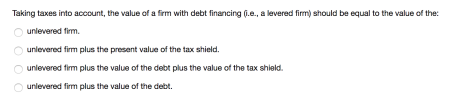 Taking taxes into account, the value of a firm with debt financing (i.e., a levered firm) should be equal to the value of the: unlevered firm. unlevered firm plus the present value of the tax shield. unlevered firm plus the value of the debt plus the value of the tax shield. unlevered firm plus the value of the debt.
 Consider a firm with two technologies to choose between when producing output. The cost function when using technology 1 is given by: C () 3600 65q +36q2 The cost function when using technology 2 is given by: (q)-900 + 900g + q2 can only implement one of the two technologies at a time. Which technology should the firm choose if it wishes to produce 15 units of output? What about 25 units of output? If q 15 units, then the...
 Future Income taxes are caused by which of the following? O Accounting errors. The fact that the value of one country's currency relative to that of another can change over time O A company's inability to pay income tax due in a particular tax year. O Differences in IFRS and ITA rules pertaining to when revenue and expenses should be recognized.
 Question 5 2 pts Should we consider sunk costs when making decisions about the present or the future? No, sunk costs cannot be recovered. Yes, we should consider all costs when making decisions for the present and the future. No, sunk costs have a non-monetary value; therefore, we should not consider the costs. Yes, sunk costs are avoidable, so we should consider the costs when making decisions. Previous Question 6 2 pts Producers selling their ice cream as "95% fat...
 Taking taxes into account, the value of a firm with debt financing (i.e., a levered firm) should be equal to the value of the: unlevered firm. unlevered firm plus the present value of the tax shield. unlevered firm plus the value of the debt plus the value of the tax shield. unlevered firm plus the value of the debt.
Most questions answered within 3 hours.
-
Where is the error in this code sequence?
String s1 = "Hello";
String s2 = "ello";...
asked 11 months ago -
Financial data for Joel de Paris, Inc., for last year
follow:
Joel de Paris, Inc.
Balance...
asked 11 months ago -
Consider this reaction:
Al2(SO4)3 (aq)+ BaCl3
(aq) Al2Cl6 (aq)- +
3BaSO4(s) . What is the...
asked 11 months ago -
Suppose that Savneet is considering increasing her
recent random sample from 20 car rentals to 40...
asked 11 months ago -
Trucks arrive at an unloading terminal at an average rate of 120
per hour.
Trucks arrive...
asked 11 months ago -
Why are methanol and ethanol completely soluble in water while
octanol is not very little soluble....
asked 11 months ago -
A facilities manager at a university reads in a research report
that the mean amount of...
asked 11 months ago -
When the CuSO4 is rehydrated by adding water to the anhydrous
compound, is this an endothermic...
asked 11 months ago -
A ray of sunlight is passing from diamond into crown glass; the
angle of incidence is...
asked 11 months ago -
A block of mass 0.249 kg is placed on top of a light, vertical
spring of...
asked 11 months ago -
how do the kidneys compensate in the presences of acidosis
a) trigger hyperventilate
b) reserve acid...
asked 11 months ago -
Question 501 pts
The rental rate of capital to the firm increases. Which of the
following...
asked 11 months ago