
Homework Answers
Add Answer to:
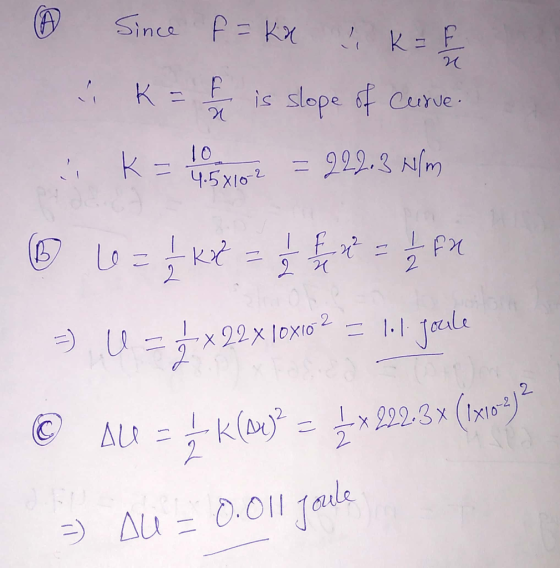
Below is a graph of F versus x for an elastic spring. Determine 25 20 15...
(c8p7_5e) A spring with a spring constant of 3250 N/m is initially stretched until the elastic...
 (c8p7_5e) A spring with a spring constant of 3250 N/m is initially stretched until the elastic potential energy is 1.50 J. (U0. for no stretch.) What is the change in the elastic potential energy if the initial stretch is changed to a stretch of 2.0 cm? Submit Answer Tries 0/1:2 What is the change in the elastic potential energy if the initial stretch is changed to a compression of 2.0 cm? Submit Answer Tries 0/12 What is the change in...
Questions 4 and 5 QUESTIONS: 1.Plot a graph of the force acting on the spring versus...
 Questions 4 and 5
QUESTIONS: 1.Plot a graph of the force acting on the spring versus spring extension. 2. (a) Use the graph to calculate the spring constant including units. () Does the spring obey Hooke's Law over the range of applied forces used? Justify your response. (e) Write the equation for the spring which describes the relationship between extension and applied force to the spring. 3. (a) Use the spring equation to calculate the extension of the spring when...
Questions 4 and 5
QUESTIONS: 1.Plot a graph of the force acting on the spring versus spring extension. 2. (a) Use the graph to calculate the spring constant including units. () Does the spring obey Hooke's Law over the range of applied forces used? Justify your response. (e) Write the equation for the spring which describes the relationship between extension and applied force to the spring. 3. (a) Use the spring equation to calculate the extension of the spring when...
Consider the force-displacement graph for a spring shown. Determine the spring constant, the potential energy stored...
 Consider the force-displacement graph for a spring shown. Determine the spring constant, the potential energy stored when the spring is stretched from x = 0 to x = 4.0 cm. the change in the potential energy stored in stretching the spring from x = 1.0 cm to x = 4.0 cm. A cart having a mass M = 180 g on a friction free horizontal surface is accelerated from rest by the launching spring of problem 2. What is the...
PHY 3460 Hooke's Law and Elastic Potential Energy Questions When applying a 37.5 N force on...
 PHY 3460 Hooke's Law and Elastic Potential Energy Questions When applying a 37.5 N force on a spring it compresses 15.0 cm. Calculate the spring 2) A spring (k 1.22 N/m) is hanging vertically. An unknown mass is hung from the spring 3) A 15.0 kg mass is hung from a spring causing it to stretch 0.25 m, find the spring constant. constant of the spring. causing it to stretch 57.3 mm. How large is the unknown mass? Then, another...
3) Consider Hooke's Law: The force required to keep a spring in a compressed or stretched position x units from the spring's equilibrium position is F(x)-kr Calculate the work required, in jo...
 3) Consider Hooke's Law: The force required to keep a spring in a compressed or stretched position x units from the spring's equilibrium position is F(x)-kr Calculate the work required, in joules, to stretch a spring 0.4 meters beyond its equilibrium position for each of the following scenarios. a) The spring requires 50 Newtons of force to hold it 0.1 m from its equilibrium position. b) The spring requires 2 Joules of work to stretch the spring 0.1 meter from...
Below is a graph of V versus x. Use it to create your own graph of...
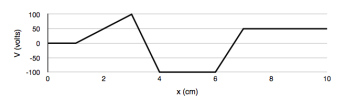 Below is a graph of V versus x. Use it to create your own graph
of electric field versus x. Make sure to properly label your
graph.
100 D50 -50 -100 8 10 2 4 6 0 x (cm)
Below is a graph of V versus x. Use it to create your own graph
of electric field versus x. Make sure to properly label your
graph.
100 D50 -50 -100 8 10 2 4 6 0 x (cm)
Hang the 100 g mass on spring 1 and enter the additional displacement of the spring...
 Hang the 100 g mass on spring 1 and enter the additional
displacement of the spring
_____10______cm. Calculate the spring constant of this
spring___________ N/m.
3. Place the 250 g mass on spring 3 and change the “Softness”
setting to 1 notch to the right of the middle.
Calculate the spring constant of spring 3
:_________________N/m.
Note that the displacement of the springs with the masses attached
is the NEW equilibrium length of the spring. The restoring force of
the...
Hang the 100 g mass on spring 1 and enter the additional
displacement of the spring
_____10______cm. Calculate the spring constant of this
spring___________ N/m.
3. Place the 250 g mass on spring 3 and change the “Softness”
setting to 1 notch to the right of the middle.
Calculate the spring constant of spring 3
:_________________N/m.
Note that the displacement of the springs with the masses attached
is the NEW equilibrium length of the spring. The restoring force of
the...
The spring in the figure below is stretched from its equilibrium position at x = 0...
 The spring in the figure below is stretched from its equilibrium position at x = 0 to a positive coordinate O 1 - ko wwwwww F PE0 The force on the spring is re and it stores elastic potential energy Peori che spring displacement is tripled to 3x, determine the ratio or the new force to the original force, and the ratio of the new to the original elastic potential energy RE HINT (a) the ratio of the new force...
SF-2 The force required to stretch Force (N) (elongate) a spring is shown in the graph...
 SF-2 The force required to stretch Force (N) (elongate) a spring is shown in the graph to the right. a) Find the spring constant K for b) The work required to stretch the 40 35 30 25 this spring. spring an infinitesimal distance dx is given by: dWk-Fdx where F-Kx. Do the integral to find an expression for the work required to stretch the spring from elongation xi to elongation x2. c) Find the work in joules to stretch 15...
Homework for Lab 15: Simple Harmonic Motion Name Date Section 15 10 -5 -15-10-5 0 5...
 Homework for Lab 15: Simple Harmonic Motion Name Date Section 15 10 -5 -15-10-5 0 5 10 15 Displacement (em) Figure 15.6: Force vs displacement graph for a 0.75 kg cart on a horizontal spring. 1. Figure 15.6 shows the force exerted by the spring on a 0.75 kg cart, as a function of its displacement from equilibrium. Positive displacements (in cm) represent stretching of the spring; negative displacements represent compression. Find the spring constant. 2. The cart is moved...
 (c8p7_5e) A spring with a spring constant of 3250 N/m is initially stretched until the elastic potential energy is 1.50 J. (U0. for no stretch.) What is the change in the elastic potential energy if the initial stretch is changed to a stretch of 2.0 cm? Submit Answer Tries 0/1:2 What is the change in the elastic potential energy if the initial stretch is changed to a compression of 2.0 cm? Submit Answer Tries 0/12 What is the change in...
 Questions 4 and 5
QUESTIONS: 1.Plot a graph of the force acting on the spring versus spring extension. 2. (a) Use the graph to calculate the spring constant including units. () Does the spring obey Hooke's Law over the range of applied forces used? Justify your response. (e) Write the equation for the spring which describes the relationship between extension and applied force to the spring. 3. (a) Use the spring equation to calculate the extension of the spring when...
Questions 4 and 5
QUESTIONS: 1.Plot a graph of the force acting on the spring versus spring extension. 2. (a) Use the graph to calculate the spring constant including units. () Does the spring obey Hooke's Law over the range of applied forces used? Justify your response. (e) Write the equation for the spring which describes the relationship between extension and applied force to the spring. 3. (a) Use the spring equation to calculate the extension of the spring when...
 Consider the force-displacement graph for a spring shown. Determine the spring constant, the potential energy stored when the spring is stretched from x = 0 to x = 4.0 cm. the change in the potential energy stored in stretching the spring from x = 1.0 cm to x = 4.0 cm. A cart having a mass M = 180 g on a friction free horizontal surface is accelerated from rest by the launching spring of problem 2. What is the...
 PHY 3460 Hooke's Law and Elastic Potential Energy Questions When applying a 37.5 N force on a spring it compresses 15.0 cm. Calculate the spring 2) A spring (k 1.22 N/m) is hanging vertically. An unknown mass is hung from the spring 3) A 15.0 kg mass is hung from a spring causing it to stretch 0.25 m, find the spring constant. constant of the spring. causing it to stretch 57.3 mm. How large is the unknown mass? Then, another...
 3) Consider Hooke's Law: The force required to keep a spring in a compressed or stretched position x units from the spring's equilibrium position is F(x)-kr Calculate the work required, in joules, to stretch a spring 0.4 meters beyond its equilibrium position for each of the following scenarios. a) The spring requires 50 Newtons of force to hold it 0.1 m from its equilibrium position. b) The spring requires 2 Joules of work to stretch the spring 0.1 meter from...
 Below is a graph of V versus x. Use it to create your own graph
of electric field versus x. Make sure to properly label your
graph.
100 D50 -50 -100 8 10 2 4 6 0 x (cm)
Below is a graph of V versus x. Use it to create your own graph
of electric field versus x. Make sure to properly label your
graph.
100 D50 -50 -100 8 10 2 4 6 0 x (cm)
 Hang the 100 g mass on spring 1 and enter the additional
displacement of the spring
_____10______cm. Calculate the spring constant of this
spring___________ N/m.
3. Place the 250 g mass on spring 3 and change the “Softness”
setting to 1 notch to the right of the middle.
Calculate the spring constant of spring 3
:_________________N/m.
Note that the displacement of the springs with the masses attached
is the NEW equilibrium length of the spring. The restoring force of
the...
Hang the 100 g mass on spring 1 and enter the additional
displacement of the spring
_____10______cm. Calculate the spring constant of this
spring___________ N/m.
3. Place the 250 g mass on spring 3 and change the “Softness”
setting to 1 notch to the right of the middle.
Calculate the spring constant of spring 3
:_________________N/m.
Note that the displacement of the springs with the masses attached
is the NEW equilibrium length of the spring. The restoring force of
the...
 The spring in the figure below is stretched from its equilibrium position at x = 0 to a positive coordinate O 1 - ko wwwwww F PE0 The force on the spring is re and it stores elastic potential energy Peori che spring displacement is tripled to 3x, determine the ratio or the new force to the original force, and the ratio of the new to the original elastic potential energy RE HINT (a) the ratio of the new force...
 SF-2 The force required to stretch Force (N) (elongate) a spring is shown in the graph to the right. a) Find the spring constant K for b) The work required to stretch the 40 35 30 25 this spring. spring an infinitesimal distance dx is given by: dWk-Fdx where F-Kx. Do the integral to find an expression for the work required to stretch the spring from elongation xi to elongation x2. c) Find the work in joules to stretch 15...
 Homework for Lab 15: Simple Harmonic Motion Name Date Section 15 10 -5 -15-10-5 0 5 10 15 Displacement (em) Figure 15.6: Force vs displacement graph for a 0.75 kg cart on a horizontal spring. 1. Figure 15.6 shows the force exerted by the spring on a 0.75 kg cart, as a function of its displacement from equilibrium. Positive displacements (in cm) represent stretching of the spring; negative displacements represent compression. Find the spring constant. 2. The cart is moved...
Most questions answered within 3 hours.
-
Where is the error in this code sequence?
String s1 = "Hello";
String s2 = "ello";...
asked 11 months ago -
Financial data for Joel de Paris, Inc., for last year
follow:
Joel de Paris, Inc.
Balance...
asked 11 months ago -
Consider this reaction:
Al2(SO4)3 (aq)+ BaCl3
(aq) Al2Cl6 (aq)- +
3BaSO4(s) . What is the...
asked 11 months ago -
Suppose that Savneet is considering increasing her
recent random sample from 20 car rentals to 40...
asked 11 months ago -
Trucks arrive at an unloading terminal at an average rate of 120
per hour.
Trucks arrive...
asked 11 months ago -
Why are methanol and ethanol completely soluble in water while
octanol is not very little soluble....
asked 11 months ago -
A facilities manager at a university reads in a research report
that the mean amount of...
asked 11 months ago -
When the CuSO4 is rehydrated by adding water to the anhydrous
compound, is this an endothermic...
asked 11 months ago -
A ray of sunlight is passing from diamond into crown glass; the
angle of incidence is...
asked 11 months ago -
A block of mass 0.249 kg is placed on top of a light, vertical
spring of...
asked 11 months ago -
how do the kidneys compensate in the presences of acidosis
a) trigger hyperventilate
b) reserve acid...
asked 11 months ago -
Question 501 pts
The rental rate of capital to the firm increases. Which of the
following...
asked 11 months ago