Below is a graph of V versus x. Use it to create your own graph of electric field versus x. Make sure to properly label your graph.

Homework Answers

Add Answer to:
Below is a graph of V versus x. Use it to create your own graph
of...
The figure below represents a graph o the electric potential in ㅀ region o space versus...
 The figure below represents a graph o the electric potential in ㅀ region o space versus position x, where the electric ied is paralle to the x axis Fach vertical division on the graph is equal to 40 volts. x (cm) 0 23 4 (a) What is the electric field at 0.5 cm? Positive values represent electric fields in the +x direction. (b) what is the electric field at x = 2.5 cm? V/m (c) What is the electric field...
is a graph of V versus I. V (V) 50 ºt x (cm) Ź 3 Part...
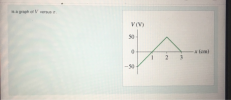 is a graph of V versus I. V (V) 50 ºt x (cm) Ź 3 Part A R 4 of Select the correct graph of E, versus a. E.(V/m) 5000 x(cm) 5000 E (V/m) 5000 *(cm) 000 E. (V/m) S000 - *(cm) -S000 E. (V/m) 5000 -x(cm) 5000
Below is a graph of F versus x for an elastic spring. Determine 25 20 15...
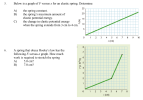 Below is a graph of F versus x for an elastic spring. Determine 25 20 15 10 A) the spring constant B)the spring's maximum amount of elastic potential energy 2 C)the change in elastic potential energy when the spring extends from 3 cm to 4 cm 0 2 3 45 6 78 9 10 8 A spring that obeys Hooke's law has the following F-versus-x graph. How much work is required to stretch the spring A) 5.0 cm? B) 7.0...
The figure shows a graph of electric potential V (in Volts) versus position x (in cm)....
 The figure shows a graph of electric potential V (in Volts) versus position x (in cm). If a proton (m = 1.67 x 10⁻²⁷ kg, q = 1.6 x 10⁻¹⁹ C) is released from rest from X;= 1.5 cm, its speed at Xp= 2.5 cm will be: V (V) 2 3 4 * (cm) O O m/s 15 m/s O 7.2 x 10⁶ m/s O 30 m/s 5.4 x 10⁴ m/s
Part 3 - Average Power 1. Create an RLC circuit with resonant frequency of your own...
 Part 3 - Average Power 1. Create an RLC circuit with resonant frequency of your own choosing. Initially set the resistance to 10 2. For at least 7 values of frequency fill out the table below. Make sure you have at least three points above, below, and including the resonant frequency. Note Irms and Vrms are the values leaving the AC Voltage. Refer to your lecture notes on how to calculate average power. R=10 [2] f[Hz] w [rad/s] Z [2]...
7) Use the x versus t graph below to find the average velocity between the following...
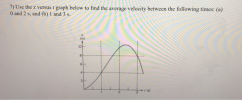 7) Use the x versus t graph below to find the average velocity between the following times: (a) 0 and 2 s, and (b) 1 and 3 s. 10 8
Plot the data for the measurements given below. Being able to create graphs and interpret graphs...
 Plot the data for the measurements given below. Being able to create graphs and interpret graphs is an integral part of any science course. You can use the graph paper included in this document, an Excel spreadsheet or your own graph paper. The time measurements are the x-axis coordinates. The temperature measurements are the y-axis coordinates. Space your axes in consecutive intervals such as units of 1,5 or 10. Make sure to label your axes with the appropriate information, including...
Use the graph below for questions 11 1 Velocity versus Thne to 12845TS t Time ()...
 Use the graph below for questions 11 1 Velocity versus Thne to 12845TS t Time () 14. Find the displacenient from t 0 to t = 6 15 Sketch the acceleration versus time graph derived from the velocity versus time graph Acceleration versus Time 0 -3 -4 1 2 3 4 5 6 7 89 10 Time (s) Extra Credit
Problem 2. The picture shows a graph of the electric potential in a region of space...
 Problem 2. The picture shows a graph of the electric potential in a region of space where the electric field is parallel to the x-axis. AV(x), Volts 200 a) Draw a graph of Ex versus x. 100 b) Label the maximum and minimum electric field on the y-axis of your graph (including units). .x, m 2 c) If an electron is placed at x = 4 m, what it would do? 3 4 5 6 7 8 -100H A. Stay...
Imagine a proton moving at 2.1 x 10m/s in the positive direction of the x-axis. It...
 Imagine a proton moving at 2.1 x 10m/s in the positive direction of the x-axis. It moves in a field-free space until it passes by the origin, x = 0, where it encounters an electric field directed along the x-axis. (The y and z components of the field are zero everywhere). The electric potential, V(x), associated with this field is shown in the graph below. 200 Hlectrical (V) 100 50 0 0 10 20 30 40 50 60 70 Position...
 The figure below represents a graph o the electric potential in ㅀ region o space versus position x, where the electric ied is paralle to the x axis Fach vertical division on the graph is equal to 40 volts. x (cm) 0 23 4 (a) What is the electric field at 0.5 cm? Positive values represent electric fields in the +x direction. (b) what is the electric field at x = 2.5 cm? V/m (c) What is the electric field...
 is a graph of V versus I. V (V) 50 ºt x (cm) Ź 3 Part A R 4 of Select the correct graph of E, versus a. E.(V/m) 5000 x(cm) 5000 E (V/m) 5000 *(cm) 000 E. (V/m) S000 - *(cm) -S000 E. (V/m) 5000 -x(cm) 5000
 Below is a graph of F versus x for an elastic spring. Determine 25 20 15 10 A) the spring constant B)the spring's maximum amount of elastic potential energy 2 C)the change in elastic potential energy when the spring extends from 3 cm to 4 cm 0 2 3 45 6 78 9 10 8 A spring that obeys Hooke's law has the following F-versus-x graph. How much work is required to stretch the spring A) 5.0 cm? B) 7.0...
 The figure shows a graph of electric potential V (in Volts) versus position x (in cm). If a proton (m = 1.67 x 10⁻²⁷ kg, q = 1.6 x 10⁻¹⁹ C) is released from rest from X;= 1.5 cm, its speed at Xp= 2.5 cm will be: V (V) 2 3 4 * (cm) O O m/s 15 m/s O 7.2 x 10⁶ m/s O 30 m/s 5.4 x 10⁴ m/s
 Part 3 - Average Power 1. Create an RLC circuit with resonant frequency of your own choosing. Initially set the resistance to 10 2. For at least 7 values of frequency fill out the table below. Make sure you have at least three points above, below, and including the resonant frequency. Note Irms and Vrms are the values leaving the AC Voltage. Refer to your lecture notes on how to calculate average power. R=10 [2] f[Hz] w [rad/s] Z [2]...
 7) Use the x versus t graph below to find the average velocity between the following times: (a) 0 and 2 s, and (b) 1 and 3 s. 10 8
 Plot the data for the measurements given below. Being able to create graphs and interpret graphs is an integral part of any science course. You can use the graph paper included in this document, an Excel spreadsheet or your own graph paper. The time measurements are the x-axis coordinates. The temperature measurements are the y-axis coordinates. Space your axes in consecutive intervals such as units of 1,5 or 10. Make sure to label your axes with the appropriate information, including...
 Use the graph below for questions 11 1 Velocity versus Thne to 12845TS t Time () 14. Find the displacenient from t 0 to t = 6 15 Sketch the acceleration versus time graph derived from the velocity versus time graph Acceleration versus Time 0 -3 -4 1 2 3 4 5 6 7 89 10 Time (s) Extra Credit
 Problem 2. The picture shows a graph of the electric potential in a region of space where the electric field is parallel to the x-axis. AV(x), Volts 200 a) Draw a graph of Ex versus x. 100 b) Label the maximum and minimum electric field on the y-axis of your graph (including units). .x, m 2 c) If an electron is placed at x = 4 m, what it would do? 3 4 5 6 7 8 -100H A. Stay...
 Imagine a proton moving at 2.1 x 10m/s in the positive direction of the x-axis. It moves in a field-free space until it passes by the origin, x = 0, where it encounters an electric field directed along the x-axis. (The y and z components of the field are zero everywhere). The electric potential, V(x), associated with this field is shown in the graph below. 200 Hlectrical (V) 100 50 0 0 10 20 30 40 50 60 70 Position...
Most questions answered within 3 hours.
-
Where is the error in this code sequence?
String s1 = "Hello";
String s2 = "ello";...
asked 10 months ago -
Financial data for Joel de Paris, Inc., for last year
follow:
Joel de Paris, Inc.
Balance...
asked 10 months ago -
Consider this reaction:
Al2(SO4)3 (aq)+ BaCl3
(aq) Al2Cl6 (aq)- +
3BaSO4(s) . What is the...
asked 10 months ago -
Suppose that Savneet is considering increasing her
recent random sample from 20 car rentals to 40...
asked 10 months ago -
Trucks arrive at an unloading terminal at an average rate of 120
per hour.
Trucks arrive...
asked 10 months ago -
Why are methanol and ethanol completely soluble in water while
octanol is not very little soluble....
asked 10 months ago -
A facilities manager at a university reads in a research report
that the mean amount of...
asked 10 months ago -
When the CuSO4 is rehydrated by adding water to the anhydrous
compound, is this an endothermic...
asked 10 months ago -
A ray of sunlight is passing from diamond into crown glass; the
angle of incidence is...
asked 10 months ago -
A block of mass 0.249 kg is placed on top of a light, vertical
spring of...
asked 10 months ago -
how do the kidneys compensate in the presences of acidosis
a) trigger hyperventilate
b) reserve acid...
asked 10 months ago -
Question 501 pts
The rental rate of capital to the firm increases. Which of the
following...
asked 10 months ago