
Homework Answers
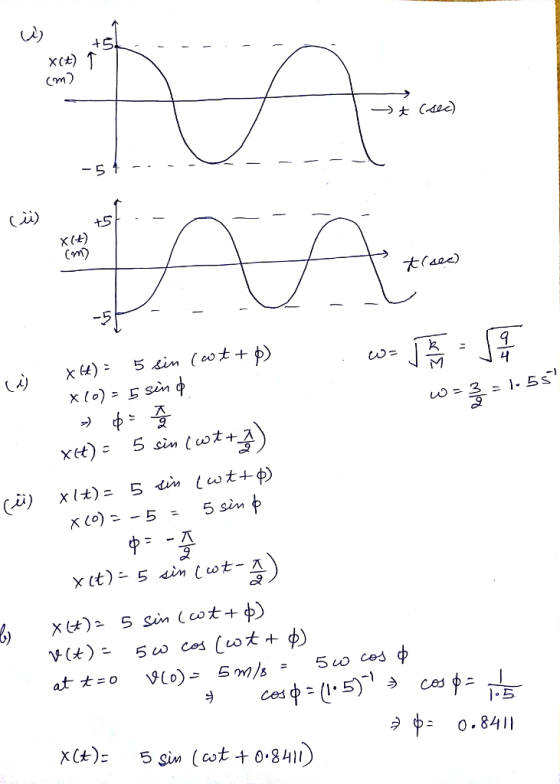
 please
rate it up thanks :)
please
rate it up thanks :)
Add Answer to:
.10 An SHO mass-spring system has M-4 kg and k # 9 N/m. At t rest....
Ignore damping forces. A mass of 4 kg is attached to a spring with constant k- 16 N/m, then the s...
 Ignore damping forces. A mass of 4 kg is attached to a spring with constant k- 16 N/m, then the spring is stretched 1 m beyond its natural length and given an initial velocity of 1 m/sec back towards its equilibrium position. Find the circular frequency ω, period T, and amplitude A of the motion. (Assume the spring is stretched in the positive direction.) A 7 kg mass is attached to a spring with constant k 112 N m. Given...
A spring-mass system has a spring constant of 3 N/m. A mass of 2 kg is...
 A spring-mass system has a
spring constant of 3 N/m. A mass of 2 kg is attached to the spring,
and the motion takes place in a viscous fluid that offers a
resistance numerically equal to the magnitude of the instantaneous
velocity. If the system is driven by an external force of (27 cos
3t − 18 sin 3t) N, determine the steady state response. Express
your answer in the form R cos(ωt − δ). (Let u(t) be the
displacement...
A spring-mass system has a
spring constant of 3 N/m. A mass of 2 kg is attached to the spring,
and the motion takes place in a viscous fluid that offers a
resistance numerically equal to the magnitude of the instantaneous
velocity. If the system is driven by an external force of (27 cos
3t − 18 sin 3t) N, determine the steady state response. Express
your answer in the form R cos(ωt − δ). (Let u(t) be the
displacement...
A 5.10 kg block hangs from a spring with spring constant 1760 N/m . The block...
A 5.10 kg block hangs from a spring with spring constant 1760 N/m . The block is pulled down 6.80 cm from the equilibrium position and given an initial velocity of 1.20 m/s back toward equilibrium. A) What is the frequency of the motion? B) What is the amplitude? C)What is the total mechanical energy of the motion?
A 5.40 kg block hangs from a spring with spring constant 2020 N/m . The block...
A 5.40 kg block hangs from a spring with spring constant 2020 N/m . The block is pulled down 6.10 cm from the equilibrium position and given an initial velocity of 1.20 m/s back toward equilibrium. a. What is the frequency of the motion? b. What is the amplitude? c. What is the total mechanical energy of the motion?
6. A mass of 2 kilogram is attached to a spring whose constant is 4 N/m, and the entire system is...
 6. A mass of 2 kilogram is attached to a spring whose constant is 4 N/m, and the entire system is then submerged in a liquid that inparts a damping force equal to 4 tines the instantansous velocity. At t = 0 the mass is released from the equilibrium position with no initial velocity. An external force t)4t-3) is applied. (a) Write (t), the external force, as a piecewise function and sketch its graph b) Write the initial-value problem (c)Solve...
A -kg mass is attached to a spring with stiffness 10 N/m. The damping constant for the system is ...
 A -kg mass is attached to a spring with stiffness 10 N/m. The damping constant for the system is 2 4 N-sec/m. If the mass is moved - m to the left of equilibrium and given an initial rightward velocity of - m/sec, determine the equation of motion of the mass and give its damping factor, quasiperiod, and quasifrequency. What is the equation of motion? 15 2 (Type an exact answer, using radicals as needed.)
A -kg mass is attached...
A -kg mass is attached to a spring with stiffness 10 N/m. The damping constant for the system is 2 4 N-sec/m. If the mass is moved - m to the left of equilibrium and given an initial rightward velocity of - m/sec, determine the equation of motion of the mass and give its damping factor, quasiperiod, and quasifrequency. What is the equation of motion? 15 2 (Type an exact answer, using radicals as needed.)
A -kg mass is attached...
A block of mass m = 2.1 kg is attached to a single spring of spring...
 A block of mass m = 2.1 kg is attached to a single spring of spring constant k = 4.3 and allowed to oscillate on a horizontal, frictionless surface while restricted to move in the x-direction. The equilibrium position of the block is x = 0m. At time t = 0s the mass is at position x =-0.7m and moving with x-component of velocity vx-1.79. what is the x- component of velocity at time t = 5.3s? Answer in meters...
A spring-mass-dashpot system for the motion of a block of mass m kg is shown in...
 A spring-mass-dashpot system for the motion of a block of mass m kg is shown in Fig. II-2. The block is moved to the right of the equilibrium position and is released from rest (time t = 0) when its displacement, x = XO. Using the notations given in Fig. II-2,4 (1) Draw the free body diagram of the block - (2) Write the equation of motion of the block- If the initial displacement of the block to the right...
A spring-mass-dashpot system for the motion of a block of mass m kg is shown in...
 A spring-mass-dashpot system for the motion of a block of mass m kg is shown in Fig. II-2. The block is moved to the right of the equilibrium position and is released from rest (time t = 0) when its displacement, x = XO. Using the notations given in Fig. II-2,4 (1) Draw the free body diagram of the block - (2) Write the equation of motion of the block- If the initial displacement of the block to the right...
(1 point) A mass m = 4 kg is attached to both a spring with spring...
 (1 point) A mass m = 4 kg is attached to both a spring with spring constant k = 325 N/m and a dash-pot with damping constant c=4N s/m. The mass is started in motion with initial position Xo = 1 m and initial velocity vo = 9 m/s. Determine the position function z(t) in meters. x(t) = Note that, in this problem, the motion of the spring is underdamped, therefore the solution can be written in the form x(t)...
 Ignore damping forces. A mass of 4 kg is attached to a spring with constant k- 16 N/m, then the spring is stretched 1 m beyond its natural length and given an initial velocity of 1 m/sec back towards its equilibrium position. Find the circular frequency ω, period T, and amplitude A of the motion. (Assume the spring is stretched in the positive direction.) A 7 kg mass is attached to a spring with constant k 112 N m. Given...
 A spring-mass system has a
spring constant of 3 N/m. A mass of 2 kg is attached to the spring,
and the motion takes place in a viscous fluid that offers a
resistance numerically equal to the magnitude of the instantaneous
velocity. If the system is driven by an external force of (27 cos
3t − 18 sin 3t) N, determine the steady state response. Express
your answer in the form R cos(ωt − δ). (Let u(t) be the
displacement...
A spring-mass system has a
spring constant of 3 N/m. A mass of 2 kg is attached to the spring,
and the motion takes place in a viscous fluid that offers a
resistance numerically equal to the magnitude of the instantaneous
velocity. If the system is driven by an external force of (27 cos
3t − 18 sin 3t) N, determine the steady state response. Express
your answer in the form R cos(ωt − δ). (Let u(t) be the
displacement...
 6. A mass of 2 kilogram is attached to a spring whose constant is 4 N/m, and the entire system is then submerged in a liquid that inparts a damping force equal to 4 tines the instantansous velocity. At t = 0 the mass is released from the equilibrium position with no initial velocity. An external force t)4t-3) is applied. (a) Write (t), the external force, as a piecewise function and sketch its graph b) Write the initial-value problem (c)Solve...
 A -kg mass is attached to a spring with stiffness 10 N/m. The damping constant for the system is 2 4 N-sec/m. If the mass is moved - m to the left of equilibrium and given an initial rightward velocity of - m/sec, determine the equation of motion of the mass and give its damping factor, quasiperiod, and quasifrequency. What is the equation of motion? 15 2 (Type an exact answer, using radicals as needed.)
A -kg mass is attached...
A -kg mass is attached to a spring with stiffness 10 N/m. The damping constant for the system is 2 4 N-sec/m. If the mass is moved - m to the left of equilibrium and given an initial rightward velocity of - m/sec, determine the equation of motion of the mass and give its damping factor, quasiperiod, and quasifrequency. What is the equation of motion? 15 2 (Type an exact answer, using radicals as needed.)
A -kg mass is attached...
 A block of mass m = 2.1 kg is attached to a single spring of spring constant k = 4.3 and allowed to oscillate on a horizontal, frictionless surface while restricted to move in the x-direction. The equilibrium position of the block is x = 0m. At time t = 0s the mass is at position x =-0.7m and moving with x-component of velocity vx-1.79. what is the x- component of velocity at time t = 5.3s? Answer in meters...
 A spring-mass-dashpot system for the motion of a block of mass m kg is shown in Fig. II-2. The block is moved to the right of the equilibrium position and is released from rest (time t = 0) when its displacement, x = XO. Using the notations given in Fig. II-2,4 (1) Draw the free body diagram of the block - (2) Write the equation of motion of the block- If the initial displacement of the block to the right...
 A spring-mass-dashpot system for the motion of a block of mass m kg is shown in Fig. II-2. The block is moved to the right of the equilibrium position and is released from rest (time t = 0) when its displacement, x = XO. Using the notations given in Fig. II-2,4 (1) Draw the free body diagram of the block - (2) Write the equation of motion of the block- If the initial displacement of the block to the right...
 (1 point) A mass m = 4 kg is attached to both a spring with spring constant k = 325 N/m and a dash-pot with damping constant c=4N s/m. The mass is started in motion with initial position Xo = 1 m and initial velocity vo = 9 m/s. Determine the position function z(t) in meters. x(t) = Note that, in this problem, the motion of the spring is underdamped, therefore the solution can be written in the form x(t)...
Most questions answered within 3 hours.
-
Where is the error in this code sequence?
String s1 = "Hello";
String s2 = "ello";...
asked 11 months ago -
Financial data for Joel de Paris, Inc., for last year
follow:
Joel de Paris, Inc.
Balance...
asked 11 months ago -
Consider this reaction:
Al2(SO4)3 (aq)+ BaCl3
(aq) Al2Cl6 (aq)- +
3BaSO4(s) . What is the...
asked 11 months ago -
Suppose that Savneet is considering increasing her
recent random sample from 20 car rentals to 40...
asked 11 months ago -
Trucks arrive at an unloading terminal at an average rate of 120
per hour.
Trucks arrive...
asked 11 months ago -
Why are methanol and ethanol completely soluble in water while
octanol is not very little soluble....
asked 11 months ago -
A facilities manager at a university reads in a research report
that the mean amount of...
asked 11 months ago -
When the CuSO4 is rehydrated by adding water to the anhydrous
compound, is this an endothermic...
asked 11 months ago -
A ray of sunlight is passing from diamond into crown glass; the
angle of incidence is...
asked 11 months ago -
A block of mass 0.249 kg is placed on top of a light, vertical
spring of...
asked 11 months ago -
how do the kidneys compensate in the presences of acidosis
a) trigger hyperventilate
b) reserve acid...
asked 11 months ago -
Question 501 pts
The rental rate of capital to the firm increases. Which of the
following...
asked 11 months ago