You invest $500,000 at the beginning of the year. At the end of the year, the...
You invest $500,000 at the beginning of the year. At the end of the year, the portfolio is worth $545,000. At that time, you add an additional $55,000. At the end of the second year, the portfolio is worth $630,000.
show your work
What is dollar-weighted return (IRR)?
What is time-weighted return?
Homework Answers
![Home nert Page Layout Formulas Data Review View dd-Ins Cut Σ AutoSum ー E ゴWrap Text aCopy в 1 프 . Ej-., Δ. : rーー 逻锂函Merge & Center. $, % , 弼,8 C Conditional Format CeInsert Delete Format Formatting, as Table w styles. ▼ ㆆ ▼ Sort &Find & 2 ClearFe Select Edting Format Painter Clipboard Alignment Number Cells CO CR CS CT CU CX CY CZ DA DB DC 53 DOLLAR VALUE WEIGHTED RETURN 54 YEAR 56 57 58 59 60 61 62 63 64 65 0 -500000 INITIAL INVESTMENT 155000 ADDITIONAL INVESTMENT 2 630000 WITHDRAWAL ANSWER: 6.88% IRR(CS56:CS58) TIME WEIGHTED RETURN ADD 100 TO RETURN RETURN FOR YEAR 1 RETURN FOR YEAR 2 9.00% [545000/500000-1 ] 5.00% [630000/(545000+55000)-1] 109 67 68 69 70 71 /4 | CALCULATOR .. LOAN OPTIONS 105 TIME WEIGHTED RETURN = 6.98 ANSWER: 6.98% fv. ann CAP STRU VALUE BOX DILUTION DOLLAR COST AVGMORTGAGE EXPO Sheeti Sheet2 Shel erences: BV6 08:19 21-01-2019](http://img.homeworklib.com/questions/2899cf30-7224-11ea-9392-87c1ad32a681.png?x-oss-process=image/resize,w_560)
Add Answer to:
You invest $500,000 at the beginning of the year. At the end of
the year, the...
You invest $1,000,000 in Fidelity China Fund. The Fund charges a front-end load of 5.75% and...
You invest $1,000,000 in Fidelity China Fund. The Fund charges a front-end load of 5.75% and an annual expense fee of 1.25% of the average asset value over the year. You believe the fund’s gross rate of return will be 11% per year. In one year, what will your investment portfolio be worth in dollar terms?
You purchase a stock for $100 that pays an annual dividend of $5.50. At the beginning...
You purchase a stock for $100 that pays an annual dividend of $5.50. At the beginning of the second year, you purchase an additional share for $130. At the end of the second year, you sell both shares for $140. Determine the dollar-weighted return and the time-weighted compounded (i.e., geometric) return on this investment. Repeat the process but assume that the second share was purchased for $110 instead of $130. Why do the rates of return differ? Please show how...
XYZ's stock price and dividend history are as follows: Beginning-of-Year Dividend Paid at Year Price Year-End...
 XYZ's stock price and dividend history are as follows: Beginning-of-Year Dividend Paid at Year Price Year-End 2017 $ 90 $ 3 2018 100 2819 80 2020 90 An investor buys three shares of XYZ at the beginning of 2017, buys another two shares at the beginning of 2018, sells one share at the beginning of 2019, and sells all four remaining shares at the beginning of 2020. a. What are the arithmetic and geometric average time-weighted rates of return for...
Suppose you plan to invest $5,000 each year (beginning at the end of this year) into...
Suppose you plan to invest $5,000 each year (beginning at the end of this year) into a retirement account that will pay 15%. What will be the value of the retirement account if you plan to retire in 40 years? (Assume the retirement account has a zero balance currently) please show work. $33,208.89 $38,190.22 $10,229,769.27 $8,895,451.54
XYZ's stock price and dividend history are as follows: Year Beginning-of-Year Price Dividend Paid at Year-End...
XYZ's stock price and dividend history are as follows: Year Beginning-of-Year Price Dividend Paid at Year-End 2017 $ 130 $ 6 2018 150 6 2019 120 6 2020 130 6 An investor buys three shares of XYZ at the beginning of 2017, buys another two shares at the beginning of 2018, sells one share at the beginning of 2019, and sells all four remaining shares at the beginning of 2020. a. What are the arithmetic and geometric average time-weighted rates...
XYZ's stock price and dividend history are as follows: Year Beginning-of-Year Price Dividend Paid at Year-End...
XYZ's stock price and dividend history are as follows: Year Beginning-of-Year Price Dividend Paid at Year-End 2017 $ 150 $ 4 2018 180 4 2019 130 4 2020 150 4 An investor buys three shares of XYZ at the beginning of 2017, buys another two shares at the beginning of 2018, sells one share at the beginning of 2019, and sells all four remaining shares at the beginning of 2020. a. What are the arithmetic and geometric average time-weighted rates...
1, Efficient Markets Hypothesis (L02,CFA1) you invest $10,000 in the market at the beginning of the...
1, Efficient Markets Hypothesis (L02,CFA1) you invest $10,000 in the market at the beginning of the year, and by the end of the year your account is worth $15,000. During the year the market return was 10 percent . Does this mean that the market is inefficient?. 2,Geoffrey Henley, a professor of finance, states: The capital market is efficient. I dont know why anyone would bother devoting their time to following individual stock and doing fundamental analysis. the best approach...
XYZ's stock price and dividend history are as follows: Year Beginning-of-Year Price Dividend Paid at Year-End 2017...
XYZ's stock price and dividend history are as follows: Year Beginning-of-Year Price Dividend Paid at Year-End 2017 $ 190 $ 5 2018 200 5 2019 180 5 2020 190 5 An investor buys three shares of XYZ at the beginning of 2017, buys another two shares at the beginning of 2018, sells one share at the beginning of 2019, and sells all four remaining shares at the beginning of 2020. a. What are the arithmetic and geometric average time-weighted rates...
XYZ's stock price and dividend history are as follows: Year Beginning-of-Year Price Dividend Paid at Year-End...
 XYZ's stock price and dividend history are as follows:
Year
Beginning-of-Year Price
Dividend Paid at Year-End
2016
$
200
$
6
2017
220
6
2018
185
6
2019
200
6
An investor buys three shares of XYZ at the beginning of 2016,
buys another two shares at the beginning of 2017, sells one share
at the beginning of 2018, and sells all four remaining shares at
the beginning of 2019.
a. What are the arithmetic and geometric
average time-weighted rates...
XYZ's stock price and dividend history are as follows:
Year
Beginning-of-Year Price
Dividend Paid at Year-End
2016
$
200
$
6
2017
220
6
2018
185
6
2019
200
6
An investor buys three shares of XYZ at the beginning of 2016,
buys another two shares at the beginning of 2017, sells one share
at the beginning of 2018, and sells all four remaining shares at
the beginning of 2019.
a. What are the arithmetic and geometric
average time-weighted rates...
12) Assume you invest $1000 initially, then $500 a year later and $200 a year after...
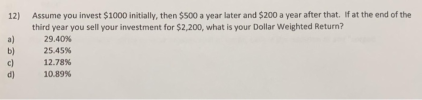 12) Assume you invest $1000 initially, then $500 a year later and $200 a year after that. If at the end of the third year you sell your investment for $2,200, what is your Dollar Weighted Return? 29.40% 25.45% 12.78% 10.89%
 XYZ's stock price and dividend history are as follows: Beginning-of-Year Dividend Paid at Year Price Year-End 2017 $ 90 $ 3 2018 100 2819 80 2020 90 An investor buys three shares of XYZ at the beginning of 2017, buys another two shares at the beginning of 2018, sells one share at the beginning of 2019, and sells all four remaining shares at the beginning of 2020. a. What are the arithmetic and geometric average time-weighted rates of return for...
 XYZ's stock price and dividend history are as follows:
Year
Beginning-of-Year Price
Dividend Paid at Year-End
2016
$
200
$
6
2017
220
6
2018
185
6
2019
200
6
An investor buys three shares of XYZ at the beginning of 2016,
buys another two shares at the beginning of 2017, sells one share
at the beginning of 2018, and sells all four remaining shares at
the beginning of 2019.
a. What are the arithmetic and geometric
average time-weighted rates...
XYZ's stock price and dividend history are as follows:
Year
Beginning-of-Year Price
Dividend Paid at Year-End
2016
$
200
$
6
2017
220
6
2018
185
6
2019
200
6
An investor buys three shares of XYZ at the beginning of 2016,
buys another two shares at the beginning of 2017, sells one share
at the beginning of 2018, and sells all four remaining shares at
the beginning of 2019.
a. What are the arithmetic and geometric
average time-weighted rates...
 12) Assume you invest $1000 initially, then $500 a year later and $200 a year after that. If at the end of the third year you sell your investment for $2,200, what is your Dollar Weighted Return? 29.40% 25.45% 12.78% 10.89%
Most questions answered within 3 hours.
-
Where is the error in this code sequence?
String s1 = "Hello";
String s2 = "ello";...
asked 11 months ago -
Financial data for Joel de Paris, Inc., for last year
follow:
Joel de Paris, Inc.
Balance...
asked 11 months ago -
Consider this reaction:
Al2(SO4)3 (aq)+ BaCl3
(aq) Al2Cl6 (aq)- +
3BaSO4(s) . What is the...
asked 11 months ago -
Suppose that Savneet is considering increasing her
recent random sample from 20 car rentals to 40...
asked 11 months ago -
Trucks arrive at an unloading terminal at an average rate of 120
per hour.
Trucks arrive...
asked 11 months ago -
Why are methanol and ethanol completely soluble in water while
octanol is not very little soluble....
asked 11 months ago -
A facilities manager at a university reads in a research report
that the mean amount of...
asked 11 months ago -
When the CuSO4 is rehydrated by adding water to the anhydrous
compound, is this an endothermic...
asked 11 months ago -
A ray of sunlight is passing from diamond into crown glass; the
angle of incidence is...
asked 11 months ago -
A block of mass 0.249 kg is placed on top of a light, vertical
spring of...
asked 11 months ago -
how do the kidneys compensate in the presences of acidosis
a) trigger hyperventilate
b) reserve acid...
asked 11 months ago -
Question 501 pts
The rental rate of capital to the firm increases. Which of the
following...
asked 11 months ago