
Homework Answers
Add Answer to:
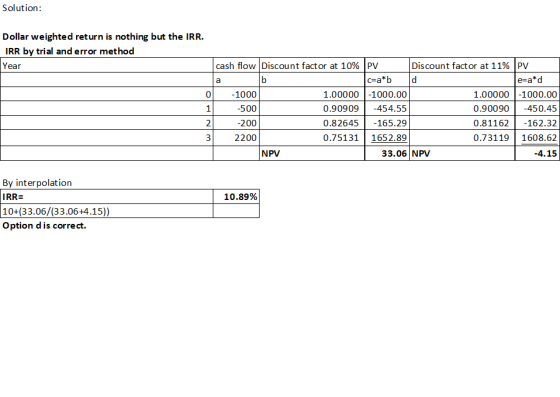
12) Assume you invest $1000 initially, then $500 a year later and $200 a year after...
Suppose that you invest $40,000 in a business. Two years later you sell 3/5 the business...
Suppose that you invest $40,000 in a business. Two years later you sell 3/5 the business for $80,000. One year after that you sell your remaining interest in the business for $20,000. What was your rate of return in your investment in this business? Be sure to draw a cash flow diagram. If using excel to solve be sure to explain methodology. Show All Work.
You invest $500,000 at the beginning of the year. At the end of the year, the...
You invest $500,000 at the beginning of the year. At the end of the year, the portfolio is worth $545,000. At that time, you add an additional $55,000. At the end of the second year, the portfolio is worth $630,000. show your work What is dollar-weighted return (IRR)? What is time-weighted return?
1. You have $200 to invest. If you put the money into an account earning 4%...
1. You have $200 to invest. If you put the money into an account earning 4% interest compounded annually, how much money will you have in 10 years? How much money will you have in 10 years if the account pays 4% simple interest? 2. You have $1,300 to invest today at 5% interest compounded annually. a. Find how much you will have accumulated in the account at the end of (1) 6 years, (2) 12 years, and (3)...
7) (2 pts) At the end of 2014 you invested $1000 into a mutual fund. You...
 7) (2 pts) At the end of 2014 you invested $1000 into a mutual fund. You invested another $2,500 into the mutual fund at the end of 2015. You did not invest any money in 2016 and by the end of 2017, the mutual fund investment was worth $5,682. What was the dollar weighted average annual return on your investment? PM DIGI 2017 25000 5692 - 23.4% OOO
Initially, $80,000 is put into an investment account. Three months later, $7,000 is withdrawn. Two years...
Initially, $80,000 is put into an investment account. Three months later, $7,000 is withdrawn. Two years after the initial investment, the account is worth $83313.70. Assuming a dollar-weighted method for the first year, and a time-weighted method for the second year, the effective annual interest rate was equal to the same value each year. What is that value?
Assume that you can invest $1,000 in a savings account or a fund consisting of different...
 Assume that you can invest $1,000 in a savings account or a fund consisting of different stocks. If you invest in the savings account, you get 1% interest per year. The fund has annual return X with expected value E(X) = 6% and standard deviation o(X) = 20%. This means that, compared to the savings account, the fund has a higher return on average, but also comes with risk. When you invest y dollars in the fund, you will have...
6. An investor deposits $2000 into a fund at time 0. Four months later when his balance has declined to $1900 he withdraws $300. After four more months his balance is $1800 and he deposits $500....
 6. An investor deposits $2000 into a fund at time 0. Four months later when his balance has declined to $1900 he withdraws $300. After four more months his balance is $1800 and he deposits $500. At the end of a year his balance is 2400. a. Find this investor' s (dollar weighted) annual rate of return. (You can assume simple interest.) b. find the fund's annual (time weighted) rate of return. 6a. Current spot rates are si- 0.025, s2...
12. Compound interest. You invest $1000 in an account that pays 5% compounded annually. What is...
 12. Compound interest. You invest $1000 in an account that pays 5% compounded annually. What is the balance after two years? 13. Compounding using different periods. You invest $2000 in an account that pays an APR of 6%. a. What is the value of the investment after three years if interest is compounded yearly? Round your
Please show all steps: You invest $2,000 and receive $200 each year for 10 years and...
Please show all steps: You invest $2,000 and receive $200 each year for 10 years and an additional payment of $2,000 at the end of the 10th year. What is the return of investment? If you received instead, $1,000 in 3 years and $2,000 in 6 years. What is the return of investiment?
Year Return at the end of the year $1000 $1000 $2000 $2000 14. You are planning...
 Year Return at the end of the year $1000 $1000 $2000 $2000 14. You are planning on investing in a project which will last 4 years. You will invest $5,000 at a rate of 4%. Calculate the Net Present Value (NPV) of the project. You expect the project to return the following: (12 points) Year . . Return at the end of the year $1000 $1000 4 S2000 Year Present Value Cash indd Flow -5000 $1000 $1000 $2000 $2000 -5000...
 7) (2 pts) At the end of 2014 you invested $1000 into a mutual fund. You invested another $2,500 into the mutual fund at the end of 2015. You did not invest any money in 2016 and by the end of 2017, the mutual fund investment was worth $5,682. What was the dollar weighted average annual return on your investment? PM DIGI 2017 25000 5692 - 23.4% OOO
 Assume that you can invest $1,000 in a savings account or a fund consisting of different stocks. If you invest in the savings account, you get 1% interest per year. The fund has annual return X with expected value E(X) = 6% and standard deviation o(X) = 20%. This means that, compared to the savings account, the fund has a higher return on average, but also comes with risk. When you invest y dollars in the fund, you will have...
 6. An investor deposits $2000 into a fund at time 0. Four months later when his balance has declined to $1900 he withdraws $300. After four more months his balance is $1800 and he deposits $500. At the end of a year his balance is 2400. a. Find this investor' s (dollar weighted) annual rate of return. (You can assume simple interest.) b. find the fund's annual (time weighted) rate of return. 6a. Current spot rates are si- 0.025, s2...
 12. Compound interest. You invest $1000 in an account that pays 5% compounded annually. What is the balance after two years? 13. Compounding using different periods. You invest $2000 in an account that pays an APR of 6%. a. What is the value of the investment after three years if interest is compounded yearly? Round your
 Year Return at the end of the year $1000 $1000 $2000 $2000 14. You are planning on investing in a project which will last 4 years. You will invest $5,000 at a rate of 4%. Calculate the Net Present Value (NPV) of the project. You expect the project to return the following: (12 points) Year . . Return at the end of the year $1000 $1000 4 S2000 Year Present Value Cash indd Flow -5000 $1000 $1000 $2000 $2000 -5000...
Most questions answered within 3 hours.
-
Where is the error in this code sequence?
String s1 = "Hello";
String s2 = "ello";...
asked 11 months ago -
Financial data for Joel de Paris, Inc., for last year
follow:
Joel de Paris, Inc.
Balance...
asked 11 months ago -
Consider this reaction:
Al2(SO4)3 (aq)+ BaCl3
(aq) Al2Cl6 (aq)- +
3BaSO4(s) . What is the...
asked 11 months ago -
Suppose that Savneet is considering increasing her
recent random sample from 20 car rentals to 40...
asked 11 months ago -
Trucks arrive at an unloading terminal at an average rate of 120
per hour.
Trucks arrive...
asked 11 months ago -
Why are methanol and ethanol completely soluble in water while
octanol is not very little soluble....
asked 11 months ago -
A facilities manager at a university reads in a research report
that the mean amount of...
asked 11 months ago -
When the CuSO4 is rehydrated by adding water to the anhydrous
compound, is this an endothermic...
asked 11 months ago -
A ray of sunlight is passing from diamond into crown glass; the
angle of incidence is...
asked 11 months ago -
A block of mass 0.249 kg is placed on top of a light, vertical
spring of...
asked 11 months ago -
how do the kidneys compensate in the presences of acidosis
a) trigger hyperventilate
b) reserve acid...
asked 11 months ago -
Question 501 pts
The rental rate of capital to the firm increases. Which of the
following...
asked 11 months ago