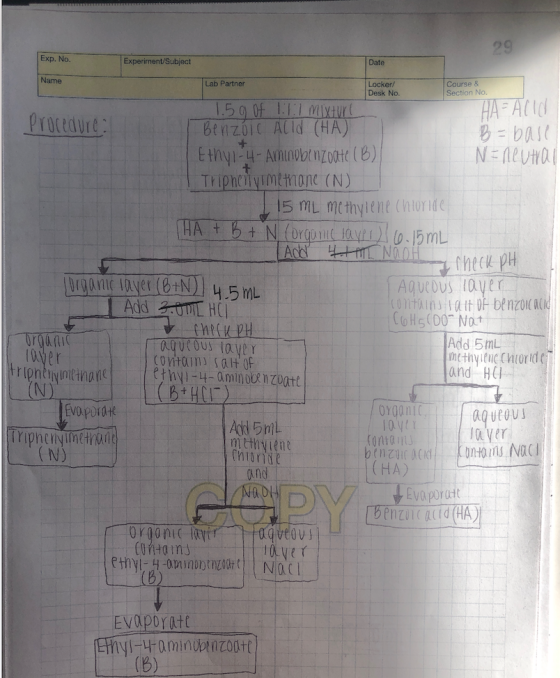
Why does the neutral compound, triphenylmethane, in this experiment fail to undergo reaction when treated with acid or base (consider the pKa of the neutral compound and acid/base equilibrium)?
Homework Answers
Triphenylmethane does not undergo reaction with acid or base
because it is a hydrocarbon with three phenyl group. It is mostly
stable de to presence of phenyl rings in which electrons
delocalized. It does not have proton acidic enough to replace by
base and form salt. Its pKa is around 33 and it remains in
equilibrium with acid or base thus it remains dissolved in organic
layer inspite of how much acid or base added to the system.
Add Answer to:
Why does the neutral compound, triphenylmethane, in this
experiment fail to undergo reaction when treated with...
Why does triphenylmethane fail to undergo a reaction when treated with an acid or base (mention...
Why does triphenylmethane fail to undergo a reaction when treated with an acid or base (mention the pKa of the neutral compound triphenylmethane and acid/base equilibrium)?
Experiment: A mixture of equal proportions of benzoic acid, ethyl 4-aminobenzoate, and 1,4-dimethoxybenzene are to be...
Experiment: A mixture of equal proportions of benzoic acid, ethyl 4-aminobenzoate, and 1,4-dimethoxybenzene are to be separated by extraction using the solvent diethyl ether. Day 1: Part A. Isolation of the basic component: In a small beaker, dissolve 3 g of the mixture (benzoic acid, ethyl 4-aminobenzoate, and 1,4-dimethoxybenzene) in 30 mL of diethyl ether and transfer the mixture to a 125- mL separatory funnel (see Fig. 1) using a little diethyl ether to complete the transfer. Add 10 mL...
Extraction of benzoic acid and 9-fluorenone using diethyl ether. (please do not include ethyl 4- aminobenzoate)....
Extraction of benzoic acid and 9-fluorenone using diethyl ether. (please do not include ethyl 4- aminobenzoate). I have to create a flow chart to diagram the key steps of the experiment and isolation of products. 0.100g of benzoic acid and 9-fluorenone are dissolved in diethyl ether. The extraction solvent is 5% sodium hydroxide (to extract the acidic component from the organic phase). Saturated sodium chloride is added to the organic layer. drying the organic solution: anhydrous sodium sulfate is added...
Explain the acid/base chemistry that occurred when you separated the organic base and neutral compound. Include...
Explain the acid/base chemistry that occurred when you separated the organic base and neutral compound. Include chemical equations. The two compounds used were 1,4-dichlorobenzene and ethyl 4-aminobenzoate.
Explain the acid/base chemistry that occurred when you separated the organic base and neutral compound. Include...
Explain the acid/base chemistry that occurred when you separated the organic base and neutral compound. Include chemical equations. The two compounds used were 1,4-dichlorobenzene and ethyl 4-aminobenzoate.
The Separation of Three Organic Compounds by Acid, Base Reactions and Liquid, Liquid Extraction. Okay, so...
The Separation of Three Organic Compounds by Acid, Base Reactions and Liquid, Liquid Extraction. Okay, so we had solid benzoic acid, ethyl 4- aminobenzoate, and 9-fluorenone all dissolved in diethyl ether. We separated the basic component by adding 3M HCl, we separated the acidic component by adding 3M NaOH. I don't understand what happens here. To isolate the acidic solution, we added 6 M NaOH and used the vacuum to recover the solid. To isolate the basic solution we added...
The Separation of Three Organic Compounds by Acid, Base Reactions and Liquid, Liquid Extraction. Okay, so...
The Separation of Three Organic Compounds by Acid, Base Reactions and Liquid, Liquid Extraction. Okay, so we had solid benzoic acid, ethyl 4- aminobenzoate, and 9-fluorenone all dissolved in methyleene chloride. We separated the basic component by adding 3M HCl, we separated the acidic component by adding 3M NaOH. I don't understand what happens here. To isolate the acidic solution, we added 6 M NaOH and used the vacuum to recover the solid. To isolate the basic solution we added...
Use of Extraction to Isolate a Neutral Compound from a Mixture Containing an Acid or Base...
 Use
of Extraction to Isolate a Neutral Compound from a Mixture
Containing an Acid or Base Impurity.
Part 4D
Hi guys I had a question about this lab. I am not sure how to
create a flow chart for it as well as what chemical equations it
needs. please let me know if you need more information.
layer. In the Optional Exercise, the sample contains a neutrum base impurity; however, a detailed procedure is not given. If you are assigned...
Use
of Extraction to Isolate a Neutral Compound from a Mixture
Containing an Acid or Base Impurity.
Part 4D
Hi guys I had a question about this lab. I am not sure how to
create a flow chart for it as well as what chemical equations it
needs. please let me know if you need more information.
layer. In the Optional Exercise, the sample contains a neutrum base impurity; however, a detailed procedure is not given. If you are assigned...
K2CO3 1.5 H20 Br он heat 2,3-dibromocinnamic acid trans-1-bromo-2-phenylethene Compound MW mp (C)bp (C) density (g/ml)...
 K2CO3 1.5 H20 Br он heat 2,3-dibromocinnamic acid trans-1-bromo-2-phenylethene Compound MW mp (C)bp (C) density (g/ml) mol) 2,3-dibromocinnamic acid 307.97 93-95 (threo) n'a n a 202-204 (erythro)E K CO.1.5H:O1 methylene chloride 138.21 84.93 56.11 891 na n a n'a 39.6 n a n a 1.33 n a 3 MKOH 2. a. What is the by-product formed in this reaction (not shown in given reaction equation)? b. What is the purpose of adding 3 M KOH at the beginning of the...
Part A 1. If you had used more methylene chloride in each step, you could have...
 Part A 1. If you had used more methylene chloride in each step, you could have extracted more caffeine. Explain why you did not. Hint - What step would have taken longer (Hint: not drying). PART A Mass of Beaker & Caffeine Mass of Beaker 167.750g 67.6809 Mass of Caffeine 0.0 75 Calculations. Show your work and circle the answers. Mass of caffeine recovered: 012919 b) Actual:.07 % caffeine recovered: a) Predicted: 9 7:213% b) Actual: 92.105% PART B Unknown...
 Use
of Extraction to Isolate a Neutral Compound from a Mixture
Containing an Acid or Base Impurity.
Part 4D
Hi guys I had a question about this lab. I am not sure how to
create a flow chart for it as well as what chemical equations it
needs. please let me know if you need more information.
layer. In the Optional Exercise, the sample contains a neutrum base impurity; however, a detailed procedure is not given. If you are assigned...
Use
of Extraction to Isolate a Neutral Compound from a Mixture
Containing an Acid or Base Impurity.
Part 4D
Hi guys I had a question about this lab. I am not sure how to
create a flow chart for it as well as what chemical equations it
needs. please let me know if you need more information.
layer. In the Optional Exercise, the sample contains a neutrum base impurity; however, a detailed procedure is not given. If you are assigned...
 K2CO3 1.5 H20 Br он heat 2,3-dibromocinnamic acid trans-1-bromo-2-phenylethene Compound MW mp (C)bp (C) density (g/ml) mol) 2,3-dibromocinnamic acid 307.97 93-95 (threo) n'a n a 202-204 (erythro)E K CO.1.5H:O1 methylene chloride 138.21 84.93 56.11 891 na n a n'a 39.6 n a n a 1.33 n a 3 MKOH 2. a. What is the by-product formed in this reaction (not shown in given reaction equation)? b. What is the purpose of adding 3 M KOH at the beginning of the...
 Part A 1. If you had used more methylene chloride in each step, you could have extracted more caffeine. Explain why you did not. Hint - What step would have taken longer (Hint: not drying). PART A Mass of Beaker & Caffeine Mass of Beaker 167.750g 67.6809 Mass of Caffeine 0.0 75 Calculations. Show your work and circle the answers. Mass of caffeine recovered: 012919 b) Actual:.07 % caffeine recovered: a) Predicted: 9 7:213% b) Actual: 92.105% PART B Unknown...
Most questions answered within 3 hours.
-
Where is the error in this code sequence?
String s1 = "Hello";
String s2 = "ello";...
asked 10 months ago -
Financial data for Joel de Paris, Inc., for last year
follow:
Joel de Paris, Inc.
Balance...
asked 10 months ago -
Consider this reaction:
Al2(SO4)3 (aq)+ BaCl3
(aq) Al2Cl6 (aq)- +
3BaSO4(s) . What is the...
asked 10 months ago -
Suppose that Savneet is considering increasing her
recent random sample from 20 car rentals to 40...
asked 10 months ago -
Trucks arrive at an unloading terminal at an average rate of 120
per hour.
Trucks arrive...
asked 10 months ago -
Why are methanol and ethanol completely soluble in water while
octanol is not very little soluble....
asked 10 months ago -
A facilities manager at a university reads in a research report
that the mean amount of...
asked 10 months ago -
When the CuSO4 is rehydrated by adding water to the anhydrous
compound, is this an endothermic...
asked 10 months ago -
A ray of sunlight is passing from diamond into crown glass; the
angle of incidence is...
asked 10 months ago -
A block of mass 0.249 kg is placed on top of a light, vertical
spring of...
asked 10 months ago -
how do the kidneys compensate in the presences of acidosis
a) trigger hyperventilate
b) reserve acid...
asked 10 months ago -
Question 501 pts
The rental rate of capital to the firm increases. Which of the
following...
asked 10 months ago