

Homework Answers


Add Answer to:
i
need help answering these thank you
Problem IV The Elimination reaction allows the removal from...
Problem i: Indicate the stereo centers of stereo centers of the following natural produs natural product...
 Problem i: Indicate the stereo centers of stereo centers of the following natural produs natural product (by placing a star next to them): Paclitaxel (also known as Taxol) Problem II: For each of the following molecules, indicate if it is chiral or not chiral Problem III: Draw the enantiomers of the following molecules: Problem IV The Elimination reaction allows the removal from a molecule of a leaving Hydrogen to generate a double bond. When that reaction is performe group (Br...
1-4 Name: Grade:_ /10 CHEM 213 Homework #5 Due Wednesday, October 30, 2019 Problem 1: Indicate...
 1-4
Name: Grade:_ /10 CHEM 213 Homework #5 Due Wednesday, October 30, 2019 Problem 1: Indicate the stereo centers of the following natural product (by placing a star next to them): Paclitaxel (also known as Taxol) Problem II: For each of the following molecules, indicate if it is chiral or not chiral Problem III: Draw the enantiomers of the following molecules: Problem IV The Elimination reaction allows the removal from a molecule of a leaving group and a neighboring Hydrogen...
1-4
Name: Grade:_ /10 CHEM 213 Homework #5 Due Wednesday, October 30, 2019 Problem 1: Indicate the stereo centers of the following natural product (by placing a star next to them): Paclitaxel (also known as Taxol) Problem II: For each of the following molecules, indicate if it is chiral or not chiral Problem III: Draw the enantiomers of the following molecules: Problem IV The Elimination reaction allows the removal from a molecule of a leaving group and a neighboring Hydrogen...
Problem IV The Elimination reaction allows the removal from a molecule of a Leaving group and...
 Problem IV The Elimination reaction allows the removal from a molecule of a Leaving group and a neighboring Hydrogen to generate a double bond. When that reaction is performed on a cyclohexane, the leaving group (Br in the example below, and the H must be Axial as shown below. When the reaction is performed on the two molecule below (A and B), it is found that the reaction works very well on molecule A but very slowly on molecule B....
Problem IV The Elimination reaction allows the removal from a molecule of a Leaving group and...
 Problem IV The Elimination reaction allows the removal from a molecule of a Leaving group and a neighboring Hydrogen to generate a double bond. When that reaction is performed on a cyclohexane, the leaving group (Br in the example below, and the H must be Axial as shown below. Base When the reaction is performed on the two molecule below (A and B), it is found that the reaction works very well on molecule A but very slowly on molecule...
POLLUULI JU, 2019 Problem i: Indicate the stereo centers of the following natural product (by placing...
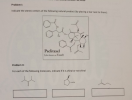 POLLUULI JU, 2019 Problem i: Indicate the stereo centers of the following natural product (by placing a star next to them: Paclitaxel (also known as Taxol) Problem II: For each of the following molecules, indicate if it is chiral or not chiral
Questions are a continuation of questions 2,3. Thank you for you help! I really need help...
 Questions are a continuation of questions 2,3. Thank you for you
help! I really need help with just 3&4.
3.Suppose you wish to perform the reation you wrote in
problem 2 on the other -OH group.How might you prepare the molecule
in order to do so? Suggest appropiate reagents and draw your
expected products.
4. Suppose after your preparation performed in problem
3, the molecule reacts very slowly with HBr. How could you prepare
the -OH group you want to...
Questions are a continuation of questions 2,3. Thank you for you
help! I really need help with just 3&4.
3.Suppose you wish to perform the reation you wrote in
problem 2 on the other -OH group.How might you prepare the molecule
in order to do so? Suggest appropiate reagents and draw your
expected products.
4. Suppose after your preparation performed in problem
3, the molecule reacts very slowly with HBr. How could you prepare
the -OH group you want to...
explain how i am suppose to do these i need major help thxs!! Homework #4 Due...
 explain how i am suppose to do these i need major help thxs!!
Homework #4 Due Monday March 9, 2020 Problem 1: Draw the direct Newman projections of the following molecules, along the indicated bond. Then Draw the most stable and the least stable conformation. CH3 Most Stable Least stable Direct I TOH HT XH OH CH3 Direct Most Stable Least stable OH 92 Problem V: Critical Thinking One of the formation of an epoxide in a cyclohexane is by...
explain how i am suppose to do these i need major help thxs!!
Homework #4 Due Monday March 9, 2020 Problem 1: Draw the direct Newman projections of the following molecules, along the indicated bond. Then Draw the most stable and the least stable conformation. CH3 Most Stable Least stable Direct I TOH HT XH OH CH3 Direct Most Stable Least stable OH 92 Problem V: Critical Thinking One of the formation of an epoxide in a cyclohexane is by...
Draw the structure of the compound you would expect from SN2 reaction of the molecule below...
 Draw the structure of the compound you would expect from SN2
reaction of the molecule below with NaCN.
Use the wedge/hash bond tools to indicate stereochemistry.
Include H atoms at chiral centers only.
If a group is achiral, do not use wedged or hashed bonds on
it.
You may use the OWL references to look up acidities if you want
to compare leaving groups.
Draw the structure of the compound you would expect from SN2
reaction of the molecule below with NaCN.
Use the wedge/hash bond tools to indicate stereochemistry.
Include H atoms at chiral centers only.
If a group is achiral, do not use wedged or hashed bonds on
it.
You may use the OWL references to look up acidities if you want
to compare leaving groups.
need help with 14-21 Stereochemistry of the Su2 reaction In the Sn2 reaction the tetrahedral carbon...
 need help with 14-21
Stereochemistry of the Su2 reaction In the Sn2 reaction the tetrahedral carbon center is inverted. We describe the mechanism as nudeophilic (Nuc) back side attack; the leaving group (LG) is leav ing from the front side. Generally, the LG and the Nucare electron rich so it would be unfavorable for them to react from the same side (charge repuls ion). The geometry of the carbon at the transition state is trigonal planar. 14) Label the 2-bromobuta...
need help with 14-21
Stereochemistry of the Su2 reaction In the Sn2 reaction the tetrahedral carbon center is inverted. We describe the mechanism as nudeophilic (Nuc) back side attack; the leaving group (LG) is leav ing from the front side. Generally, the LG and the Nucare electron rich so it would be unfavorable for them to react from the same side (charge repuls ion). The geometry of the carbon at the transition state is trigonal planar. 14) Label the 2-bromobuta...
need help with 1-21 1) Label the steps below as "slow" and "fast". HCH 013 10...
 need help with 1-21
1) Label the steps below as "slow" and "fast". HCH 013 10 = H. C + + H-LG H-LG 2) Why are they slow/fast? Explain using chemical terms. Stereochemistry of the Sn1 reaction 3) What type of intermediate does the Sn1 reaction proceed through? 4) What is the geometry of the carbon that the nucleophile coordinates to in the 2 step? 5) From how many directions would it be reasonable for the nucleophile to approach the...
need help with 1-21
1) Label the steps below as "slow" and "fast". HCH 013 10 = H. C + + H-LG H-LG 2) Why are they slow/fast? Explain using chemical terms. Stereochemistry of the Sn1 reaction 3) What type of intermediate does the Sn1 reaction proceed through? 4) What is the geometry of the carbon that the nucleophile coordinates to in the 2 step? 5) From how many directions would it be reasonable for the nucleophile to approach the...
 Problem i: Indicate the stereo centers of stereo centers of the following natural produs natural product (by placing a star next to them): Paclitaxel (also known as Taxol) Problem II: For each of the following molecules, indicate if it is chiral or not chiral Problem III: Draw the enantiomers of the following molecules: Problem IV The Elimination reaction allows the removal from a molecule of a leaving Hydrogen to generate a double bond. When that reaction is performe group (Br...
 1-4
Name: Grade:_ /10 CHEM 213 Homework #5 Due Wednesday, October 30, 2019 Problem 1: Indicate the stereo centers of the following natural product (by placing a star next to them): Paclitaxel (also known as Taxol) Problem II: For each of the following molecules, indicate if it is chiral or not chiral Problem III: Draw the enantiomers of the following molecules: Problem IV The Elimination reaction allows the removal from a molecule of a leaving group and a neighboring Hydrogen...
1-4
Name: Grade:_ /10 CHEM 213 Homework #5 Due Wednesday, October 30, 2019 Problem 1: Indicate the stereo centers of the following natural product (by placing a star next to them): Paclitaxel (also known as Taxol) Problem II: For each of the following molecules, indicate if it is chiral or not chiral Problem III: Draw the enantiomers of the following molecules: Problem IV The Elimination reaction allows the removal from a molecule of a leaving group and a neighboring Hydrogen...
 Problem IV The Elimination reaction allows the removal from a molecule of a Leaving group and a neighboring Hydrogen to generate a double bond. When that reaction is performed on a cyclohexane, the leaving group (Br in the example below, and the H must be Axial as shown below. When the reaction is performed on the two molecule below (A and B), it is found that the reaction works very well on molecule A but very slowly on molecule B....
 Problem IV The Elimination reaction allows the removal from a molecule of a Leaving group and a neighboring Hydrogen to generate a double bond. When that reaction is performed on a cyclohexane, the leaving group (Br in the example below, and the H must be Axial as shown below. Base When the reaction is performed on the two molecule below (A and B), it is found that the reaction works very well on molecule A but very slowly on molecule...
 POLLUULI JU, 2019 Problem i: Indicate the stereo centers of the following natural product (by placing a star next to them: Paclitaxel (also known as Taxol) Problem II: For each of the following molecules, indicate if it is chiral or not chiral
 Questions are a continuation of questions 2,3. Thank you for you
help! I really need help with just 3&4.
3.Suppose you wish to perform the reation you wrote in
problem 2 on the other -OH group.How might you prepare the molecule
in order to do so? Suggest appropiate reagents and draw your
expected products.
4. Suppose after your preparation performed in problem
3, the molecule reacts very slowly with HBr. How could you prepare
the -OH group you want to...
Questions are a continuation of questions 2,3. Thank you for you
help! I really need help with just 3&4.
3.Suppose you wish to perform the reation you wrote in
problem 2 on the other -OH group.How might you prepare the molecule
in order to do so? Suggest appropiate reagents and draw your
expected products.
4. Suppose after your preparation performed in problem
3, the molecule reacts very slowly with HBr. How could you prepare
the -OH group you want to...
 explain how i am suppose to do these i need major help thxs!!
Homework #4 Due Monday March 9, 2020 Problem 1: Draw the direct Newman projections of the following molecules, along the indicated bond. Then Draw the most stable and the least stable conformation. CH3 Most Stable Least stable Direct I TOH HT XH OH CH3 Direct Most Stable Least stable OH 92 Problem V: Critical Thinking One of the formation of an epoxide in a cyclohexane is by...
explain how i am suppose to do these i need major help thxs!!
Homework #4 Due Monday March 9, 2020 Problem 1: Draw the direct Newman projections of the following molecules, along the indicated bond. Then Draw the most stable and the least stable conformation. CH3 Most Stable Least stable Direct I TOH HT XH OH CH3 Direct Most Stable Least stable OH 92 Problem V: Critical Thinking One of the formation of an epoxide in a cyclohexane is by...
 Draw the structure of the compound you would expect from SN2
reaction of the molecule below with NaCN.
Use the wedge/hash bond tools to indicate stereochemistry.
Include H atoms at chiral centers only.
If a group is achiral, do not use wedged or hashed bonds on
it.
You may use the OWL references to look up acidities if you want
to compare leaving groups.
Draw the structure of the compound you would expect from SN2
reaction of the molecule below with NaCN.
Use the wedge/hash bond tools to indicate stereochemistry.
Include H atoms at chiral centers only.
If a group is achiral, do not use wedged or hashed bonds on
it.
You may use the OWL references to look up acidities if you want
to compare leaving groups.
 need help with 14-21
Stereochemistry of the Su2 reaction In the Sn2 reaction the tetrahedral carbon center is inverted. We describe the mechanism as nudeophilic (Nuc) back side attack; the leaving group (LG) is leav ing from the front side. Generally, the LG and the Nucare electron rich so it would be unfavorable for them to react from the same side (charge repuls ion). The geometry of the carbon at the transition state is trigonal planar. 14) Label the 2-bromobuta...
need help with 14-21
Stereochemistry of the Su2 reaction In the Sn2 reaction the tetrahedral carbon center is inverted. We describe the mechanism as nudeophilic (Nuc) back side attack; the leaving group (LG) is leav ing from the front side. Generally, the LG and the Nucare electron rich so it would be unfavorable for them to react from the same side (charge repuls ion). The geometry of the carbon at the transition state is trigonal planar. 14) Label the 2-bromobuta...
 need help with 1-21
1) Label the steps below as "slow" and "fast". HCH 013 10 = H. C + + H-LG H-LG 2) Why are they slow/fast? Explain using chemical terms. Stereochemistry of the Sn1 reaction 3) What type of intermediate does the Sn1 reaction proceed through? 4) What is the geometry of the carbon that the nucleophile coordinates to in the 2 step? 5) From how many directions would it be reasonable for the nucleophile to approach the...
need help with 1-21
1) Label the steps below as "slow" and "fast". HCH 013 10 = H. C + + H-LG H-LG 2) Why are they slow/fast? Explain using chemical terms. Stereochemistry of the Sn1 reaction 3) What type of intermediate does the Sn1 reaction proceed through? 4) What is the geometry of the carbon that the nucleophile coordinates to in the 2 step? 5) From how many directions would it be reasonable for the nucleophile to approach the...
Most questions answered within 3 hours.
-
Where is the error in this code sequence?
String s1 = "Hello";
String s2 = "ello";...
asked 10 months ago -
Financial data for Joel de Paris, Inc., for last year
follow:
Joel de Paris, Inc.
Balance...
asked 10 months ago -
Consider this reaction:
Al2(SO4)3 (aq)+ BaCl3
(aq) Al2Cl6 (aq)- +
3BaSO4(s) . What is the...
asked 10 months ago -
Suppose that Savneet is considering increasing her
recent random sample from 20 car rentals to 40...
asked 10 months ago -
Trucks arrive at an unloading terminal at an average rate of 120
per hour.
Trucks arrive...
asked 10 months ago -
Why are methanol and ethanol completely soluble in water while
octanol is not very little soluble....
asked 10 months ago -
A facilities manager at a university reads in a research report
that the mean amount of...
asked 10 months ago -
When the CuSO4 is rehydrated by adding water to the anhydrous
compound, is this an endothermic...
asked 10 months ago -
A ray of sunlight is passing from diamond into crown glass; the
angle of incidence is...
asked 10 months ago -
A block of mass 0.249 kg is placed on top of a light, vertical
spring of...
asked 10 months ago -
how do the kidneys compensate in the presences of acidosis
a) trigger hyperventilate
b) reserve acid...
asked 10 months ago -
Question 501 pts
The rental rate of capital to the firm increases. Which of the
following...
asked 10 months ago