
Homework Answers

Add Answer to:
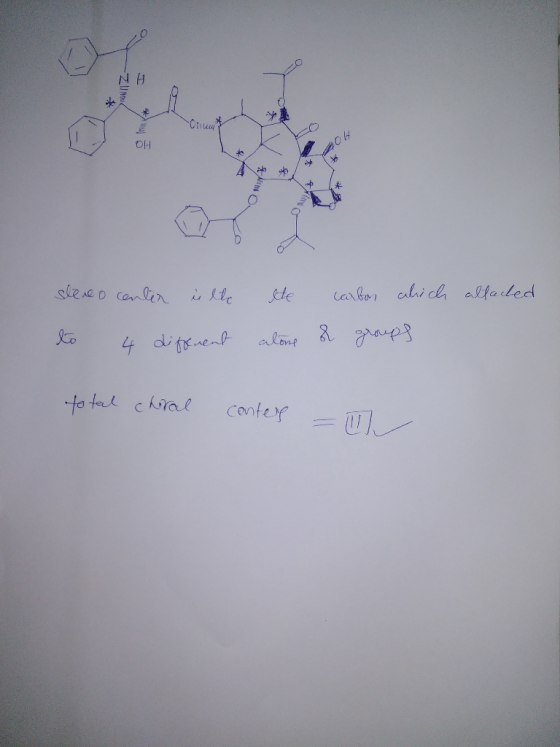
POLLUULI JU, 2019 Problem i: Indicate the stereo centers of the following natural product (by placing...
Problem i: Indicate the stereo centers of stereo centers of the following natural produs natural product...
 Problem i: Indicate the stereo centers of stereo centers of the following natural produs natural product (by placing a star next to them): Paclitaxel (also known as Taxol) Problem II: For each of the following molecules, indicate if it is chiral or not chiral Problem III: Draw the enantiomers of the following molecules: Problem IV The Elimination reaction allows the removal from a molecule of a leaving Hydrogen to generate a double bond. When that reaction is performe group (Br...
1-4 Name: Grade:_ /10 CHEM 213 Homework #5 Due Wednesday, October 30, 2019 Problem 1: Indicate...
 1-4
Name: Grade:_ /10 CHEM 213 Homework #5 Due Wednesday, October 30, 2019 Problem 1: Indicate the stereo centers of the following natural product (by placing a star next to them): Paclitaxel (also known as Taxol) Problem II: For each of the following molecules, indicate if it is chiral or not chiral Problem III: Draw the enantiomers of the following molecules: Problem IV The Elimination reaction allows the removal from a molecule of a leaving group and a neighboring Hydrogen...
1-4
Name: Grade:_ /10 CHEM 213 Homework #5 Due Wednesday, October 30, 2019 Problem 1: Indicate the stereo centers of the following natural product (by placing a star next to them): Paclitaxel (also known as Taxol) Problem II: For each of the following molecules, indicate if it is chiral or not chiral Problem III: Draw the enantiomers of the following molecules: Problem IV The Elimination reaction allows the removal from a molecule of a leaving group and a neighboring Hydrogen...
i need help answering these thank you Problem IV The Elimination reaction allows the removal from...
 i
need help answering these thank you
Problem IV The Elimination reaction allows the removal from a molecule of a Leaving group and a neighboring Hydrogen to generate a double bond. When that reaction is performed on a cyclohexane, the leaving group (or in the example below, and the must be Axial as shown below. When the reaction is performed on the two molecule below (A and B), it is found that the reaction works very well on molecule A...
i
need help answering these thank you
Problem IV The Elimination reaction allows the removal from a molecule of a Leaving group and a neighboring Hydrogen to generate a double bond. When that reaction is performed on a cyclohexane, the leaving group (or in the example below, and the must be Axial as shown below. When the reaction is performed on the two molecule below (A and B), it is found that the reaction works very well on molecule A...
1-5 Problem I: Give the approximate pka of the indicated H's in the following molecules: Problem...
 1-5
Problem I: Give the approximate pka of the indicated H's in the following molecules: Problem II: Circle the most acidic proton in the following molecules: Problem IV: Using ARIO order the following molecule in decreasing order: Problem V: Indicate the direction the reaction would go by placing the appropriate arrows: (reaction goes from lowest to highest pka) + OH + H2O
1-5
Problem I: Give the approximate pka of the indicated H's in the following molecules: Problem II: Circle the most acidic proton in the following molecules: Problem IV: Using ARIO order the following molecule in decreasing order: Problem V: Indicate the direction the reaction would go by placing the appropriate arrows: (reaction goes from lowest to highest pka) + OH + H2O
5.50 For each molecule in Problem 5.49, identify all chiral centers that exist. Which of those molecule 5.51 Draw e...
 5.50 For each molecule in Problem 5.49, identify all chiral centers that exist. Which of those molecule 5.51 Draw each of the following molecules in a zigzag conformation. (a) CH,он (b) CH3 (c) (d) CN Но HO=O -H но- -OH -H H -OH OH ОН Н- -Cl OH Н- но но -H - CH3 но- CH2OH H но- CO2H CH,он CH2CI WOT I
are all of these identical? 4. Determine if each of the following structures i) contain chiral centers. Label Chical...
 are all of these identical?
4. Determine if each of the following structures i) contain chiral centers. Label Chical centers with an asterisk. ii) are enantiomers or not. Write "enantiomers" or "identical below each pair. (Hint: determine Ror S for each) a k al identical identical 3 CH | HỌC, OH HOA Hu H + C F ¢ identical ch; HH Br B HC CH, HẠC X 10 identical 3 4 O HC H4 4. 3 . 44 4n/ ТОН...
are all of these identical?
4. Determine if each of the following structures i) contain chiral centers. Label Chical centers with an asterisk. ii) are enantiomers or not. Write "enantiomers" or "identical below each pair. (Hint: determine Ror S for each) a k al identical identical 3 CH | HỌC, OH HOA Hu H + C F ¢ identical ch; HH Br B HC CH, HẠC X 10 identical 3 4 O HC H4 4. 3 . 44 4n/ ТОН...
Challenge CH 235R F 2019 Week 11 Problem #2 1. Predicting Major and Minor elimination products...
 Challenge CH 235R F 2019 Week 11 Problem #2 1. Predicting Major and Minor elimination products For each of the following alkenes, draw all possible elimination products for the following molecules, ignoring the mechanism. Indicate the major alkene product. noted II. E2 Eliminations on substituted cyclohexane halides Consider the two isomeric compounds below. a) Draw each in a chair conformation, b) Show the mechanism and final alkene product(s) that form from an E2 reaction with CH,O/CH,OH. c) If more than...
For each of the following molecules and ions: i.) Write the Lewis structure ii.) Indicate the...
For each of the following molecules and ions: i.) Write the Lewis structure ii.) Indicate the molecular geometry iii.) Indicate the approximate bond angles A.) Sulfur trioxide, SO3 B.) triiodide ion, I3- C.) sulfur hexafluoride, SF6
Indicate the stereochemical configuration for the tetrahedral centers shown below. OR OS not a configuration center...
 Indicate the stereochemical configuration for the tetrahedral centers shown below. OR OS not a configuration center Br R OS not a configuration center ООО Select the proper IUPAC name for the following compound, including the (R) or (S) designation where appropriate. Н. - (2R,3S)-2-chloro-3-methylpentane (29,3R)-2-chloro-3-methylpentane (2R 3R)-2-chloro-3-methylpentane O (2S,3S)-2-chloro-3-methylpentane Classify the following pair of compounds as the same compound, enantiomers, diastereomers, constitutional isomers, or not isomeric. Also, select the correct IUPAC name, including the correct (R) or (S) designation, for...
For each of the following difference equations (i) obtain the general solution; (ii) solve an initial value problem: (iii) solve for the fixed point if it exists and indicate whether or not yk co...
 For each of the following difference equations (i) obtain the general solution; (ii) solve an initial value problem: (iii) solve for the fixed point if it exists and indicate whether or not yk converges to the fixed point.
For each of the following difference equations (i) obtain the general solution; (ii) solve an initial value problem: (iii) solve for the fixed point if it exists and indicate whether or not yk converges to the fixed point.
For each of the following difference equations (i) obtain the general solution; (ii) solve an initial value problem: (iii) solve for the fixed point if it exists and indicate whether or not yk converges to the fixed point.
 Problem i: Indicate the stereo centers of stereo centers of the following natural produs natural product (by placing a star next to them): Paclitaxel (also known as Taxol) Problem II: For each of the following molecules, indicate if it is chiral or not chiral Problem III: Draw the enantiomers of the following molecules: Problem IV The Elimination reaction allows the removal from a molecule of a leaving Hydrogen to generate a double bond. When that reaction is performe group (Br...
 1-4
Name: Grade:_ /10 CHEM 213 Homework #5 Due Wednesday, October 30, 2019 Problem 1: Indicate the stereo centers of the following natural product (by placing a star next to them): Paclitaxel (also known as Taxol) Problem II: For each of the following molecules, indicate if it is chiral or not chiral Problem III: Draw the enantiomers of the following molecules: Problem IV The Elimination reaction allows the removal from a molecule of a leaving group and a neighboring Hydrogen...
1-4
Name: Grade:_ /10 CHEM 213 Homework #5 Due Wednesday, October 30, 2019 Problem 1: Indicate the stereo centers of the following natural product (by placing a star next to them): Paclitaxel (also known as Taxol) Problem II: For each of the following molecules, indicate if it is chiral or not chiral Problem III: Draw the enantiomers of the following molecules: Problem IV The Elimination reaction allows the removal from a molecule of a leaving group and a neighboring Hydrogen...
 i
need help answering these thank you
Problem IV The Elimination reaction allows the removal from a molecule of a Leaving group and a neighboring Hydrogen to generate a double bond. When that reaction is performed on a cyclohexane, the leaving group (or in the example below, and the must be Axial as shown below. When the reaction is performed on the two molecule below (A and B), it is found that the reaction works very well on molecule A...
i
need help answering these thank you
Problem IV The Elimination reaction allows the removal from a molecule of a Leaving group and a neighboring Hydrogen to generate a double bond. When that reaction is performed on a cyclohexane, the leaving group (or in the example below, and the must be Axial as shown below. When the reaction is performed on the two molecule below (A and B), it is found that the reaction works very well on molecule A...
 1-5
Problem I: Give the approximate pka of the indicated H's in the following molecules: Problem II: Circle the most acidic proton in the following molecules: Problem IV: Using ARIO order the following molecule in decreasing order: Problem V: Indicate the direction the reaction would go by placing the appropriate arrows: (reaction goes from lowest to highest pka) + OH + H2O
1-5
Problem I: Give the approximate pka of the indicated H's in the following molecules: Problem II: Circle the most acidic proton in the following molecules: Problem IV: Using ARIO order the following molecule in decreasing order: Problem V: Indicate the direction the reaction would go by placing the appropriate arrows: (reaction goes from lowest to highest pka) + OH + H2O
 5.50 For each molecule in Problem 5.49, identify all chiral centers that exist. Which of those molecule 5.51 Draw each of the following molecules in a zigzag conformation. (a) CH,он (b) CH3 (c) (d) CN Но HO=O -H но- -OH -H H -OH OH ОН Н- -Cl OH Н- но но -H - CH3 но- CH2OH H но- CO2H CH,он CH2CI WOT I
 are all of these identical?
4. Determine if each of the following structures i) contain chiral centers. Label Chical centers with an asterisk. ii) are enantiomers or not. Write "enantiomers" or "identical below each pair. (Hint: determine Ror S for each) a k al identical identical 3 CH | HỌC, OH HOA Hu H + C F ¢ identical ch; HH Br B HC CH, HẠC X 10 identical 3 4 O HC H4 4. 3 . 44 4n/ ТОН...
are all of these identical?
4. Determine if each of the following structures i) contain chiral centers. Label Chical centers with an asterisk. ii) are enantiomers or not. Write "enantiomers" or "identical below each pair. (Hint: determine Ror S for each) a k al identical identical 3 CH | HỌC, OH HOA Hu H + C F ¢ identical ch; HH Br B HC CH, HẠC X 10 identical 3 4 O HC H4 4. 3 . 44 4n/ ТОН...
 Challenge CH 235R F 2019 Week 11 Problem #2 1. Predicting Major and Minor elimination products For each of the following alkenes, draw all possible elimination products for the following molecules, ignoring the mechanism. Indicate the major alkene product. noted II. E2 Eliminations on substituted cyclohexane halides Consider the two isomeric compounds below. a) Draw each in a chair conformation, b) Show the mechanism and final alkene product(s) that form from an E2 reaction with CH,O/CH,OH. c) If more than...
 Indicate the stereochemical configuration for the tetrahedral centers shown below. OR OS not a configuration center Br R OS not a configuration center ООО Select the proper IUPAC name for the following compound, including the (R) or (S) designation where appropriate. Н. - (2R,3S)-2-chloro-3-methylpentane (29,3R)-2-chloro-3-methylpentane (2R 3R)-2-chloro-3-methylpentane O (2S,3S)-2-chloro-3-methylpentane Classify the following pair of compounds as the same compound, enantiomers, diastereomers, constitutional isomers, or not isomeric. Also, select the correct IUPAC name, including the correct (R) or (S) designation, for...
 For each of the following difference equations (i) obtain the general solution; (ii) solve an initial value problem: (iii) solve for the fixed point if it exists and indicate whether or not yk converges to the fixed point.
For each of the following difference equations (i) obtain the general solution; (ii) solve an initial value problem: (iii) solve for the fixed point if it exists and indicate whether or not yk converges to the fixed point.
For each of the following difference equations (i) obtain the general solution; (ii) solve an initial value problem: (iii) solve for the fixed point if it exists and indicate whether or not yk converges to the fixed point.
Most questions answered within 3 hours.
-
Where is the error in this code sequence?
String s1 = "Hello";
String s2 = "ello";...
asked 10 months ago -
Financial data for Joel de Paris, Inc., for last year
follow:
Joel de Paris, Inc.
Balance...
asked 10 months ago -
Consider this reaction:
Al2(SO4)3 (aq)+ BaCl3
(aq) Al2Cl6 (aq)- +
3BaSO4(s) . What is the...
asked 10 months ago -
Suppose that Savneet is considering increasing her
recent random sample from 20 car rentals to 40...
asked 10 months ago -
Trucks arrive at an unloading terminal at an average rate of 120
per hour.
Trucks arrive...
asked 10 months ago -
Why are methanol and ethanol completely soluble in water while
octanol is not very little soluble....
asked 10 months ago -
A facilities manager at a university reads in a research report
that the mean amount of...
asked 10 months ago -
When the CuSO4 is rehydrated by adding water to the anhydrous
compound, is this an endothermic...
asked 10 months ago -
A ray of sunlight is passing from diamond into crown glass; the
angle of incidence is...
asked 10 months ago -
A block of mass 0.249 kg is placed on top of a light, vertical
spring of...
asked 10 months ago -
how do the kidneys compensate in the presences of acidosis
a) trigger hyperventilate
b) reserve acid...
asked 10 months ago -
Question 501 pts
The rental rate of capital to the firm increases. Which of the
following...
asked 10 months ago